1 free read left. Create a free account for unlimited reading + AI research.
Create free account
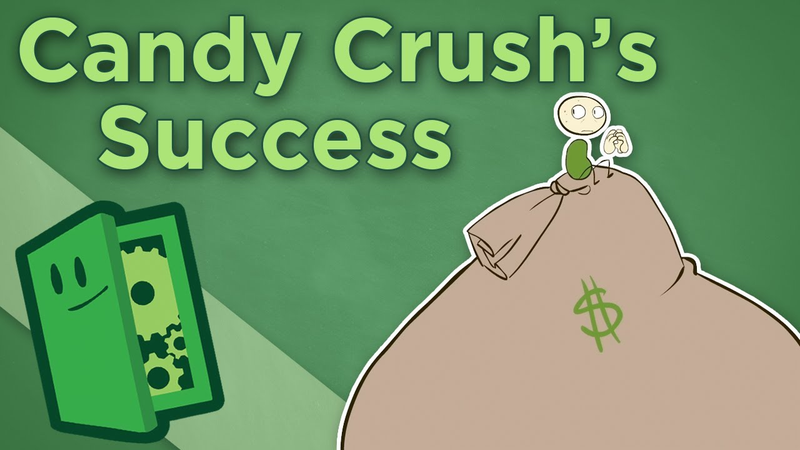
Candy Crush's Success - Why People Can't Get Enough Candy Crush - Extra Credits
Key insights
5 takeaways- 01Candy Crush Saga achieves high engagement by modulating the player's interest curve through hand-crafted, non-rectangular level designs and varied, non-repetitive objectives.
- 02The game utilizes controlled randomness in its starting boards to ensure every level attempt is a unique challenge, which encourages persistence after failure by preventing the perception of a static logic problem.
- 03The design creates a psychological 'near-miss' effect where failing with only one or two moves remaining provides a compelling incentive for players to purchase additional turns.
- 04Monetization is driven by shifting the player's focus from abstract score-chasing to tangible, visually obvious goals like clearing specific grid squares or moving items to the bottom of the screen.
- 05The game's commercial success is fundamentally tied to the seamless integration of its interest-curve modulation with its monetization systems, proving that effective design is inseparable from financial performance.
Ask AI about this video
Transcript
So, okay, we want to talk about Candy Crush, but not for the reason that you're probably thinking. I mean, we had to talk about Candy Crush Saga sooner or later. It makes over a million dollars a day on just the app alone. It eclipsed FarmVille as the most popular Facebook game, and it's almost certainly the most played game of this year in terms of raw hours spent. Yes, if you put together all the hours spent on Call of Duty or League of Legends, I'd wager it still pales in comparison to the total amount of time humanity has spent poking away at Candy Crush. So, the thing we actually want to discuss today is this: Why is Candy Crush so popular? After all, on the surface, it just looks like another Bejeweled clone. So, how come it's doing so much better than PopCap's own Bejeweled Blitz, which, while it does quite well, isn't clearing anything like the astronomical numbers Candy Crush has been? Let's dig into this. Well, first we have to talk about pacing. In a previous episode, we talked about differences in kind and how they're used to modulate a player's interest curve. And this is something that Candy Crush does substantially better than most of its competitors. In Bejeweled's main play mode, you're fundamentally performing the same set of actions level after level. You're simply
matching things in order to try to hit a score goal. But, Candy Crush gives you a plethora of goal types from level to level. That, combined with Candy Crush's hand-crafted stages, means the player experiences something different every level. Each new stage is intended to evoke in the player the thought, I wonder what the next level will be, which is immediately followed by the thought, I'll try it once just to see what they do, which is, of course, immediately followed by 30 more minutes playing Candy Crush. Now, as a designer, when we look at Candy Crush, it's important to note that the crafting of the stages is just as important in delivering the interest curve as varying up the goals. One of the things that set Candy Crush apart from many of its competitors is that they freed themselves from only using a rectangular play space for a Bejeweled type game. This, in turn, meant that they were able to have actual level design in this game, which is essential to Candy Crush, because otherwise they'd have to introduce new gameplay elements too quickly, and it would have resulted in information overload for their audience. If every time they wanted to modulate the interest curve, they had to either present the player with new goals or give them some new mechanic to play with, it would, at the very best, prevent the player from ever really getting comfortable enough with a specific set of mechanics to truly experience depth of play, and at worst it would just fall into the incoherent
and overwhelming space that many games do when they toss new mechanics at you or change up your goal continuously in a desperate attempt to keep you interested. So, Candy Crush provides far better modulation of their interest curve than most match-three games because they're aware that getting cherries and hazelnuts to the bottom of the screen in a level that's shaped like an inverted pyramid feels much different than trying to do the same thing in a level that's just your standard rectangle. But, none of this would work without the random factor. Very often you'll see match-three games include puzzle levels. But, those levels always start with all the same pieces in the same places. They're simply a logic problem for the player to work through. The genius of Candy Crush is that they have crafted puzzle-like boards for the player to play on, but the starting set of pieces the player gets to solve the challenge with is randomized. And this means that when a player loses, instead of getting frustrated or just deciding that they don't know how they're supposed to beat the level and giving up, they're much more likely to just hop right back in hoping that this time they get a better draw. It also means that every time a player has to replay a level, they're presented with a new and interesting problem to solve. The player doesn't have to figure out how the designer wants them to solve the problem, but rather has to assess the board they've been provided and figure out how they want to approach the
challenge ahead of them. But, all right. So, Candy Crush manages a much better interest curve than most match-three games through judicious use of play modes coupled with wildly varying board types, but that still doesn't explain how they monetize so well. Well, it comes from the fact that Candy Crush may be the most exquisitely balanced free-to-play game I have ever played. Ask any Candy Crush player and they'll tell you that often they'll end up losing the game when they're very clearly only one or two moves away from a win. That's really hard to achieve in a game that involves this level of randomness. Of course, the goal of that balanced design is monetization. You see, when you lose a level in Candy Crush, they offer to sell you a few extra bonus turns. And while they don't make the numbers publicly available, I'd wager that this is one of their best-selling offers. And this isn't chance, either. If you look at the two main gameplay modes in Candy Crush, it's quite clear that this is part of the core design of the game. In most match-three games, the player's goal is simply to achieve a specified score on any given level. Not so in Candy Crush. In Candy Crush, score is secondary. The two main gameplay modes involve either getting specific pieces to the bottom of the screen or making matches in specific squares on the grid. You know what's
special about those two types of mode? What ties it into their monetization so well? It's the fact that it's incredibly easy to see exactly how close you were to winning when you run out of turns. Score is a nebulous thing. It's not easily grokkable, especially with all sorts of bonuses and modifiers to factor in. Plus, it's generally not the thing you're staring at the entire time when you're playing. But with modes like these, it's right there in front of you and you can't miss it. You were so close. Two more moves and I would have had it. With victory so tantalizingly near, you're way more likely to consider buying those bonus turns. There's a lot that went on in terms of marketing and corporate strategy to make Candy Crush the phenomenon that it is today, but looking at it strictly from a design sense, the game's success comes from the fact that they created a much better interest curve than most of the competing match-three games by abandoning some of the standard conventions of the genre and having custom-designed levels with enough randomness to allow players to want to play them again and again. From there, directly integrating their game design and their monetization, rather than viewing them as two separate things, took them over the top. Hopefully that answers some questions for those of you pondering Candy Crush's success, and I really hope it goes to show how valuable building ways to modulate your interest curve directly into your systems and
mechanics really is. And I also sincerely hope that by the time this comes out, Candy Crush has also proven that being a complete jerk and wielding copyright law like a club against smaller developers is a great way to lose you sales, destroy your company's reputation, and prove to the world that you're worth nowhere near the $7 billion you value yourself at. Catch you next week.
Summary
Candy Crush Saga’s immense commercial success, characterized by its status as a top-grossing mobile application and a leader in total player engagement, stems from sophisticated game design that transcends the standard match-three genre. While competitors often rely on repetitive mechanics and static scoring goals, Candy Crush distinguishes itself through superior modulation of the player’s interest curve. By utilizing hand-crafted, non-rectangular level designs and a diverse array of objective types, the game ensures that each stage offers a unique experience, effectively preventing the information overload that often plagues similar titles.
A critical component of this design is the integration of controlled randomness. Unlike traditional puzzle games that present static logic problems, Candy Crush provides randomized starting boards. This ensures that every attempt at a level is a fresh challenge, encouraging players to persist after failure rather than feeling discouraged by a perceived lack of skill. This design choice transforms the gameplay loop into a series of manageable, distinct problems that maintain long-term player engagement.
The game’s monetization strategy is equally deliberate, relying on an exquisite balance between gameplay and the purchase of extra turns. By shifting the primary objective from abstract score-chasing to tangible goals—such as clearing specific grid squares or moving items to the bottom of the screen—the game makes the player’s proximity to victory visually obvious. When a player fails with only one or two moves remaining, the psychological proximity to success creates a compelling incentive to purchase additional turns. Ultimately, the game’s success is attributed to the seamless synthesis of its interest-curve modulation and its monetization systems, proving that effective design is inseparable from commercial performance.



















Comments