1 free read left. Create a free account for unlimited reading + AI research.
Create free accountArticleHomo Ludens
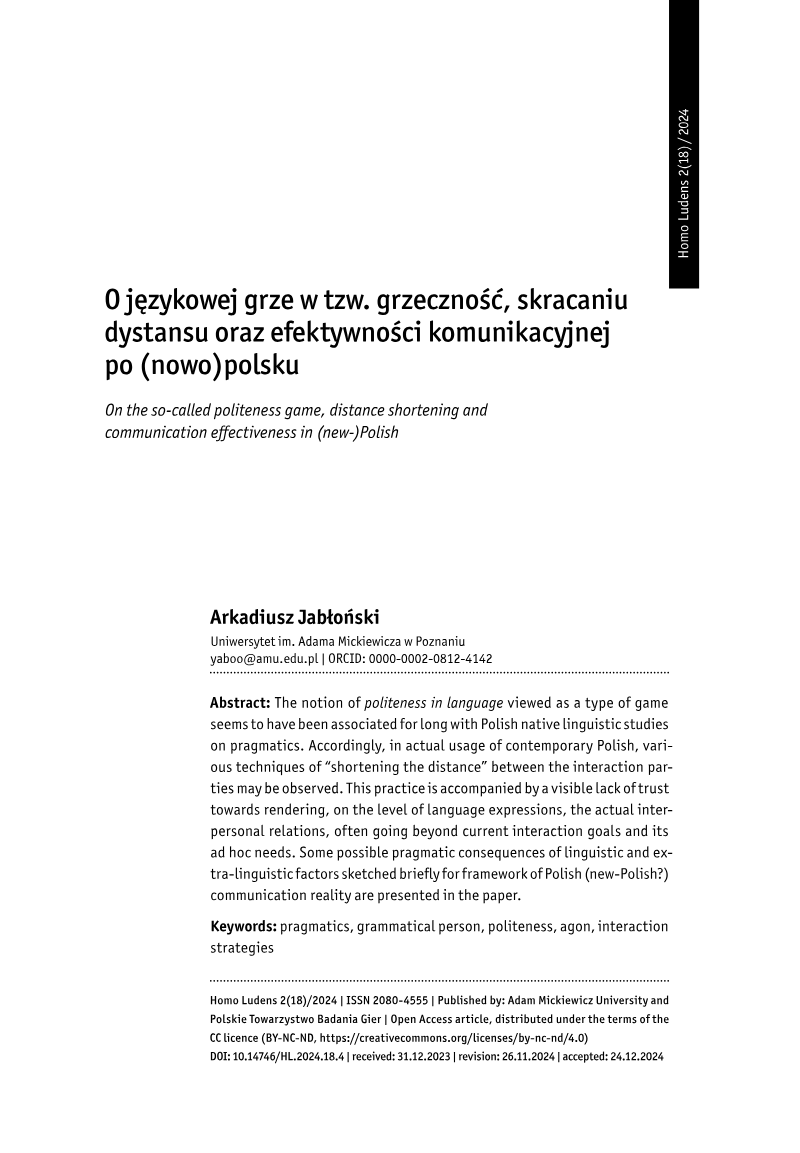
The binary I/you opposition of English is often transposed directly into Polish. The result is communicative friction rather than the intended warmth.
This paper, by linguist Arkadiusz Jabłoński of Adam Mickiewicz University in Poznań, examines how contemporary Polish speakers and institutions use second-person forms, particularly the pronoun "ty" (informal "you"), and what pragmatic consequences follow. Building on Caillois's notion of agon, a competitive game between equal rivals, the author argues that the binary I/you opposition of English is often transposed directly into Polish, producing communicative friction rather than the intended warmth. The study is framed as an exploratory overview of Polish usage, not a quantitative investigation, and its evidence consists of illustrative examples drawn from everyday encounters, popular culture, and corporate and institutional communications such as banking, utility, retail, and transport messages from roughly 2018 to 2023.
The central findings concern the mismatch between "ty" and the social situations in which it appears. The author observes that informal address can be perceived as intrusive, aggressive, or presumptuous when used between strangers or by institutions toward customers, and that forced intimacy in corporate messaging often sounds condescending. Several recurring patterns are identified: the use of an abstract or indefinite "you" that clashes with Polish grammatical agreement, the unnecessary repetition of possessive forms calqued from English, and imperative constructions in product labelling that feel disproportionately forceful. Against these, the paper proposes the "zero person" strategy, which uses impersonal constructions, object-focused wording, and general rules instead of direct address to reduce conflict while preserving clarity.
The conclusions emphasise that informal pronouns do not automatically signal neutral closeness in Polish, and that relational politeness depends on context, procedure, and negotiated roles rather than pronoun choice alone. The author suggests that awareness of impersonal and nuanced alternatives should be promoted among professional communicators, translators, and the general public, since linguistic economy in address does not necessarily yield better communicative outcomes.
Homo Ludens · 2025
Homo Ludens · 2025
Homo Ludens · 2025
Homo Ludens · 2025
Homo Ludens · 2024
Homo Ludens · 2024
Homo Ludens · 2024
Homo Ludens · 2024
Homo Ludens · 2024
Homo Ludens · 2024
Homo Ludens · 2024
Homo Ludens · 2024
GAMEHEARTS · 2026





















Comments