1 free read left. Create a free account for unlimited reading + AI research.
Create free accountArticleHomo Ludens
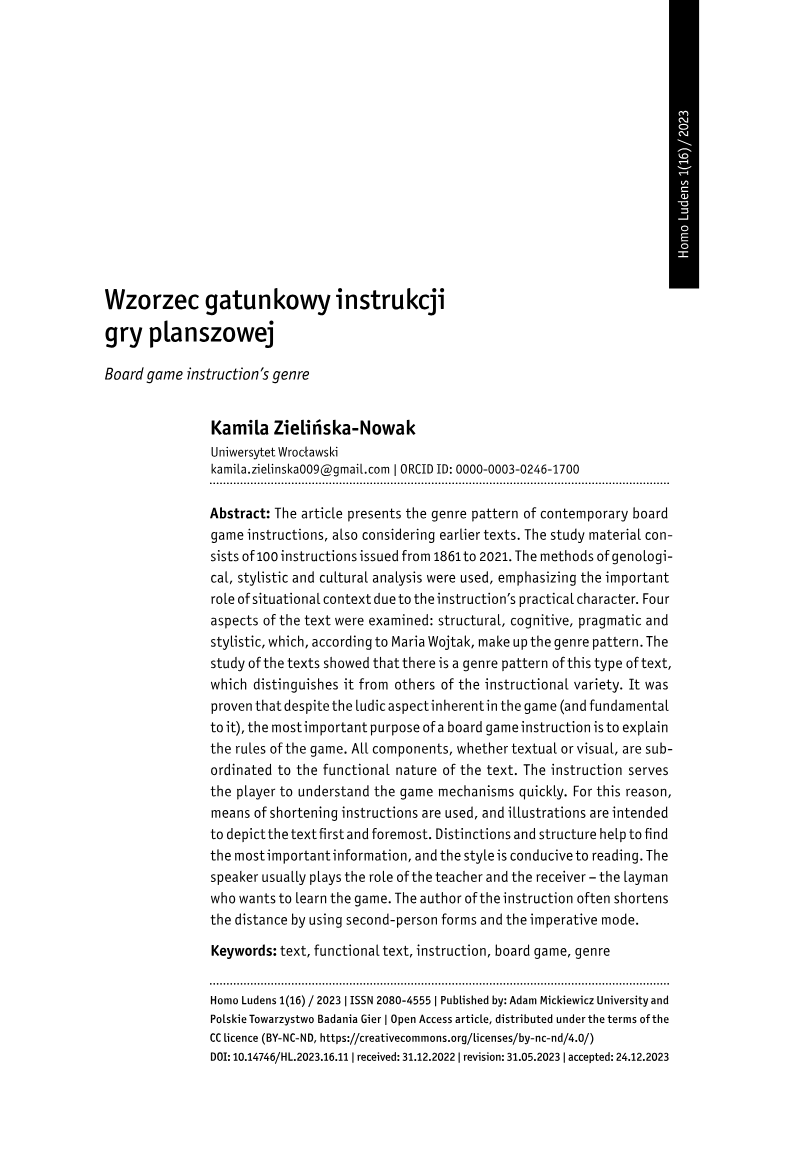
The article argues that instructions aim to explain rules concisely and efficiently. This holds even though the games they accompany are playful.
Kamila Zielińska-Nowak's article, published in Homo Ludens (2023), argues that board game instructions constitute a distinct genre whose primary purpose is functional: to explain rules concisely and efficiently, even though the games they accompany are playful. The analysis rests on a corpus of 100 Polish instructions published between 1861 and 2021, examined through four aspects drawn from Maria Wojtak's framework: structural, pragmatic, cognitive, and stylistic. This coverage gives the study a long historical span and a focus on a single national language market.
On structure, the study finds that pre-2000 instructions took varied forms, including booklets, single sheets, and text printed directly on game boards, whereas 21st-century instructions are mostly booklets whose column layout (one to three) depends on game complexity. The classic three-part segmentation of title, subtitle, and rules has persisted, but later texts offer finer segmentation so players can locate information quickly. Visual design has moved from plain black-on-white text toward varied fonts, colors, frames, and illustrations, though clarity remains the overriding priority, and author credits and publisher information became standard from the 1990s.
Pragmatically, instructions are shown to be one-way, indirect communication in which the author adopts a teacher-like voice. Older texts used authoritative and impersonal forms, while post-2000 instructions tend toward direct, conversational, and playful address, typically via "gracz" or character identities, with age recommendations tailoring tone to audience. Cognitively and stylistically, the article identifies subjective framing, selective topic choice, and realism-building techniques such as identifying players with in-game characters that shape how the game world is perceived. Modern texts favor present tense, indicative mood, visual organization, and abbreviations, whereas earlier texts leaned on patriotic, moralizing, and literary framing.
Homo Ludens · 2025
Homo Ludens · 2025
Homo Ludens · 2025
Homo Ludens · 2025
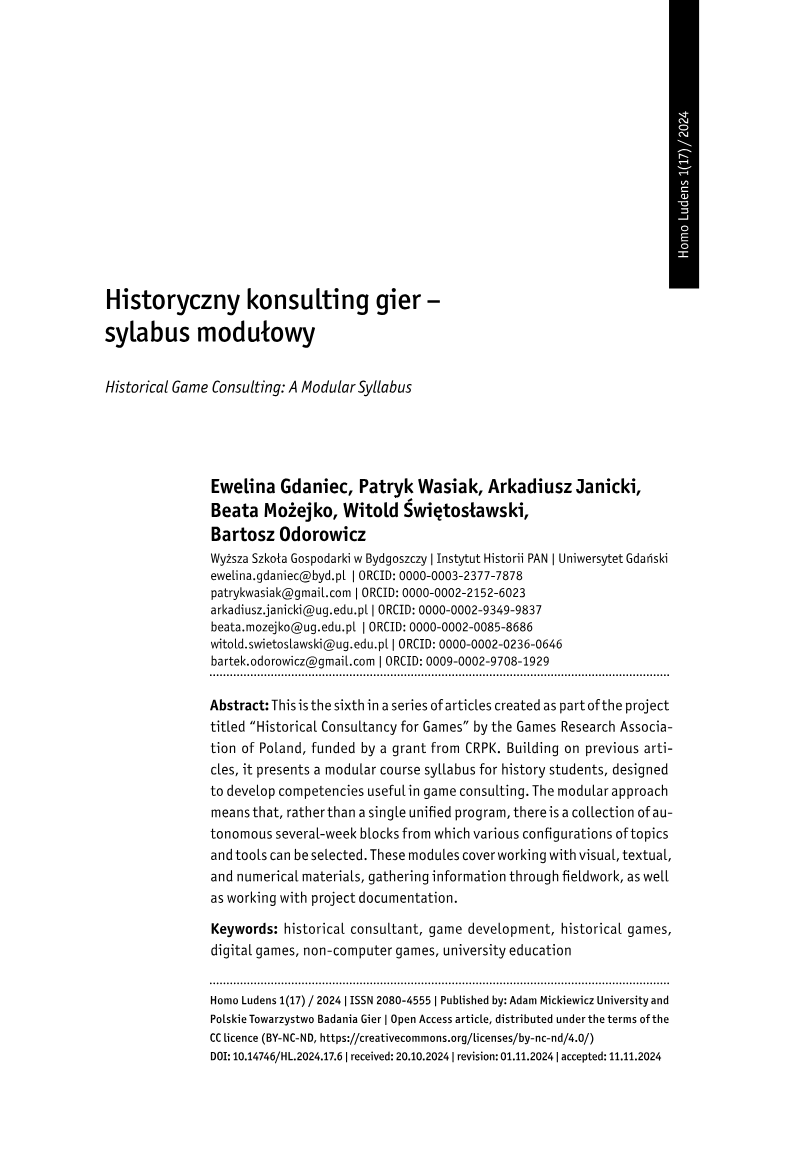
Homo Ludens · 2024
Homo Ludens · 2024
Homo Ludens · 2024
Homo Ludens · 2024
Homo Ludens · 2024
Homo Ludens · 2024
Homo Ludens · 2024
Homo Ludens · 2024



European Conference on Games Based Learning (ECGBL) · 2026



European Conference on Games Based Learning (ECGBL) · 2026



European Conference on Games Based Learning (ECGBL) · 2026















Comments