Key insights
8 slides
Market shift
Gaming has moved from supply-constrained to infinite choice.
Success now requires deep engagement with specific player segments rather than broad, unfocused appeal.

1 / 8
- 01The gaming market has shifted from a supply-constrained environment to one of infinite choice, where success now requires deep engagement with specific player segments rather than broad, unfocused appeal.See it on page 5
- 02Focused games—those designed for a specific, identifiable audience—achieved an 83% commercial success rate, significantly outperforming the 50% success rate of unfocused titles.See it on page 12
- 03Player preferences are highly fragmented, with no single experience type (such as story-driven, sandbox, or multiplayer) capturing more than 26% of the market, and two-thirds of gamers preferring to stick to familiar franchises or existing habits.See it on page 6
- 04Nearly half of all gamers now purchase content directly from developer web stores at least once a year, and 75% of top-grossing mobile games currently operate their own direct-to-consumer storefronts, up from just 12% in 2019.See it on page 22
- 05Studios should adopt AI-driven, real-time personalization—specifically contextual bandit algorithms—to optimize individual player experiences, as the highest-spending segment of the market accounts for approximately 75% of total gaming revenue.See it on page 18
- 06Willingness to spend on gaming declines sharply with age, with 86% of teenagers making monthly purchases compared to only 27% of players in their 70s.See it on page 7
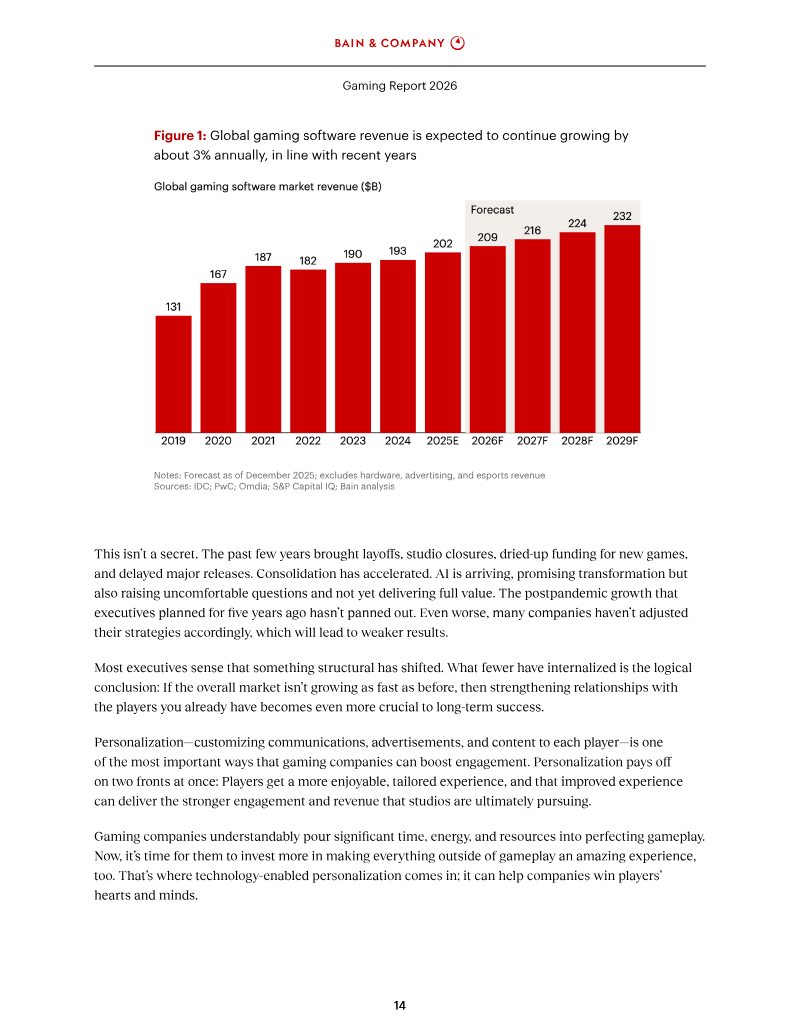
- 07Global gaming software revenue is projected to grow at a modest 3% annual rate, necessitating a strategic shift toward strengthening existing player relationships rather than relying on broad market expansion.See it on page 16
Ask AI about this report
Summary
The gaming industry has reached a critical inflection point where the concept of the average player has become obsolete. Market fragmentation across age, geography, and playstyle necessitates a shift away from broad, mass-appeal strategies toward highly targeted engagement models. Because unfocused titles are increasingly prone to failure in a saturated market, studios must prioritize direct relationships with core, high-value player segments. This strategic pivot is essential for maintaining profitability as growth plateaus across the global sector.
To navigate this landscape, developers are increasingly deploying AI-driven personalization to deliver real-time, one-to-one experiences. By utilizing advanced algorithms, studios can optimize in-game offers and retention mechanics, effectively moving beyond traditional segmentation. This technical integration is most effective when paired with a robust direct-to-consumer distribution strategy. Currently, three-quarters of top-grossing mobile titles have established proprietary web stores to bypass platform fees and capture higher margins. These direct channels are proving to be a significant financial lever, with successful implementations now accounting for over one-third of total revenue for leading publishers.
Ultimately, the transition to a direct-to-consumer model requires more than simple discounting; it demands a sophisticated engagement engine capable of leveraging granular player data. As companies migrate their portfolios toward these owned channels, they reduce long-term incremental costs and gain greater control over the player lifecycle. Executives who prioritize the development of these internal infrastructures are better positioned to sustain growth and maximize revenue in an increasingly competitive 2026 market environment.