
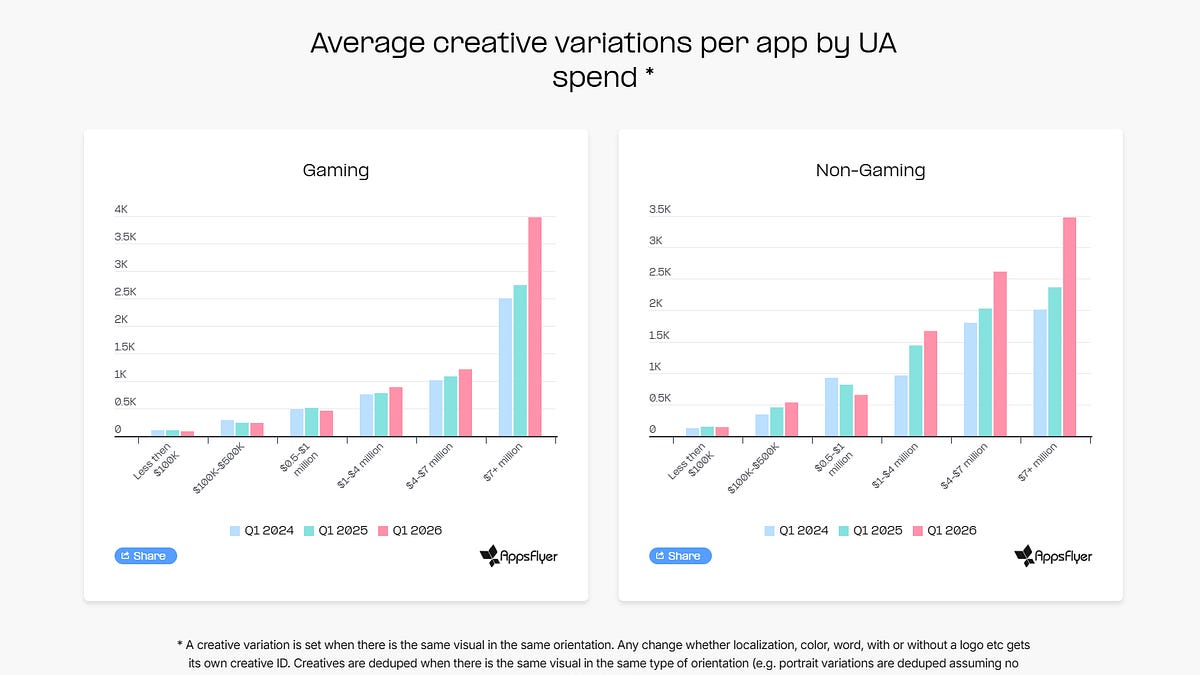
Advertisers investing over $7 million per quarter reached an average of 3,977 variations per app. This expansion is driven by AI-assisted tools that allow top-tier advertisers to significantly expand their testing volume.
The 2026 creative trends analysis examines the evolving landscape of mobile game user acquisition (UA) by evaluating 1.2 million creative variations across 1,400 applications. The primary thesis centers on the increasing professionalization and scale of creative production, driven by AI-assisted tools that allow top-tier advertisers to significantly expand their testing volume. Large-scale UA spenders, defined as those investing over $7 million per quarter, increased their creative output by 45% year-over-year, reaching an average of 3,977 variations per app.
A key finding is the extreme concentration of marketing spend within a small fraction of total creative assets. In the gaming sector, the top 2% of video creatives now command 60.7% of total spend, indicating a shift toward doubling down on high-performing assets rather than broad experimentation. This trend is less pronounced in static creatives, where concentration has actually decreased. The analysis suggests that genre-specific mechanics and hooks in video ads are difficult to replicate across variations, leading marketers to prioritize proven winners.
Methodologically, the analysis utilizes AI-tagged content to categorize creatives by tone, hook, call to action, and player motivation across three primary channels: Social & Search, Ad Networks, and DSPs. Genre-specific insights reveal distinct strategies: Puzzle and Lifestyle games rely heavily on "benefit-driven" messaging and animated content, while Action and Strategy titles lean into "exciting" tones and gameplay-focused hooks. Notably, the use of "fail ads"—where the player is shown losing—remains a dominant strategy for Puzzle games on ad networks, whereas other genres prefer neutral or win-focused outcomes. These findings highlight a market where production volume and data-driven optimization are essential for maintaining competitive UA performance.
AppsFlyer · 2026
AppsFlyer · 2026

AppsFlyer · 2025


AppsFlyer · 2023

AppsFlyer · 2021
AppsFlyer

Two & a Half Gamers · 2026

Deconstructor of Fun · 2026

Deconstructor of Fun · 2026

Deconstructor of Fun · 2025
Two & a Half Gamers · 2024

Mobile Dev Memo · 2026

Naavik · 2026

Two & a Half Gamers · 2026

Two & a Half Gamers · 2026

Two & a Half Gamers · 2026

SocialPeta · 2026
Mobile Dev Memo · 2026
Comments