Key insights
5 slides
The right method
An A/A/B testing framework ensures statistical accuracy and minimizes misleading results.
This framework uses two control groups and one test group. It helps validate hypotheses regarding ad revenue strategies.
Like having two identical scales to check the accuracy of a third, experimental scale.
1 / 5
- 01Use an A/A/B testing framework with two control groups and one test group to ensure statistical accuracy and minimize the risk of misleading results.See it on page 6
- 02Measure success primarily through Day 7 Cumulative ARPU (LTV) to capture the long-term revenue impact of monetization changes.See it on page 4
- 03Only pursue hypotheses that anticipate at least a 10% change in the focus metric, as smaller variations are considered inconclusive.See it on page 5
- 04Target a 95% confidence level for all experiments to ensure the validity of the data-driven results.See it on page 6
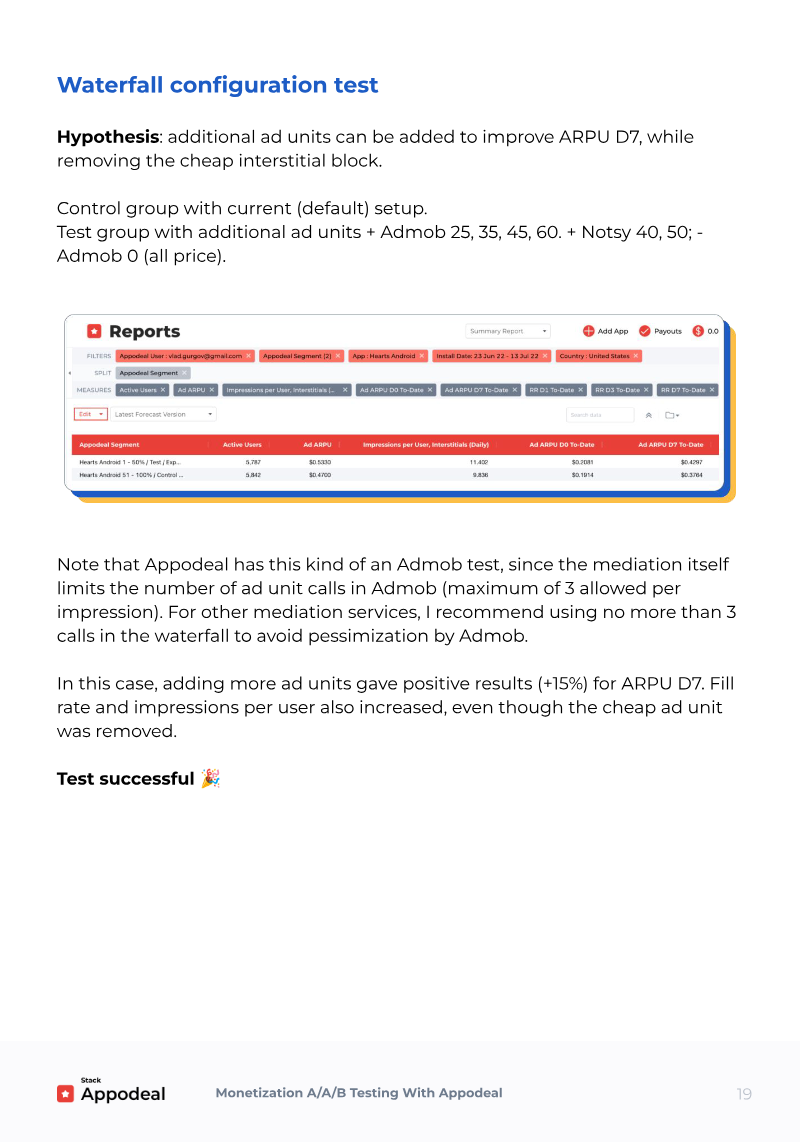
- 05Successful implementations of these monetization optimizations have historically yielded ARPU increases ranging from 8% to 40%.See it on page 19
- 06Focus testing efforts on ad impression intervals, waterfall configurations, and monetization strategies for specific user segments like those with restricted IDFA access.See it on page 18
Ask AI about this report
Summary
Monetization A/B testing serves as a critical methodology for mobile app developers to validate hypotheses regarding ad revenue strategies, such as impression frequency, waterfall configurations, and ad network selection. The primary objective of these tests is to identify growth opportunities while mitigating the risk of negative impacts on user retention and engagement. By employing a rigorous, data-driven approach, developers can make controlled changes to their monetization mechanics, ensuring that only beneficial strategies are implemented across their entire user base.
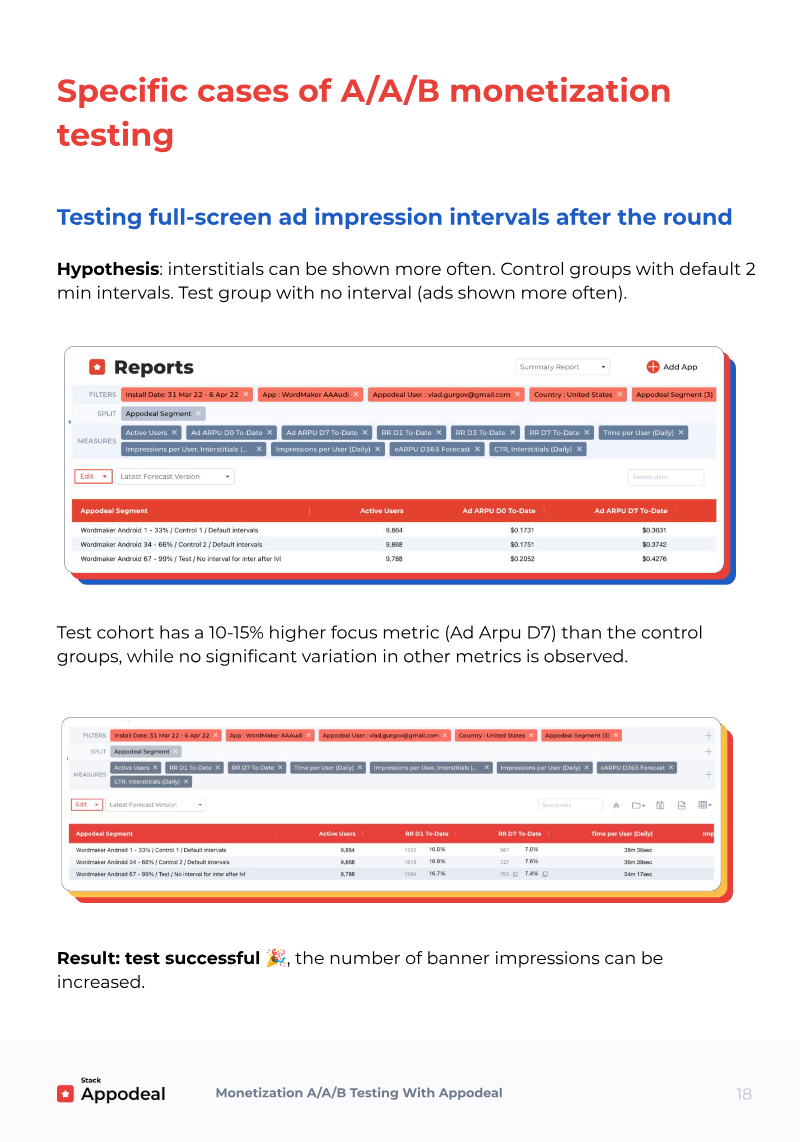
The recommended framework for these experiments is A/A/B testing, which utilizes two control groups and one test group to ensure statistical accuracy and minimize the risk of random, misleading results. Success is measured primarily through Day 7 Cumulative ARPU (LTV), as this metric effectively captures the long-term revenue impact of monetization changes. To ensure validity, tests should target a 95% confidence level, and researchers should only pursue hypotheses that anticipate at least a 10% change in the focus metric. If a test yields smaller variations or unclear results, it is considered unsuccessful or inconclusive.
The scope of this methodology is primarily focused on the casual mobile gaming sector. Effective implementation requires careful calculation of sample sizes based on the specific revenue variance of the user cohort. Key areas for testing include adjusting ad impression intervals, optimizing waterfall setups by adding or removing ad units, and tailoring monetization strategies for specific user segments, such as those with restricted IDFA access. By maintaining consistent control groups and allowing sufficient time for data collection, developers can achieve significant revenue growth, as evidenced by successful case studies where targeted optimizations led to ARPU increases ranging from 8% to 40%.