1 free read left. Create a free account for unlimited reading + AI research.
Create free account
AI Art: Copyright, Ownership and Infringement (oh my!)
Key insights
6 takeaways- 01AI is currently best utilized as a tool for concept generation rather than final asset production to avoid the legal uncertainties surrounding machine-generated output.
- 02Because most AI providers do not offer legal indemnification, developers must implement internal policies to monitor prompts and verify that final assets are not substantially similar to protected works.
- 03Content generated entirely by artificial intelligence is currently ineligible for copyright protection under United States Copyright Office standards, leaving studios unable to legally protect purely AI-created assets.
- 04The legal status of AI training data remains unresolved, with ongoing debates over whether training algorithms on copyrighted works without authorization constitutes infringement.
- 05Studios should maintain significant human authorship in the creation or modification of game assets to ensure clear copyright assignment and strengthen legal ownership claims.
- 06Developers face direct liability risks if they prompt AI to replicate existing copyrighted characters or if they use AI services that prohibit commercial usage.
Ask AI about this video
Transcript
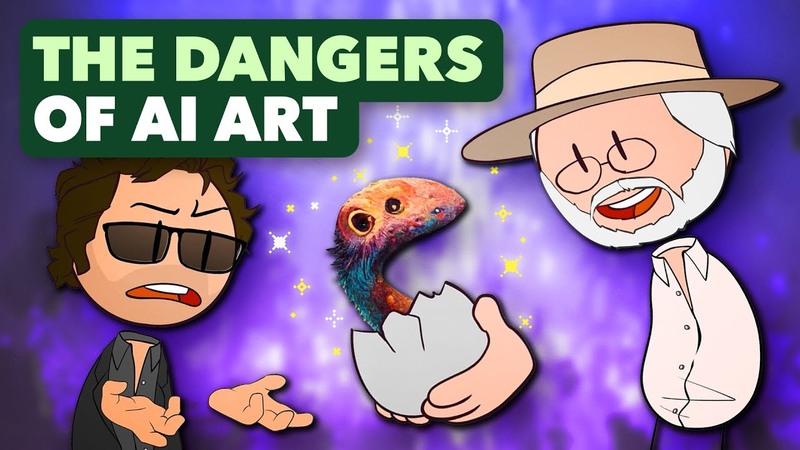
I don't need to tell you that AI and AI generated images are upending the way that we make art, and the game space is definitely no exception. Game studios are rapidly embracing AI to speed up concept and other forms of art production, and we've already seen games like this girl does not exist use AI for nearly every part of its content creation, from the art to the story to the music. Now, we could easily spend many episodes dissecting and debating whether or not we should actually use any of this stuff in games, but since we don't have time in this singular episode to fully unpack the socioeconomic implications of automation, questions about whether or not artificial intelligence should have intellectual property rights, or whether AI-generated art should even be considered real art itself, we do still have to ask, is using AI art in this way even legal? Well, to help shed some light on this sliver of the subject, we've once again called in our video game lawyer friends at ties law group, Joe Newman and Jonathan Downing. And no, big spoiler here, I'm sure, but yeah, there are some huge legal landmines you're definitely going to want to be aware of, and we're going to talk about them right now.
Thanks so much to Ground News for helping to keep us in the know. Hey there, you. Thanks so much for finding this video on the new Extra Credits gaming channel. If you haven't already, please subscribe and ring the bell. We'd greatly appreciate it. And now on to the show. Hey, did you hear the one about how this video doesn't constitute legal advice and the opinions expressed here are Joe and Jonathan's own based on their understanding of United States law with a little of my own mixed in there, and do not necessarily reflect the views of ties law or its clients. Yeah, turns out you should really see a real life and not animated lawyer for any specific legal advice in your jurisdiction. Hey, wait, wait, wait. That was supposed to be a joke. Who wrote that crap? Oh. Now, there are two main questions Joe and Jonathan always get when it comes to using AI-generated art in the video game development world. One, will I get sued for this? And two, will I own this when it's done? AKA can I use this, you know, to sue somebody else? So, let's start by unpacking that first question into a
series of steps that all creation of AI art follows. A person gives the AI a prompt, the AI creates an image based on that prompt, and then the person uses that image somewhere else. And as you'll see, you can run into legal trouble in any of these steps. At step one, this is pretty straightforward stuff. If you prompt the AI to infringe, for instance, typing in something like, "Make me Iron Man," and then the resulting image looks like Iron Man, you've essentially told the AI to create an unauthorized derivative work of Iron Man, and that, my friends, is likely copyright infringement. Same goes if you feed the AI an image that you don't own and prompt it to build from that. Now, skipping over step two for a moment, step three is relatively straightforward as well. Most AI services have legal documentation, like a terms of service, that says what you can and can't do with the images you create with them. For example, DALL-E's terms of service say that you can use the images you create for commercial use, but only if you don't depict sexual activity, illegal activities, obscene gestures, harassment, etc. If you are a free user
of Midjourney, on the other hand, you can't use the images for any commercial purpose. You and your lawyer should carefully review the license terms of any AI service you want to use, even if the AI-generated content doesn't actually end up in the final product, since it could still violate the AI provider's terms. Also, something you might not have thought of is that your prompts to the AI service are likely not confidential, i.e. anything you prompt might be used against you in a court of law. So, it's a good idea to create internal policies and procedures, ideally tailored for each AI service you use, that describe acceptable prompt parameters. Because even if you didn't intend to infringe, there's a definite possibility that the work the AI spits out still ends up substantially similar to someone else's existing copyrighted work. And unlike, say, a human-run design firm, you're not going to be able to get the AI service owners to indemnify you, i.e. defend you in court if somebody sues you down the line. Therefore, it's just good practice to run any resulting image you make through a service like a Google Image Search and
use your judgment to see if it's too similar to something already out there. And one last note around this topic, which of course should go without saying, but I'm going to say it anyway. If your work is closely inspired by an artist's existing work that you are not paying, change it. And never try to pass it off as the artist's actual work. Circling back to step two, though, this is where things get really interesting. One of the arguments we've seen from advocates against AI is that it's unlawful, or at least unethical, to rely on algorithms that have been trained using copyrighted works. We sometimes call this the fruit of the poisonous tree argument. If the system that created the art was illegal, then all art created from that system must therefore also be illegal. On the other hand, some AI advocates argue that if an AI is trained off of copyrighted images, it's at least similar in theory to what humans do when they study references. Designers and art students, arguably, shouldn't have to get a license just to look at these references, so long as they don't directly copy them. But then, on the other other hand, my third hand, you kind of get into this space of does
the speed and method in which the AI used this copyrighted work to learn change that analysis? I mean, I personally think so, but I'm not a lawyer. And shouldn't AI even be able to use an image as a training reference if the artist has specifically told the AI not to? Joe and Jonathan tell me this is one of the key legal battles facing this new field, and it is very much unresolved. Now, at this point, let's assume that you've done everything right by the letter of the current law, and your AI-created work is unlikely to infringe on anyone else's rights. You're not out of the woods yet, because there's still one more very tricky question. Do you own it? Well, the US Copyright Office has already decided that art authored by artificial intelligence cannot be copyrighted. A human being who directs an AI to make that art might have an ownership claim, but it's still unclear whether they own the entire art or just the written prompt used to create the art. The takeaway being, even if you use AI as a tool to help draft your ideas, the final content that makes it into your game
should still be made by a human author. Then, not only will your studio be paying artists, but you'll also have a clear record of copyright assignment from the artist that is being paid to your studio, making your claim to ownership much clearer. Wow, would you look at that, Zoe. Turns out there's a good moral and legal reason to keep us humans around after all. But what do you all think? Do the legal worries around AI art make it too risky for commercial use? Or do you fully embrace the AI art, air quotes, renaissance? Let us know in the completely human-generated comments below, and we'll put Joe and Jonathan's links in the description in case you'd like more advice on this topic. And then if you want to go even beyond lawyer speak and get into the myriad of other opinions about AI from a ton of different and diverse perspectives, a really good place to start that exploration would be with today's sponsor, Ground News. In case you don't know, Ground News is a really helpful website and app that I use to help me not only get the news I read, but also compare exactly how news stories are being covered across the different news outlets from both around the world and around the political spectrum, which I
just find super helpful when I'm trying to figure out what's going on with like conflicting information or sensationalized coverage or seemingly endless social media feeds that I just melt my brain at this point. That way, you know, I'm more confident that I can find the whole story that I'm looking for. And actually, when you do go beyond the individual articles, you get to use things like their bias distribution chart to see all sorts of interesting information about the various media outlets you get your news from. Everything from stuff like factual accuracy, that's important, to political leaning, oh heck yeah, and even who actually owns said media outlet. I found that one particularly interesting. All in one easy-to-read location that helps you not only spot media bias, but just better understand your own personal reading habits. And of course, because biases are kind of like ear holes, you know, everybody's got them. Ground News has this other really cool feature called a blind spot feed, which basically shows you all the news stories that you probably would be interested in, but that aren't talked about as much at your regular news haunts. Wait, they found a 17-lb meteor in Antarctica? Isn't that how The Thing started? Oh boy. Okay, Zoey, you go get the
flamethrower, and I'm going to customize my newsfeed so I don't miss stories like this again. So, if you're looking for a better way to stay informed about current events from all over the world, you should go and check out Ground News right now by visiting ground.news/extracredits to download their free app. Then, not only will you have more information about where your news is actually coming from, but you'll also be helping out our channel in the process, which, you know, keeps us in things like flamethrower fuel, which, in this particular case, is very important. As always, we appreciate your support so much because, as we all know, the news never really stops. Okay, ready, Zoey? Let's go hunt a sus AF meteor. Leeroy Jenkins! A million big old thanks to Skyler Holmes, Kuya Coy, Joseph Blain, Dominic Valenciana, Casey Musser, Arclight Games, Angela Valenciana, and Amadzia Turk for being fantastic, legendary patrons.
Summary
The integration of artificial intelligence into game development presents significant legal challenges regarding copyright infringement and intellectual property ownership. The primary legal risks for developers stem from three stages of the AI creation process: the initial prompt, the training data used by the AI model, and the final output. Developers face potential liability if they prompt an AI to replicate existing copyrighted characters or works, or if they utilize AI services that violate specific terms of service regarding commercial usage. Because AI providers typically do not offer indemnification, developers are advised to implement internal policies, monitor prompts for potential infringement, and verify that final assets are not substantially similar to existing protected works.
A central, unresolved legal debate concerns the training phase of AI models. Critics argue that training algorithms on copyrighted works without authorization constitutes an infringement, while proponents suggest it mirrors the human process of studying artistic references. Furthermore, the question of ownership remains a critical hurdle for studios. Under current United States Copyright Office standards, content generated entirely by artificial intelligence cannot be copyrighted. This creates a precarious situation for developers who rely on AI for final assets, as they may lack the legal standing to protect their own intellectual property.
To mitigate these risks, the consensus suggests that studios should maintain human authorship for final game assets. By ensuring that human artists create or significantly modify content, studios can secure clear copyright assignments, thereby strengthening their ownership claims. Ultimately, while AI serves as a powerful tool for concept generation, the legal uncertainties surrounding training data and the inability to copyright machine-generated output necessitate a cautious, human-centric approach to game design to avoid litigation and protect creative assets.


















Comments