1 free read left. Create a free account for unlimited reading + AI research.
Create free accountArticleSerious Games Society
Bridging the gap between theoretical environmental science and practical resource management is difficult.
Key Challenge. The simulation aims to teach complex sustainability without inducing cognitive overload.
Resilience: After the Eruption functions as a digital role-playing simulation designed to cultivate systems thinking and collaborative decision-making regarding ecological recovery. By tasking participants with managing interconnected natural, economic, and social capital following the 1980 Mount St. Helens disaster, the simulation forces players to navigate the conflicting priorities of diverse stakeholders. The primary thesis posits that interactive, role-based gameplay provides a robust framework for teaching complex sustainability concepts without inducing cognitive overload, effectively bridging the gap between theoretical environmental science and practical resource management.
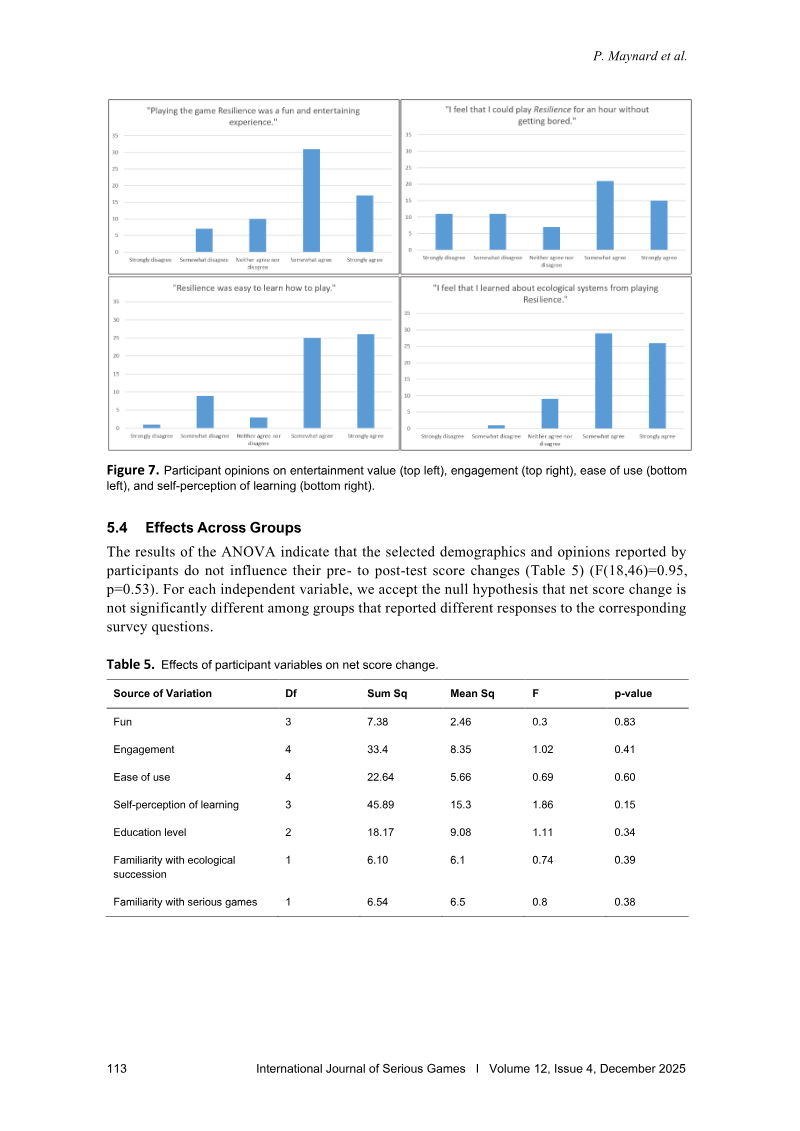
Empirical analysis confirms the educational efficacy of this approach, as participants demonstrated a statistically significant 21 percent increase in knowledge scores following engagement with the simulation. Statistical testing, including analysis of variance, indicates that these gains remain consistent across diverse demographics, suggesting that the game serves as a reliable pedagogical tool regardless of a user’s prior background or personal opinions. These findings validate the use of serious games as a viable medium for teaching intricate ecological processes and the necessity of multi-stakeholder cooperation in disaster recovery scenarios.
While the simulation proves successful as an instructional resource, future development must address identified technical performance limitations and gameplay repetition to sustain long-term engagement. Plans to expand the reach of the simulation to include both academic students and professional resource managers underscore its potential as a versatile training tool. By refining assessment metrics and optimizing the user experience, the project aims to further solidify its role in environmental education, ultimately providing a scalable solution for teaching the complexities of sustainable equilibrium in the face of environmental disruption.
Serious Games Society · 2026
Serious Games Society · 2026
Serious Games Society · 2026
Serious Games Society · 2026
Serious Games Society · 2026



Serious Games Society · 2026
Serious Games Society · 2026
Serious Games Society · 2026
Serious Games Society · 2026
Serious Games Society · 2026

International Journal of Serious Games · 2026
Serious Games Society · 2026
DiGRA · 2024






Comments