Loading the document
Key insights
6 slides
The solution
Integrating smartphone sensors into a PDR system offers an alternative to GPS for indoor gaming.
A Pedestrian Dead Reckoning (PDR) system uses smartphone accelerometers, magnetometers, and gyroscopes. This provides a viable alternative for location-aware gaming indoors.
1 / 6
- 01Integrating smartphone accelerometers, magnetometers, and gyroscopes into a Pedestrian Dead Reckoning (PDR) system provides a viable alternative to GPS for indoor location-aware gaming.See it on page 1
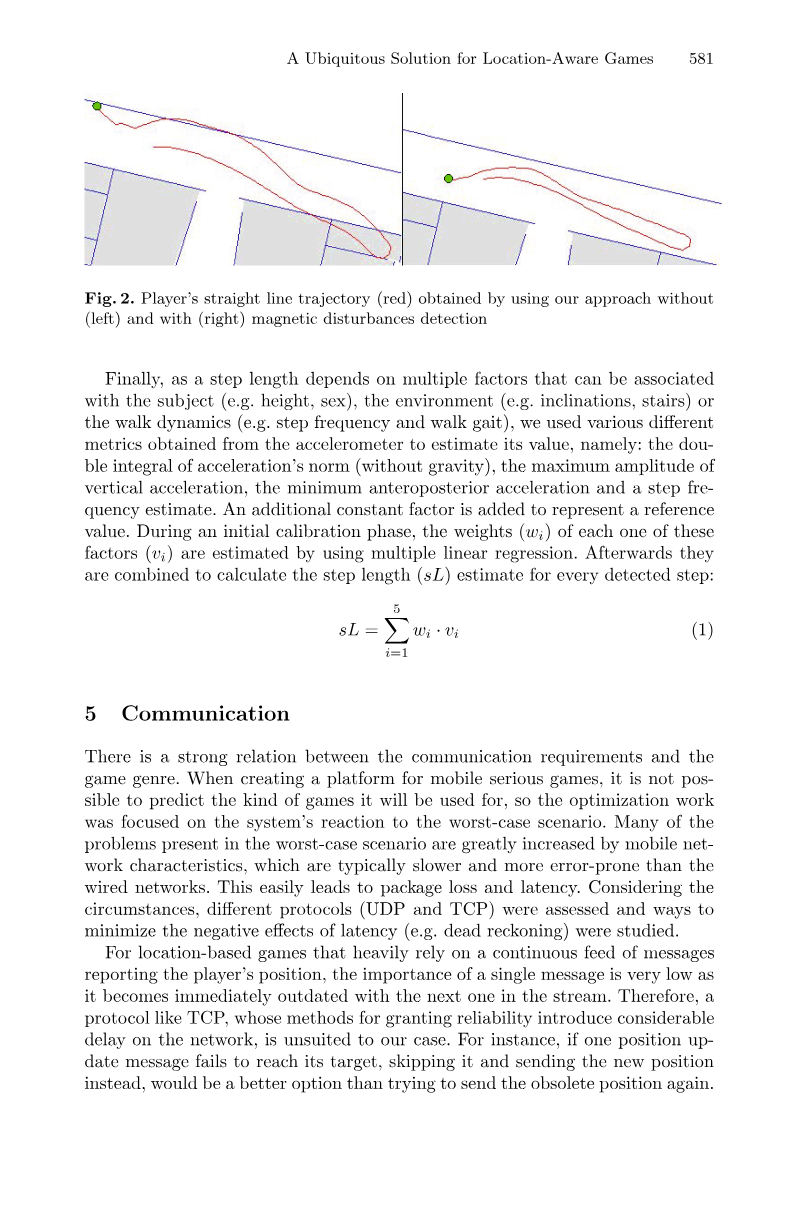
- 02The PDR framework improves accuracy by using a direction cosine matrix for sensor fusion and a magnetic disturbance detection technique to ignore unreliable magnetometer data.See it on page 3
- 03Step detection is managed via a state machine, while step length is calculated using a weighted linear regression model that accounts for individual gait dynamics.See it on page 3
- 04Utilizing UDP protocols instead of TCP reduces network overhead and latency, which is critical for real-time position updates in multiplayer mobile environments.See it on page 4
- 05PDR systems are prone to cumulative errors over time, necessitating the future integration of trajectory constraints to prevent movement through physical obstacles.See it on page 5
- 06Developers can mitigate remaining technical limitations by adopting a 'seamful' design approach, incorporating positioning inaccuracies directly into game mechanics.See it on page 5
Ask AI about this report
Summary
This research presents a technical framework designed to overcome the limitations of GPS and wireless positioning in location-aware mobile gaming, particularly within indoor environments. The primary thesis is that integrating smartphone-based sensor data with a Pedestrian Dead Reckoning (PDR) algorithm significantly improves location accuracy, while utilizing UDP protocols mitigates network latency issues inherent in multiplayer mobile environments.
The methodology centers on a PDR system that processes data from accelerometers, magnetometers, and gyroscopes to track user movement. To ensure reliability, the system employs a direction cosine matrix to fuse sensor inputs and implements a magnetic disturbance detection technique that ignores magnetometer data during periods of interference. Step detection is managed via a state machine, while step length is calculated using a weighted linear regression model that accounts for individual gait dynamics and environmental factors. For network communication, the platform prioritizes UDP over TCP, citing lower overhead and superior performance in high-latency mobile networks where continuous, real-time position updates render packet reliability less critical than speed.
The findings indicate that while the PDR approach provides a viable alternative to traditional positioning, it remains susceptible to cumulative errors over time. The authors conclude that future refinements should incorporate trajectory constraints—such as preventing movement through physical obstacles—to maintain positional accuracy. The study suggests that this platform is suitable for both standalone indoor navigation and as an auxiliary component for outdoor games requiring high precision. Ultimately, the research advocates for a flexible development approach, suggesting that developers may also leverage "seamful" design to incorporate remaining technical limitations directly into game mechanics.