Cinematronics
Company
2 documents in the library are about Cinematronics, from writers such as DiGRA and G|A|M|E – The Italian Journal of Game Studies. Each has a summary and key insights with the page they come from.
Connections
Each row is a game or company named alongside Cinematronics, each column a document, oldest first. A mark means that document names it. Select a row to see those documents.
Documents about Cinematronics
How Accessible QTE Inputs Reshape Suspense Trajectories in Survival Horror Games
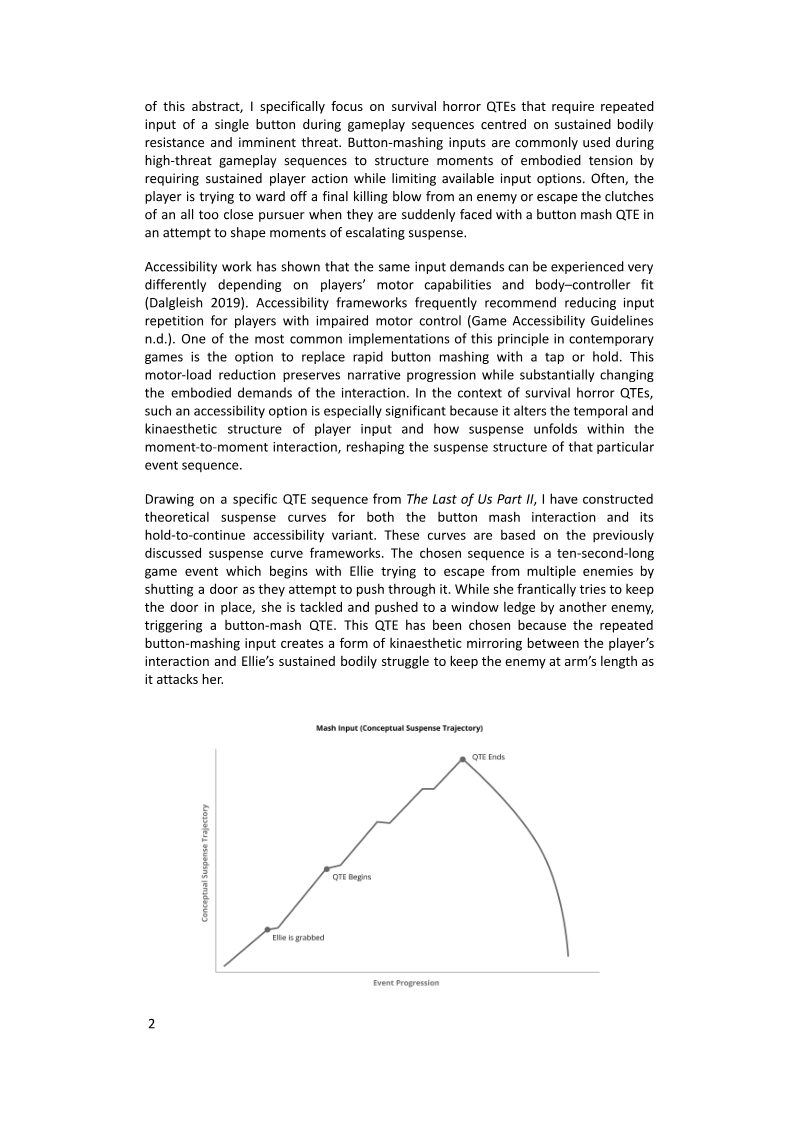
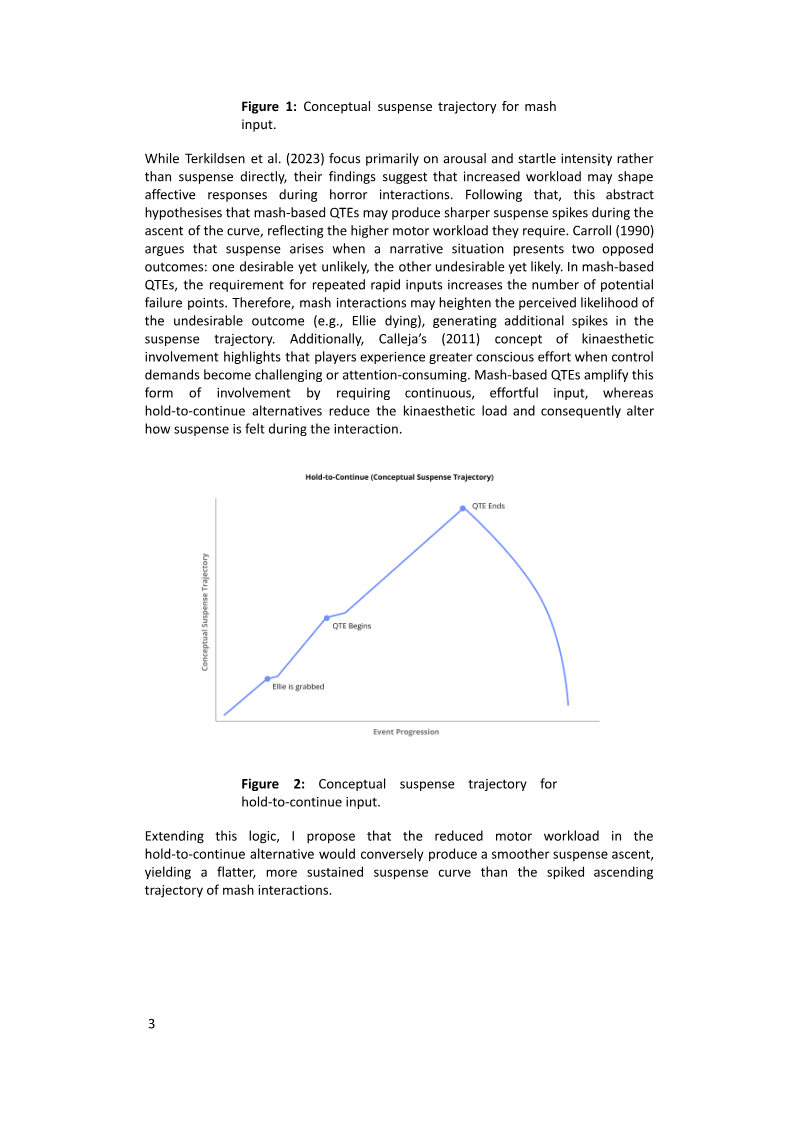
This extended abstract proposes that the input mode of a survival horror quick-time event, specifically a rapid button-mash versus a hold-to-continue accessibility alternative, can reshape the suspense trajectory of the same in-game event.
- The paper argues that accessible input modes for a survival horror QTE, such as hold-to-continue versus rapid button-mashing, can reshape the suspense trajectory of the same in-game event rather than being neutral barrier removals.
- Using a single illustrative case from The Last of Us Part II (a ten-second QTE where Ellie is pinned to a window ledge), the author constructs two conceptual suspense curves to model the differences.
- Button-mashing is hypothesised to produce sharper suspense spikes during the ascent because repeated inputs multiply potential failure points and raise perceived likelihood of an undesirable outcome.
De-framing Video Games from the Light of Cinema
Perron and Arsenault's 2015 essay, "De-framing Video Games from the Light of Cinema," argues that video game scholarship has been shaped too heavily by a cinema-centric framing that treats film as the default lens for understanding games.
- The essay argues that video game scholarship has been overly shaped by a cinema-centric framing that treats film as the default lens, and that this alignment is a cultural and historical construction rather than a natural fit.
- Its central thesis is methodological: games should be analyzed through their own traditions, including real-time animation, parallel projection, cartography, and text-based interactive fiction, along with ludic and computational dimensions that cinema-focused analysis underweights.
- Drawing on Gaudreault and Marion's theory, the authors call on scholars to use film theory with awareness of its limits rather than importing film assumptions wholesale.