Mobile Games
The mobile market by genre, from hypercasual and puzzle to midcore and idle.
403 documents

GameRefinery · 2021
ReportRPG Genre Snapshot Report June 2021
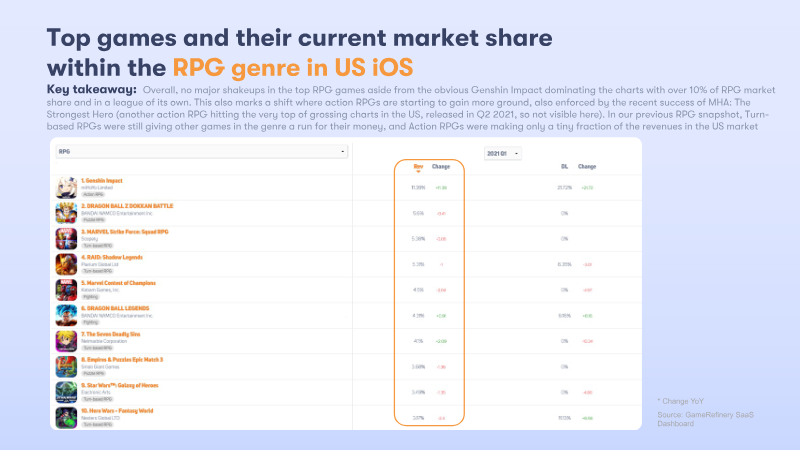
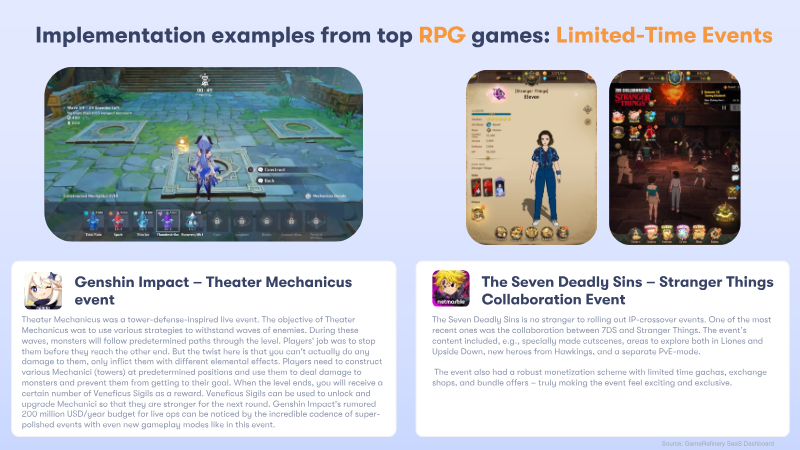
Role-playing games (RPGs) represent a cornerstone of the mobile gaming market, accounting for approximately 14% of total revenue on the US iOS platform as of mid-2021. While the genre has long been dominated by established turn-based titles like Raid: Shadow Legends and Marvel Strike Force, recent market data indicates a significant shift toward Action RPGs. This transition is driven primarily by high-production, open-world titles that bridge the gap between mobile and console-quality experiences. The primary catalyst for this shift is Genshin Impact, which alone commands over 10% of the RPG market share. Alongside the more recent launch of My Hero Academia (MHA): The Strongest Hero, these titles emphasize narrative depth, exploration, and high-fidelity graphics. While both utilize an anime art style, they cater to different player motivations: Genshin Impact focuses on single-player exploration and skill-based combat, whereas MHA integrates more competitive social elements, including synchronous and asynchronous PvP. Monetization within the genre remains heavily reliant on character collection mechanics and sophisticated gacha systems. Analysis of top-performing updates shows that revenue spikes are most frequently tied to limited-time "banner" gachas and IP collaboration events, such as the crossover between The Seven Deadly Sins: Grand Cross and Stranger Things. These events often introduce bespoke gameplay modes, such as tower defense or unique PvE challenges, to maintain engagement. The findings are based on GameRefinery’s proprietary three-layered taxonomy and a motivation framework derived from a survey of over 7000 mobile gamers across English-speaking Western markets. The data specifically covers the US iOS market for the 12-month period leading up to June 2021, highlighting a clear evolution from traditional turn-based mechanics toward immersive, open-world action experiences.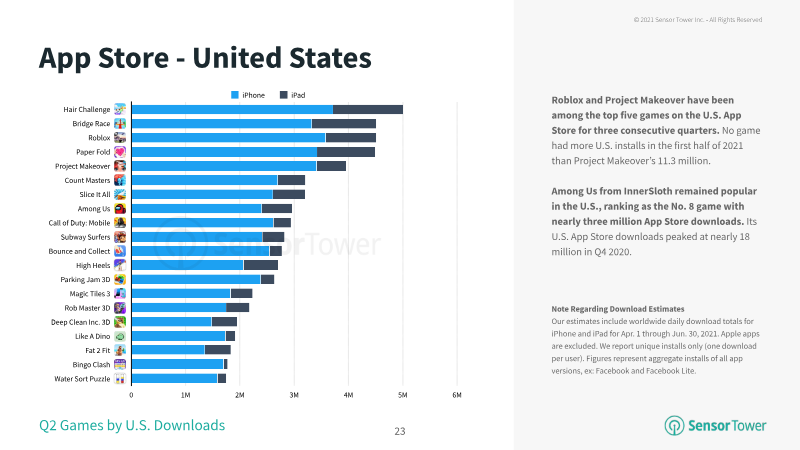

Sensor Tower · 2021
ReportQ2 2021: Store Intelligence Data Digest
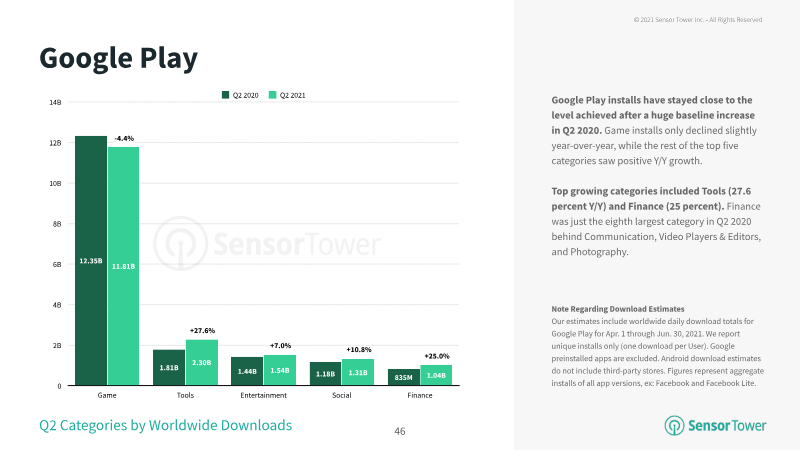
Global app downloads reached 35.9 billion in the second quarter of 2021, representing a 4.8% year-over-year decline as the market stabilized following the unprecedented pandemic-driven highs of 2020. Despite this slight contraction, the mobile ecosystem demonstrated significant resilience and evolution across various sectors. TikTok remained the dominant global application with over 200 million quarterly installs, while the mobile gaming sector saw Pokémon GO surpass the $5 billion lifetime revenue milestone. The quarter was characterized by a resurgence in travel and finance applications, such as Google Maps and Coinbase, alongside a notable surge in the gig economy as Uber and Lyft downloads returned to pre-pandemic levels. The mobile gaming landscape was primarily defined by the continued dominance of the Hypercasual genre, with titles like Bridge Race and Hair Challenge leading global charts. Regional performance remained distinct, with Asian markets showing high stability through established titles like Ludo King, while the United States and Europe favored rapid-growth Hypercasual releases. India maintained its status as the world’s largest market by volume, exceeding 7 billion downloads. On the publisher side, Google and Facebook retained their global leadership, though Zynga and Supersonic Studios saw significant upward mobility due to aggressive expansions into the Hypercasual space. Geographically, the market exhibited a clear divide in platform influence. Chinese firms like Tencent and ByteDance dominated the App Store in Asia, where China alone accounted for over half of all iOS installs. Conversely, U.S. publishers maintained a firm grip on domestic and European markets. Emerging trends in the Photo and Video category, driven by viral AI-based applications and video editing tools like CapCut, further illustrated the shifting consumer interests toward creative and social content. This period ultimately reflects a transition toward a post-pandemic equilibrium, marked by the recovery of service-based apps and the sustained profitability of established gaming franchises.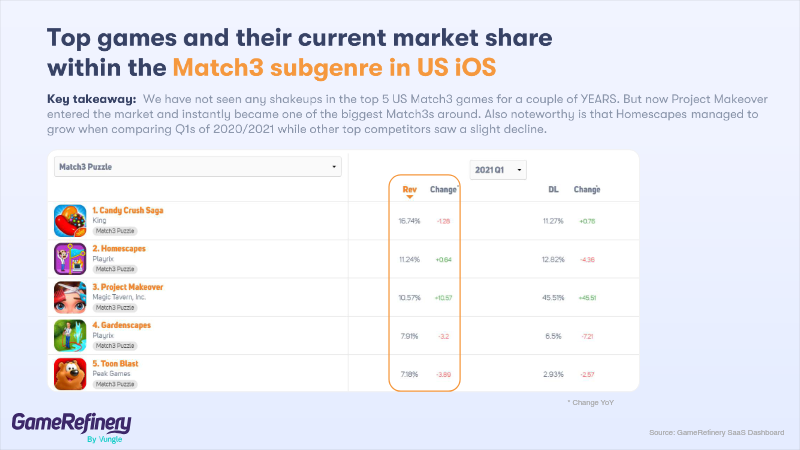
GameRefinery · 2021
ReportMatch3 Genre Snapshot: US iOS (May 2021)
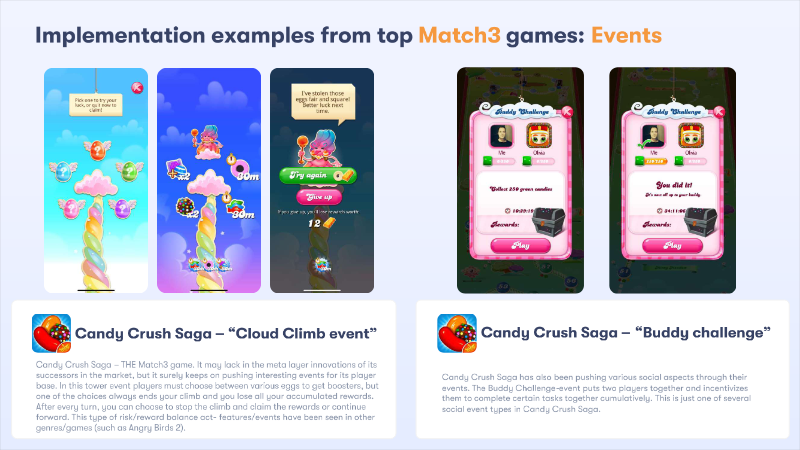
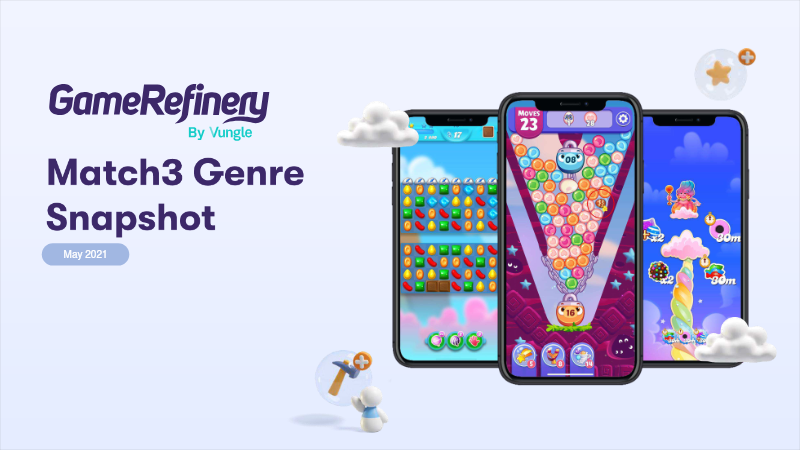
The Match3 subgenre represents the largest individual segment of the US iOS mobile gaming market, accounting for approximately 16% of total market revenue as of May 2021. While the category has long been dominated by established titles that have maintained chart positions for years, recent market shifts indicate a move away from traditional swapping mechanics. Notably, none of the new Match3 titles entering the top 500 grossing rankings over the last 18 months utilize standard swapping gameplay, signaling a diversification in core mechanics and the rising importance of meta-layers. Meta-elements, particularly those focused on decoration and customization, have become essential components for modern success in the genre. Successful megahits like Royal Match and Project Makeover demonstrate the effectiveness of combining core puzzle gameplay with deep progression systems and sophisticated monetization strategies. Data indicates that recurring live events, special event rewards, and limited-time in-app purchase offers have the highest impact on revenue. Furthermore, social features such as guild mechanics and "send/ask help" systems are increasingly vital for driving engagement and retention. Player motivation analysis, based on a survey of over 7,000 mobile gamers across English-speaking Western markets, reveals distinct psychological drivers within the genre. While "Thinking and Solving" remains the primary driver for traditional titles like Candy Crush Saga, newer successful entries increasingly lean into "Customization and Decoration" and "Role-playing and Emotions." This shift reflects a broader industry trend where loss aversion mechanics and social competition are leveraged to enhance the player experience and maximize lifetime value in a highly competitive landscape.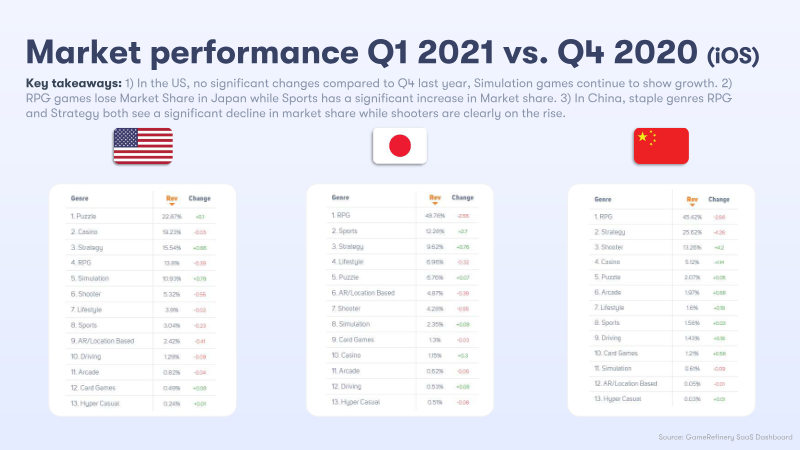
GameRefinery · 2021
ReportMarket Snapshot: Q1 2021 US, China & Japan
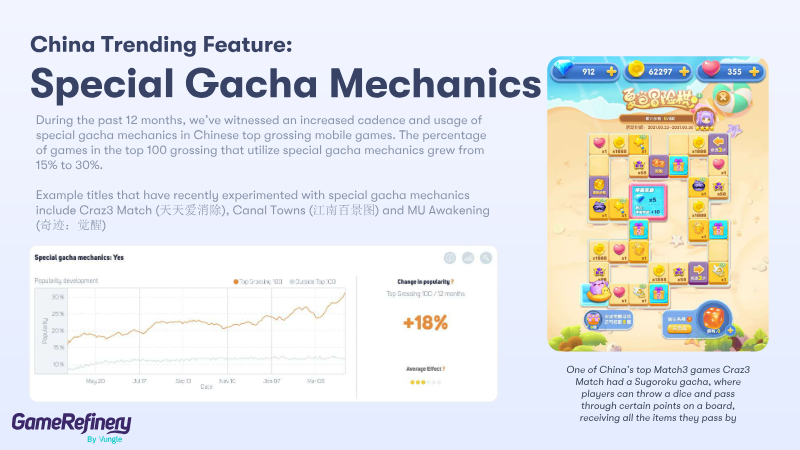
The mobile gaming market in the first quarter of 2021 demonstrated regional divergence in genre performance, with the United States remaining relatively stable while China and Japan experienced notable shifts in market share. In the US, simulation games continued to grow, and Roblox Corporation solidified its position as the top-grossing publisher. Conversely, Japan saw a decline in RPG market share alongside a significant rise in sports titles, driven by the breakout success of Cygames’ Uma Musume Pretty Derby. China’s market moved away from traditional RPG and strategy dominance, favoring a surge in shooter games. Data analysis reveals distinct trends in monetization and feature implementation across these regions. Collectible albums have become a staple in the US, utilized by over 70% of top-grossing games. In Japan, battle pass mechanics are gaining traction, appearing in over 25% of top-grossing titles. Meanwhile, Chinese developers have doubled the year-over-year utilization of special gacha mechanics, which now appear in 30% of top-grossing games. Social features, particularly guild mechanics and co-op modes, remain essential for retention across puzzle, RPG, and strategy genres. The analysis utilizes a proprietary genre taxonomy and a motivation framework to categorize player archetypes. In the US market, the top 200 grossing games primarily appeal to five distinct archetypes, with a rising trend toward the Skill Master archetype, indicating an increased consumer appetite for competitive gameplay that rewards reflexes and skill. These findings are based on iOS market performance data, publisher share metrics, and an evaluation of soft-launch titles, providing a comprehensive view of the mobile landscape during the transition from late 2020 to early 2021.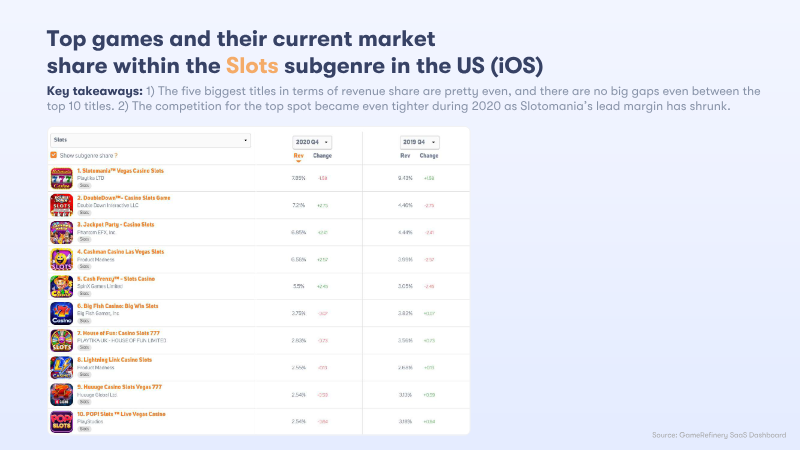
GameRefinery · 2021
ReportCasino Snapshot Report: Market, Features & Updates, Motivations (March 2021)
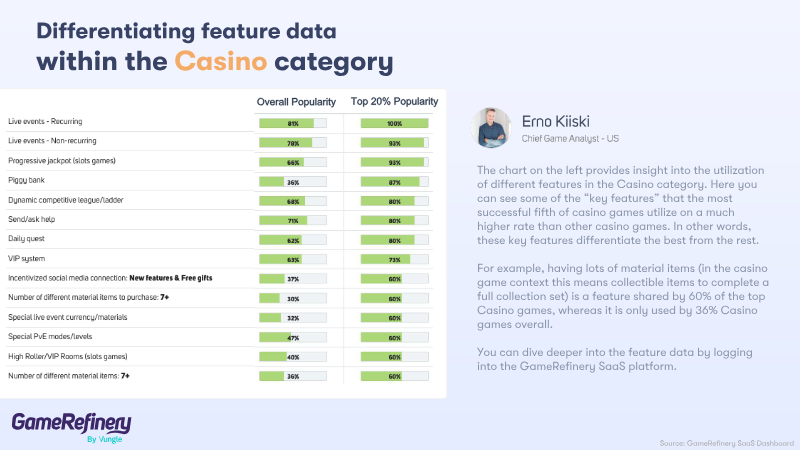
This analysis examines the state of the mobile Casino game category in the United States during the fourth quarter of 2020. Utilizing a proprietary three-layered taxonomy and data from the GameRefinery SaaS platform, the findings highlight that Casino games represent the second-largest revenue-generating category on iOS in the US, accounting for 17.2% of total mobile game revenue. The research identifies three primary subgenres—Slots, Poker/Cards, and Bingo—and evaluates their market share, competitive landscapes, and player motivations. The data reveals that Slots is the dominant subgenre, responsible for 80% of the category's revenue. Unlike Poker and Bingo, which are characterized by "king of the hill" titles like World Series of Poker and Bingo Blitz, the Slots market is highly competitive with no single dominant leader. Market share is distributed relatively evenly among the top five titles, including Slotomania and DoubleDown Casino. The study notes that the Casino market is mature, with most top-grossing titles having maintained their positions for several years, making it difficult for new challengers to break into the top charts. Methodology involves a survey of over 7,000 mobile gamers across English-speaking Western markets to identify key motivational drivers. Findings indicate that Casino players are primarily driven by excitement, competition, and treasure collection. Consequently, top-performing games increasingly adopt "meta" features from other genres to drive engagement. Key differentiating features include collectible albums, guild mechanics for social play, and "Piggy Bank" monetization systems. For instance, 60% of top-tier Casino games utilize collectible mechanics compared to only 36% of the broader category, illustrating a clear correlation between complex progression features and commercial success.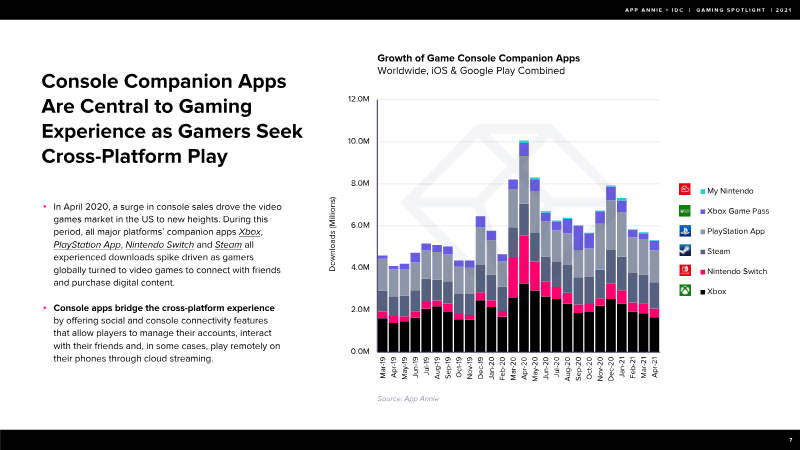

App Annie · 2021
ReportGaming Spotlight: 2021 Review
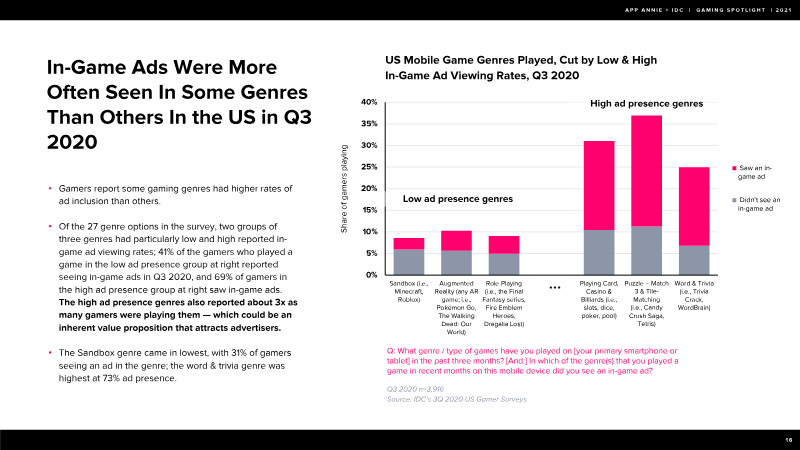
The 2021 Gaming Spotlight provides a comprehensive analysis of the global digital gaming landscape, emphasizing the dominance of mobile gaming and the increasing integration of cross-platform experiences. The primary thesis posits that mobile gaming has become the central driver of industry growth, with its global lead over home consoles projected to reach 3.1x by the end of 2021. This shift is supported by data indicating that mobile game downloads and consumer spending in Q1 2021 increased by 30% and 40%, respectively, compared to pre-pandemic levels in late 2019. The analysis highlights a significant evolution in player behavior, where social connectivity and cross-play capabilities have become essential for long-term engagement. High-grossing titles such as Roblox and Genshin Impact exemplify this trend, leveraging cross-platform features to scale rapidly across mobile, PC, and console environments. Furthermore, the report notes that console companion apps have become vital tools for managing accounts and maintaining social connections, reflecting a broader trend of merging mobile and console experiences. Methodologically, the findings rely on market intelligence from App Annie and consumer survey data from IDC, which polled over 3,300 US gamers regarding their attitudes toward in-game advertising. The research reveals that while overall sentiment toward in-game ads improved between 2019 and 2020, player reception is highly dependent on the ad format. Rewarded video and playable ads, which offer a direct value exchange, consistently outperform traditional banner and video ads in user sentiment. The data warns that ad oversaturation, particularly in high-frequency genres like word and trivia games, correlates with more negative player sentiment and potential churn. Ultimately, the industry is trending toward casual, session-based gaming, with hyper-casual and simulation genres seeing the most significant growth in download market share.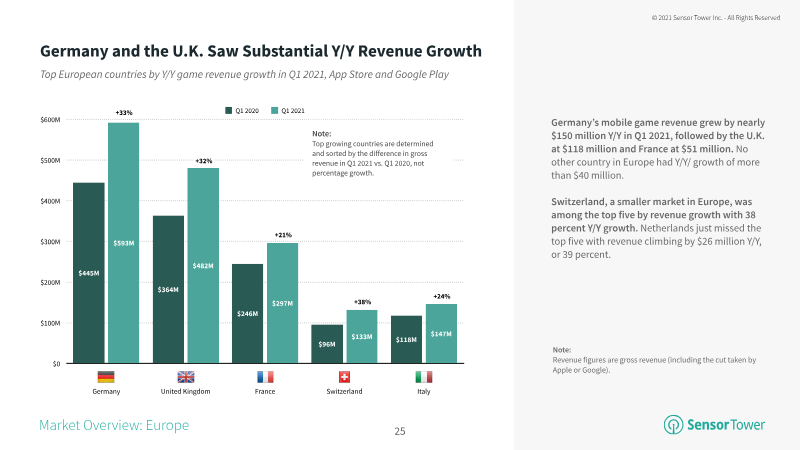
Sensor Tower · 2021
ReportThe State of Mobile Gaming 2021: U.S., Europe, and Asia
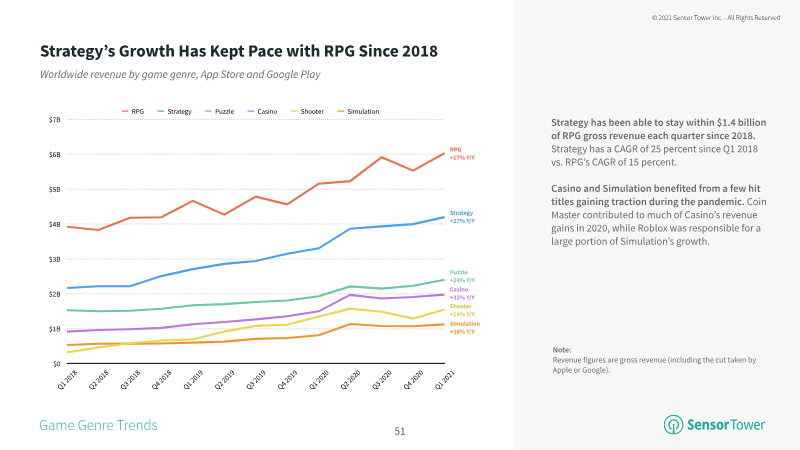
The global mobile gaming market experienced an unprecedented surge during the 2020–2021 period, fueled by pandemic-related shifts in consumer behavior that accelerated both spending and engagement. By early 2021, quarterly consumer spending reached $22 billion, representing a 25% year-over-year increase. While the United States maintains its position as the primary revenue generator, Asia remains the dominant force in total download volume, led by high adoption rates in India and Indonesia. Europe has also demonstrated significant growth, particularly in Germany, where social and multiplayer titles have sustained long-term engagement even as initial pandemic-era download spikes began to normalize. Monetization remains heavily concentrated, with the top five global markets accounting for 77% of total spending. The freemium model continues to define the industry, generating 99% of App Store revenue, while premium titles face a continued decline. Although one-time in-app purchases remain the standard, subscription models are gaining momentum, currently utilized by 29% of top-grossing titles. Advertising remains a critical revenue stream, particularly within the hypercasual and puzzle genres, which lead the market in ad publishing volume and network spend. Major industry players like Zynga and Playrix continue to dominate the share of voice, though developers are increasingly cautious as they navigate the evolving landscape of user privacy and advertising attribution. Looking toward 2023, the industry is projected to reach $117 billion in consumer spending and 67.2 billion annual downloads. While role-playing games maintain their status as the highest-grossing genre, hypercasual titles continue to drive the majority of download volume. Future growth is expected to be particularly robust in emerging markets across Southeast Asia and Europe, which are anticipated to outpace global revenue growth rates. As the market matures, the strategic shift toward diversified monetization—balancing freemium, subscription, and ad-based models—will be essential for developers to sustain growth in a post-pandemic environment.

AudioMob · 2021
ReportAudio Ad Engagement in Mobile Games
This analysis examines the efficacy of in-game audio advertising as a non-intrusive alternative to traditional video and banner formats within the mobile gaming industry. The primary thesis posits that audio ads maintain player engagement and retention by allowing gameplay to continue uninterrupted, thereby fostering a more positive brand association compared to conventional, disruptive advertising models. Research findings are derived from a combination of market surveys and behavioral testing. A YouGov survey of 2,200 respondents highlights that 86% of UK adults dislike video ads, while 28% identify audio ads as their preferred monetization model. Behavioral testing conducted by Go Live Test confirms that 100% of participants continued playing during audio ad delivery and achieved 100% brand recall when ads were paired with a companion banner. Furthermore, the data indicates a significant engagement advantage, with audio ads achieving a click-through rate (CTR) of approximately one click per 1.4 listens, vastly outperforming the 0.08% average CTR typical of static banners. The effectiveness of this format is further validated by a Warner Music Group case study targeting 18-to-30-year-olds in the United States. The campaign achieved a 1.78% CTR—representing a 1,000% increase over traditional banner standards—and an ad completion rate exceeding 75%, significantly higher than the 4% to 8% industry standard for skippable video ads. Additionally, the campaign recorded a 1.8% bounce rate on the destination page, suggesting high intent among users who engaged with the audio format. These findings suggest that audio advertising offers a viable solution for developers and brands seeking to monetize a global audience of 2.8 billion mobile gamers without compromising the user experience. By integrating seamlessly into the background of gameplay, audio ads mitigate the frustration associated with screen-blocking video ads, ultimately driving higher engagement and more favorable brand outcomes.


SocialPeta Data Research Institute · 2021
ReportWhite Paper on Global Mobile Games
The white paper argues that mobile-game advertising has entered a new phase of intensity and sophistication, driven by rapid creative growth, the dominance of video formats, and evolving privacy regulations. In 2021 ad creatives surged by 200% YoY while CPMs rose 34%, with video ads now accounting for over 85% of spend. The market continues to expand, projecting more than 70 000 advertisers by 2023, yet advertiser growth has slowed post-pandemic to just 5% YoY. Android remains the primary platform, hosting roughly two-thirds of advertisers, and high-spending Tier 1 markets—particularly the United States, Japan, and Korea—retain their status as key targets for publishers. Geographically, the United States shows a casual-game bias among advertisers (26% of spend) but still supports high-spending titles such as Free Fire and Subway Surfers. China’s landscape is shifting from RPGs to casual titles, with puzzle games capturing the largest creative share. In the Middle East, strategy and shooter games like Rise of Kingdoms and PUBG Mobile dominate downloads and revenue, whereas the CIS market displays a more diversified mix of strategy, shooter, and casual titles. Across all regions, vertical video ads—especially 30–34 second formats with end-card elements—outperform horizontal variants for mid- and hard-core titles, achieving conversion rates around 0.15%. Playable ads also deliver significant lift for mid-core games. Privacy changes from Apple and Google have accelerated a shift toward probabilistic attribution models such as SKAN, compelling advertisers to prioritize creative design over granular targeting. Hybrid monetization platforms that blend bidding and non-bidding networks are gaining traction, while developers increasingly adopt innovative in-app purchase mechanics (limited-time offers, battle passes) and social features (chat, PvP, guilds) to enhance engagement and retention. These trends collectively underscore a mobile-gaming ecosystem that is more video-centric, privacy-aware, and focused on long-cycle strategy titles in high-engagement markets.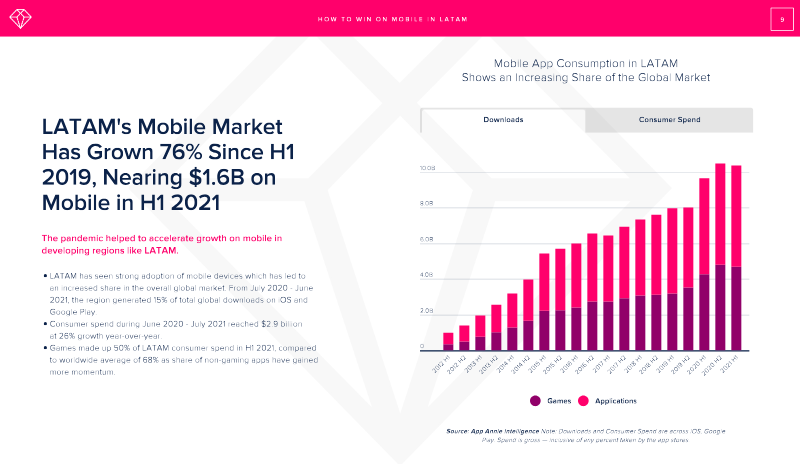

App Annie · 2021
ReportHow to Win on Mobile in LATAM: 2021
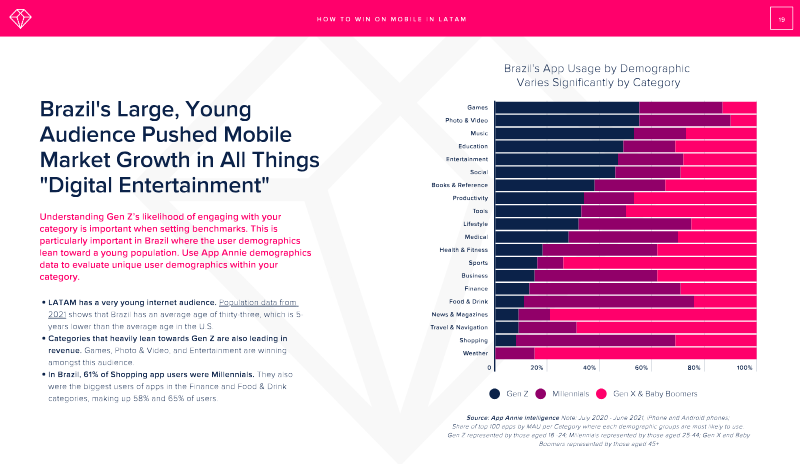
The analysis focuses on Latin America’s mobile ecosystem from July 2020 to June 2021, revealing a region that has accelerated digital adoption and monetization amid the pandemic. Mobile downloads surged 76% year-on-year, reaching roughly 21 billion across iOS and Google Play, while consumer spend climbed 26% to $2.9 billion. Android dominates downloads (≈89%) yet iOS retains a higher spend share, commanding 56% of total consumer expenditure. Brazil and Mexico together generate 73% of regional downloads, with Brazil’s per-capita income lower than Uruguay’s but still driving significant spend growth. Gaming remains a key driver, accounting for 50% of LATAM consumer spend—below the global average of 68%. Brazil leads in both downloads (4.6 billion) and revenue ($557 million), with Chile showing a strong spend-to-download ratio. Non-gaming verticals such as Finance, Shopping, and Entertainment also expanded; finance apps grew 36% YoY in Brazil, while shopping app downloads rose 30%. Entertainment became the largest spend category in four of six major markets, reflecting limited Smart TV penetration and a shift to mobile streaming. User engagement metrics underscore high daily time spent, with Brazil averaging 5.4 hours per user and Mexico 4.8 hours—up 32% and 36% respectively from two years prior. Social, tools, and business categories saw the largest increases in sessions and minutes, indicating opportunities for productivity and contactless payment solutions. Demographic analysis shows a youthful audience: 61% of shopping app users in Brazil are Millennials, and Gen Z dominates photo-video and entertainment segments. Overall, the report highlights LATAM as a high-growth mobile market with distinct platform dynamics, strong gaming and finance opportunities, and an emerging preference for mobile-first entertainment and productivity apps.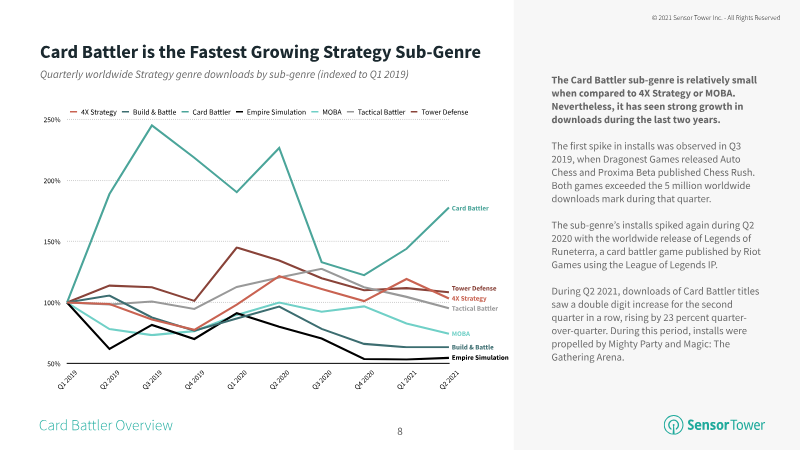
Sensor Tower · 2021
ReportThe State of Card Battler Mobile Games
The report examines the mobile card-battler sub-genre, focusing on global market dynamics and U.S. performance during the first half of 2021. It identifies card-battlers as a fast-growing segment within the broader mid-core strategy category, accounting for 34% of strategy revenue and 6% of overall downloads worldwide. Quarterly data show a 17% rise in card-battler revenue during Q1 2021, with monthly spending surpassing $55 million and peaking at $70 million in January. Key titles such as Yu-Gi-Oh! Duel Links, Hearthstone, and Magic: The Gathering Arena dominate revenue, with Yu-Gi-Oh! generating $110 million and Hearthstone over $40 million in H1 2021. Six of the top ten titles derive most revenue from Asian markets, yet U.S. share grew to 27% of player spending—an increase of six percentage points from H1 2020. The analysis highlights that card-battlers attract both legacy franchises and new entrants; Mighty Party, Teamfight Tactics, and Legends of Runeterra achieved high download volumes despite lower retention. Revenue per download (RPD) in the U.S. averages $31 USD for strategy games, with card-battlers at $19 USD—double the global average—indicating strong monetization potential. RPD growth for card-battlers reached 175% in H1 2021, the fastest among strategy sub-genres. Methodologically, the study relies on Sensor Tower’s Game Taxonomy, Store Intelligence, and Ad Intelligence data, estimating downloads per user and gross revenue (excluding platform cuts). Geographic coverage spans Japan, China, the U.S., and other markets; the time frame covers Q1 2019 to H1 2021. The report concludes that card-battlers represent a lucrative niche for both established IPs and innovative titles, with expanding U.S. market share and robust monetization metrics.
Sensor Tower · 2021
Report