Square Enix
Game Co.36 documents
Japanese publisher/developer. Final Fantasy, Dragon Quest, Kingdom Hearts. HD Games + MMO + mobile segments.
Documents

Report74 pages
2016 Annual Report
To spread happiness across the globe by providing unforgettable experiences To spread happiness across the globe by providing unforgettable experiences This philosophy represents our company’s mission and the beliefs for which we stand. The Square Enix Group provides high-quality content, services, and products to help those customers create their own Each of our customers has his or her own definition of happiness.
- Net sales for the fiscal year ended March 31, 2016, exceeded ¥200 billion for the first time, reaching ¥214,101 million, a 27.5% increase from the prior fiscal year, and operating income increased by 58.4% to ¥26,018 million.
- The MMO domain, specifically "DRAGON QUEST X" and "FINAL FANTASY XIV," generated stable earnings, with new content and expansion packs released in the fiscal year ended March 2016 successfully retaining and attracting players.
- The Amusement Business Segment saw brisk performance with year-on-year existing revenue topping 100%, driven by strong demand from foreign tourists, especially from Asia, and the successful rollout of an e-money system.
- The company plans to expand localization efforts beyond EFIGS (English, French, Italian, German, Spanish) to include Chinese (simplified), Arabic, and Portuguese to access growing consumer markets in China, the Middle East, and Latin America.
- Capital expenditures decreased by ¥176 million to ¥5,872 million in the fiscal year ended March 31, 2016, primarily due to the relocation of subsidiaries' offices.
+1
Square Enix
Report2 pages
Dragon Quest: Reimagined
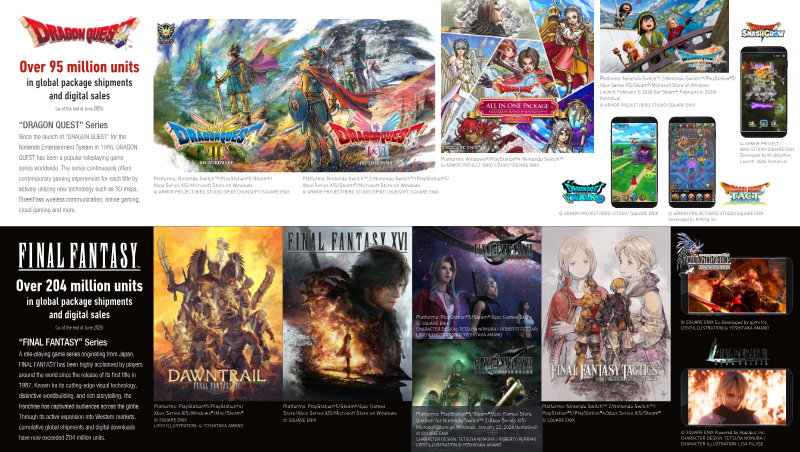
The document presents a comprehensive overview of several flagship role‑playing franchises, focusing on recent releases and cumulative sales achievements. It highlights the launch of “Dragon Quest: Reimagined” on February 5, 2026, available in a bundled package across Nintendo Switch 2, PlayStation 5, Xbox Series X|S, Steam, and Microsoft Store. The title is positioned as a high‑definition 2D remake developed by KLabGames, with a projected global shipment of over 95 million units as of June 2025. The text also references the broader “Dragon Quest” series, noting its continuous evolution since 1986 and its adoption of modern technologies such as 3D mapping, cloud gaming, and cross‑platform connectivity.
The “Final Fantasy” section cites cumulative sales of 204 million units for the series, emphasizing its long‑standing appeal since 1987 and its expansion into Western markets. Platforms listed include PlayStation 5, Steam, Epic Games Store, and Nintendo Switch 2, with a focus on the franchise’s visual innovation and narrative depth. The document underscores the series’ global reach, with sales data aggregated across multiple regions.
Additionally, the “Kingdom Hearts” entry reports 38 million units shipped worldwide by June 2025, noting its collaborative origin with Disney and Square Enix. The overview includes platform details for the original PlayStation 2 release and mentions forthcoming titles slated for various consoles. Overall, the document serves as a market snapshot of key RPG franchises, detailing launch dates, platform coverage, sales milestones, and development partnerships across the industry.
- The Final Fantasy series has reached 204 million units in cumulative global sales since its 1987 debut.
- Dragon Quest: Reimagined, a high-definition 2D remake developed by KLabGames, launched on February 5, 2026, for Nintendo Switch 2, PlayStation 5, Xbox Series X|S, Steam, and Microsoft Store.
- The Dragon Quest franchise reported a projected global shipment of over 95 million units as of June 2025.
- The Kingdom Hearts franchise, a collaboration between Disney and Square Enix, has shipped 38 million units worldwide as of June 2025.
- Major RPG franchises are increasingly utilizing modern technologies including 3D mapping, cloud gaming, and cross-platform connectivity to maintain market relevance.
+2
Square Enix

Report39 pages
2025 Annual Report
Purpose C O N T E N T S Creating New Worlds With Boundless Imagination 03 Financial Highlights Creating New Worlds With Boundless Imagination 03 Financial Highlights 04 A Message to Our Stakeholders to Enhance People’s Lives.
- In the fiscal year ended March 2025, Square Enix Holdings recorded net sales of ¥324.5 billion (a decline from the previous fiscal year) but an increase in profit, with operating income at ¥40.5 billion, ordinary income at ¥40.9 billion, and profit attributable to owners of parent at ¥24.4 billion.
- The Game sub-segment saw increased net sales and profit due to the release of "FINAL FANTASY XIV: Dawntrail" and "The Apothecary Diaries" series, despite a decline in the Games for Smart Devices/PC Browsers sub-segment due to weak existing titles and the absence of prior year royalty income.
- The Merchandising segment reported net sales of ¥19.0 billion (up 0.8% from the prior fiscal year) and operating income of ¥6.0 billion (up 7.2%), driven by strong sales of new character merchandise related to popular Group IP.
- Square Enix Holdings is collaborating with the Matsuo Lab at the University of Tokyo’s School of Engineering on a sponsored course focused on simulations and deep learning, and with the Graduate School of Film and New Media at Tokyo University of the Arts on a joint research project.
- The company has an alliance with gumi Inc. for the development and distribution of mobile online and blockchain games, and another alliance to study establishing a dedicated platform for blockchain games.
+1
Square Enix

Financial18 pages
Annual Report 2025: Environment, Social and Governance
Square Enix has formalized a comprehensive sustainability and governance framework aimed at aligning long-term corporate value with environmental responsibility and human capital development. Central to this strategy is a commitment to achieve net-zero CO2 emissions at Japanese offices and data centers by 2030. This transition is already evidenced by a significant reduction in electricity-related emissions, which fell from 34,320 tCO2 in 2017 to 20,635 tCO2 by 2025. By shifting toward digital sales and renewable energy, the Group seeks to mitigate climate-related risks while modernizing its operational footprint.
The organizational focus on human capital emphasizes creativity and employee well-being through specialized training in emerging technologies like AI and blockchain, alongside "Game Dev Boot Camps." Support systems have been expanded to include flexible work-from-home options, daycare concierge services, and gamified wellness initiatives designed to incentivize healthy lifestyles. These efforts are intended to foster a high-performance culture capable of navigating the evolving digital entertainment landscape.
Governance is characterized by a clear separation between management oversight and operational execution. The Board of Directors is predominantly composed of independent outside directors who maintained near-perfect attendance throughout the fiscal year ending March 31, 2025. Executive remuneration is strictly tied to performance metrics, including consolidated net sales and operating income, with a significant portion of compensation delivered via restricted stock to align leadership interests with those of shareholders. Furthermore, strategic shareholdings in partners like gumi Inc. underscore a commitment to expanding influence within blockchain, cloud gaming, and the metaverse.
- Square Enix has committed to achieving net-zero CO2 emissions at its Japanese offices and data centers by 2030.
- The company reduced its electricity-related emissions from 34,320 tCO2 in 2017 to 20,635 tCO2 by 2025.
- Executive compensation is tied to performance metrics, including consolidated net sales and operating income, with a significant portion paid in restricted stock to align with shareholder interests.
- The Board of Directors is composed primarily of independent outside directors, who maintained near-perfect attendance for the fiscal year ending March 31, 2025.
- Human capital development includes specialized training in AI and blockchain, alongside expanded employee support systems like daycare concierge services and flexible work-from-home options.
Square EnixMar 2026
Financial2 pages
Executive Members As of July 31, 2025
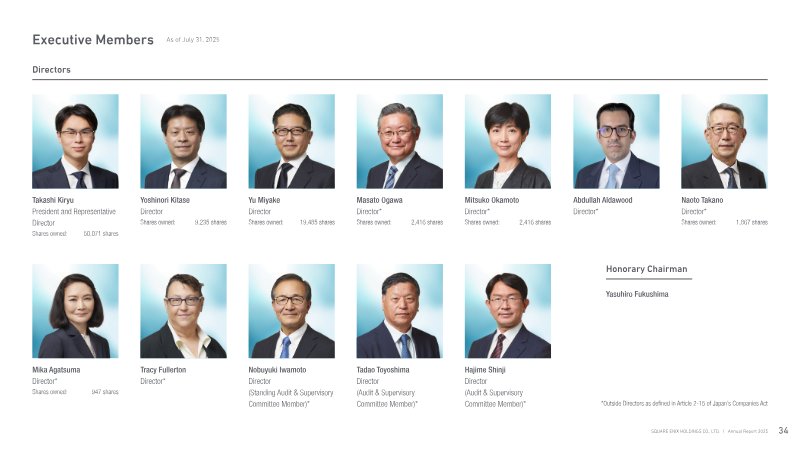
The leadership structure of Square Enix Holdings as of July 31, 2025, reflects a strategic emphasis on balancing creative expertise with global corporate governance. Under the leadership of President and Representative Director Takashi Kiryu, the board comprises twelve directors, a significant majority of whom are classified as outside directors under Japan’s Companies Act. This composition indicates a commitment to independent oversight, particularly within the Audit and Supervisory Committee. Share ownership among the executive team varies significantly, with President Kiryu holding the largest stake at 50,071 shares, followed by Yoshinori Kitase with 19,485 shares, while outside directors maintain comparatively nominal holdings.
The organizational framework is further defined by a comprehensive skills matrix designed to ensure diverse institutional knowledge across six core competencies: corporate and global management, media entertainment, IT and technology, legal and risk management, finance and accounting, and organizational development. While internal directors like Kiryu, Kitase, and Yu Miyake provide the foundational expertise in media entertainment and technology, the outside directors bolster the board’s capabilities in specialized areas such as legal compliance and financial auditing. Notably, Abdullah Aldawood and Tracy Fullerton bring multi-disciplinary strengths in global management and technology, aligning with the company's international growth objectives.
This governance model serves to integrate creative production experience with rigorous fiscal and legal standards. By maintaining a high ratio of outside directors and documenting specific skill sets, the leadership structure aims to mitigate risk while fostering innovation within the global entertainment market. The inclusion of an Honorary Chairman, Yasuhiro Fukushima, further suggests a continuity of institutional values alongside the modernized oversight provided by the Audit and Supervisory Committee members. This strategic alignment of personnel is positioned to support the company’s operational stability and long-term strategic planning through the 2025 fiscal period.
- As of July 31, 2025, the Square Enix Holdings board consists of twelve directors, with a significant majority classified as outside directors to ensure independent oversight.
- President and Representative Director Takashi Kiryu holds the largest executive stake with 50,071 shares, while Yoshinori Kitase holds 19,485 shares.
- The board utilizes a skills matrix covering six core competencies: corporate and global management, media entertainment, IT and technology, legal and risk management, finance and accounting, and organizational development.
- The governance structure integrates internal creative expertise from directors like Kiryu, Kitase, and Yu Miyake with specialized outside oversight in legal compliance and financial auditing.
- International growth objectives are supported by the inclusion of directors such as Abdullah Aldawood and Tracy Fullerton, who provide expertise in global management and technology.
+2
Square EnixFeb 2026

Financial6 pages
Review of Operations: Square Enix Holdings Co., Ltd. Annual Report 2025
The Square Enix Group’s operational review for the fiscal year ended March 31, 2025, reveals a period of strategic transition characterized by improved profitability despite a decline in overall revenue. Net sales fell 8.9% year-on-year to ¥324,506 million, yet operating income rose significantly by 24.6% to ¥40,580 million. This divergence was driven largely by cost-optimization efforts and the performance of key intellectual properties across the Digital Entertainment, Amusement, Publication, and Merchandising segments.
The Digital Entertainment segment, which accounts for 63.6% of net sales, saw revenue drop 16.8% due to a lighter release schedule compared to the previous year’s major launches. However, the segment’s operating income grew by 33.0%. This profitability was bolstered by the success of the Dragon Quest III HD-2D Remake and the Final Fantasy XIV: Dawntrail expansion, alongside reduced development cost amortization and lower advertising expenses. Conversely, the smart device sub-segment faced challenges as existing titles weakened and royalty revenues normalized.
Other business units showed mixed but generally stable results. The Amusement segment experienced growth in both sales and profits, rising 15.7% and 3.7% respectively, fueled by strong same-store sales and arcade machine distribution. The Publication segment saw a slight decline in performance, attributed to a high baseline set by the previous year’s hit adaptation of The Apothecary Diaries. Finally, the Merchandising segment remained a steady contributor, with a 7.2% increase in operating income supported by new character-based products. Overall, the Group’s results reflect a focus on enhancing margins and leveraging core IP through diverse entertainment formats.
- Square Enix achieved a 24.6% increase in operating income to ¥40,580 million for the fiscal year ending March 31, 2025, despite an 8.9% decline in net sales to ¥324,506 million.
- The Digital Entertainment segment, representing 63.6% of total sales, grew operating income by 33.0% through cost-optimization, reduced advertising, and lower development amortization, even as segment revenue fell 16.8%.
- Key intellectual property performance, specifically the 'Dragon Quest III HD-2D Remake' and 'Final Fantasy XIV: Dawntrail' expansion, served as the primary drivers for the company's improved profitability.
- The Amusement segment recorded a 15.7% increase in sales and a 3.7% rise in operating income, bolstered by strong arcade machine distribution and same-store performance.
- The smart device sub-segment underperformed due to the weakening of existing titles and the normalization of royalty revenues.
+1
Square EnixFeb 2026

Financial42 pages
Annual Report 2025 Financial Section
The fiscal year ending March 31, 2025, marked a strategic pivot toward profitability and structural reform, characterized by a recovery in earnings despite a contraction in top-line revenue. Net sales decreased 8.9% to ¥324.5 billion, yet operating income rose 24.6% to ¥40.6 billion. This improvement in margins was driven primarily by a significant reduction in extraordinary losses and content disposal costs compared to the previous year. Profit attributable to owners rose to ¥24.4 billion, resulting in a substantial increase in earnings per share to ¥203.38.
Central to this financial performance is a three-year "reboot" plan designed to optimize development footprints and diversify earnings across the Digital Entertainment, Amusement, Publication, and Merchandising segments. A rigorous strategic review led to the termination of several high-definition game projects deemed incompatible with a new focus on multiplatform development. While this resulted in specific losses on the disposal of content, it contributed to a leaner balance sheet, with the content production account decreasing to ¥46.9 billion and inventory valuation losses nearly halving to ¥7.5 billion.
The Group maintains a robust liquidity position with ¥243.6 billion in cash and equivalents, supported by conservative risk management and a reduction in interest-bearing liabilities to ¥1.5 billion. This financial stability has enabled increased shareholder returns, including a significant dividend hike and a three-for-one stock split scheduled for late 2025 to enhance market liquidity. Despite navigating foreign exchange volatility and rising statutory tax rates, the transition toward a multiplatform internal development model aims to stabilize long-term growth and mitigate the risks associated with high-budget software production.
- Operating income rose 24.6% to ¥40.6 billion for the fiscal year ending March 31, 2025, despite an 8.9% decline in net sales to ¥324.5 billion.
- The company is executing a three-year 'reboot' plan that prioritizes multiplatform development and includes the termination of high-definition game projects deemed incompatible with the new strategy.
- Profit attributable to owners reached ¥24.4 billion, driving earnings per share up to ¥203.38.
- Balance sheet efficiency improved as the content production account decreased to ¥46.9 billion and inventory valuation losses were nearly halved to ¥7.5 billion.
- The group maintains a strong liquidity position with ¥243.6 billion in cash and equivalents while reducing interest-bearing liabilities to ¥1.5 billion.
Square EnixFeb 2026
Report2 pages
Square Enix Special Feature: Erdrick Trilogy Reimagined
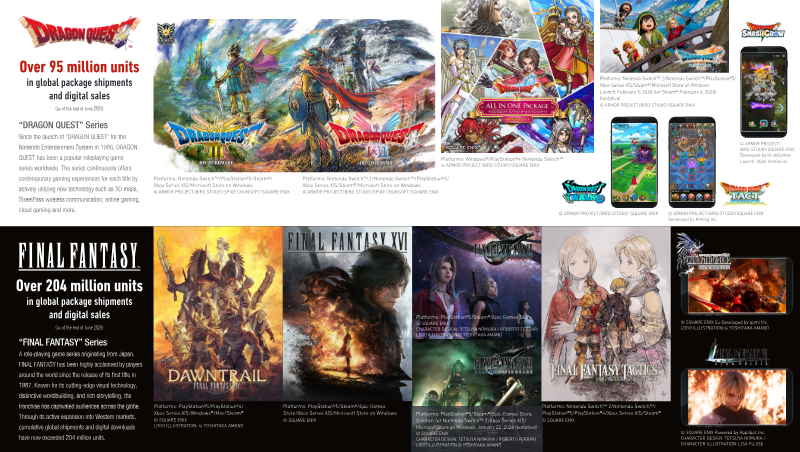
The Dragon Quest franchise continues to expand its global footprint, reaching over 95 million units in total shipments and digital sales as of June 2025. A central focus of the current release strategy is the reimagining of the foundational Erdrick Trilogy through HD-2D remakes. Dragon Quest I & II HD-2D Remake is scheduled for a February 5, 2026, launch on a wide array of platforms, including the Nintendo Switch 2, PlayStation 5, Xbox Series X|S, and PC via Steam and the Microsoft Store. This multi-platform approach reflects a broader commitment to utilizing contemporary technology to modernize classic role-playing experiences for a global audience.
Beyond the core Dragon Quest series, the broader portfolio demonstrates significant market penetration across several flagship intellectual properties. The Final Fantasy franchise has surpassed 204 million units globally as of mid-2025, supported by the ongoing expansion of Final Fantasy XIV: Dawntrail and the continued rollout of Final Fantasy VII Rebirth across various ecosystems. Additionally, the Kingdom Hearts series, a collaborative effort with Disney, has achieved over 38 million units in sales, with new entries currently in development for unspecified launch windows.
The strategic roadmap emphasizes cross-platform accessibility and the revitalization of legacy content. By targeting next-generation hardware like the Nintendo Switch 2 alongside established consoles and PC storefronts, there is a clear intent to maximize reach across diverse geographic markets. This strategy is complemented by a robust pipeline of mobile and niche titles, including Dragon Quest Tact and various entries in the Bravely Default and Octopath Traveler series, ensuring a steady cadence of content across the role-playing game segment through 2026.
- The Dragon Quest I & II HD-2D Remake is scheduled for release on February 5, 2026, across Nintendo Switch 2, PlayStation 5, Xbox Series X|S, and PC.
- The Dragon Quest franchise has reached 95 million units in total shipments and digital sales as of June 2025.
- The Final Fantasy franchise has surpassed 204 million units globally as of mid-2025, driven by Final Fantasy XIV: Dawntrail and Final Fantasy VII Rebirth.
- Square Enix is prioritizing a cross-platform strategy that targets next-generation hardware alongside established consoles and PC storefronts to maximize global market reach.
- The Kingdom Hearts series has achieved over 38 million units in sales, with new entries currently in development.
+3
Square EnixSept 2025

Financial1 pages
Square Enix Annual Report (Fragment)
The Square Enix Group operates under a central mission to leverage boundless imagination to create new content that resonates with global audiences and enriches daily lives. This strategic framework emphasizes the delivery of unforgettable experiences through a commitment to innovation, swift action, and collaborative evolution. By focusing on the transformation of creative energy into immersive worlds, the organization aims to maintain its position as a premier provider of entertainment while upholding core values of integrity and continuous improvement.
Operational reviews and financial highlights indicate a multifaceted approach to the entertainment industry, spanning digital entertainment, amusement, and publication segments. The organizational structure is designed to support long-term stakeholder value by integrating environmental, social, and governance (ESG) principles into the core business model. This commitment to sustainability and corporate responsibility is presented as a fundamental component of the group’s identity, ensuring that creative pursuits are balanced with ethical operations and transparent governance.
The scope of these activities is global, reflecting a history of expansion and a diverse portfolio of intellectual properties. Executive leadership focuses on navigating the evolving landscape of the gaming and media sectors by embracing challenges and fostering a culture of excellence. Through a combination of historical expertise and a forward-looking strategy, the group seeks to sustain its competitive edge and drive growth across all primary business units, ensuring that its creative output remains a significant force in the international market.
- Square Enix operates a diversified business model spanning three primary segments: digital entertainment, amusement, and publication.
- The company maintains a global operational scope, leveraging a portfolio of established intellectual properties to compete in international markets.
- Corporate strategy is centered on integrating environmental, social, and governance (ESG) principles directly into the core business model to drive long-term stakeholder value.
- Executive leadership is prioritizing a culture of innovation and operational agility to navigate the evolving gaming and media sectors.
- The organization aims to sustain competitive growth by balancing historical expertise with a forward-looking approach to content creation.
+1
Square EnixSept 2025
Financial1 pages
Corporate Data: As of August 31, 2025
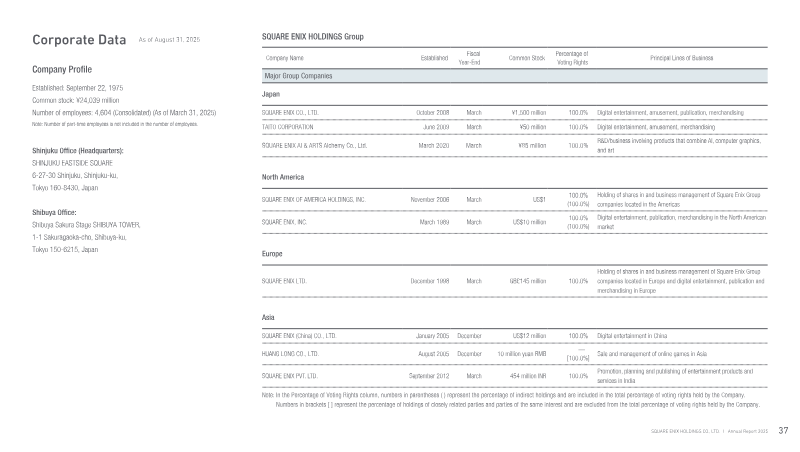
The Square Enix Holdings Group maintains a robust global infrastructure centered on digital entertainment, amusement, publication, and merchandising. As of August 31, 2025, the organization operates with a consolidated workforce of 4,604 employees and a common stock valuation of 24,039 million yen. The corporate structure is defined by a series of wholly owned subsidiaries that manage regional operations across Japan, North America, Europe, and Asia, ensuring a localized approach to publishing and service management.
The Japanese core consists of Square Enix Co., Ltd. and Taito Corporation, which handle the primary development and amusement sectors, alongside specialized entities like Square Enix AI & Arts Alchemy. This latter subsidiary focuses on research and development at the intersection of artificial intelligence and computer graphics. International operations are segmented by geography, with Square Enix of America Holdings and Square Enix Ltd. overseeing the North American and European markets, respectively. These entities manage the distribution of digital content and physical merchandise while providing business management for their respective territories.
Expansion into Asian markets is facilitated through dedicated branches in China and India. Square Enix (China) Co., Ltd. and Huang Long Co., Ltd. manage digital entertainment and online game sales within the Chinese market, while Square Enix Pvt. Ltd. focuses on the promotion and publishing of entertainment services in India. This organizational framework demonstrates a strategic commitment to global diversification, utilizing a network of 100% voting right subsidiaries to maintain strict brand control while scaling operations across diverse regulatory and consumer landscapes.
- As of August 31, 2025, Square Enix Holdings Group maintains a consolidated workforce of 4,604 employees and a common stock valuation of 24,039 million yen.
- The organization operates through a network of wholly owned subsidiaries to ensure strict brand control while managing regional publishing and service operations.
- Core development and amusement operations are centralized in Japan under Square Enix Co., Ltd. and Taito Corporation, supported by the specialized AI and computer graphics research entity, Square Enix AI & Arts Alchemy.
- International market distribution and business management are divided into regional hubs, with Square Enix of America Holdings overseeing North America and Square Enix Ltd. managing Europe.
- The company is actively expanding its footprint in Asia through dedicated entities, including Square Enix (China) Co., Ltd. and Huang Long Co., Ltd. for the Chinese market, and Square Enix Pvt. Ltd. for India.
+2
Square EnixAug 2025
Financial1 pages
Investor Information: As of March 31, 2025
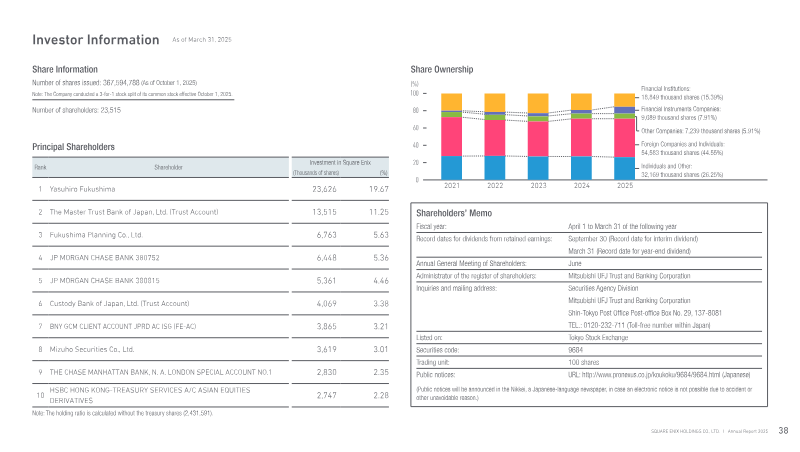
Square Enix Holdings maintains a diverse global ownership structure as of the conclusion of the 2025 fiscal year. Foreign companies and individuals represent the largest shareholder segment, controlling 44.55% of the company’s equity. This is followed by individual investors and other minor holders at 26.25%, while financial institutions and instruments companies collectively account for approximately 23% of the shares. The remaining 5.91% is held by other domestic corporations. A significant corporate action occurred on October 1, 2025, when the company executed a three-for-one stock split, resulting in a total of 367,594,788 issued shares.
The distribution of principal shareholders reveals a mix of individual founders, trust banks, and international financial entities. Yasuhiro Fukushima remains the largest single shareholder with a 19.67% stake, followed by The Master Trust Bank of Japan at 11.25%. Other major positions are held by Fukushima Planning Co., Ltd. and various accounts managed by JP Morgan Chase Bank and the Custody Bank of Japan. These figures exclude treasury shares, which totaled approximately 2.43 million at the time of reporting.
Operational governance is centered on a fiscal year running from April to March, with the annual general meeting of shareholders held each June. Dividend record dates are established at the end of September and March to facilitate interim and year-end payouts. Listed on the Tokyo Stock Exchange under securities code 9684, the company utilizes Mitsubishi UFJ Trust and Banking Corporation as its shareholder register administrator. This data reflects the company's capitalization and governance framework within the Japanese gaming and entertainment industry for the 2025 reporting period.
- Foreign entities hold the largest share of Square Enix equity at 44.55%, followed by individual investors at 26.25% and financial institutions at 23%.
- Yasuhiro Fukushima is the company's largest individual shareholder with a 19.67% stake, while The Master Trust Bank of Japan holds 11.25%.
- Square Enix executed a three-for-one stock split on October 1, 2025, bringing the total number of issued shares to 367,594,788.
- The company maintains 2.43 million treasury shares, which are excluded from the reported principal shareholder distribution figures.
- Square Enix is publicly traded on the Tokyo Stock Exchange under the securities code 9684.
Square EnixMar 2025
Financial1 pages
Financial Highlights: Fiscal Years Ended March 31, 2024
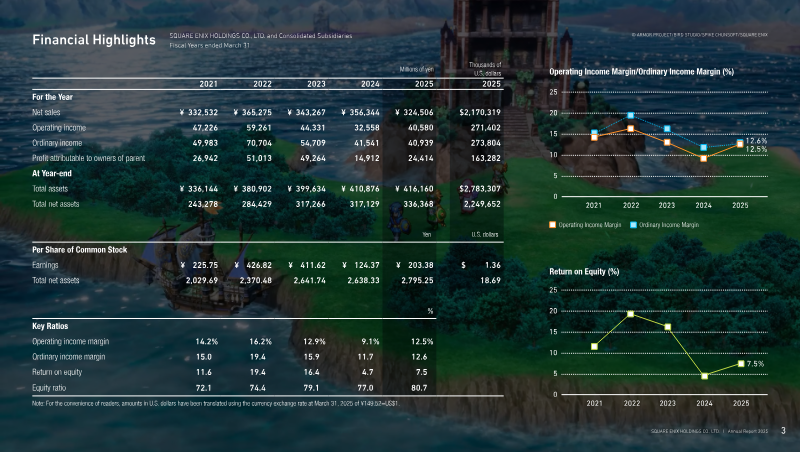
Square Enix Holdings Co., Ltd. experienced a period of fluctuating financial performance between the fiscal years ending March 2021 and March 2024, with projections extending into 2025. While net sales reached a peak of ¥365,275 million in 2022, they remained relatively stable through 2024 at ¥356,344 million. However, profitability metrics showed a notable decline during the 2024 fiscal year. Operating income dropped to ¥32,558 million, down from a high of ¥59,261 million in 2022, resulting in an operating income margin of 9.1%, the lowest in the five-year period analyzed.
The most significant contraction occurred in profit attributable to owners of the parent, which fell sharply from ¥49,264 million in 2023 to ¥14,912 million in 2024. This decline is reflected in the earnings per share, which plummeted from ¥411.62 to ¥124.37 year-over-year. Consequently, the return on equity saw a substantial reduction, falling to 4.7% in 2024 after maintaining double-digit percentages in the preceding three years. Despite these pressures on earnings, the consolidated balance sheet remained robust, with total assets growing to ¥410,876 million and the equity ratio maintaining a strong position at 77.0%.
Looking forward to the 2025 fiscal year, projections suggest a strategic recovery in profitability despite an anticipated decrease in net sales to ¥324,506 million. Operating income is expected to rebound to ¥40,580 million, improving the operating margin to 12.5%. This forecast indicates a focus on operational efficiency and margin recovery. The data, presented in both Japanese yen and U.S. dollars, covers the global operations of the parent company and its consolidated subsidiaries, providing a comprehensive view of the firm’s financial health and its trajectory toward improved capital efficiency and shareholder returns.
- Profit attributable to owners of the parent fell sharply from ¥49,264 million in 2023 to ¥14,912 million in 2024, causing earnings per share to drop from ¥411.62 to ¥124.37.
- Operating income declined to ¥32,558 million in 2024, resulting in a 9.1% operating margin, the lowest level recorded in the five-year period analyzed.
- Return on equity (ROE) fell to 4.7% in 2024, breaking a three-year streak of double-digit performance.
- Despite earnings volatility, Square Enix maintained a strong balance sheet with total assets of ¥410,876 million and an equity ratio of 77.0%.
- Net sales remained relatively stable at ¥356,344 million in 2024, down only slightly from the 2022 peak of ¥365,275 million.
Square EnixSept 2024