PCF Group
Game Co.591 documents
Documents
Legal1 pages
Raport Roczny PCF Group S.A. za 2020 r.
The 2020 annual financial disclosure for PCF Group S.A. outlines the company’s fiscal performance and operational status for the period ending December 31, 2020. As the parent entity of the People Can Fly studio, the group operates within the global AAA game development sector, focusing on high-budget action titles. The primary objective of this reporting is to provide a transparent overview of the company’s financial health, corporate governance, and strategic development following its transition to a public entity on the Warsaw Stock Exchange.
Financial data presented in the disclosure adheres to International Financial Reporting Standards as adopted by the European Union. The figures reflect a pivotal year for the group, characterized by the final development stages of the title Outriders and the expansion of its international studio network. The reporting confirms that the financial statements provide a fair and clear view of the assets, liabilities, and overall financial results of both the individual company and the larger capital group.
The scope of the analysis covers the group’s diversified geographic presence, including its primary operations in Poland and its subsidiary studios in North America and Europe. Beyond financial metrics, the disclosure emphasizes the implementation of rigorous corporate governance policies and the maintenance of auditor independence. It concludes that the group’s management has successfully navigated the risks inherent in large-scale game production while maintaining the necessary internal controls to support continued growth in the competitive global gaming market.
- PCF Group S.A. transitioned to a public entity on the Warsaw Stock Exchange during the 2020 fiscal year.
- The company’s 2020 operations were primarily defined by the final development stages of its high-budget AAA title, Outriders.
- Financial reporting for the period ending December 31, 2020, was prepared in accordance with International Financial Reporting Standards as adopted by the European Union.
- The group expanded its international footprint in 2020 by operating subsidiary studios across North America and Europe in addition to its primary base in Poland.
- Management implemented rigorous corporate governance policies and internal controls to mitigate risks associated with large-scale AAA game production.
+2
PCF GroupApr 2021

Financial80 pages
PCF Group Annual Financial Report for the Fiscal Year Ended 31 December 2020
PCF Group S.A., a prominent video game developer headquartered in Warsaw, experienced a year of transformative growth and financial strengthening during the 2020 fiscal year. The period was defined by a successful debut on the Warsaw Stock Exchange, a strategic corporate merger with its subsidiary People Can Fly Sp. z o.o., and a substantial increase in production scale. Total assets grew by approximately 80% to 91.2 million PLN, while net profit rose more than twelvefold to 29.1 million PLN. This performance was underpinned by a 75.8% increase in sales revenue, totaling 83.5 million PLN, driven primarily by the "game production for hire" segment.
The financial results highlight a high degree of revenue concentration, with over 80% of income derived from a major partnership with Square Enix for titles such as Outriders and Project Gemini. Revenue recognition followed IFRS 15 standards, incorporating work-for-hire milestones, intellectual property royalties, and intercompany services. Despite the global COVID-19 pandemic, operations remained resilient as the company transitioned to remote work and utilized Polish government financial shields. The company’s fiscal position was further optimized by the application of a 5% preferential IP Box tax rate, supported by formal tax interpretations.
Operational expansion was a key theme throughout 2020 and early 2021, characterized by the growth of the workforce to 236 personnel and the strengthening of international subsidiaries in the UK, Canada, and the US. Significant post-balance sheet events included a Series B share issuance that raised 100.3 million PLN and the acquisition of a development team in Chicago. With a liquidity surplus of 29.4 million PLN and a new dividend policy recommending a 10% to 20% payout of net profit, the company concluded the year with a robust balance sheet and a clear trajectory for continued global scaling.
- PCF Group achieved significant financial growth in 2020, with net profit increasing over twelvefold to 29.1 million PLN and total assets rising by 80% to 91.2 million PLN.
- Sales revenue grew by 75.8% to 83.5 million PLN, heavily reliant on a work-for-hire partnership with Square Enix for titles including Outriders and Project Gemini, which accounted for over 80% of total income.
- The company successfully executed an IPO on the Warsaw Stock Exchange and a subsequent Series B share issuance that raised 100.3 million PLN to fund international expansion.
- Operational scale increased significantly, with the workforce growing to 236 personnel and the company establishing or strengthening subsidiaries in the UK, Canada, and the US, including a Chicago-based development team acquisition.
- Fiscal efficiency was bolstered by the application of a 5% preferential IP Box tax rate and the utilization of government financial support during the COVID-19 pandemic.
+1
PCF GroupApr 2021
Legal2 pages
Raport bieżący nr 11/2021
PCF Group S.A. issued this regulatory report to disclose the acquisition of the Phosphor Games development team and the associated financial arrangements used to facilitate the transaction. Originally classified as delayed inside information under European Union Market Abuse Regulations, the details were made public on April 23, 2021, following the formal conclusion of the acquisition process. The transaction marks a strategic expansion for the Warsaw-based parent company into the United States market, specifically targeting the Chicago-based development talent of Phosphor Studios and Phosphor Games.
The acquisition was executed through a newly established subsidiary, People Can Fly U.S., LLC. To fund this expansion and the operational integration of the Phosphor team, PCF Group S.A. provided a $5,000,000 loan to its American subsidiary. This ten-year intercompany loan carries an interest rate of LIBOR plus two percentage points and is secured by the assets of the U.S. entity, including its intellectual property rights. Prior to the acquisition, the two entities maintained a professional relationship through a work-for-hire agreement where Phosphor Games served as a subcontractor for People Can Fly projects.
The decision to delay the public announcement from the initial signing of the letter of intent on March 31, 2021, was a tactical measure to protect the negotiation process. Management concluded that premature disclosure could invite third-party interference, worsen transaction terms, or lead to public misinformation regarding the deal's certainty. By waiting until the acquisition was finalized, the company ensured market stability and the successful execution of its long-term growth strategy within the global gaming industry.
- PCF Group S.A. acquired the Chicago-based Phosphor Games development team to facilitate its strategic expansion into the United States market.
- The acquisition was executed through a newly formed subsidiary, People Can Fly U.S., LLC, which was finalized on April 23, 2021.
- PCF Group S.A. provided a $5,000,000 intercompany loan to its U.S. subsidiary to fund the acquisition and operational integration.
- The ten-year loan carries an interest rate of LIBOR plus two percentage points and is secured by the U.S. entity's assets, including its intellectual property.
- Prior to the acquisition, Phosphor Games operated as a subcontractor for People Can Fly projects under a work-for-hire agreement.
+2
PCF GroupApr 2021
Legal1 pages
Current Report No. 13/2021: Acquisition of Phosphor Games Development Team
PCF Group S.A. expanded its international development capabilities through the strategic acquisition of the Phosphor Games development team in Chicago, Illinois. Executed via the subsidiary People Can Fly Chicago, LLC, the transaction involved the transition of eighteen developers, including the three original founders of the studio. This move establishes a permanent presence for the group in the Chicago market, with the new studio officially commencing operations under the People Can Fly brand on May 1, 2021.
The acquisition process utilized a structured legal framework to ensure a seamless transition of talent and assets. Each developer entered into separation agreements with the former entity while simultaneously signing confidentiality, non-solicitation, and non-compete agreements with the new employer. Employment offers were standardized to align with the parent company’s global compensation and bonus structures. Furthermore, the founders provided indemnification to protect the acquiring entity from potential third-party claims, tax liabilities, or employment obligations stemming from the previous operations of Phosphor Games.
Beyond the human capital, the agreement included the transfer of the existing office lease in Chicago to serve as the headquarters for the new studio. Financial backing for the expansion was secured through an internal loan provided by the parent company to its United States holding entity. This acquisition represents a targeted effort to bolster the group’s creative workforce in North America, integrating an established team of industry veterans into its global production pipeline.
- PCF Group S.A. acquired the Phosphor Games development team in Chicago, Illinois, to establish a permanent North American production presence.
- The transaction, executed via subsidiary People Can Fly Chicago, LLC, resulted in the transition of 18 developers, including the three original founders of Phosphor Games.
- The new studio officially commenced operations under the People Can Fly brand on May 1, 2021.
- The acquisition included the transfer of the existing Chicago office lease to serve as the new studio's headquarters.
- Employment terms for the transitioning staff were standardized to align with the parent company's global compensation and bonus structures.
+1
PCF GroupApr 2021
Legal2 pages
Current Report No. 12/2021
PCF Group S.A. issued a formal regulatory disclosure regarding the establishment of a new subsidiary, People Can Fly Chicago, LLC, as part of its broader corporate growth strategy. The primary purpose of this disclosure is to reveal previously delayed inside information concerning the expansion of the company’s development capabilities in the United States. This action follows the successful acquisition of the development team from Phosphor Games, LLC, which served as the catalyst for making the information public on April 23, 2021.
The expansion originated on March 31, 2021, with a letter of intent signed between PCF Group and Chicago-based Phosphor Studios and Phosphor Games. Under the laws of Delaware, the new entity was officially incorporated on April 6, 2021. The strategic intent behind this formation was to create a dedicated vehicle for absorbing the Phosphor Games team, thereby strengthening PCF Group’s international presence and internal production capacity.
The decision to delay the public announcement was made in accordance with European Union Market Abuse Regulations to protect the company’s legitimate interests. Management concluded that immediate disclosure during the negotiation phase could have jeopardized the transaction by inviting third-party interference or negatively impacting the terms of the deal. Furthermore, the company sought to prevent public misinformation, as the final outcome of the acquisition remained uncertain at the time of the subsidiary's formation. By maintaining confidentiality and monitoring access to this information, the company ensured market integrity until the acquisition was finalized.
- PCF Group S.A. established a new U.S.-based subsidiary, People Can Fly Chicago, LLC, to expand its international development capacity.
- The subsidiary was formed to absorb the development team from Phosphor Games, LLC following an acquisition process that began with a letter of intent on March 31, 2021.
- People Can Fly Chicago, LLC was officially incorporated under Delaware law on April 6, 2021.
- PCF Group S.A. publicly disclosed the acquisition and subsidiary formation on April 23, 2021, after the transaction was finalized.
- The company delayed the public announcement of the acquisition to comply with EU Market Abuse Regulations and to prevent potential interference during the negotiation phase.
+1
PCF GroupApr 2021
Presentation28 pages
People Can Fly 2020 – Omówienie Wyników
This financial and operational analysis details the performance of PCF Group (People Can Fly) for the 2020 fiscal year, a period marked by significant scaling and preparation for major releases. The group reported a 23.6% increase in revenue, reaching 103.8 million PLN, driven primarily by development work for Square Enix on Outriders and Project Gemini, as well as work for Take-Two Interactive on Project Dagger. Adjusted EBITDA saw a substantial rise of 76.7% to 32.6 million PLN, while net profit grew by over 400% to 24.6 million PLN.
The group’s operational scope expanded globally during this period, with the workforce growing by 28.3% to 281 employees across studios in Poland, the United States, the United Kingdom, and Canada. This growth was supported by strategic acquisitions in early 2021, including Phosphor Games in Chicago and Game On Creative in Montreal, the latter specializing in motion capture and animation. These moves were intended to bolster internal production capabilities and secure new intellectual property rights, particularly under the agreement with Take-Two Interactive where PCF retains IP ownership.
The production pipeline is centered on a multi-project strategy. Following the April 2021 launch of Outriders—which became Square Enix’s largest Steam debut—the group shifted focus to Project Gemini and Project Dagger. The latter is an action-RPG with a projected budget of 40-60 million EUR. To align interests with its primary publishing partner, Square Enix holds investment warrants that could represent up to 18.1% of the company, contingent on reaching specific revenue milestones.
Financially, the group maintained a strong liquidity position, ending 2020 with 36.7 million PLN in net cash. This figure does not include the proceeds from a January 2021 share issuance. Capital expenditures increased to 6.6 million PLN in 2020, largely directed toward finishing a new headquarters in Warsaw and upgrading IT infrastructure to support concurrent AAA game development.
- PCF Group achieved significant financial growth in 2020, with revenue rising 23.6% to 103.8 million PLN and net profit increasing over 400% to 24.6 million PLN.
- Adjusted EBITDA grew by 76.7% to 32.6 million PLN, supported by development work for major partners including Square Enix and Take-Two Interactive.
- The company is executing a multi-project strategy that includes the action-RPG 'Project Dagger,' which has a projected budget of 40-60 million EUR and allows PCF to retain IP ownership.
- To scale production capabilities, the workforce grew by 28.3% to 281 employees, complemented by the 2021 acquisitions of Phosphor Games and Game On Creative.
- Square Enix holds investment warrants in PCF Group that could represent up to 18.1% of the company, contingent upon the achievement of specific revenue milestones.
+1
PCF GroupApr 2021
Legal2 pages
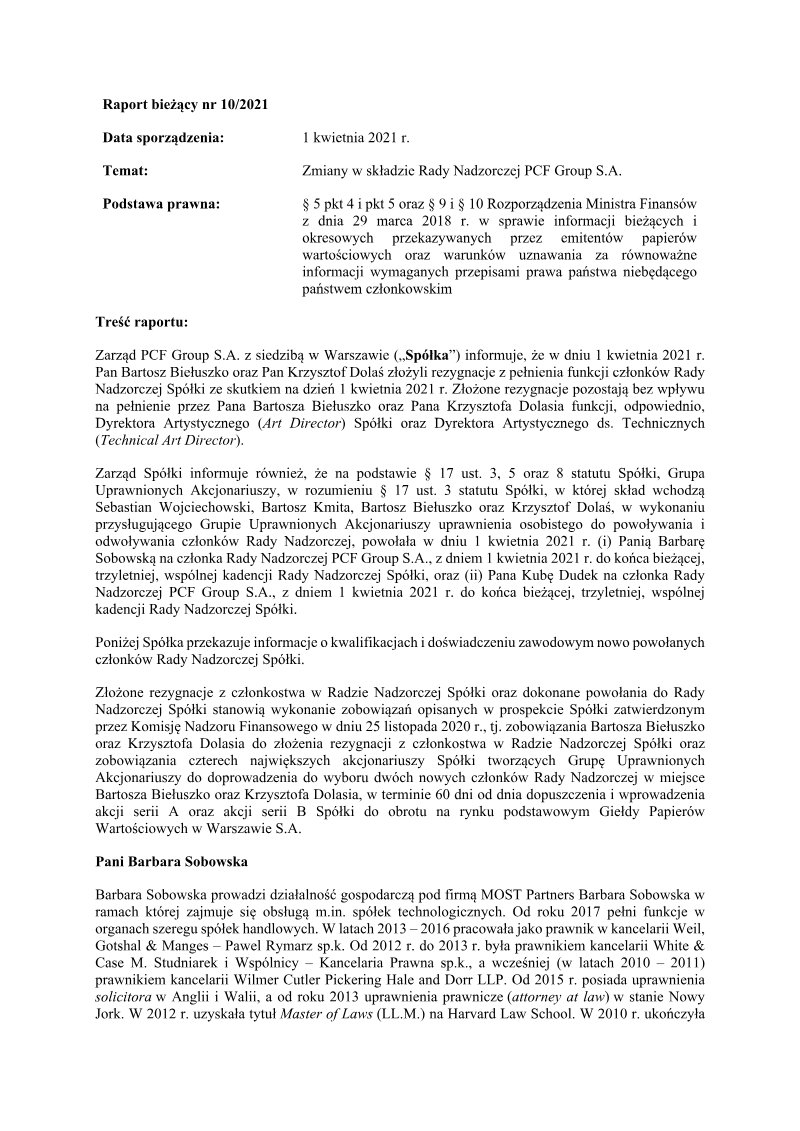
Raport Bieżący Nr 10/2021
PCF Group S.A., the parent company of game development studio People Can Fly, announced significant changes to its Supervisory Board effective April 1, 2021. This corporate action involved the simultaneous resignation of two board members and the appointment of their successors. The transition fulfills specific governance obligations outlined in the company’s November 2020 prospectus following its initial public offering on the Warsaw Stock Exchange.
Bartosz Biełuszko and Krzysztof Dolaś resigned from their positions on the Supervisory Board to align with the company's post-IPO commitments. Despite stepping down from their oversight roles, both individuals maintain their operational leadership positions within the studio as Art Director and Technical Art Director, respectively. Their departures were mandated to occur within 60 days of the company’s shares being admitted to trading on the main market.
To fill these vacancies, the Group of Authorized Shareholders—comprising Sebastian Wojciechowski, Bartosz Kmita, Bartosz Biełuszko, and Krzysztof Dolaś—exercised their personal rights under the company’s articles of association to appoint Barbara Sobowska and Kuba Dudek. Both new members will serve until the end of the current three-year joint term.
The new appointees bring extensive legal and financial expertise to the board. Barbara Sobowska is a dual-qualified lawyer in New York and England & Wales with a background in international law firms and technology sector advisory. Kuba Dudek serves as a managing partner at SpeedUp Venture Capital Group, bringing experience from over 30 investment processes in the technology industry. Both appointees confirmed they do not engage in activities competitive with PCF Group S.A. and are not listed in the Register of Insolvent Debtors.
- Effective April 1, 2021, PCF Group S.A. restructured its Supervisory Board to comply with post-IPO governance obligations established in its November 2020 prospectus.
- Bartosz Biełuszko and Krzysztof Dolaś resigned from the Supervisory Board to meet the requirement that these roles be vacated within 60 days of the company’s Warsaw Stock Exchange listing.
- Despite leaving the Supervisory Board, Biełuszko and Dolaś retain their operational leadership roles as Art Director and Technical Art Director at People Can Fly.
- The Group of Authorized Shareholders appointed Barbara Sobowska and Kuba Dudek to fill the vacant Supervisory Board seats for the remainder of the current three-year term.
- Barbara Sobowska joins the board with an international legal background in the technology sector, while Kuba Dudek brings investment experience as a managing partner at SpeedUp Venture Capital Group.
PCF GroupApr 2021
Legal1 pages
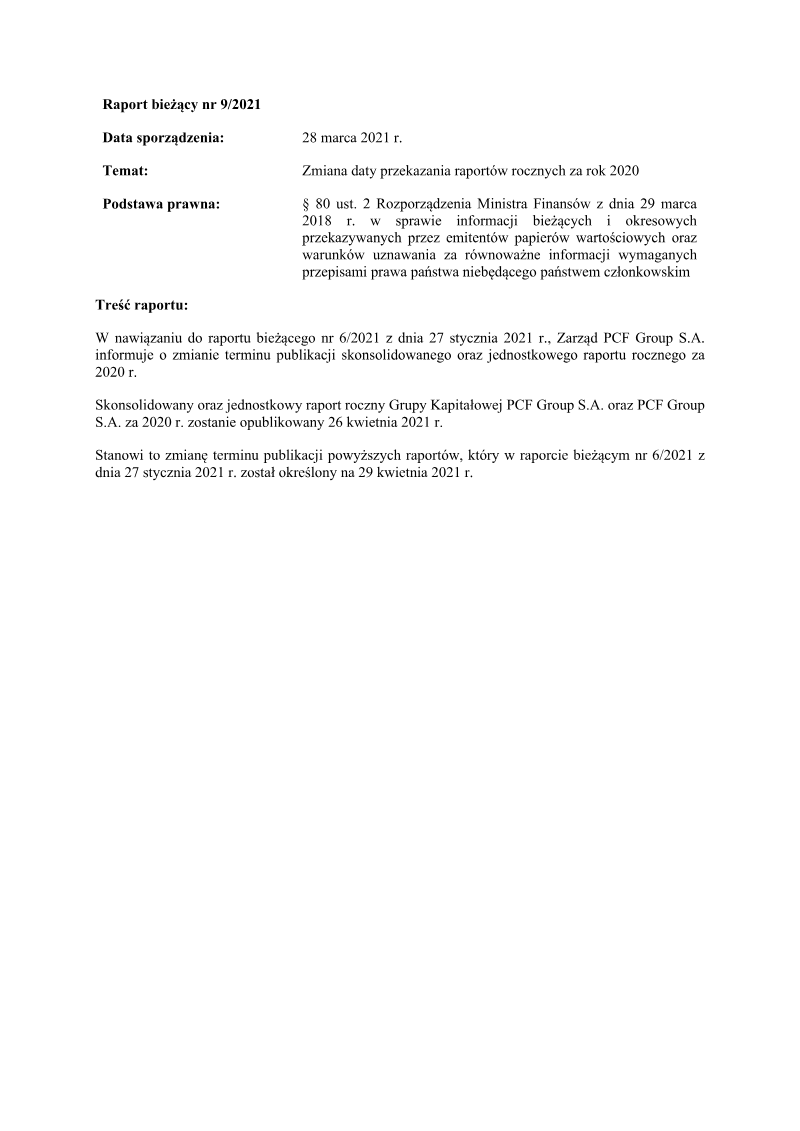
Raport Bieżący Nr 9/2021
The Management Board of PCF Group S.A. has officially rescheduled the publication date for its 2020 annual financial results. This adjustment affects both the standalone annual report for the parent company and the consolidated annual report for the entire capital group. The revised release date is now set for April 26, 2021, moving the disclosure forward from the previously announced deadline of April 29, 2021.
This administrative update serves as a formal correction to the schedule originally established in January 2021. By advancing the publication date by three days, the company ensures that investors and regulatory bodies receive the comprehensive financial performance data for the 2020 fiscal year slightly ahead of the initial projection. The scope of this disclosure is limited to the Polish domestic market where the issuer is listed, specifically addressing the reporting obligations for the 2020 calendar year.
The announcement adheres to the legal framework governing public issuers of securities in Poland, specifically following the regulations set by the Minister of Finance regarding current and periodic information. This procedural filing is a standard requirement for maintaining transparency within the capital markets, ensuring that all stakeholders are informed of changes to the financial reporting calendar. No specific reasons for the schedule acceleration were provided, as the primary function of the communication is to establish the new definitive date for the dissemination of audited financial statements.
- PCF Group S.A. has moved the publication date for its 2020 annual financial results forward to April 26, 2021.
- The new release date replaces the previously scheduled deadline of April 29, 2021.
- The updated reporting schedule applies to both the standalone annual report for the parent company and the consolidated annual report for the entire capital group.
- The change in the reporting calendar is a formal administrative update intended to ensure regulatory compliance and transparency for stakeholders.
- PCF Group S.A. provided no specific reason for the three-day acceleration of the financial disclosure.
+1
PCF GroupMar 2021
Legal1 pages
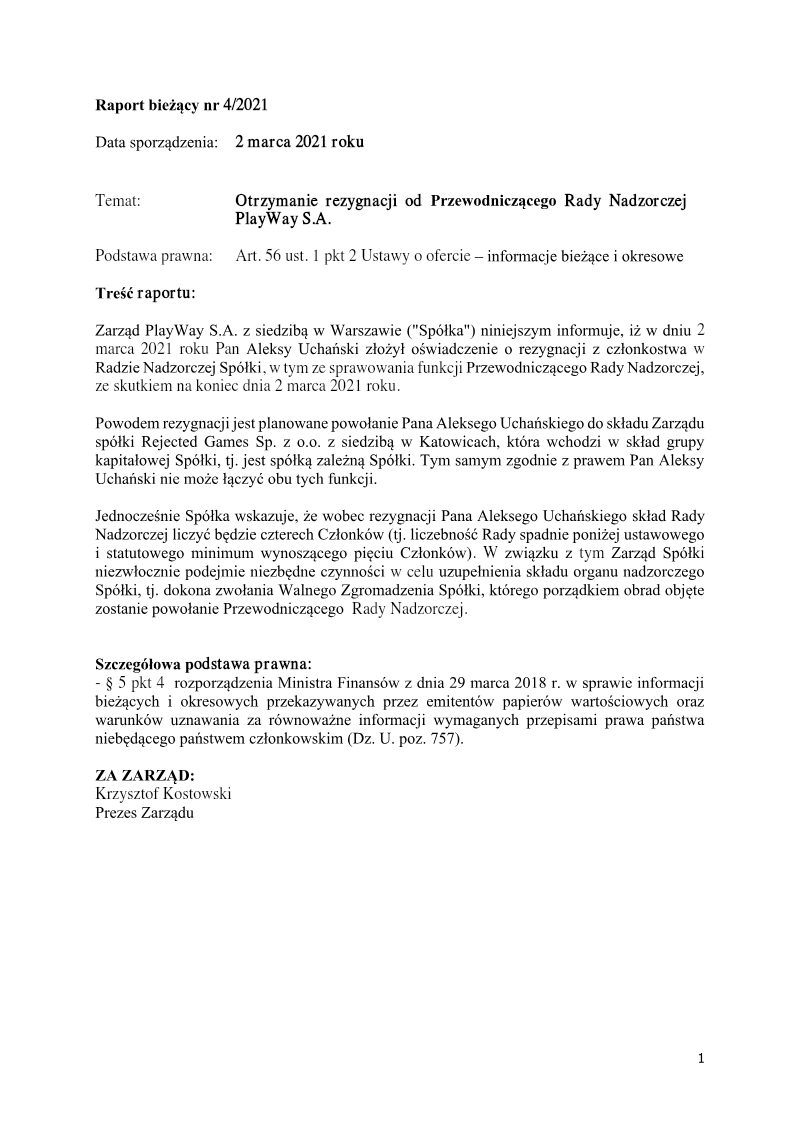
Raport Bieżący Nr 4/2021
The management board of PlayWay S.A., a prominent Polish video game developer and publisher, announced a significant change in its corporate governance structure effective March 2, 2021. Aleksy Uchański submitted his resignation from the Supervisory Board, where he served as Chairman. This departure was immediate, concluding his tenure at the end of the day the notice was issued. The transition is driven by internal restructuring within the capital group, as Uchański is slated to join the management board of Rejected Games Sp. z o.o., a Katowice-based subsidiary of PlayWay. Legal restrictions regarding the simultaneous holding of supervisory and management roles within the same corporate group necessitated this resignation.
This leadership change has immediate regulatory implications for the company’s governance. Following the departure, the Supervisory Board is reduced to four members, which falls below the statutory and articles of association requirement of a five-member minimum. To rectify this non-compliance, the management board is initiating procedures to convene a General Meeting of Shareholders. The primary objective of this upcoming assembly will be to appoint a new member to the Supervisory Board and select a new Chairman to restore the body to its full legal capacity.
The announcement adheres to the reporting requirements for issuers of securities listed on the Polish market, specifically citing the Act on Public Offering and the Regulation of the Minister of Finance regarding current and periodic information. This disclosure ensures transparency for investors regarding the leadership of the PlayWay capital group and the steps being taken to maintain corporate oversight standards during the transition of key personnel between parent and subsidiary entities.
- Aleksy Uchański resigned as Chairman of the Supervisory Board of PlayWay S.A. effective March 2, 2021.
- Uchański is transitioning to the management board of Rejected Games Sp. z o.o., a Katowice-based subsidiary of PlayWay.
- The resignation was legally required to avoid conflicts of interest, as individuals cannot simultaneously hold supervisory and management roles within the same corporate group.
- The departure reduced the Supervisory Board to four members, falling below the statutory and articles of association requirement of five members.
- PlayWay S.A. must convene a General Meeting of Shareholders to appoint a new Supervisory Board member and elect a new Chairman to restore full legal compliance.
PlayWayMar 2021
Legal2 pages
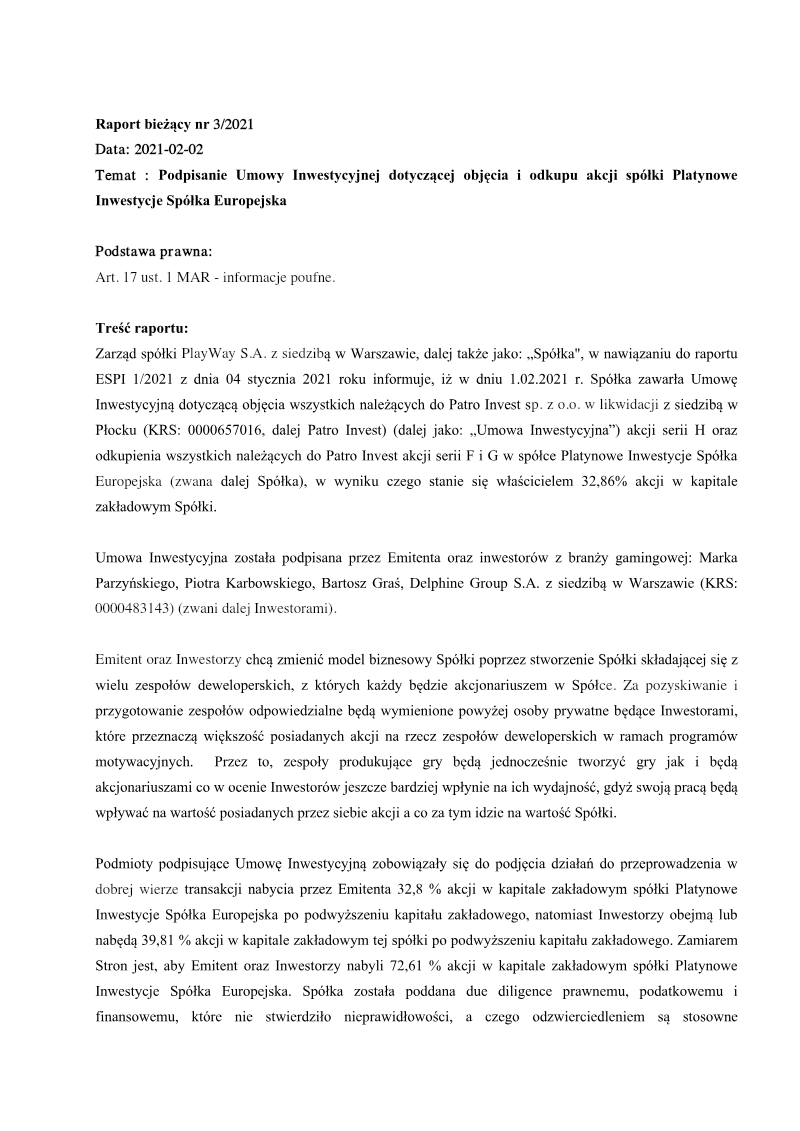
Raport bieżący nr 3/2021
PlayWay S.A. has entered into a formal investment agreement to acquire a significant minority stake in Platynowe Inwestycje Spółka Europejska, marking a strategic pivot for the target entity into the gaming sector. Under the terms of the agreement signed on February 1, 2021, PlayWay will acquire 32.86% of the share capital by taking over Series H shares and purchasing Series F and G shares from Patro Invest. This transaction is part of a broader consortium effort involving individual gaming industry investors and Delphine Group S.A., who together aim to control a combined 72.61% of the company following a planned capital increase.
The primary objective of this acquisition is to transform Platynowe Inwestycje into a multi-team development hub. The new business model focuses on creating a decentralized structure where various development teams operate as both creators and shareholders. Individual investors Marek Parzyński, Piotr Karbowski, and Bartosz Graś are tasked with recruiting these teams and will distribute the majority of their own shares to developers through incentive programs. This strategy is designed to align the interests of the workforce with the company's market valuation, theoretically driving higher productivity and long-term commitment from the creative staff.
The scope of this agreement is centered on the Polish gaming market and follows a comprehensive due diligence process covering legal, tax, and financial aspects, which yielded no irregularities. PlayWay has indicated that it does not currently plan to alter its percentage ownership following the completion of the acquisition. This move reflects a broader industry trend of utilizing equity-based motivation to secure talent in a competitive development landscape, leveraging PlayWay’s established position to foster a new ecosystem of developer-owned studios.
- PlayWay S.A. acquired a 32.86% minority stake in Platynowe Inwestycje on February 1, 2021, through a combination of Series H share acquisition and purchases from Patro Invest.
- A consortium including PlayWay, Delphine Group S.A., and individual investors aims to control a combined 72.61% of Platynowe Inwestycje following a planned capital increase.
- Platynowe Inwestycje will pivot to a decentralized business model, operating as a multi-team development hub where individual teams function as both creators and shareholders.
- Individual investors Marek Parzyński, Piotr Karbowski, and Bartosz Graś are responsible for recruiting development teams and distributing their own shares to staff via incentive programs.
- The acquisition strategy uses equity-based motivation to align developer interests with company market valuation, aiming to increase productivity and talent retention.
PlayWayFeb 2021
Legal1 pages
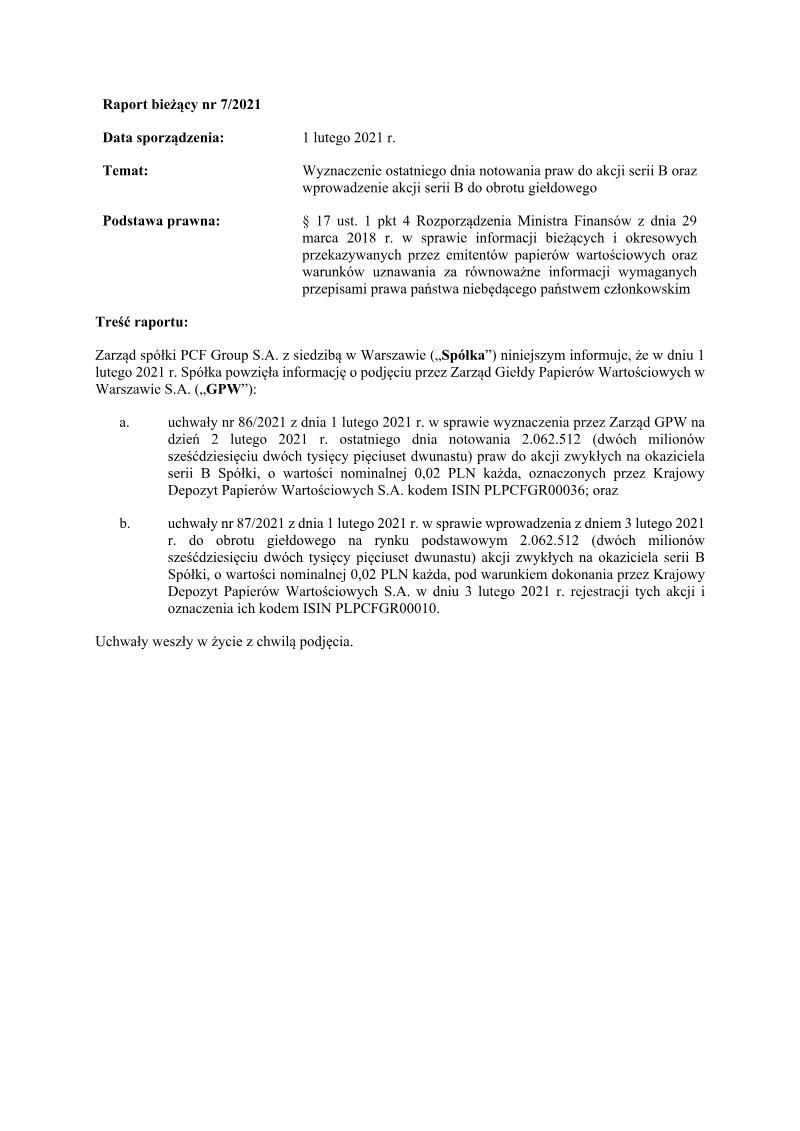
Raport Bieżący Nr 7/2021
PCF Group S.A., the Warsaw-based parent company of the game development studio People Can Fly, finalized the transition of its Series B shares to the main market of the Warsaw Stock Exchange in early February 2021. This regulatory filing details the formal resolutions passed by the exchange management to convert temporary allotment certificates into permanent ordinary bearer shares. The process involved 2,062,512 Series B shares, each carrying a nominal value of 0.02 PLN.
The transition followed a specific timeline where February 2, 2021, served as the final trading day for the rights to shares, previously identified under the ISIN code PLPCFGR00036. Effective February 3, 2021, these rights were replaced by the actual Series B ordinary shares, which were introduced to trading on the primary market under the new ISIN code PLPCFGR00010. This administrative milestone was contingent upon the formal registration of the shares by the National Depository for Securities.
This action represents a standard post-IPO procedure for Polish game developers listed on the Warsaw Stock Exchange, ensuring that newly issued capital is fully integrated into the public trading environment. By converting these rights into shares, the company solidified its equity structure following its initial public offering. The resolutions governing this change took effect immediately upon their adoption on February 1, 2021, marking the completion of the listing process for this specific tranche of securities within the Polish capital market.
- PCF Group S.A. finalized the transition of 2,062,512 Series B shares to the main market of the Warsaw Stock Exchange in early February 2021.
- The conversion of temporary allotment certificates into permanent ordinary bearer shares was completed following resolutions adopted on February 1, 2021.
- Effective February 3, 2021, the Series B shares began trading under the new ISIN code PLPCFGR00010, replacing the previous rights identified as PLPCFGR00036.
- February 2, 2021, served as the final trading day for the rights to the Series B shares before their full integration into the primary market.
- Each of the 2,062,512 Series B shares carries a nominal value of 0.02 PLN.
+2
PCF GroupFeb 2021
Legal1 pages
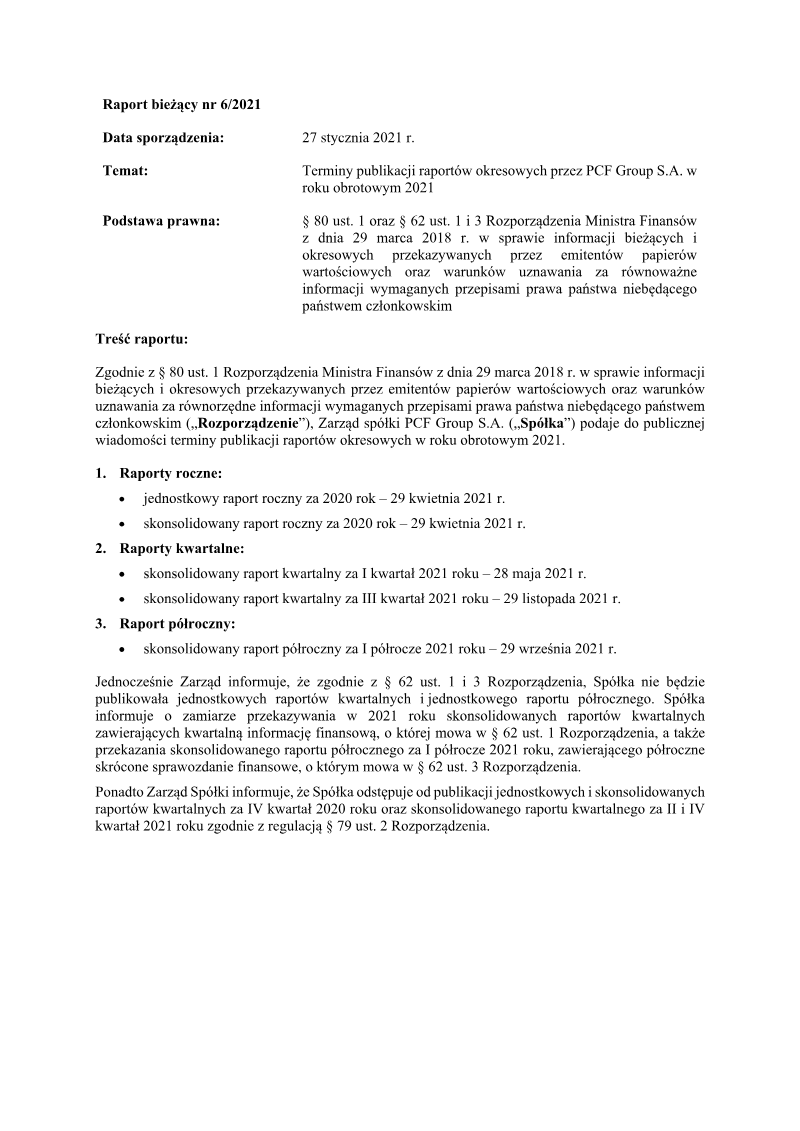
Raport Bieżący Nr 6/2021
PCF Group S.A., the parent company of the game development studio People Can Fly, established its financial reporting calendar for the 2021 fiscal year in compliance with Polish regulatory requirements for public issuers. The schedule outlines the specific dates for the release of annual, semi-annual, and quarterly financial results, ensuring transparency for investors and regulatory bodies following the company’s transition to the public market.
The reporting cycle begins with the publication of both the standalone and consolidated annual reports for the 2020 fiscal year on April 29, 2021. Subsequent reporting for the 2021 fiscal year includes the consolidated quarterly report for the first quarter on May 28, 2021, and the consolidated quarterly report for the third quarter on November 29, 2021. The consolidated semi-annual report, covering the first half of 2021, is scheduled for release on September 29, 2021.
The company has elected to utilize specific regulatory exemptions regarding the scope of its filings. PCF Group S.A. will not publish separate standalone quarterly or semi-annual reports, opting instead to include the required condensed financial information within its consolidated filings. Furthermore, the company has exercised its right to omit the publication of quarterly reports for the fourth quarter of 2020, as well as the second and fourth quarters of 2021, as permitted under the Regulation of the Minister of Finance. This schedule provides a clear roadmap for the company's financial disclosures throughout the 2021 calendar year.
- PCF Group S.A. will release its 2020 annual standalone and consolidated financial reports on April 29, 2021.
- The company’s 2021 financial reporting schedule includes a consolidated semi-annual report on September 29, 2021, and consolidated quarterly reports on May 28 (Q1) and November 29 (Q3).
- PCF Group S.A. is opting to consolidate its standalone financial information into its consolidated filings rather than publishing separate standalone quarterly or semi-annual reports.
- The company will omit the publication of quarterly reports for the fourth quarter of 2020, as well as the second and fourth quarters of 2021, in accordance with regulatory exemptions.
- This reporting calendar establishes the formal disclosure roadmap for PCF Group S.A. following its transition to the public market.
+1
PCF GroupJan 2021