Liftoff
Technology18 documents
Documents
Report31 pages
Social Casino Gaming Apps Report 2021
The global social casino market reached $6.2 billion in gross revenue in 2020, demonstrating robust financial health despite a highly saturated competitive landscape. Data collected from 239 apps and 39 million events between August 2020 and August 2021 indicates that while the sector is expanding, it has become increasingly difficult for new entrants to break into the top rankings. Marketing costs reflect this friction, with the average cost-per-install reaching $7.21. Significant disparities exist between platforms, as iOS installations cost more than double those on Android, largely due to shifting privacy regulations and tracking limitations.
Profitability in this sector relies on high long-term engagement and sophisticated monetization mechanics. The genre maintains a Day 30 return on ad spend of 25.18%, supported by a player base that is predominantly older, with nearly half of users aged 45 or above. These players are primarily motivated by the thrill of gameplay and the desire for treasure collection. To capitalize on these motivations, top-performing apps have increasingly adopted features such as album collectibles and special side-modes. Most notably, the battle pass mechanic saw a dramatic rise in market penetration, growing from 5% to 36% within a single year, while piggy banks and guild systems remain essential for driving social interaction and consistent spending.
Sustaining growth in the current climate requires a strategic shift toward high-excitement ad creatives and seamless integration with in-app experiences. Because no new titles reached the top 200 during the study period, established players must utilize machine learning and feature-level data to optimize for long-term value. Success is no longer defined solely by user acquisition but by the ability to integrate complex meta-features that satisfy the core audience's psychological drivers within an increasingly crowded and expensive digital marketplace.
- The social casino market is highly consolidated, with no new titles breaking into the top 200 rankings between August 2020 and August 2021.
- Market entry is increasingly expensive, with average cost-per-install reaching $7.21 and iOS acquisition costs more than double those of Android due to privacy tracking limitations.
- Battle pass mechanics experienced rapid adoption, with market penetration growing from 5% to 36% in a single year.
- The sector generated $6.2 billion in gross revenue in 2020, maintaining a Day 30 return on ad spend of 25.18%.
- The core player demographic is mature, with nearly 50% of users aged 45 or older, driving a focus on treasure collection and album collectible features.
+1
LiftoffJan 2021

Report13 pages
Mobile Game Video Ads Analysis: Optimal Video Lengths and End Cards
This analysis examines the relationship between video ad length, end card formats, and campaign performance across five major mobile gaming genres: Hyper-Casual, RPG, Strategy, Puzzle, and Social Casino. By evaluating 3.7 billion in-app video ad impressions and subsequent installs via the Vungle platform, the study establishes creative benchmarks using a proprietary Power Index to measure efficacy. The findings suggest that as the industry moves toward a post-IDFA environment with limited user-level data, marketers must prioritize creative optimization and mass-appeal strategies to drive engagement.
The data reveals distinct audience preferences for each genre. Social Casino players favor efficiency, responding best to 10-second ads paired with standard static end cards. Puzzle and Strategy games both see peak performance when utilizing app store end cards that provide a direct path to download, though their optimal video lengths differ at 22 seconds and 33 seconds, respectively. Conversely, genres with deeper gameplay loops require more extensive creative storytelling. Hyper-Casual games perform best with 37-second ads and video end cards, while RPGs benefit from the longest engagement times, peaking at 46 seconds with looping video end cards to showcase aesthetic and narrative depth.
The scope of the research covers a global audience of over one billion unique devices, focusing on the structural elements of ad creatives rather than specific visual content. The methodology filters out low-performing impressions to ensure the Power Index accurately reflects the most successful format pairings. Ultimately, the findings conclude that aligning ad duration and post-roll interactive elements with genre-specific player expectations is essential for maximizing return on ad spend in an increasingly competitive mobile marketplace.
- Optimal video ad length varies significantly by genre, ranging from 10 seconds for Social Casino to 46 seconds for RPGs.
- Hyper-Casual games achieve peak performance with 37-second ads paired with video end cards.
- Strategy games perform best with 33-second ads, while Puzzle games reach peak efficacy at 22 seconds; both benefit most from app store end cards.
- Social Casino players prefer short, efficient 10-second ads combined with standard static end cards.
- RPGs require the longest engagement times at 46 seconds, utilizing looping video end cards to highlight narrative and aesthetic depth.
+2
LiftoffJan 2021
Report31 pages
Social Casino Gaming Apps Report
The social casino gaming market experienced significant growth and transformation between August 2020 and August 2021, driven largely by global social distancing measures. While the segment reached a global gross gaming revenue of $6.2 billion in 2020 with a projected increase to $7.5 billion by 2026, the market has become increasingly saturated. High barriers to entry mean that established titles dominate the top rankings, while new entrants struggle to scale. The analysis draws on 83 billion impressions and 12 million installs to provide a comprehensive look at acquisition costs, retention strategies, and player motivations.
Financial data indicates a widening gap between platforms. The average cost-per-install (CPI) on iOS rose to $11.09, making it over twice as expensive as Android, which saw its CPI decrease to $5.00. Despite these costs, the sector maintains healthy performance metrics, with Day 7 return-on-ad-spend (ROAS) averaging 11.12% and Day 30 ROAS reaching 25.18%. Geographically, Latin America offers the lowest acquisition costs at $1.43 per install, though North America remains the primary target for high-value returns.
To combat rising costs and market saturation, developers are increasingly integrating sophisticated "mid-core" features to deepen engagement. Album collectibles are the most prevalent mechanic, appearing in 74% of top games, followed closely by special side-modes and piggy bank monetization systems. Battle passes have seen the most dramatic growth, jumping from 5% to 36% adoption in a single year. These features cater to a unique player demographic that is evenly split by gender but skews older, with nearly half of all users over the age of 45. Successful titles now focus on a "meta-driven" experience, utilizing guild mechanics and narrative elements to move beyond simple slot or bingo loops.
- The social casino market is projected to grow from $6.2 billion in 2020 to $7.5 billion by 2026, though high barriers to entry and market saturation make scaling difficult for new entrants.
- Acquisition costs vary significantly by platform, with iOS CPI reaching $11.09 compared to $5.00 on Android, while Latin America offers the lowest entry point at $1.43 per install.
- Developers are increasingly adopting 'mid-core' features to drive engagement, with battle pass integration growing from 5% to 36% adoption in a single year.
- Album collectibles are the most common engagement mechanic, appearing in 74% of top-performing titles, alongside side-modes and piggy bank monetization systems.
- The sector demonstrates strong financial performance with an average Day 7 ROAS of 11.12% and a Day 30 ROAS of 25.18%.
+1
LiftoffJan 2021
Report28 pages
Casual Gaming Apps Report: The State of Play in 2021
The casual gaming sector experienced significant growth and volatility between March 2020 and February 2021, driven largely by shifting consumer habits during the COVID-19 pandemic. While mobile gaming spend surged to nearly triple that of PC and console platforms, the market became increasingly competitive. Analysis of 246 million installs across 416 apps reveals that while the audience for casual titles is massive, the cost to acquire these users has risen sharply. The average cost-per-install (CPI) for casual games increased by 45.2% year-over-year to $1.96, while return-on-ad-spend (ROAS) saw a corresponding decline, dropping 7.5 percentage points to 29.6% by Day 30.
Market dynamics vary significantly by sub-genre and platform. Lifestyle games emerged as the most expensive to acquire at $2.57 per install but offered the highest engagement, yielding a Day 7 ROAS of 22.5%, which far outperforms Puzzle and Simulation categories. Platform trends indicate a strategic shift toward Android, where CPIs surged by 120% as marketers prepared for privacy changes on iOS. Despite this, iOS remains the more expensive platform, with an average CPI of $4.30 compared to $1.15 on Android.
Geographically, North America remains the most expensive region for user acquisition, while APAC and EMEA offer more cost-effective opportunities. Countries such as France, Germany, and South Korea are highlighted as high-performance markets with relatively low CPIs and strong ROAS. To combat rising costs and diminishing returns, the findings suggest a heavy reliance on creative experimentation, particularly through playable ads, which saw a 113% increase in usage. The data indicates that success in the current landscape requires balancing localized strategies with high-engagement ad formats to convert increasingly distracted global audiences.
- Casual gaming user acquisition costs rose significantly between March 2020 and February 2021, with the average cost-per-install (CPI) increasing 45.2% year-over-year to $1.96.
- Return-on-ad-spend (ROAS) for casual games declined by 7.5 percentage points to 29.6% by Day 30, signaling a tightening market for profitability.
- Android CPIs surged 120% as marketers shifted strategies ahead of iOS privacy changes, though iOS remains more expensive with an average CPI of $4.30 compared to $1.15 on Android.
- Lifestyle games command the highest acquisition costs at $2.57 per install but deliver superior engagement, achieving a Day 7 ROAS of 22.5% that outperforms Puzzle and Simulation categories.
- Playable ads have become a primary mitigation strategy for rising acquisition costs, with usage of this format increasing by 113%.
+2
LiftoffJan 2021
Report64 pages
2020 Mobile Gaming Apps Report
The global mobile gaming market is projected to surpass $100 billion in revenue in 2020, fueled by a 2.6 billion-person player base and a 24% surge in daily in-app payments. While the average cost per install has reached a record low of $1.47, the industry faces a tightening conversion landscape where install-to-purchase costs have risen by 24% and conversion rates have dropped to 3.3%. Midcore and strategy games have emerged as the most efficient segments, offering the highest 30-day return on ad spend at 39.5% while maintaining low acquisition costs, particularly on the Android platform.
Geographic performance varies significantly, with Japan and North America established as the premier markets for user retention and monetization. Japan consistently outperforms global benchmarks, doubling the retention rates of its regional peers and exceeding return on ad spend targets by over 10 percentage points. While the Asia-Pacific region as a whole delivers high returns, it is characterized by the highest acquisition costs. In contrast, the EMEA region, specifically the United Kingdom, provides a high-value alternative by balancing affordable install costs with strong returns. Emerging markets like Brazil offer the lowest entry costs globally but present high risks due to poor long-term retention and low conversion.
The hyper-casual sector is expected to reach $3 billion in 2020, though market saturation is driving a shift toward hybrid monetization models to combat declining long-term engagement. Across all genres, platform choice remains a critical strategic factor; iOS provides a slight advantage in return on investment but requires four times the acquisition spend of Android. Furthermore, while paid user acquisition drives initial engagement in midcore and social casino categories, organic users continue to demonstrate superior long-term loyalty, highlighting the ongoing importance of organic growth strategies in a competitive global landscape.
- The global mobile gaming market is projected to exceed $100 billion in 2020, supported by 2.6 billion players and a 24% increase in daily in-app payments.
- Midcore and strategy games are the most efficient segments, achieving a 39.5% 30-day return on ad spend with low acquisition costs, particularly on Android.
- While the average cost per install has hit a record low of $1.47, the industry faces a 24% rise in install-to-purchase costs and a decline in conversion rates to 3.3%.
- Japan remains the premier market for monetization and retention, doubling regional peer retention rates and exceeding return on ad spend targets by over 10 percentage points.
- iOS offers a higher return on investment than Android but requires four times the acquisition spend, while organic users continue to outperform paid users in long-term loyalty.
+2
LiftoffJan 2020
Report47 pages
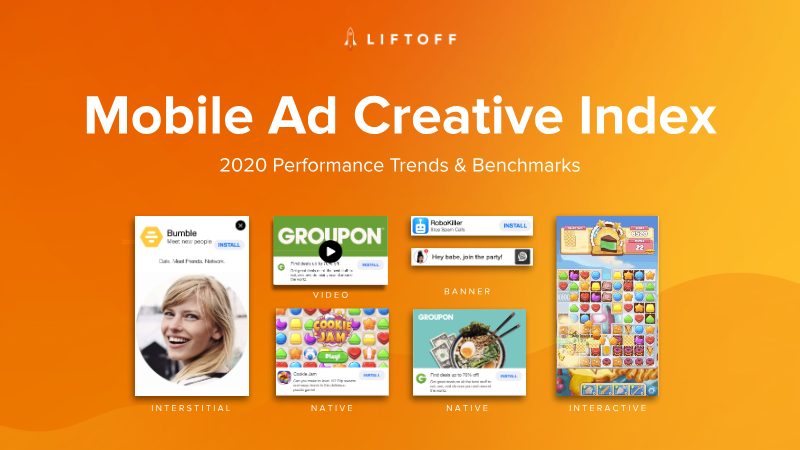
Mobile Ad Creative Index 2020
The 2020 mobile advertising landscape is defined by a stark divergence in performance metrics across creative formats, operating systems, and geographic regions. While banner ads remain the most cost-effective entry point for driving initial installs, native and video formats demonstrate superior efficacy in securing high-value, deep-funnel actions such as in-app purchases. Native ads, in particular, achieve conversion rates as high as 52.8%, signaling their importance for long-term user retention. However, these performance gains come at a premium on iOS, where costs consistently dwarf those on Android. For instance, the cost of securing an in-app purchase through native ads on iOS reaches $218.09, nearly triple the $73.62 required on Android.
Geographically, North America persists as the most expensive market for user acquisition across all formats, while the LATAM and APAC regions offer significantly more accessible pricing for advertisers. Seasonal trends also influence these costs, with install expenses typically peaking during the summer months. To navigate these fluctuations, successful campaigns increasingly rely on iterative A/B testing and dynamic creative strategies. Case studies from major brands like Credit Karma and Groupon illustrate that disciplined testing can yield lifts in click-to-install rates exceeding 120%, underscoring the necessity of a data-driven approach to creative optimization.
The industry is shifting toward a performance-based, cost-per-action model that prioritizes post-install revenue events over simple downloads. By leveraging machine learning and focusing on single-deal creative strategies, advertisers can better align their spending with actual user value. Ultimately, the data suggests that while the cost of acquisition is rising, particularly on premium platforms and in mature markets, the integration of dynamic product ads and rigorous testing frameworks remains the most effective path toward achieving sustainable return on ad spend.
- Native ads achieve conversion rates as high as 52.8%, making them the most effective format for driving long-term user retention and high-value in-app purchases.
- Acquiring an in-app purchase via native ads on iOS costs $218.09, which is nearly triple the $73.62 cost required on Android.
- Disciplined A/B testing and dynamic creative strategies, as utilized by brands like Credit Karma and Groupon, can increase click-to-install rates by more than 120%.
- The mobile advertising industry is shifting from simple download-based metrics to a performance-based model that prioritizes post-install revenue events.
- North America remains the most expensive market for user acquisition, while LATAM and APAC provide more cost-accessible alternatives for advertisers.
+1
LiftoffJan 2020