Denmark
2 documents·2 publishers
Documents
Report60 pages
Digital Games' Impact in Denmark
The study evaluates how digital games shape everyday life in Denmark, measuring participation rates, motivations, and social outcomes among a representative sample of gamers. By linking behavioural data with self‑reported wellbeing, it argues that games have become a mainstream cultural activity that delivers measurable, though modest, emotional benefits while also fostering relational ties when played socially.
Among 1,172 respondents, 79 % reported playing a digital game within the past year, with weekly engagement ranging from 62 % of those aged 55‑79 to 74 % of 16‑24‑year‑olds. This high penetration underscores games as a routine leisure pursuit across age groups. Players rate gaming as an “active, rewarding break,” assigning an average relaxation score of 3.9 on a five‑point scale and an immersion rating of roughly 3.6, indicating that the activity is perceived as both soothing and engaging.
The majority of gaming occurs in solitary settings—91 % of participants play at home—and puzzle titles dominate preferences, attracting 65 % of respondents and achieving the highest relaxation scores. Nevertheless, social play, whether with friends, online strangers (12 % of gamers) or one’s own children (11 % of gamers), markedly elevates relational and community metrics; relational scores rise from an overall average of 2.1 to 2.9 for those who game with children, and empathy levels increase especially among action‑ and adventure‑game players. These findings suggest that shared gaming experiences amplify social connection, empathy, and cross‑generational bonding.
Overall, digital games in Denmark generate modest emotional gains while serving as a versatile tool for personal relaxation and, when played together, for strengthening social ties. The results highlight the dual role of games as both an individual stress‑relief mechanism and a catalyst for community cohesion within the Danish cultural context.
- Digital gaming is a mainstream activity in Denmark, with 79% of the population having played a game in the past year.
- Engagement is high across all age groups, ranging from 62% of those aged 55–79 to 74% of those aged 16–24 playing on a weekly basis.
- Puzzle games are the most popular genre, preferred by 65% of respondents and yielding the highest relaxation scores among all game types.
- Gaming is primarily a solitary, home-based activity, with 91% of participants playing at home.
- Social gaming significantly boosts relational metrics, with scores rising from an overall average of 2.1 to 2.9 when parents play with their children.
+2
NIMBI – Danish Institute for Game DevelopmentJan 2023
Whitepaper2 pages
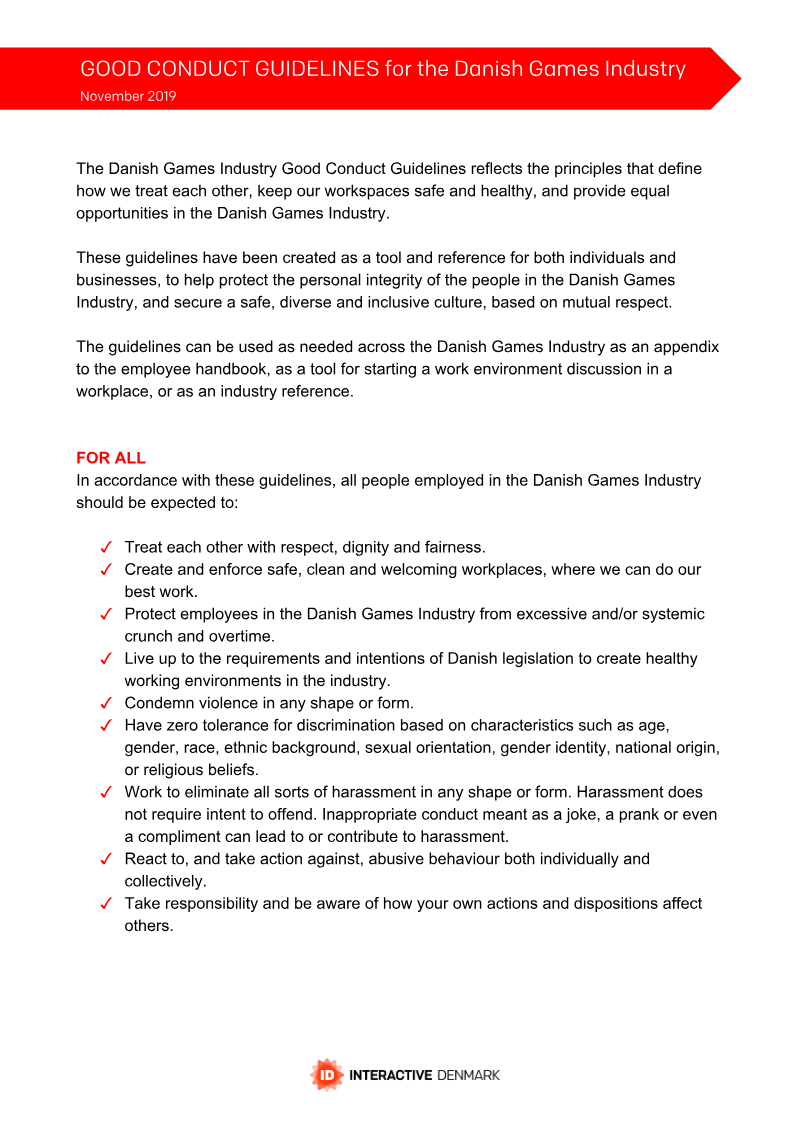
Good Conduct Guidelines for the Danish Games Industry
The Good Conduct Guidelines for the Danish Games Industry, published in November 2019, establish a standardized framework for fostering a safe, inclusive, and professional work environment across the Danish game development sector. The primary objective is to protect the personal integrity of industry professionals by promoting a culture of mutual respect, diversity, and accountability. These guidelines serve as a foundational reference for businesses to integrate into employee handbooks or internal policy discussions, ensuring that workplace practices align with both ethical standards and Danish labor legislation.
The guidelines mandate that all industry participants uphold principles of dignity and fairness, with a specific emphasis on eliminating systemic crunch, excessive overtime, and all forms of harassment or discrimination. The policy adopts a zero-tolerance stance toward abusive behavior, noting that harassment is defined by its impact rather than the intent of the perpetrator. Furthermore, the framework places a heightened responsibility on management to act as ethical role models, proactively prevent unsafe conditions, and ensure that employees can report grievances without fear of retaliation.
To support enforcement, the guidelines outline clear procedures for addressing workplace misconduct. Employees are encouraged to engage with internal representatives, such as HR or management, while also being reminded of their rights to seek external support through labor unions, occupational health providers, or the Danish Working Environment Authority. By formalizing these expectations, the industry aims to standardize professional conduct and ensure that all developers and staff operate within a healthy, sustainable, and welcoming environment.
- The Good Conduct Guidelines, published in November 2019, establish a standardized framework for professional behavior and workplace safety across the Danish game development sector.
- The policy mandates the elimination of systemic crunch and excessive overtime to ensure a sustainable working environment for all industry staff.
- Harassment is defined by its objective impact on the victim rather than the intent of the perpetrator, and the industry maintains a zero-tolerance stance toward all forms of abusive behavior.
- Management holds a heightened responsibility to act as ethical role models, proactively prevent unsafe conditions, and guarantee that employees can report grievances without fear of retaliation.
- The guidelines align internal workplace practices with Danish labor legislation to promote a culture of mutual respect, diversity, and accountability.
+1
Danish Games IndustryNov 2019