Showing 30 of 2,246 results · 2.77s
Jan 2025
Video Gaming Report: How Platforms Are Colliding and Why This Will Spark the Next Era of Growth
Boston Consulting Group
generated content (UGC) creator economy, the mainstream adoption of cloud gaming, and the regulatory opening of mobile app stores. Key findings indicate that Generative AI is already being
Report26 pages
Jul 2025
Kingshot: Global Mobile Market Performance Analysis
SocialPeta
Kingshot, released on February 22 by Century Games, has rapidly ascended global mobile charts, reaching the U.S. Top 10 in June and securing positions behind Fortnite on free
Article1 pages
Jan 2019
Evolution of Mobile Esports for the Mass Market
Niko Partners
billion that already surpasses the combined reach of PC and console gaming. In 2018, mobile esports titles generated $15.32 billion in revenue, representing over a quarter
Report45 pages
Dec 2019
iOS/Android/Steam Sales Case Study: Golf Peaks
GameDiscoverCo
covers the period between the game’s initial launch in November 2018 and late 2019. While the game was designed for mobile, it was also ported to Steam
Article1 pages
Jul 2025
Introducing the UK Video Games Council: July 2025
Video Games Industry Memo
group of frontline industry experts, including representatives from triple-A studios, indie developers, mobile game creators, and service providers. Notable members include leadership from Larian, Miniclip, ustwo games
Article1 pages
Jun 2026
Asian Games SEA MLBB Qualifiers: 2026 Popularity Analysis
Esports Charts
Asian Games Southeast Asian Mobile Legends: Bang Bang qualifiers have risen to the top‑ten most popular esports events worldwide, eclipsing traditional titles such as Mid‑Season Invitational
Article1 pages
Aug 2025
Vorhaus Digital Strategy Study: All Findings 2025
Vorhaus Advisors
population engaging across various platforms and over half of the country playing mobile games daily. The industry is seeing a significant rise in social and cloud gaming, alongside
Report133 pages
Jan 2022
Key Insights Into German Gamers
Newzoo
most prevalent, reflecting a mix of casual mobile play and more dedicated multi-platform engagement. Platform preferences show that mobile gaming has the highest reach, utilized
Report18 pages
Top Esports Games and Tournaments by Viewership: Q1 2026
Esports Charts
highlights the critical influence of localized fanbases in sustaining high-stakes competitive ecosystems. Mobile gaming remains the dominant force in viewership, exemplified by the M7 World Championship
Article1 pages
Jan 2022
Global Esports & Live Streaming Market Report 2022
Newzoo
console markets, whereas YouTube and Facebook are capitalizing on the rapid proliferation of mobile gaming in emerging economies. These platforms are further evolving by integrating non-gaming content
Report51 pages
May 2026
Podcast: AI and Video Games (with Julian Togelius)
Mobile Dev Memo
The episode explores the intersection of artificial intelligence and video game design through a conversation
Article1 pages
Recap: Games Compass 2022
Gamecity Hamburg, InnoGames
digital media sectors in Hamburg, Germany. Jointly organized by the browser and mobile game developer InnoGames and the industry initiative Gamecity Hamburg, the event marked the return
Article1 pages
May 2021
FY2021 Third Quarter Financial Results
GREE
reduction in advertising and variable costs. The operational scope centers on the Japanese mobile gaming market with expanding global distribution across North America, Europe, and Asia. The game
Financial26 pages
Apr 2022
E3 Self-destructs: A Showcase in Sclerotic Management
SuperJoost
Show. Data points indicate a broader cooling of the interactive entertainment market; global mobile game spending fell 7% year-over-year to $21 billion in the first quarter
Article
Apr 2019
FY 2019 Third Quarter Financial Results
GREE
DanMachi contributed to increased daily active users and revenue. The company’s mobile game segment remains the primary revenue driver, accounting for ¥13.65 billion of total sales, while
Financial29 pages
Feb 2022
Motivations and Demographics Snapshot Report
GameRefinery
mobile gaming landscape in the United States is defined by a complex interplay between game mechanics and player psychology, categorized through a framework of twelve distinct motivational drivers
Report31 pages
Dec 2023
The Evolution of Gates Runner Mechanics: From Hyper-Casual to 4X Strategy Games
Brutally Honest
gates runner mechanic has emerged as a transformative force in mobile gaming, evolving from a simple hyper-casual trope into a sophisticated engagement tool for complex 4X strategy
Article
Sep 2019
Tales From Discoverability Land: Vol. 1
GameDiscoverCo
financial success. The scope of this analysis covers the global PC and mobile gaming markets as of September 2019, utilizing a combination of anecdotal industry data, developer case
Article1 pages
Nov 2025
Kakao Games Q3 2025 Earnings Announcement
Kakao Games
revenue, totaling 42.7 billion KRW, fueled by successful collaboration updates for Battlegrounds. Conversely, mobile gaming revenue fell 16% sequentially to 84.8 billion KRW due to the natural stabilization
Financial7 pages
Sep 2021
Gaming Deals Activity Report Q1‑Q3 ’21
InvestGame
segment remained the primary driver of activity, representing 75% of total deal value. Mobile gaming emerged as a particularly dominant force, contributing 84% of M&A value
Report21 pages
Jan 2019
Tencent Games Strategy 2019
Niko Partners
esports. Leveraging a cloud network that already supports 75% of China’s top mobile games, Tencent is positioned to lead the domestic market in the absence of major
Report14 pages
Aug 2025
Take‑Two Interactive 10‑Q: Q2 FY2025
Take-Two Interactive
increase in recurrent consumer spending and a modest 3 % lift in full‑game sales. Mobile and digital online channels accounted for the bulk of earnings, with mobile revenue
Article1 pages
Jan 2021
Deconstructing the Superstars: The Metrics Behind Hyper-Casual Games 2020 Industry Snapshot
GameIntel
This industry snapshot provides a detailed analysis of the hyper-casual mobile gaming sector throughout 2020, utilizing aggregated data from a network of over 140,000 integrated games
Report10 pages
Feb 2026
ERA: The UK Entertainment Market in 2025
GameDev Reports
follows closely with £5.37 billion, marking a 7.4% year-over-year rise. Mobile and tablet gaming served as the primary catalyst for this growth, contributing £1.88 billion, while
Article1 pages
Jan 2022
Newzoo Gamer Insights: The Future of Gaming
Newzoo
Alpha and 48% of Gen Z spending money on games, primarily on mobile platforms. The top spending motivators include unlocking exclusive content and personalizing in-game experiences through
Report22 pages
Jan 2025
Newzoo's Generations Report: How Different Generations Engage with Games
Newzoo
players prioritize relaxation. Platform preferences differ markedly; Gen Z spends 77% of gaming spend on mobile, whereas Baby Boomers allocate 73% to PC. Younger gamers also engage more
Report21 pages
May 2024
Summary of Main Supplementary Explanations Questions and Answers at the FY2024 Third Quarter GREE Results Briefing
GREE
Recognizing the evolving market landscape, preparations are currently underway to expand beyond mobile into console game development. Simultaneously, the VTuber Business is receiving targeted investments focused
Financial1 pages
Jan 2020
2020 Global Games Market Report
Newzoo
generate $159.3 billion in 2020, representing a 9.3% year-on-year increase. Mobile gaming remained the largest segment, accounting for $77.2 billion (48% of the market), driven
Report31 pages
Oct 2023
What Are Your Steam Wishlists Meant to Do After Release?
GameDiscoverCo
examines the post-launch lifecycle of Steam wishlists and the evolving landscape of mobile game publishing. By evaluating Steamworks data from premium titles released over the last several
Article
Mar 2026
Meta Is Back in the Game: What That Actually Means
Deconstructor of Fun
standard last-click models. The scope of this analysis covers the global mobile gaming industry as of early 2026. It emphasizes that the market is increasingly concentrated, with
Article1 pages

Video Gaming Report: How Platforms Are Colliding and Why This Will Spark the Next Era of Growth
Jan 202526 pages7k words
Summary
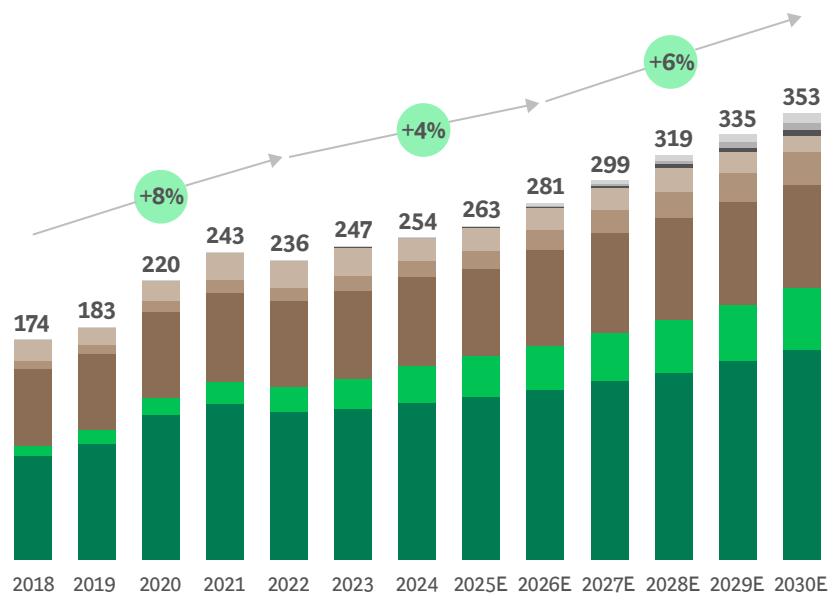
The video gaming industry is transitioning into a new era of growth following a post-pandemic stabilization period. While the sector is unlikely to replicate the rapid doubling of the 2010s, a convergence of technological and structural shifts is expected to revitalize the market. This evolution is driven by four primary strategic trends: the integration of Generative AI, the expansion of the user-generated content (UGC) creator economy, the mainstream adoption of cloud gaming, and the regulatory opening of mobile app stores.
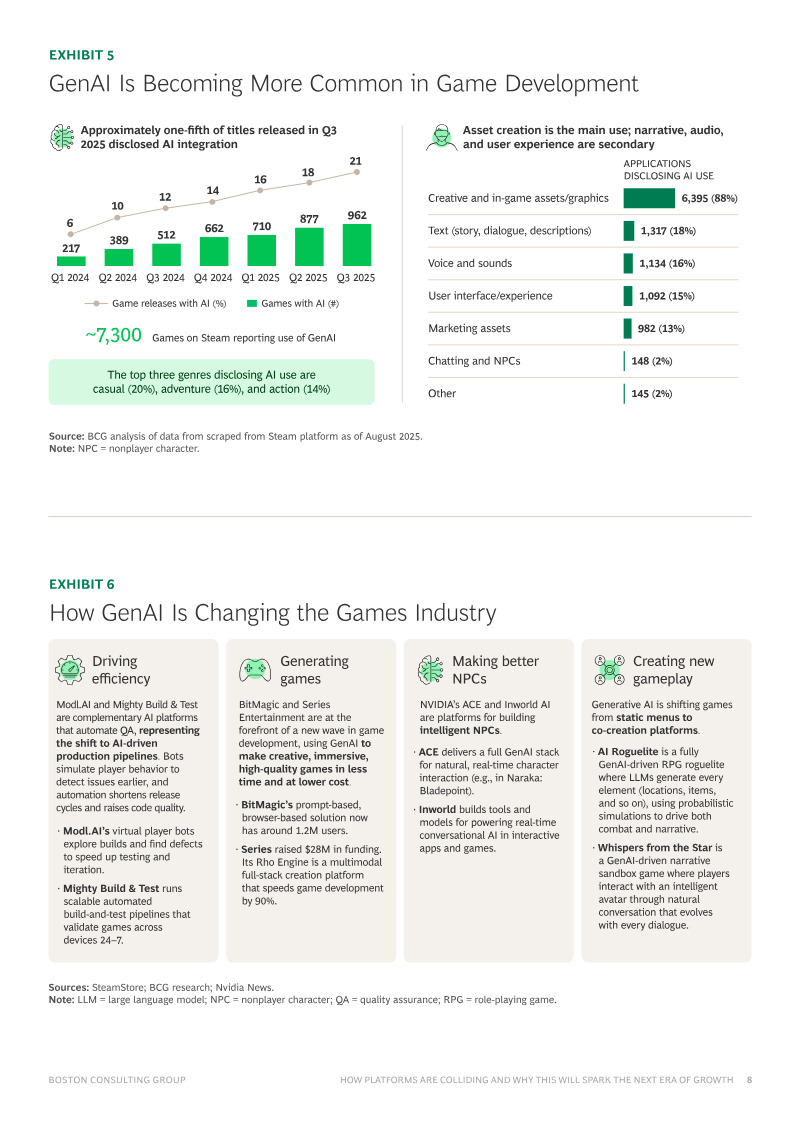
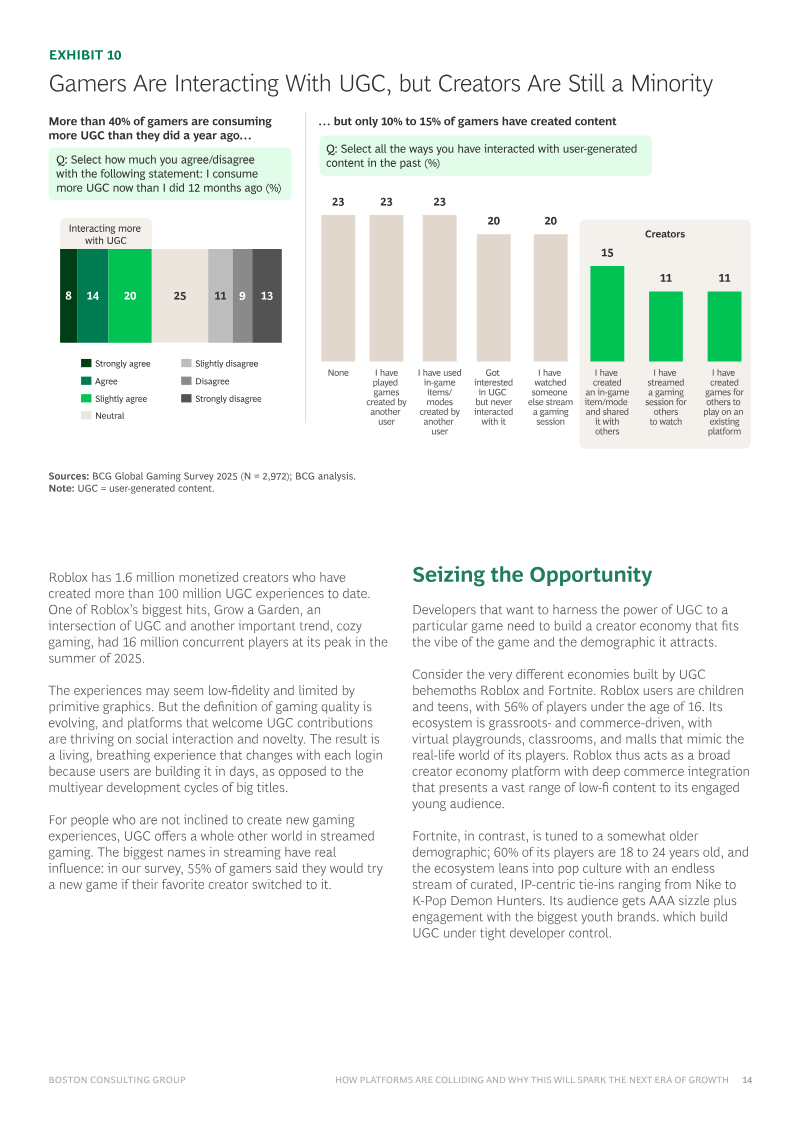
Key findings indicate that Generative AI is already being utilized by approximately 50% of studios to improve development efficiency and create adaptive gameplay, with 20% of new Steam games disclosing AI use by mid-2025. Simultaneously, the creator economy is surging; payouts from platforms like Roblox and Fortnite are projected to exceed $1.5 billion in 2025. Cloud gaming is also positioned for a massive scale-up, with revenues forecasted to grow from $1.4 billion in 2025 to $18.3 billion by 2030. This shift toward hardware-agnostic play is mirrored in distribution, where 33% of adult gamers have already purchased titles directly from developer web stores to bypass traditional platform fees.
The scope of this analysis is global, with a particular focus on major markets including the US, China, Germany, Japan, and South Korea. It covers the industry from late 2025 through projections for 2030, spanning mobile, console, and PC segments. Data is derived from the Global Gaming Survey of approximately 3,000 gamers, metadata analysis of the Steam platform, and interviews with industry leaders and developers.
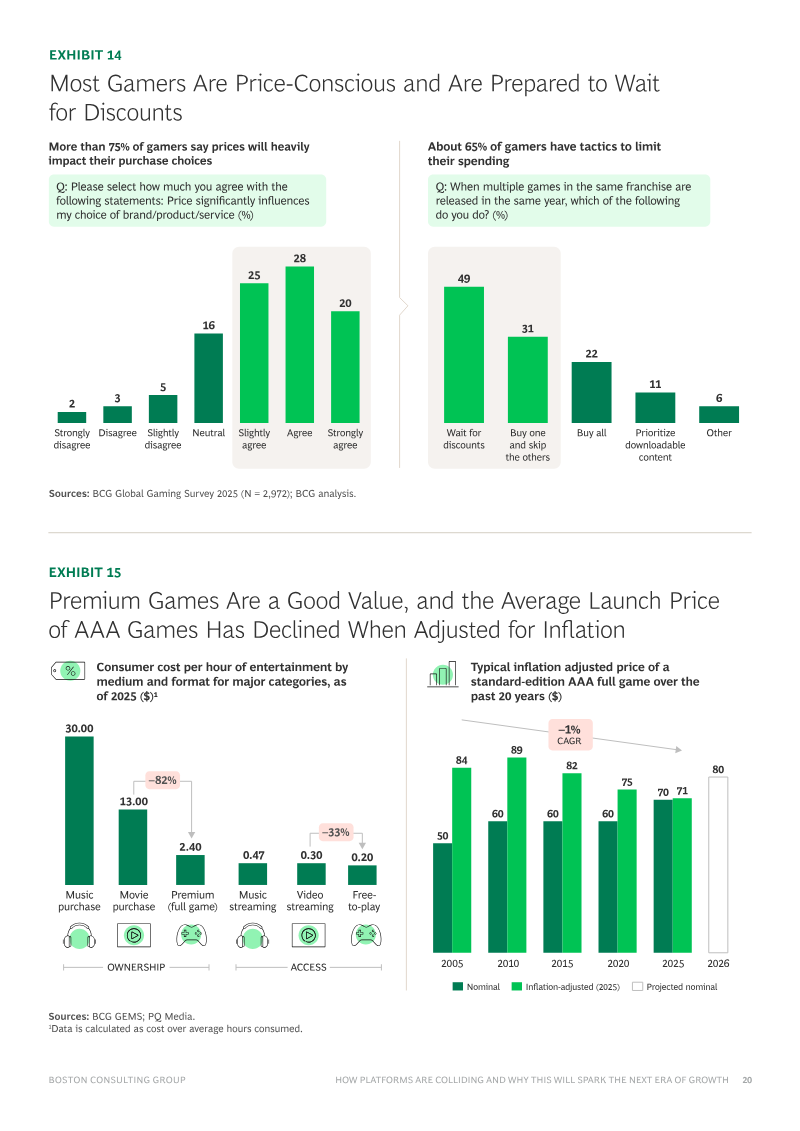
The industry concludes that success in this new landscape requires a departure from traditional "console war" mentalities in favor of ecosystem-based strategies. Developers must master new monetization models, such as tiered pricing and windowing, to protect the value of premium content while navigating a market increasingly defined by infinite digital shelf space and algorithmic discovery.
Pages

Insights
- Cloud gaming revenue is projected to scale from $1.4 billion in 2025 to $18.3 billion by 2030, marking a transition toward hardware-agnostic play.
- The creator economy is expanding rapidly, with payouts to creators on platforms like Roblox and Fortnite projected to exceed $1.5 billion in 2025.
- Generative AI is currently used by 50% of studios to enhance development efficiency, with 20% of new Steam games expected to disclose AI usage by mid-2025.
- Direct-to-consumer distribution is gaining traction, as 33% of adult gamers have already purchased titles via developer web stores to circumvent traditional platform fees.
- Industry success now requires shifting from console-centric competition to ecosystem-based strategies that utilize tiered pricing and windowing to manage content value.
This image from a game industry report displays a stacked bar chart showing the total market size (in units, likely millions or billions) from 2018 to 2030E, with different colored segments representing various components of the market. An overlaid trend line indicates projected annual growth rates, such as +8%, +4%, and +6%, suggesting an overall upward trajectory in the market size over the years.