

Report
Genre and Great Games: Understanding Audiences and Designing Better Mobile Games
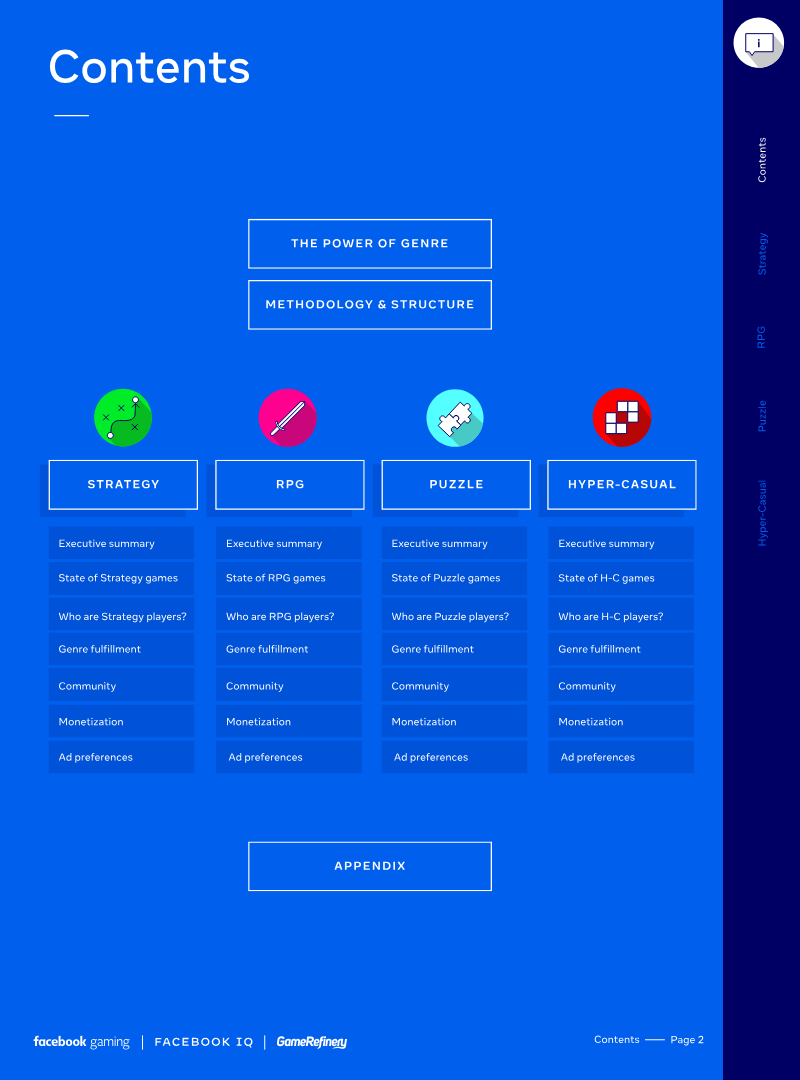
The mobile gaming landscape is currently defined by a significant trend toward genre diversification, where only a small minority of players expect their next title to fall within the same category as their current one. Genre serves as the primary catalyst for game discovery, influencing 49% of players, though specific preferences vary geographically, with RPGs dominating in Japan and Card or Casino games leading in the United States. Despite the popularity of established genres like Strategy and Puzzle, a notable fulfillment gap exists; many players cite boredom and repetitive gameplay as primary reasons for churn, indicating that current titles often fail to meet demands for challenge, accomplishment, and self-expression. To combat player fatigue and drive long-term retention, successful developers are increasingly integrating sophisticated social frameworks and "light meta" features into traditional gameplay loops. In the Strategy and RPG segments, top-grossing titles differentiate themselves through advanced community features such as guild wars, co-op tasks, and item donation systems. Similarly, Puzzle and Hyper-casual games are evolving beyond simple mechanics by incorporating collectibles, decorative skins, and leaderboards. These elements foster a sense of community and progression that extends the lifecycle of a game, with data showing that integrating social and ad-based engagement can increase total minutes played by over 130% several months after installation. Monetization strategies are shifting toward mixed models that balance in-app purchases with rewarded advertising. While Strategy and RPG players remain the highest spenders, over 70% are receptive to in-app ads if they provide tangible progression benefits. Battle Pass systems and RPG-style character layers have emerged as highly effective revenue drivers that mitigate the friction of aggressive direct-purchase prompts. In the Hyper-casual and Puzzle sectors, where purchase conversion rates often fall below 4%, ad-based revenue remains essential. Players across all regions generally accept ads as a fair exchange for free content, though they express a clear preference for longer, less frequent ad breaks over constant interruptions.
MetaAug 2020

Report
Deconstructing the Superstars: The Metrics Behind Hyper-Casual Games 2020 Industry Snapshot
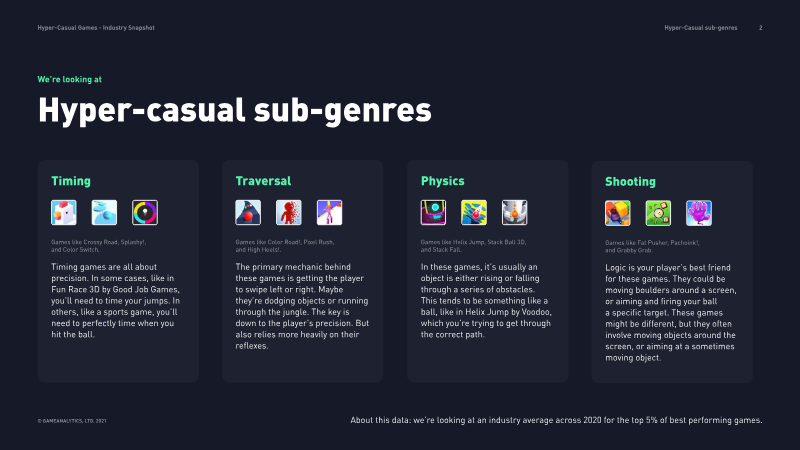
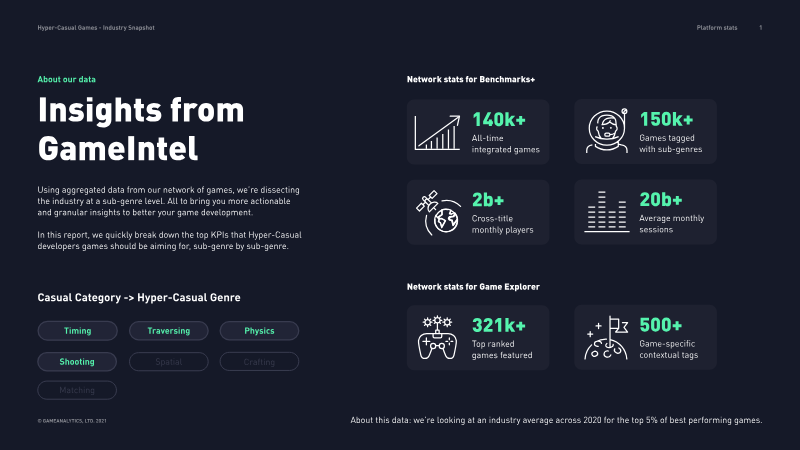
This industry snapshot provides a detailed analysis of the hyper-casual mobile gaming sector throughout 2020, utilizing aggregated data from a network of over 140,000 integrated games and two billion monthly players. The primary thesis centers on identifying the specific performance benchmarks and mechanical traits that define "superstar" titles within this high-growth category. By segmenting the genre into four distinct sub-genres—Timing, Traversal, Physics, and Shooting—the analysis offers granular insights into the mechanics and player behaviors that drive commercial success. Key findings highlight significant geographic variations in player engagement and retention. European markets, specifically France, Germany, Italy, and the Netherlands, lead in Day 1 retention at 49%, while Germany, the Netherlands, and Japan share the top spot for Day 7 retention at 19%. Despite lower retention rates compared to European counterparts, Japan exhibits the highest average playtime at 63 minutes, significantly outpacing the United States at 43 minutes and China at 27 minutes. These statistics underscore the importance of localized performance expectations for developers targeting global audiences. The analysis concludes with actionable strategic recommendations for game development, emphasizing that successful hyper-casual titles must be short, simple, and satisfying. A critical threshold for viability is identified at 40% Day 1 retention; titles falling below this mark are typically deemed unpromising, necessitating either rapid iterative sprints or abandonment. The study advocates for a forgiving gameplay design—often incorporating multiple lives or low-difficulty curves—to cater to the "snackable" nature of the genre. By examining 2020 hits like High Heels! and Slap Kings, the findings illustrate that low production effort combined with high-impact mechanics remains the dominant model for hyper-casual market leaders.
GameIntelJan 2021
Report
Tower Defense Games 2020 Industry Snapshot
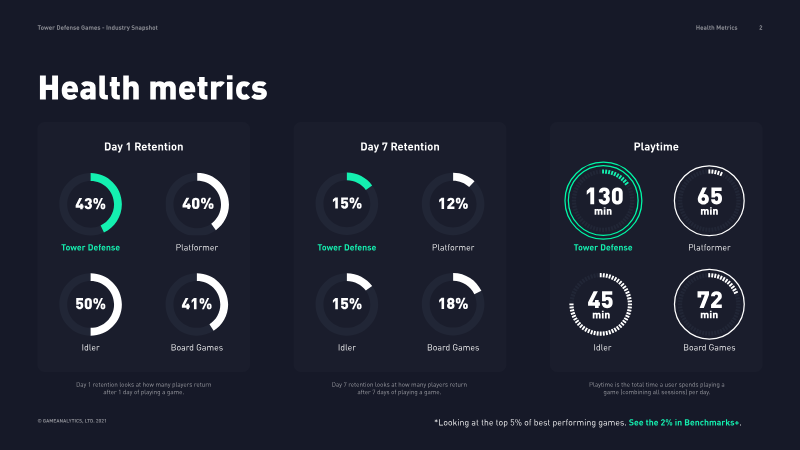
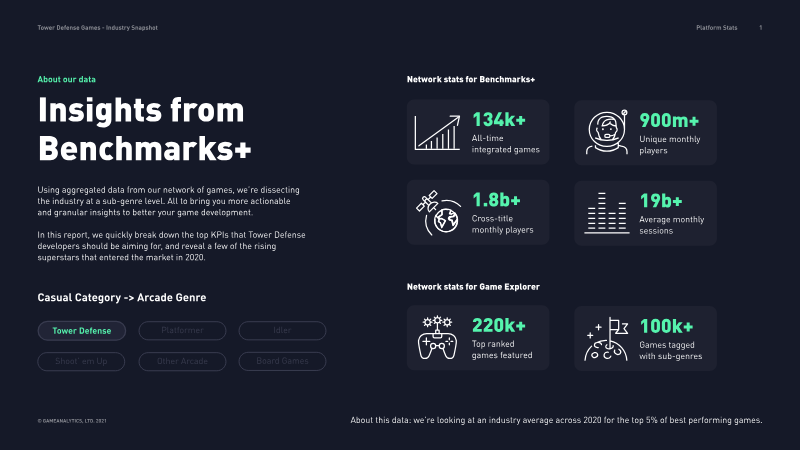
The tower defense sub-genre within the mobile arcade category demonstrated significant monetization potential and engagement depth throughout 2020. Based on an analysis of over 134,000 integrated games and 900 million unique monthly players, the sector is characterized by high-value users and strong global performance. Key financial benchmarks reveal that tower defense titles achieve an average revenue per paying user (ARPPU) of $83, significantly outperforming related genres like board games and idlers. Furthermore, the sub-genre maintains an average revenue per daily active user (ARPDAU) of $1.66 and a daily conversion rate of 3.83%, indicating a highly effective monetization funnel compared to other casual arcade segments. Geographic performance varies by metric, with European and Asian markets showing the strongest engagement. Italy leads in Day 7 retention at 39%, while France records the highest average playtime at 210 minutes. China stands out as the most effective market for monetization, boasting a conversion rate of 8.7%, nearly double that of the United States at 4.6%. These figures suggest that while Western audiences engage deeply in terms of time, Asian markets provide superior direct financial returns. The success of the genre is attributed to its accessible core mechanics, which offer immediate satisfaction and high replayability. Developers benefit from a sustainable content model where minor adjustments to characters or obstacles can shift the entire meta-game without requiring extensive new map design. The integration of meta-features such as daily challenges, cooperative modes, and PvP elements further drives player stickiness. Notable market entrants in 2020, including Kingdom Wars Defense and Rush Royale, exemplify these trends by blending traditional defense mechanics with RPG and merge elements to capture high user ratings and market share.
GameAnalyticsJan 2021
Report
State of the Stream December/2020 Year in Review
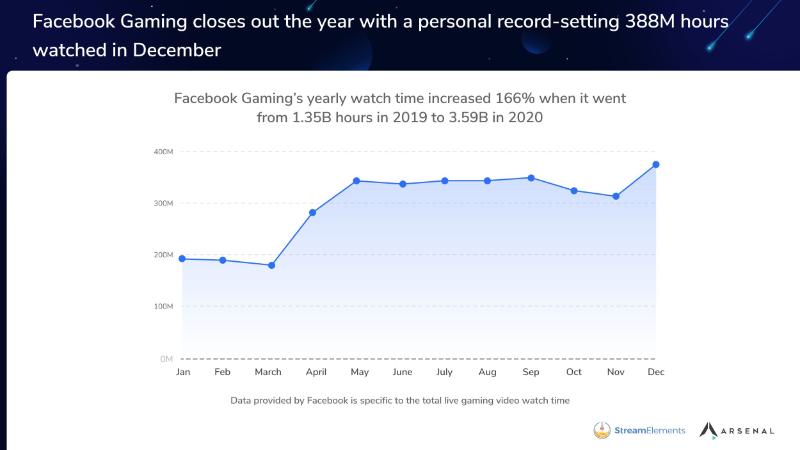
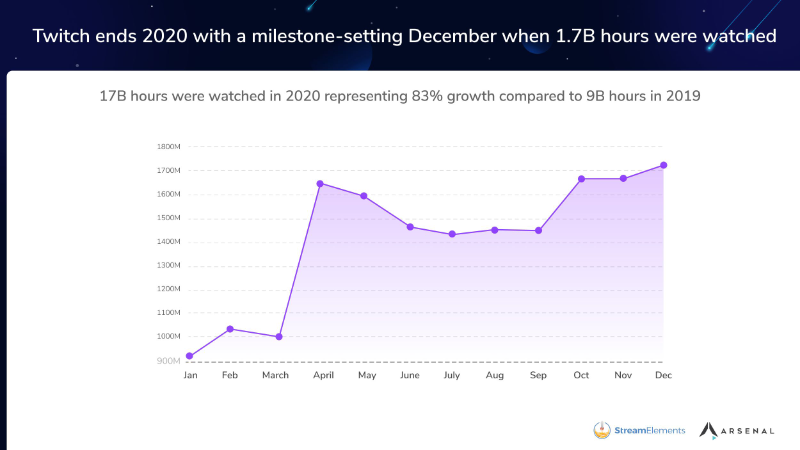
The livestreaming industry experienced unprecedented growth throughout 2020, driven largely by global quarantine measures that accelerated viewership across all major platforms. Twitch remained the dominant force in the market, with the Just Chatting category emerging as the year's most popular content segment, amassing 1.9 billion hours watched. This was followed by established titles like League of Legends at 1.4 billion hours and Fortnite at 904 million hours. While established platforms led the market, nascent services like DLive also saw significant gains, jumping from 9.7 million hours in the first quarter to a consistent range of 15 to 17 million hours for the remainder of the year. The year was characterized by the rapid rise of new intellectual properties and viral sensations. Valorant led the pack of new releases with 737 million hours watched, achieving a massive peak of 334 million hours in April alone. Other breakout hits included Among Us, which peaked at 140 million hours in September, and Fall Guys, which reached 106 million hours in August. By the end of the year, titles like Cyberpunk 2077 and Phasmophobia solidified their positions as top-tier content, while World of Warcraft and Call of Duty: Warzone saw late-year surges in viewership due to new updates and seasonal interest. Individual creator performance was led by xQcOW, who finished 2020 as the most-watched streamer on Twitch. Data provided by StreamElements and ArsenalGG indicates that the industry is shifting toward a mix of traditional gaming and non-gaming content, with Just Chatting maintaining its lead even as major game releases fluctuate. The final month of the year showed a diverse landscape where new titles like Cyberpunk 2077 competed directly with long-standing staples, reflecting a robust and diversifying ecosystem for digital content creators and brands.
StreamElementsDec 2020
Report
Europe's Video Game Industry: Key Facts 2020
The European video games industry experienced steady growth in 2019, reaching a total market turnover of €21.6 billion. This represents a 3% year-on-year increase and a 55% rise since 2014 across key markets. Revenue is increasingly driven by digital ecosystems, with online and app-based income accounting for 76% of the market, while physical sales represent 24%. Within the online segment, 66% of revenue is generated through in-game extras and downloadable content. Console gaming remains the leading hardware category by revenue at 43%, closely followed by mobile and tablets at 40%. Demographic data indicates that 51% of the European population aged 6 to 64 plays video games, with an average player age of 31. While engagement is highest among younger cohorts, 31% of those aged 45 to 64 are active players. Gender representation is nearly balanced, as women make up 45% of the player base and over half of all mobile gamers. On average, European players spend 8.6 hours per week gaming, significantly less than the time spent on social media or television. The industry maintains a strong focus on responsible gameplay through the PEGI age rating system, which is active in over 35 countries. Approximately 67% of parents are aware of these labels, and 85% have established agreements with their children regarding in-game spending. Beyond consumer protection, the sector is expanding its educational footprint. Initiatives like the Games in Schools project, conducted with European Schoolnet, have trained over 4,000 teachers across 73 countries to integrate commercial games into pedagogical frameworks. Data for these findings was primarily extrapolated from the 2019 GameTrack and Newzoo reports, utilizing surveys and sales tracking across major European territories including France, Germany, Italy, Spain, and the United Kingdom. The scope covers the 2019 calendar year while acknowledging the emerging impact of the COVID-19 pandemic on 2020 industry trends.
Interactive Software Federation of EuropeJan 2020