
Report39 pages
Global Cloud Gaming Report: The Infrastructure Edition 2021
This analysis provides a comprehensive overview of the cloud gaming sector in 2021, focusing on how network infrastructure and global economic conditions have accelerated industry adoption. The primary thesis asserts that while the COVID-19 pandemic provided an initial surge in engagement, the market is now transitioning toward sustainable growth driven by technological maturity, strategic business partnerships, and a global semiconductor shortage that has made cloud streaming a viable alternative to expensive, unavailable local hardware.
The scope of the research is global, with specific emphasis on ten subregions and thirty-three individual markets, including deep dives into China, North America, and Western Europe. Data was gathered through a proprietary model incorporating internet connection speeds, urbanization rates, and service availability, supplemented by a July 2021 survey of 6,788 gamers across China, Germany, Japan, and the United States. The methodology utilizes three forecasting scenarios—base, optimistic, and pessimistic—to account for the inherent volatility of a nascent technology market.
Key findings indicate that the global cloud gaming market reached $1.6 billion in revenues and 23.7 million paying users in 2021. Projections suggest significant expansion, with revenues expected to exceed $6.5 billion and paying users reaching 60.7 million by 2024. While North America and Europe currently account for 59% of consumer spending, emerging markets in Asia-Pacific, Latin America, and the Middle East are poised for rapid growth due to the rollout of 5G infrastructure and high consumer interest in regions where gaming hardware is prohibitively expensive.
The analysis concludes that the industry is moving toward a more frictionless user experience through edge computing and B2B partnerships between service providers and telecommunications companies. Despite the closure of some first-party studios, investment remains high among stakeholders like NVIDIA, Haima Cloud, and now.gg. Consumer sentiment remains positive, characterized by high satisfaction levels and low churn, though long-term success depends on overcoming hardware ownership preferences and continuing to improve global network stability.
- The global cloud gaming market reached $1.6 billion in revenue and 23.7 million paying users in 2021, with projections estimating growth to over $6.5 billion and 60.7 million users by 2024.
- North America and Europe currently dominate the sector, accounting for 59% of total consumer spending.
- The global semiconductor shortage has acted as a catalyst for cloud gaming adoption by positioning streaming services as a viable alternative to scarce and expensive local hardware.
- Rapid growth is expected in Asia-Pacific, Latin America, and the Middle East, driven by the rollout of 5G infrastructure and high demand in regions where local gaming hardware is cost-prohibitive.
- Industry stakeholders, including NVIDIA, Haima Cloud, and now.gg, are prioritizing edge computing and B2B partnerships with telecommunications companies to improve service stability and user experience.
+1
NewzooSept 2021

Report53 pages
2021-2025 Mobile Market Forecast
The global mobile application market is poised for substantial expansion, with consumer spending projected to reach $270 billion and annual downloads expected to hit 230 billion by 2025. While the rapid acceleration in adoption triggered by the COVID-19 pandemic is normalizing, the industry maintains a resilient growth trajectory. The App Store and Google Play continue to serve as the primary engines of this economy, sustaining strong compound annual growth rates of 21% and 17%, respectively.
A significant structural shift is underway as non-game applications increasingly drive revenue, with projections indicating that non-gaming spend will surpass gaming revenue on the App Store by 2024. This transition is fueled by the widespread adoption of subscription-based business and lifestyle models, reflecting a permanent change in consumer digital behavior. While mature markets like the United States and Germany show signs of slowing adoption, emerging regions such as India, Indonesia, and the Philippines are becoming critical drivers of volume. Simultaneously, Europe is emerging as a high-growth territory, boasting a 23% compound annual growth rate in consumer spending.
These findings underscore a maturing mobile ecosystem where strategic success depends on navigating the divergence between gaming and non-gaming sectors. As the market evolves, stakeholders must leverage data-driven intelligence to optimize competitive strategies and capitalize on the shifting preferences of a global user base. By focusing on high-growth geographic regions and the rising dominance of subscription-based utility apps, developers and marketers can effectively position themselves within the broader mobile economy through 2025.
- By 2025, global mobile consumer spending is projected to reach $270 billion, with annual downloads expected to hit 230 billion.
- Non-gaming applications are projected to surpass gaming revenue on the Apple App Store by 2024, driven by a shift toward subscription-based business models.
- The Apple App Store and Google Play continue to drive the market with compound annual growth rates of 21% and 17%, respectively.
- Europe is emerging as a high-growth territory with a 23% compound annual growth rate in consumer spending.
- While adoption is slowing in mature markets like the United States and Germany, India, Indonesia, and the Philippines are becoming the primary drivers of download volume.
+2
Sensor TowerJan 2021

Whitepaper95 pages
Libro Blanco del Desarrollo Español de Videojuegos 2021
Fondo Europeo de Desarrollo Regional Foto: Francesco Ungaro (Pexels) LIBRO BLANCO DEL DESARROLLO ESPAÑOL DE VIDEOJUEGOS 2021 1. Íntroduccion 6 2. Tribuna 8 3. Medidas para incentivar la economía de la industria española de desarrollo de videojuegos en 2022 10 4.
- The Spanish video game industry advocates for a tax incentive for video game production, similar to that for the audiovisual industry, to attract international projects and investment. This measure is common in other European countries like France, Italy, Belgium, and the UK.
- The primary funding sources for Spanish studios are their own resources (74%) and self-financing (71%). Funding from publishers increased from 18% to 28%, while bank financing decreased from 16% to 7%.
- Over half (52%) of the Spanish video game industry workforce is under 30 years old, with only 5% over 45. The majority of workers (43%) have 3-6 years of experience.
- 88% of Spanish studios develop their own intellectual properties. 54% self-publish, a decrease from the previous year, while 45% engage in development for third parties/outsourcing, and 22% develop serious games.
- Serious games are a significant niche, with 21% of published games falling into this category. They are primarily directed at the Education sector (85%), followed by Culture (37%) and Tourism (33%).
+1
Fondo Europeo de Desarrollo RegionalJan 2021

Report53 pages
Mobile Market Forecast: 2021-2025
The global mobile application market is entering a period of sustained expansion, with total consumer spending projected to reach $270 billion and annual downloads expected to hit 230 billion by 2025. Although the rapid acceleration in activity triggered by the COVID-19 pandemic is normalizing, the industry maintains strong momentum across both the Apple App Store and Google Play. This growth is underpinned by a fundamental shift in revenue composition, as non-game applications increasingly capture market share. Projections indicate that non-game revenue will account for nearly half of total spending by 2025, with these applications expected to surpass gaming revenue on the App Store as early as 2024.
Geographically, the market landscape is evolving as mature regions and emerging economies follow distinct trajectories. While Asia continues to dominate global download volume, fueled largely by the massive scale of the Indian market, Europe is emerging as the primary engine for future revenue growth with a projected compound annual growth rate of 23 percent. Meanwhile, mature markets such as the United States are experiencing a deceleration in new app adoption, yet they continue to demonstrate significant increases in per-user spending. China, the United States, and India remain the most critical pillars of the global mobile economy.
These trends underscore a maturing ecosystem where developers and marketers must pivot toward high-value non-gaming sectors and capitalize on the rising monetization potential within European markets. As the industry moves toward 2025, the ability to leverage granular data on user demographics, advertising performance, and SDK adoption will be essential for navigating the shifting competitive landscape. The continued resilience of consumer spending, even as download growth stabilizes, confirms that the mobile economy remains a primary driver of global digital commerce.
- The global mobile application market is projected to reach $270 billion in consumer spending and 230 billion annual downloads by 2025.
- Non-game applications are rapidly gaining market share and are expected to account for nearly 50% of total spending by 2025.
- Non-game revenue is projected to surpass gaming revenue on the Apple App Store as early as 2024.
- Europe is positioned as the primary engine for future revenue growth, with a projected compound annual growth rate of 23%.
- While Asia leads in total download volume, the United States is seeing a deceleration in new app adoption alongside an increase in per-user spending.
+1
Sensor TowerJan 2021

Report52 pages
Go Global Mobile Game: New Insights
During the first half of 2021, China-headquartered publishers ascended to the global leadership position in the mobile gaming market, capturing 23% of overseas consumer spend. This 47% year-over-year growth resulted in $8 billion in revenue, driven by a strategic expansion into both established markets like Germany and emerging regions such as Chile and Egypt. The industry landscape is currently defined by a shift toward hybridization, where developers integrate casual mechanics into core genres to broaden audience appeal and sustain engagement.
The 4X March-Battle subgenre remains a dominant global force, leading consumer spend across major economies including the United States and the United Kingdom. While mature titles in the 4X and M3-Meta categories continue to drive massive revenue growth, emerging opportunities are surfacing in high-growth subgenres like Luck Battle and Merge Saga. These "Score Leaders" demonstrate significant increases in consumer spending despite declining download rates, suggesting a market pivot toward deeper monetization of existing user bases rather than raw acquisition.
The market is also experiencing a surge in specialized categories, most notably the Idol Training subgenre, which saw triple-digit growth in both spending and downloads during the first half of the year. In contrast, Puzzle RPGs faced declines in performance, likely due to shifting privacy policies impacting user acquisition strategies. To navigate these fluctuations, publishers are increasingly leveraging "Nijigen" or anime-style aesthetics and gacha monetization models. By combining these thematic elements with cross-subgenre mechanics and social features, developers are successfully maintaining competitive advantages in an increasingly crowded global marketplace.
- China-headquartered publishers captured 23% of overseas mobile gaming consumer spend in H1 2021, achieving $8 billion in revenue and 47% year-over-year growth.
- Developers are increasingly adopting a hybridization strategy, integrating casual mechanics into core genres to broaden audience appeal and improve user engagement.
- The 4X March-Battle subgenre remains the leading driver of consumer spend in major markets like the United States and the United Kingdom.
- High-growth subgenres such as Luck Battle and Merge Saga are seeing increased consumer spending despite declining download rates, signaling a shift toward deeper monetization of existing users.
- The Idol Training subgenre experienced triple-digit growth in both spending and downloads during the first half of 2021.
+1
data.aiJan 2021
Report78 pages
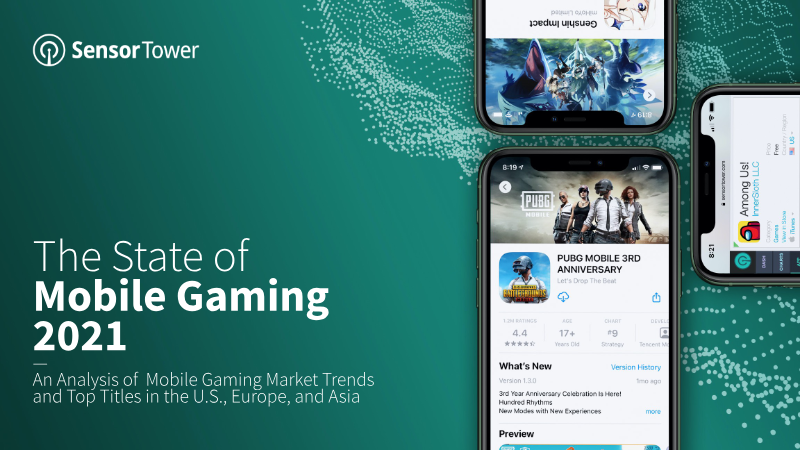
The State of Mobile Gaming 2021
The global mobile gaming industry experienced unprecedented expansion through early 2021, catalyzed by a pandemic-induced surge that drove quarterly revenue to a record $22.2 billion. This growth represents a significant 33% year-over-year increase, with the United States emerging as the premier revenue market, contributing 28% of global consumer spending. While mature markets in North America and Europe reached new financial heights, developing regions—most notably India—served as the primary engines for user acquisition, pushing global downloads to new peaks. Asia remains the largest collective region, surpassing $12 billion in quarterly revenue, anchored by Japan’s robust $5 billion contribution.
Market dynamics shifted toward social and multiplayer experiences, with titles such as Roblox and Genshin Impact dominating both engagement and monetization. RPG and Strategy remain the highest-grossing genres, generating $21.9 billion and $15.1 billion respectively in 2020, though Simulation and Shooter categories exhibited the fastest year-over-year growth. Simultaneously, the Hypercasual genre achieved staggering scale, reaching 3.4 billion downloads in a single quarter. This high-volume segment has become a cornerstone of the mobile advertising ecosystem, where publishers like Zynga and Playrix maintain a dominant share of voice across major digital networks.
Monetization has consolidated almost entirely around the freemium model, which now accounts for 99% of App Store revenue through a combination of in-app purchases, subscriptions, and advertising. Looking forward, the industry is projected to reach $117 billion in annual revenue by 2023, maintaining a compound annual growth rate of 13.5%. While the initial pandemic-driven spike in downloads has stabilized, the sustained increase in consumer spending and the rapid growth of markets in Southeast Asia and Europe indicate a permanent upward shift in the global gaming trajectory.
- The mobile gaming industry reached a record $22.2 billion in quarterly revenue in early 2021, marking a 33% year-over-year increase.
- The industry is projected to reach $117 billion in annual revenue by 2023, maintaining a compound annual growth rate of 13.5%.
- The freemium model now dominates the market, accounting for 99% of App Store revenue through in-app purchases, subscriptions, and advertising.
- RPG and Strategy remain the highest-grossing genres at $21.9 billion and $15.1 billion respectively, while Hypercasual games reached 3.4 billion downloads in a single quarter.
- The United States is the premier revenue market, contributing 28% of global consumer spending, while Asia remains the largest collective region with over $12 billion in quarterly revenue.
+1
Sensor TowerJan 2021

Report19 pages
Beyond 2021: Where Does Gaming Go Next?
The global games market experienced unprecedented acceleration between February 2020 and May 2021, driven by the unique social and economic conditions of the COVID-19 pandemic. This period saw the addition of 173 million new or returning players, bringing the global total to nearly 3 billion. While veteran players—those active before the pandemic—accounted for the majority of market growth by increasing their playtime by 42%, new and returning players represent a significant demographic shift, with 53% of this group being female.
The industry reached $175.8$ billion in revenue in 2021, with mobile gaming accounting for 52% of the total. Projections indicate a compound annual growth rate of 8.7%, with the market expected to surpass $218 billion by 2024. Key drivers for this continued expansion include the rise of gaming subscription services, which provide low-barrier entry points for new players, and the evolution of games into social hubs or "metaverses." These persistent virtual worlds facilitate non-gaming experiences such as virtual concerts and identity expression through avatars, effectively competing with traditional social media.
Engagement is increasingly defined by content consumption beyond active play. Live-streaming audiences are expected to reach 920 million by 2024, and players report a higher intent to continue watching gaming content than to increase their spending or playtime. Furthermore, the industry is moving toward a platform-agnostic future. Cross-platform play and cloud gaming are dissolving traditional hardware barriers, a trend reinforced by global semiconductor shortages and game development delays that have hampered the console and PC segments more than mobile.
This analysis is based on a Newzoo study commissioned by Google, utilizing market sizing models and a survey of over 16,900 respondents across 16 countries in North America, Latin America, Europe, the Middle East, Africa, and Asia-Pacific. The findings suggest that while new players may be less "sticky" than veterans, long-term retention will depend on fostering a holistic gaming culture that integrates social interaction, viewership, and multi-platform accessibility.
- The global games market reached $175.8 billion in 2021 and is projected to exceed $218 billion by 2024, representing a compound annual growth rate of 8.7%.
- Mobile gaming remains the dominant sector, accounting for 52% of total industry revenue.
- The pandemic-driven surge added 173 million new or returning players, 53% of whom are female, bringing the global player base to nearly 3 billion.
- Engagement is shifting toward content consumption, with live-streaming audiences projected to reach 920 million by 2024.
- The industry is transitioning toward a platform-agnostic model, as cross-platform play and cloud gaming dissolve traditional hardware barriers exacerbated by semiconductor shortages.
+1
Google & NewzooJan 2021

Report47 pages
Next-Gen Mobile Games: The Arrival of Cross-Platform and Evolution of High-Fidelity Mobile Games
Mobile gaming has emerged as the dominant force in the global games industry, projected to generate $90.7 billion in 2021 and represent over half of all global gaming revenue. This growth is underpinned by a massive player base of 2.8 billion people, which is expected to expand to 3.2 billion by 2023. The industry is currently undergoing a fundamental transformation as it shifts toward high-fidelity experiences characterized by complex mechanics, 3D graphics, and AAA-quality production. While Western markets still lean toward casual titles, mobile-first regions like China are leading this evolution, with high-fidelity games accounting for nearly 70% of the top-grossing iOS titles in that region.
The convergence of mobile hardware and traditional console capabilities is a primary driver of this trend. Advancements in 5G connectivity, cloud computing, and AI-powered procedural storytelling are enabling developers to port flagship PC and console franchises to mobile devices without sacrificing depth. This technological leap has positioned mobile as a first-class platform where cross-platform play and social connectivity are now essential requirements. Furthermore, the rise of dedicated gaming smartphones and premium 5G-ready devices reflects a growing consumer demand for competitive, mid-core, and immersive experiences that were previously restricted to high-end hardware.
Industry leaders anticipate that mobile gaming will achieve technical parity with high-end PCs and consoles within the next five to ten years. As major publishers increasingly prioritize platform-agnostic development, the gap between Western and Eastern market compositions is expected to narrow. The future of the medium lies in its ability to provide sophisticated, snackable, yet deeply immersive content to a mobile-native generation, solidifying the smartphone as the primary gateway for global gaming engagement.
- Mobile gaming is the industry's dominant force, generating $90.7 billion in 2021 and accounting for over half of total global gaming revenue.
- The global mobile player base is projected to grow from 2.8 billion in 2021 to 3.2 billion by 2023.
- High-fidelity games with AAA-quality production now account for nearly 70% of the top-grossing iOS titles in China, signaling a shift away from casual-only dominance.
- Technological advancements in 5G, cloud computing, and AI are enabling developers to port flagship PC and console franchises to mobile without sacrificing mechanical depth.
- Industry experts expect mobile hardware to reach technical parity with high-end PCs and consoles within the next five to ten years.
+1
NewzooJan 2021

Report38 pages
Global Games Market Report 2021: The VR & Metaverse Edition
The global games market is projected to generate $175.8 billion in 2021, representing a marginal 1.1% year-on-year decline. This temporary contraction is primarily driven by pandemic-related supply chain disruptions, hardware shortages, and significant delays in AAA game releases, which have disproportionately impacted the console and PC segments. Despite these challenges, mobile gaming continues to expand, accounting for $90.7$ billion or 51% of total market revenue. The Asia-Pacific region remains the dominant force in the industry, contributing over half of all global revenue and supporting 55% of the world’s three billion players.
The long-term outlook for the industry remains robust, with total revenues expected to surpass $218 billion by 2024. This growth is fueled by the permanent acceleration of the metaverse trend, which has transitioned video games from mere entertainment products into essential social hubs. This shift has revitalized the virtual reality sector, particularly following the commercial success of the Oculus Quest 2, and has spurred a wave of consolidation through high-profile mergers and acquisitions. While privacy changes such as the removal of Apple’s IDFA present new hurdles for mobile marketing, the segment’s 4.4% growth indicates continued resilience.
Strategic decision-making in this evolving landscape relies on granular performance metrics and consumer insights across dozens of global markets. By tracking key performance indicators such as monthly active users and retention rates for thousands of titles, stakeholders can navigate the complexities of game development and transaction advisory. Ultimately, the integration of social connectivity, immersive hardware, and mobile accessibility ensures that the gaming industry will continue its upward trajectory beyond the immediate disruptions of the early 2020s.
- The global games market is projected to reach $175.8 billion in 2021, a 1.1% year-on-year decline caused by hardware shortages and AAA game delays.
- Mobile gaming remains the industry's largest segment, generating $90.7 billion and accounting for 51% of total market revenue despite privacy-related marketing hurdles.
- The industry is forecast to reach $218 billion in total revenue by 2024, driven by the long-term growth of the metaverse and social gaming hubs.
- The Asia-Pacific region is the primary market driver, contributing over 50% of global revenue and hosting 55% of the world’s three billion players.
- The virtual reality sector has seen a revitalization in commercial interest, significantly bolstered by the success of the Oculus Quest 2.
+2
NewzooJan 2021

Report23 pages
Newzoo’s Global Games Market Report 2021
This analysis explores the trajectory of the global games, esports, and mobile markets for 2021, forecasting a year of sustained engagement despite the easing of pandemic-related lockdowns. The primary thesis suggests that while the explosive growth of 2020 will normalize, gaming habits have become deeply ingrained, positioning the global market to reach 2.8 billion players and $189.3 billion in revenue. Growth is expected to be particularly robust in emerging markets such as Southeast Asia and the Middle East.
Key findings highlight a significant shift toward platform agnosticism and the "metaverse." Cloud gaming is projected to surpass $1 billion in annual revenue for the first time, driven by high-fidelity experiences like Cyberpunk 2077 that bypass expensive hardware requirements. Simultaneously, games are evolving into social platforms for non-gaming events, exemplified by virtual concerts in Fortnite and Roblox. In the hardware sector, supply chain disruptions will continue to limit next-generation console availability, while AAA software delays are expected as the long-term impacts of remote development manifest.
The mobile segment faces a pivotal transition due to Apple’s removal of the Identifier for Advertisers (IDFA), which is expected to disrupt traditional user acquisition and push publishers toward IP-based games and creative marketing. Despite these hurdles, 5G penetration is set to triple, with 16% of active smartphones becoming 5G-ready by year-end. Additionally, Chinese developers are increasingly exporting high-budget, immersive mobile experiences like Genshin Impact to Western markets.
In the esports and streaming sectors, mobile titles are beginning to outperform traditional PC giants in viewership. Organizations are diversifying into lifestyle brands and content-creator collectives to mitigate risk. Furthermore, the industry is placing a heightened focus on social responsibility, with major stakeholders collaborating to reduce toxicity and improve diversity and inclusion in response to growing consumer demand for representative content.
- The global games market is projected to reach 2.8 billion players and $189.3 billion in revenue in 2021, with growth concentrated in emerging markets like Southeast Asia and the Middle East.
- Cloud gaming is expected to exceed $1 billion in annual revenue for the first time, as high-fidelity titles enable users to bypass traditional hardware limitations.
- Apple’s removal of the Identifier for Advertisers (IDFA) is forcing mobile publishers to pivot away from traditional user acquisition toward IP-based games and creative marketing strategies.
- 5G smartphone penetration is set to triple by the end of 2021, with 16% of active devices becoming 5G-ready to support increasingly immersive mobile experiences.
- Games are evolving into social platforms for non-gaming events, as evidenced by virtual concerts hosted within titles like Fortnite and Roblox.
NewzooJan 2021

Report108 pages
Análisis del Impacto del COVID‑19 y Mejores Prácticas de Teletrabajo en el Sector de los Videojuegos: Dec 2020
Resumen Ejecutivo Documento: Análisis del Impacto del COVID‑19 y Mejores Prácticas de Teletrabajo en el Sector de los Videojuegos – Diciembre 2020
El informe examina cómo la pandemia de COVID‑19 transformó los mercados financieros, la producción, el consumo y la organización de la industria de los videojuegos. A partir de datos de mercado, encuestas a desarrolladores y análisis de herramientas de trabajo remoto, se extraen lecciones y recomendaciones que siguen siendo relevantes para 2024‑2025.
1. Mercados y comportamiento del consumidor | Aspecto | Observaciones clave | Implicaciones | |---|---|---| | Acciones | Los índices globales cayeron al inicio de la pandemia, pero los valores vinculados a videojuegos (Tencent, Ubisoft, etc.) superaron a los índices generales, que permanecen por debajo de los niveles pre‑COVID. | Los videojuegos se consolidan como “refugio defensivo” y sector de crecimiento. | | Actividad de juego | Picos de usuarios concurrentes en Steam dejaron de seguir patrones semanales; ventas de hardware (Nintendo Switch) y de software digital se dispararon en marzo‑mayo 2020. Las ventas físicas cayeron drásticamente. | La demanda se desplazó a canales digitales; los fabricantes de hardware que ofrecieron portátiles (Switch, Switch Lite) se beneficiaron. | | Móvil | (Resumen incompleto en el texto) – se indica un aumento de la actividad en plataformas móviles, reforzando la tendencia “play‑anywhere”. | Los estudios con presencia móvil ganaron cuota de mercado y deben reforzar sus pipelines cross‑platform. |
2. Impacto en la fuerza laboral de los estudios IGDA Survey (2 500 devs) 18,5 % detuvieron contrataciones. 13,3 % cancelaron pasantías. 8,6 % (dato incompleto) redujeron equipos o pospusieron proyectos. Consecuencias Reducción de la capacidad de escalar proyectos a medio plazo. Aumento de la incertidumbre laboral y de la carga de trabajo para los equipos existentes.
3. Cambios en los hábitos de consumo de juegos Servicios de suscripción (e.g., Xbox Game Pass, PlayStation Now) mostraron resiliencia y crecimiento sostenido. Nuevas suscripciones aumentaron rápidamente al inicio de la pandemia, pero su ritmo se estabilizó por debajo del crecimiento de los usuarios activos de juegos tradicionales. Implicación: Los modelos basados en suscripción son ahora una pieza central de la estrategia de ingresos y requieren inversión en contenido continuo (LiveOps, DLCs).
4. Esports y eventos competitivos Los torneos migraron totalmente a entornos online. League
- Video game stocks, including companies like Tencent and Ubisoft, outperformed global market indices during the pandemic, establishing the sector as a defensive asset class with long-term growth potential.
- Consumer demand shifted decisively toward digital channels between March and May 2020, causing a sharp decline in physical sales while hardware platforms offering portability, such as the Nintendo Switch, saw significant spikes in sales.
- Subscription services like Xbox Game Pass and PlayStation Now proved resilient, becoming a central pillar of revenue strategy that necessitates ongoing investment in LiveOps and DLC content.
- The IGDA survey of 2,500 developers revealed that 18.5% of studios halted hiring and 13.3% canceled internship programs, leading to reduced project scalability and increased workforce instability.
- Gaming activity patterns shifted during the pandemic, with concurrent user counts on platforms like Steam breaking traditional weekly cycles and mobile gaming activity increasing, reinforcing the industry-wide 'play-anywhere' trend.
+1
IDG ConsultingDec 2020

Presentation54 pages
FY2020 Presentation Material
CyberAgent achieved record-high financial performance in fiscal year 2020, reporting consolidated sales of 478.5 billion yen and an operating profit of 33.8 billion yen. These results represent year-over-year increases of 5.5% and 9.9% respectively, surpassing initial forecasts despite the operational challenges posed by the global pandemic. Growth was primarily catalyzed by the Game business, which generated 155.8 billion yen in sales. This segment benefited from the sustained performance of legacy titles and the successful launch of Project SEKAI, which acquired over two million users within its first three weeks.
The Media business, centered on the ABEMA streaming platform, remains a critical pillar for long-term expansion. ABEMA experienced a 22.6% increase in annual sales to 57 billion yen, supported by a cumulative download base exceeding 59 million. While the segment continues to operate at a loss of 18.5 billion yen due to aggressive up-front investments, these losses are narrowing as new monetization streams mature. Specifically, the rapid adoption of Pay-Per-View services and a seventeen-fold increase in transaction volume for the WINTICKET cycling betting service have diversified the platform's revenue model beyond traditional advertising.
Looking toward fiscal year 2021, the strategic focus shifts toward scaling consolidated sales to 500 billion yen while maintaining a robust financial position. To manage this growth, a new governance structure has been implemented to separate management oversight from execution. Although increased selling, general, and administrative expenses led to a quarterly dip in operating profit during the final months of 2020, the overall trajectory remains positive. The combination of a highly profitable gaming portfolio and the accelerating monetization of digital media assets positions the organization for sustained domestic leadership in the Japanese internet services market.
- CyberAgent achieved record FY2020 performance with 478.5 billion yen in sales and 33.8 billion yen in operating profit, marking year-over-year growth of 5.5% and 9.9% respectively.
- The Game business served as the primary growth engine, generating 155.8 billion yen in sales driven by legacy titles and the successful launch of Project SEKAI, which reached two million users in three weeks.
- The Media segment, anchored by ABEMA, grew annual sales by 22.6% to 57 billion yen, supported by a cumulative base of over 59 million downloads.
- Despite an 18.5 billion yen operating loss in the Media segment due to aggressive investment, monetization is diversifying through Pay-Per-View services and a seventeen-fold increase in transaction volume for the WINTICKET cycling betting service.
- CyberAgent has set a consolidated sales target of 500 billion yen for FY2021 and implemented a new governance structure to separate management oversight from operational execution.
+1
CyberAgentOct 2020
Report34 pages
Creative Industries Statistics: United Kingdom (August 2020)
Creative Industries Statistics United Kingdom August 2020 Released: Official Statistics on Film, High-End 13 August 2020 Television, Animation, Video Games, Next release: Children’s Television, Theatre, Orchestra, Summer 2021 and Museums & Galleries Exhibition Frequency of release: Tax Reliefs https://www.gov.uk/government/org Section 1: Key points and summary 4 1.1 Summary ...
- Since its introduction in 2007, Film Tax Relief (FTR) has supported 3,470 films, accounting for £18.4 billion in UK expenditure. In 2019-20 alone, 300 films claimed FTR with £2.5 billion in UK expenditure.
- High-End Television (HETV) Tax Relief, introduced in 2013, has supported 635 programmes with £5.9 billion in UK expenditure. In 2019-20, 110 programmes claimed HETV tax relief, totaling £1.5 billion in UK expenditure.
- Video Games Tax Relief (VGTR) paid out an estimated £161 million for 2018-19, with 310 claims made by 270 companies. Since its introduction in 2014, the relief aims to promote sustainable production of culturally relevant video games in the UK.
- Theatre Tax Relief (TTR) paid out £71 million in 2019-20 across 1,115 claims, representing 3,580 productions. Since its 2014 introduction, TTR has disbursed £280 million for 12,065 productions.
- Children's Television Tax Relief (CTR) supported 25 British children's TV programmes in 2019-20 with £30 million in UK expenditure. Since 2015, 280 programmes have claimed CTR, totaling £299 million in UK expenditure and £59 million in payments.
HM RevenueAug 2020

Presentation40 pages
3Q FY2020 Presentation Material
CyberAgent’s performance during the third quarter of fiscal year 2020 remained resilient despite the economic disruptions caused by the COVID-19 pandemic. Consolidated sales reached 112.8 billion yen, a marginal year-over-year decrease of 0.7%, while operating profit stood at 8.2 billion yen. By the end of this period, the company had already achieved between 89% and 102% of its full-year operating profit forecasts. This stability was largely driven by the Internet Advertisement segment, which successfully offset declining demand in certain sectors by pivoting toward advertisers benefiting from stay-at-home trends, and the Game business, which generated 36.7 billion yen in quarterly revenue following major title anniversaries.
The media segment, centered on the streaming platform ABEMA, demonstrated significant growth with a 19.2% year-over-year increase in sales to 13.3 billion yen. This expansion was supported by a record 56 million downloads and a surge in the WINTICKET gambling transaction business, which doubled its volume to 7.2 billion yen. Strategic priorities for this segment include reaching one million ABEMA Premium subscribers by late 2020 and leveraging new virtual production technologies, such as Pay-Per-View systems, to enhance monetization.
Looking forward, the corporate strategy focuses on establishing ABEMA as a long-term financial pillar while maintaining market share in the advertising sector through AI-driven efficiency. In the gaming division, the emphasis remains on the dual approach of developing new intellectual properties and extending the lifecycle of existing titles through robust operational management. These efforts are underpinned by a broader commitment to ESG initiatives and information security, ensuring sustainable value creation across the company’s diverse digital portfolio.
- CyberAgent reported 112.8 billion yen in consolidated sales for 3Q FY2020, achieving 89% to 102% of its full-year operating profit forecast despite a marginal 0.7% year-over-year revenue decline.
- The Game business generated 36.7 billion yen in quarterly revenue, bolstered by major title anniversaries and a strategy focused on both new IP development and lifecycle extension for existing games.
- The media segment, anchored by the ABEMA streaming platform, grew sales by 19.2% year-over-year to 13.3 billion yen, supported by 56 million total downloads.
- WINTICKET gambling transactions doubled in volume to 7.2 billion yen, contributing significantly to the media segment's growth.
- The Internet Advertisement segment maintained stability by pivoting toward advertisers benefiting from stay-at-home trends to offset sector-specific demand declines.
+1
CyberAgentJul 2020

Report9 pages
Games Monitor: The Netherlands 2020 Update – COVID Impact
This update provides an analysis of the Dutch video game industry’s performance during 2020, specifically examining the operational and economic impacts of the COVID-19 pandemic. The findings are based on a survey of over 100 industry professionals conducted in late 2020, supplemented by desk research and database updates. The report tracks industry growth, employment trends, and the shift in business dynamics necessitated by global lockdowns.
The Dutch games sector demonstrated resilience, growing from 575 companies in 2018 to 615 by the end of 2020, with total employment reaching approximately 4,000 jobs. While the industry largely transitioned to remote work with minimal impact on output quality, the pandemic created a divide between business-to-consumer (B2C) and business-to-business (B2B) entities. B2C entertainment companies generally benefited from increased consumer demand for home-based entertainment. Conversely, B2B and applied game developers faced significant challenges in the spring of 2020 as client projects were paused or canceled, though some firms in the healthcare sector identified new opportunities.
Operational challenges were primarily centered on human resources and networking. While productivity remained stable for most, employee engagement declined due to the loss of informal office culture, and nearly half of respondents reported increased stress levels. The absence of physical industry events hindered the establishment of new business relationships, with one-third of respondents unable to pursue new business opportunities effectively. Despite these hurdles, the industry maintained its growth trajectory, supported by government labor cost subsidies that assisted approximately 85 companies during the initial lockdown phases. Overall, the sector proved adaptable, leveraging digital infrastructure to sustain operations while navigating a volatile market environment.
- The Dutch video game industry grew from 575 companies in 2018 to 615 by the end of 2020, supporting approximately 4,000 total jobs.
- B2C entertainment developers experienced increased consumer demand during the pandemic, while B2B and applied game developers faced project cancellations and delays.
- Operational productivity remained stable despite the transition to remote work, though nearly 50% of industry professionals reported increased stress levels.
- The loss of physical industry events hindered business development, with one-third of surveyed professionals unable to effectively pursue new opportunities.
- Approximately 85 companies in the sector utilized government labor cost subsidies to maintain operations during the initial 2020 lockdown phases.
+2
Dutch Game GardenJan 2020

Report31 pages
2020 Global Games Market Report
The 2020 Global Games Market Report provides a comprehensive analysis of the video game industry during a landmark year defined by the COVID-19 pandemic and the transition to next-generation consoles. The central thesis posits that gaming has evolved beyond simple entertainment to become a primary social network and a precursor to the "metaverse," with interactive virtual spaces increasingly replacing traditional social media for younger generations.
Key findings indicate that the global games market was projected to generate $159.3 billion in 2020, representing a 9.3% year-on-year increase. Mobile gaming remained the largest segment, accounting for $77.2 billion (48% of the market), driven by low barriers to entry and the rise of hypercasual titles. Console and PC segments followed with $45.2 billion and $36.9 billion respectively. Geographically, the Asia-Pacific region dominated the landscape, generating $78.4 billion—nearly half of all global revenues—while the Middle East and Africa emerged as the fastest-growing region. By the end of 2020, the global player base was expected to reach 2.7 billion, with forecasts suggesting the market would surpass $200 billion and 3 billion players by 2023.
The scope of the analysis covers 30 key markets representing over 90% of global revenues, with data segmented by region (Asia-Pacific, North America, Europe, Latin America, and Middle East/Africa) and platform. Methodology relies on a top-down predictive model integrating macroeconomic data, financial reports from over 100 public companies, and primary consumer research involving 62,500 respondents.
The report concludes that while lockdown measures provided a short-term surge in engagement and revenue, the industry faces long-term shifts toward platform-agnostic cloud gaming and subscription models. Additionally, it highlights the successful globalization of Chinese gaming firms, which pivoted to international markets following domestic regulatory freezes, now leading the industry in mobile development and cross-border investment.
- The global games market generated $159.3 billion in 2020, a 9.3% year-on-year increase, with projections to exceed $200 billion by 2023.
- Mobile gaming is the industry's dominant segment, accounting for $77.2 billion or 48% of total global revenue.
- The Asia-Pacific region is the primary market hub, generating $78.4 billion, while the Middle East and Africa represent the fastest-growing geographic regions.
- The global player base reached 2.7 billion in 2020 and is forecast to surpass 3 billion players by 2023.
- Console and PC gaming segments generated $45.2 billion and $36.9 billion respectively during the 2020 fiscal year.
+1
NewzooJan 2020

Whitepaper22 pages
Game Industry Policy Recommendations for 2019‑2024: Finland
Three ways to bring Finland to the forefront of the digital shift............. 3 More than half of Finns and nearly a third of the global population 4 play games actively............................................................................... The Finnish game industry 5 is the success story of the 21st century.....
- The Finnish game industry is a significant success story, with almost 3,000 employees and a growing number of companies employing over 50 people with turnovers exceeding 10 million euros by 2017.
- Finland has a high rate of game players, with over half of Finns and nearly a third of the global population actively playing games. The average age of a Finnish player is 38 years old.
- The shift to digital distribution revolutionized the game industry, allowing developers to retain 70% of profits, a significant increase from the previous 15-25%. Rovio's Angry Birds was an early beneficiary of this change.
- Key policy recommendations include allocating 100 million euros to address the talent shortage, making Finland an attractive place for digital development, and advocating for Europe to drive global regulation of digital markets.
- Finnish game development has a long history, starting with Chesmac in 1979, and saw its first boom with the advent of WAP in 1999, despite WAP not meeting expectations. Notable successes include Housemarque’s Supreme Snowboarding, Remedy’s Max Payne, and Sulake’s Habbo Hotel.
Neogames FinlandJan 2019

Report45 pages
Evolution of Mobile Esports for the Mass Market
Mobile esports is positioned to become the primary catalyst for growth in the digital games industry over the next five years, leveraging a global player base of 2.53 billion that already surpasses the combined reach of PC and console gaming. In 2018, mobile esports titles generated $15.32 billion in revenue, representing over a quarter of the total mobile market. This expansion is driven by high smartphone penetration and a fundamental shift from high-profile spectator events toward a pervasive ecosystem of regional and online-only competitions. By lowering barriers to entry, the sector has successfully attracted a more diverse and gender-balanced audience than traditional competitive gaming platforms.
The industry is currently transitioning from a publisher-funded marketing tool into a scalable mass-market powerhouse. While professional PC esports historically dominated revenue, mobile esports is rapidly closing the gap, fueled by sophisticated monetization strategies including media rights, sponsorships, and microtransaction-based models like season passes. Asia serves as the epicenter of this evolution, with China and Southeast Asia hosting the most concentrated markets for competitive mobile titles. Significant investments from traditional sports franchises and the expansion of media rights into mainstream cable television further signal the professionalization and maturation of the sector.
Technological advancements in 5G and cloud gaming are disrupting the historical dominance of PC titles by delivering high-quality competitive experiences on accessible hardware. This technological shift, combined with strong government support in Asian markets, has led to explosive growth, exemplified by a 44.5% revenue increase in top Belt and Road markets during the first half of 2019. As industry leaders establish franchised leagues and record-breaking prize pools, the mobile esports model is proving more sustainable and participatory than its predecessors. Ultimately, the sector’s massive reach and superior monetization capabilities ensure its trajectory to overtake PC esports as the dominant global competitive gaming format.
- Mobile esports is projected to overtake PC esports as the dominant global competitive gaming format, leveraging a player base of 2.53 billion that exceeds the combined reach of PC and console gaming.
- Mobile esports titles generated $15.32 billion in revenue in 2018, accounting for more than 25% of the total mobile gaming market.
- The sector is shifting from a publisher-funded marketing tool to a scalable, professionalized industry supported by media rights, sponsorships, and microtransaction-based models like season passes.
- Technological advancements in 5G and cloud gaming are enabling high-quality competitive experiences on accessible hardware, effectively disrupting the historical dominance of PC-based titles.
- Growth in top Belt and Road markets reached 44.5% in the first half of 2019, with Asia—specifically China and Southeast Asia—serving as the primary epicenter for competitive mobile gaming.
+2
Niko PartnersJan 2019

Report65 pages
Games Workshop Group PLC Annual Report 2015
Games Workshop’s 2015 fiscal year was defined by a major leadership transition and significant structural reorganization aimed at stabilizing the business for long-term growth. Under the new leadership of CEO Kevin Rountree, the company reported a profit before taxation of £16.6 million on revenues of £119.1 million. While total revenue saw a 3.5% decline from the previous year—attributed to currency headwinds and internal restructuring—net profit attributable to owners rose significantly from £8.0 million to £12.3 million. This recovery supported a substantial dividend payout of 52 pence per share, totaling £16.6 million, reflecting a core strategic commitment to returning surplus capital to shareholders.
The company’s strategic focus shifted toward global expansion and operational efficiency, particularly through the rebranding of retail outlets to "Warhammer" and the implementation of a "one-man" store model to improve margins. Geographically, North America emerged as a key growth driver, contrasting with revenue declines in the United Kingdom and Continental Europe. A pivotal product milestone was the relaunch of the core fantasy line as Warhammer: Age of Sigmar. Simultaneously, the company expanded its high-margin licensing portfolio, which included 50 interactive products, and invested £6.4 million in a new global ERP system to modernize its digital and logistical infrastructure.
Operating with a workforce of 1,654 employees, the Group maintained a debt-free balance sheet and a strong cash position of £12.6 million. Governance and remuneration policies were updated to align with the new leadership, including a revised profit-sharing trigger based on sales revenue growth rather than operating profit. Despite some non-compliance issues regarding the UK Corporate Governance Code during the leadership handover, the company successfully formalized a global health and safety strategy and introduced a new all-employee Sharesave Plan. These initiatives underscore a transition toward a more standardized, scalable international business model focused on cash generation and disciplined capital allocation.
- Games Workshop reported a profit before taxation of £16.6 million on £119.1 million in revenue for fiscal year 2015, with net profit rising to £12.3 million from £8.0 million the previous year.
- The company maintained a debt-free balance sheet with £12.6 million in cash, supporting a dividend payout of 52 pence per share totaling £16.6 million.
- Total revenue declined by 3.5% due to currency headwinds and internal restructuring, with growth in North America failing to offset declines in the UK and Continental Europe.
- Operational efficiency initiatives included the rebranding of retail outlets to 'Warhammer,' the implementation of a 'one-man' store model, and a £6.4 million investment in a new global ERP system.
- The product portfolio was significantly updated with the relaunch of the core fantasy line as 'Warhammer: Age of Sigmar' and the expansion of a licensing portfolio comprising 50 interactive products.
+1
Games Workshop GroupAug 2015

Report24 pages
El Futuro del Videojuego: Informe de Resultados (España)
The study set out to explore how Spanish video‑game players envision the medium’s evolution, focusing on genre development, social dimensions, technological advances, and the role of online and mobile gaming. It surveyed internet users aged 14‑44 who play at least once a month, using a quota‑based online questionnaire administered to a nationally representative sample of 332 respondents, with a 95 % confidence level and a 5.2 % margin of error. The sample reflects the regional distribution of Spain and is balanced by gender and three age brackets.
Findings show that gaming is as routine as sport or social outings, with 56 % of participants engaging in video games several times a week. Men play more frequently than women (65 % versus 42 % regular play). A striking 90 % anticipate that by 2020 gaming will be ubiquitous across all ages, including grandparents, and 78 % expect it to become highly social, with solitary play becoming rare. Nearly nine out of ten respondents believe most games will be rendered in 3D and that conventional controllers will be replaced by motion‑detecting devices, while older players (35‑44) express the strongest confidence in full‑immersion virtual reality.
The most appealing VR scenarios involve traveling to fantastical locations and learning new skills, interests that are especially pronounced among women, whereas men favor sports‑oriented experiences. Respondents also foresee extensive non‑gaming uses for VR, such as surgical simulation, virtual real‑estate tours, e‑commerce, and education from primary to university levels. Regarding online play, 72 % predict increased activity, with men leaning toward competitive environments and women toward social interaction. Parallel trends include a rise in home‑based cinema, social‑media use, and overall digital entertainment.
- Gaming is a routine activity for 56% of Spanish players, with a notable gender gap where 65% of men play regularly compared to 42% of women.
- 90% of respondents expect gaming to reach ubiquity across all age groups, including older generations, by 2020.
- 78% of players anticipate a shift toward highly social gaming experiences, predicting that solitary play will become a rarity.
- Nearly 90% of participants expect 3D rendering to become the industry standard and predict that motion-detecting devices will replace conventional controllers.
- 72% of respondents foresee an increase in online play, with men primarily favoring competitive environments while women prioritize social interaction.
ADeSeJun 2010