
Whitepaper10 pages
2026 Global Mobile App Marketing Trends White Paper
The white paper argues that the 2025 mobile app market has shifted from volume‑driven traffic growth to value‑centric, technology‑enabled optimization. It identifies a “scissor gap” where the number of active advertisers fell 16.7 % YoY while creatives per advertiser rose 73.3 %, indicating higher competitive thresholds and a focus on creative quality. Market share remains strongest in business & productivity, utilities, entertainment, and finance, but creative volume is dominated by short‑drama, reading, and AI apps. iOS and Android advertising ratios stabilized at 4:6, with iOS advertisers producing more creatives due to higher monetization expectations.
User acquisition spend reached $78 billion, a 13 % YoY increase driven almost entirely by iOS, with e‑commerce, fintech, and betting leading non‑gaming verticals. Video remains the dominant ad format (≈70 % of social inventory), while static and playable ads serve testing, Android traffic, and engagement signals. AI has moved from a marketing tool to a core capability; leading AI apps scale through volume and quality, while many smaller entrants exit due to weak monetization.
Finance apps maintain steady growth focused on user quality, lifetime value, and compliance, contrasting with AI’s rapid scaling. North America remains the most selective market, demanding high content quality and long‑term trust; success here signals scalability elsewhere. The paper concludes that sustainable growth now hinges on creative capability, system efficiency, AI integration, and long‑term value creation rather than sheer traffic volume.
- The mobile app market has shifted from volume-based growth to a quality-focused model, evidenced by a 16.7% YoY decline in active advertisers alongside a 73.3% surge in creatives per advertiser.
- Global user acquisition spend grew 13% YoY to $78 billion, with the increase driven almost exclusively by iOS advertising.
- Video remains the dominant advertising format, accounting for approximately 70% of social media inventory, while static and playable ads are relegated to testing and engagement signaling.
- The iOS-to-Android advertising ratio has stabilized at 4:6, though iOS advertisers maintain higher creative output due to expectations for superior monetization.
- AI has transitioned from a marketing tool to a core operational capability, where success is defined by the ability to scale volume and quality while maintaining sustainable monetization.
+3
SocialPetaApr 2026

Report43 pages
Insight into Global Micro Drama App Marketing for 2026
SocialPeta’s analytics platform aggregates data from more than 90,000 micro‑drama advertisers and 80 million ad creatives across over 55 countries, positioning itself as a key resource for launching and scaling micro‑drama apps worldwide. The platform projects the global micro‑drama market to reach $6 billion by 2026, emphasizing its capacity to deliver actionable insights into advertising strategies, creative formulas, and regional audience preferences.
In 2025 the ecosystem expanded sharply: active advertisers rose by 63.6 % to over 700, while each advertiser produced a 144.9 % increase in creatives, largely thanks to AI‑powered production tools. Southeast Asia dominated genre preferences for “reversal of fortune” and “rebirth” dramas, whereas North America’s high‑paying users gravitated toward premium romance content. Europe remained the largest source of creative volume, underscoring a sustained upward trend in both advertiser participation and output across the globe.
A case study of “Evil Bride vs. The CEO’s Secret Mom” illustrates high‑impact marketing: 44 K creatives generated an estimated 2.7 B impressions in key markets such as the USA, UK, Canada, Australia, and Germany. AI‑driven tools—DSV restructuring and automated cover/clip generation—reduced production time, enabling rapid localization. Short, cliffhanger‑style ads with intense conflict and strong visual hooks outperformed longer formats, driving downloads and engagement in North America, Southeast Asia, Latin America, and the Middle East.
By late 2024 vertical micro‑dramas had matured into a stable ecosystem, with regional preferences—“reversal of fortune” in Southeast Asia and conflict‑driven stories in Latin America—fueling audience engagement. Production scaled to 55 vertical dramas in 2025 through standardized pipelines and AI‑enhanced marketing, allowing faster creative validation, lower volatility, and continuous data‑driven optimization. The analysis stresses that audience‑first IP development—testing concepts in short form before scaling—and multi‑platform, AI‑supported workflows are essential for reducing creative risk and converting IP into long‑term company capital.
- The global micro-drama market is projected to reach $6 billion by 2026, supported by a 63.6% increase in active advertisers to over 700 in 2025.
- AI-powered production tools drove a 144.9% increase in creative output per advertiser in 2025, enabling rapid localization and standardized production pipelines.
- High-impact marketing campaigns, such as the 44,000 creatives for 'Evil Bride vs. The CEO’s Secret Mom,' demonstrate that short, cliffhanger-style ads with intense conflict are the most effective format for driving global engagement.
- Regional audience preferences are highly segmented, with Southeast Asia favoring 'reversal of fortune' and 'rebirth' themes, while North American users gravitate toward premium romance content.
- Europe currently leads the global market in total creative volume, while Latin America and the Middle East show strong engagement with conflict-driven storytelling.
+3
SocialPetaApr 2026

Report69 pages
State of Gaming 2026
The 2026 State of Gaming analysis demonstrates a shifting landscape in which mobile gaming remains the largest driver of downloads—approximately 50 billion in 2025—but its growth rate is slowing. Revenue, however, continues to climb as monetization models mature and lifetime value deepens, especially within hybrid‑casual titles that now generate the most incremental income. In contrast, PC and console platforms experience record revenue growth, with Steam’s premium segment up 32 % and blockbuster releases such as Battlefield 6 capturing significant market share from incumbents. Shooter downloads on these platforms have plateaued, suggesting new titles are primarily cannibalizing existing audiences rather than expanding the category.
Genre‑specific dynamics reveal that strategy games are the only mobile genre to grow in downloads, driven by 4X titles from Eastern developers. Action and shooter games dominate PC/console gains, while hyper‑casual remains the largest download engine but shows a notable lift in time spent, particularly in Tier 2 markets. Casual titles face declining day‑7 retention, indicating a stickiness challenge that could erode long‑term player value.
Live‑ops and acquisition strategies have evolved toward retention‑focused events, multi‑tier season passes, and expedition‑style rewards. These mechanisms now represent the most reliable revenue drivers across competitive genres such as RPG, action, and simulation. Advertising spend remains concentrated on social channels—YouTube, Facebook/Instagram—and high‑attention formats like video, playable, and rewarded ads. Battlefield 6’s pre‑launch spend surpassed Call of Duty titles, leveraging Facebook, Reddit, and desktop display, while its post‑launch strategy pivoted to YouTube with cinematic, celebrity‑hook creatives.
Geographically, the U.S. market shows a skew toward lifestyle and puzzle categories despite lower IAP shares, whereas casino titles exhibit higher spend‑to‑revenue efficiency. Overall, the industry is moving from acquisition toward deeper monetization per user, with indie shooters and simulation titles gaining traction amid intense competition in the shooter segment.
- PC and console platforms are seeing record revenue growth, highlighted by a 32% increase in Steam’s premium segment and the strong market performance of Battlefield 6.
- Mobile gaming growth is slowing despite reaching 50 billion downloads in 2025, with hybrid-casual titles now serving as the primary drivers of incremental revenue.
- Shooter games on PC and console have reached a download plateau, indicating that new releases are cannibalizing existing player bases rather than expanding the total market.
- Retention-focused live-ops, including multi-tier season passes and expedition-style rewards, have become the most reliable revenue drivers for RPG, action, and simulation genres.
- Strategy games are the only mobile genre experiencing download growth, fueled primarily by 4X titles from Eastern developers.
+1
Sensor TowerApr 2026

Report53 pages
Ad Monetization Without Killing Retention
Hybrid monetization can increase revenue without eroding player retention by treating advertisements as an integral part of the game’s design system. Three core ad formats—interstitials, rewarded video (RV), and banners—are positioned strategically through careful gating on level progression, playtime, or cooldown periods. Optimal triggers and placement reduce player frustration while maximizing eCPM, ensuring that monetization flows naturally with gameplay.
Rewarded video is most effective when offered during high‑stakes moments such as revives, boosters, or time‑limited rewards. Leveraging scarcity and urgency in these contexts drives conversions while preserving the core experience. Consistent visual cues, a clear distinction between coin rewards and RV value, and optional “No Ads” bundles further balance monetization with player comfort.
Selling “No Ads” bundles requires thoughtful presentation. Bundles should appear side‑by‑side with regular items, use distinct visual cues and anchoring to convey high value, and be gated behind a minimum purchase tier to protect payer retention. Segmenting ad exposure—capping impressions, applying cooldowns, and filtering out disruptive creatives—maintains a positive user experience while sustaining revenue.
Overall, the strategy blends ad formats with gameplay mechanics, employs scarcity and urgency for rewarded video, and offers high‑value “No Ads” options. This approach delivers robust monetization across diverse segments while safeguarding long‑term player engagement and retention.
- Integrate advertisements as core gameplay design elements rather than external overlays to increase revenue without negatively impacting player retention.
- Deploy rewarded video ads during high-stakes moments—such as revives, boosters, or time-limited rewards—to leverage scarcity and urgency for higher conversion rates.
- Implement strategic gating for ad triggers based on level progression, total playtime, or specific cooldown periods to minimize player frustration.
- Market 'No Ads' bundles by presenting them alongside regular items using clear visual anchoring to establish high value, while gating them behind minimum purchase tiers to protect payer retention.
- Maintain a positive user experience by segmenting ad exposure through impression caps, cooldown timers, and the filtering of disruptive creative content.
+2
Sensor TowerApr 2026

Report90 pages
2026 Global Mobile Gaming Marketing Trends White Paper
The white paper establishes that the mobile‑gaming advertising ecosystem expanded rapidly in 2025, with more than 90 000 active advertisers and an influx of roughly 8 000 new entrants each month, a 22 % year‑over‑year rise. Advertisers increasingly deploy fresh creatives, with video accounting for 74 % of all ads—up 14 % YoY—and Android remains the dominant acquisition platform, though iOS shares grow for mid‑core and hard‑core titles.
Top mobile games in 2025 show a clear split between volume‑driven casual installs and value‑focused premium titles. Casual hits such as Block Blast! and Subway Surfers dominate downloads, while mid‑core and premium games generate the bulk of revenue. Leading spenders—FunPlus, Yotta Games, Hungry Studio—continue to favor Android for lower cost‑per‑install acquisition, whereas iOS delivers higher monetization per install.
The industry is moving from a linear funnel to an “Infinity Loop” model that integrates acquisition, retargeting, and lifecycle actions. Aarki’s supervised‑AI engine demonstrates the potential to boost lifetime value by up to 30 % and reduce campaign volatility, underscoring the importance of a unified, data‑driven full‑funnel strategy that prioritizes LTV over instant installs.
Early‑stage mobile games must achieve rapid habit formation, with 60‑minute daily play by week 2 and high alliance join rates. Paid‑traffic validation is critical; a Day‑1 acquisition rate below 35 % signals readiness issues. Creative trends vary by genre: lightweight socializing and parkour mini‑games dominate SLG spend, RPGs favor narrative IP‑linked content, while simulation and casual titles rely on realistic or viral short‑video formats that capture 70–80 % of impressions.
Regional insights reveal puzzle and casino titles lead creative trends in 2026, with Japan/Korea driving new creative volume and Southeast Asia showing higher local IP acceptance. Mobile‑gaming ad spend rises modestly in Oceania and South America, with Android dominating creative output. A strategic pivot toward “authenticity‑utility‑impact” stacks—solving real problems and building defensible communities—drives higher retention, while AI‑powered creatives accelerate rapid testing. Finally, marketers increasingly adopt AI and programmatic DSPs beyond walled gardens; performance gaps and trust issues persist, yet data show significant install uplifts when CTV campaigns complement mobile ads, indicating a shift toward transparent, scalable programmatic solutions.
- The mobile gaming advertising ecosystem grew by 22% year-over-year in 2025, with over 90,000 active advertisers and 8,000 new entrants joining monthly.
- Video content now accounts for 74% of all mobile game ads, representing a 14% year-over-year increase in usage.
- A shift toward an 'Infinity Loop' marketing model, supported by supervised AI, can increase player lifetime value (LTV) by up to 30% by integrating acquisition, retargeting, and lifecycle management.
- Android remains the primary platform for volume-driven acquisition due to lower costs, while iOS is increasingly favored for mid-core and hard-core titles to maximize monetization per install.
- Early-stage games require a Day-1 acquisition rate of at least 35% and 60 minutes of daily play by week two to signal long-term viability.
+1
SocialPetaApr 2026
Report33 pages
The Future of Consumer Apps: How AI and Game Design Principles Are Reshaping Every Category
The analysis establishes that consumer applications are entering a “Game‑Design 2.0” era, driven by AI‑native personalization, real‑time feedback and progression systems that elevate engagement and monetization across education, fintech, e‑commerce, health, social media and emerging verticals. 2025 data reveal that spending on non‑gaming apps has already eclipsed gaming, with AI emerging as the primary revenue catalyst and consumer demand for instant, tailored experiences rising sharply. Founders are advised to secure durable competitive advantages by harvesting proprietary data from launch, embedding culturally resonant narratives, and deploying AI to deliver seamless, game‑like value rather than merely branding an app as “AI‑powered.”
In high‑friction sectors, AI‑augmented game mechanics transform user behavior. Fintech platforms such as StockGro employ practice portfolios, leaderboards and AI‑personalized tutorials to convert financial discipline into instant gratification. E‑commerce brands like Temu and Bins use algorithmic discovery feeds, mystery boxes and streak rewards to boost retention beyond price. Health apps leverage voice‑first AI coaches with progression loops, while social networks such as TikTok demonstrate that behavioral AI coupled with variable rewards can drive record‑setting daily engagement. These examples underscore how immersive, AI‑enhanced game design unlocks higher user engagement and monetization in traditionally low‑engagement sectors.
BITKRAFT Ventures positions itself as a top‑decile investor in consumer apps, employing equity, crypto and non‑dilutive user acquisition financing to accelerate growth. The firm projects that by 2025 non‑gaming mobile apps will surpass gaming revenue, reaching $150 B by 2030, and that AI‑driven gamification will create rapid, defensible moats. By 2035, BITKRAFT forecasts that at least five consumer non‑gaming companies could exceed $10 B in valuation, highlighting the strategic importance of AI and game design for future digital experiences.
- Non-gaming mobile app revenue is projected to reach $150 billion by 2030, with spending in this sector already surpassing traditional gaming apps as of 2025.
- AI-driven gamification is the primary catalyst for revenue and engagement, with BITKRAFT forecasting at least five non-gaming consumer companies will exceed $10 billion valuations by 2035.
- High-friction sectors are successfully using game mechanics to drive retention; for example, fintech platforms like StockGro use leaderboards and AI-personalized tutorials to convert financial discipline into instant gratification.
- E-commerce brands such as Temu and Bins are leveraging algorithmic discovery feeds, mystery boxes, and streak rewards to boost user retention beyond simple price competition.
- Behavioral AI combined with variable rewards, as demonstrated by TikTok, is the current industry standard for driving record-setting daily engagement across social platforms.
+2
BITKRAFT VenturesMar 2026
Report2 pages
Announcement of Consolidated Results for Fiscal Year Ended March 31, 2025, a Comparison with Prior Year Results, Extraordinary Loss, and Non-operating Expense
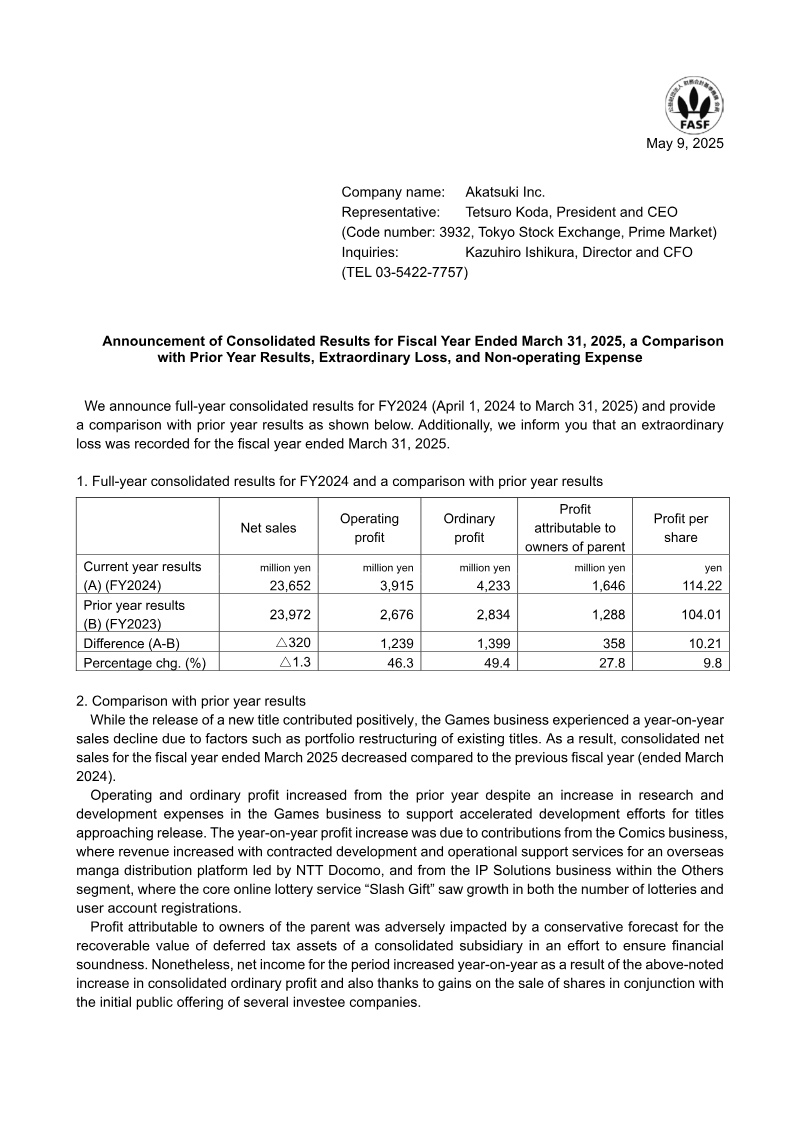
Akatsuki Inc. reported consolidated financial results for the fiscal year ending March 31, 2025 (April 1 2024–March 31 2025). Net sales fell by 1.3 % to ¥23,652 million from ¥23,972 million in FY2023, reflecting a decline in the Games segment despite a new title launch. Operating ordinary profit rose by ¥1,239 million (46.3 %) to ¥3,915 million, driven largely by gains in the Comics and IP Solutions businesses; the former benefited from contracted services for an overseas manga platform, while the latter saw growth in its online lottery service “Slash Gift.” Ordinary profit attributable to parent shareholders increased by ¥1,399 million (49.4 %) to ¥4,233 million, and net income attributable to owners of the parent grew by ¥358 million (27.8 %) to ¥1,646 million, aided by gains on share sales from IPOs of investee companies. A conservative write‑down of deferred tax assets reduced the profit attributable to owners, yet overall net income still improved.
An extraordinary loss of ¥593 million was recorded on the valuation of investment securities held by the group, reflecting a conservative assessment of recoverable value amid market uncertainty. On a non‑consolidated basis, the company recorded a ¥5,776 million provision for doubtful accounts and a ¥2,454 million loss on valuation of shares in affiliated companies; these items are largely confined to consolidated subsidiaries and have a minor impact on the consolidated results. The report covers Japan‑based operations for FY2025, with data derived from internal financial statements and market assessments.
- Akatsuki Inc. reported a 49.4% increase in ordinary profit to ¥4,233 million for the fiscal year ending March 31, 2025, despite a 1.3% decline in net sales to ¥23,652 million.
- Operating ordinary profit grew by 46.3% to ¥3,915 million, driven by strong performance in the Comics segment and the 'Slash Gift' online lottery service within the IP Solutions business.
- Net income attributable to owners of the parent rose 27.8% to ¥1,646 million, bolstered by gains from share sales related to the IPOs of investee companies.
- The Games segment experienced a decline in revenue during FY2025, failing to offset the overall sales decrease despite the launch of a new title.
- The company recorded an extraordinary loss of ¥593 million due to a conservative valuation of investment securities held by the group.
+1
Akatsuki
Report11 pages
Consolidated Financial Statements: Q1 Fiscal Year 2026 (Japan)
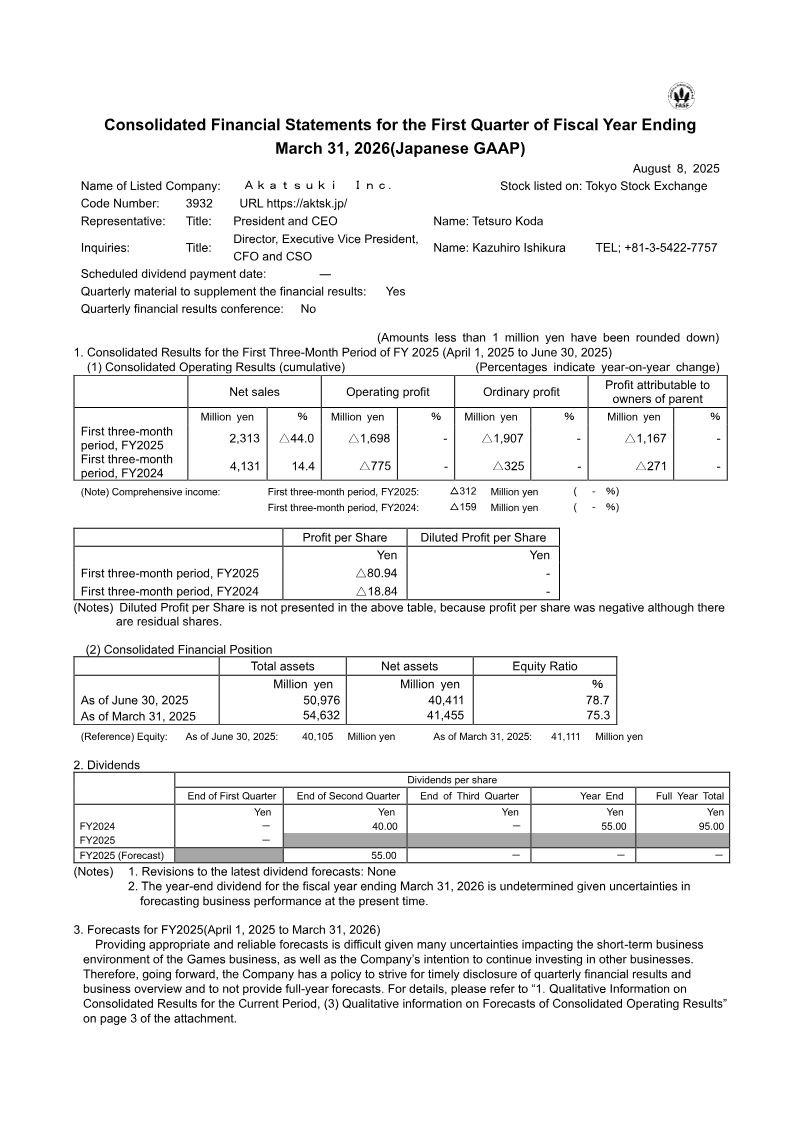
Akatsuki Inc. reports a first‑quarter fiscal 2025 performance that reflects a sharp contraction in its core gaming and comics businesses amid a challenging macro‑environment. Net sales fell 44 % YoY to ¥2,313 million, while operating loss widened to ¥1,698 million from a prior‑year loss of ¥775 million. The company’s consolidated equity ratio improved to 78.7 % from 75.3 %, but total assets declined by ¥3,656 million to ¥50,976 million. Net loss attributable to parent shareholders reached ¥1,167 million, a significant increase from the prior‑year loss of ¥271 million. Comprehensive income deteriorated to ¥312 million in losses versus ¥159 million previously.
Segment analysis shows the Games unit suffered a 52.3 % sales decline and an operating loss of ¥1,643 million; the Comics unit posted a modest profit of ¥20 million after an 18.3 % sales drop; the newly standalone IP Solutions unit grew sales by 167 % and generated a ¥122 million profit, largely driven by the inclusion of subsidiary CRAYON, Inc. The Others segment recorded a small profit after an 80.9 % sales increase.
Geographically, the report focuses on Japan with no disclosed overseas revenue breakdown. Methodologically, figures are based on Japanese GAAP quarterly consolidation; no full‑year forecasts are provided due to market uncertainty. The company maintains a policy of timely quarterly disclosure while withholding FY2026 forecasts, citing volatile gaming and investment conditions.
- Akatsuki Inc. experienced a sharp financial downturn in Q1 FY2025, with net sales falling 44% year-over-year to ¥2,313 million and operating losses widening to ¥1,698 million.
- The core Games unit was the primary driver of the deficit, suffering a 52.3% decline in sales and recording an operating loss of ¥1,643 million.
- Net loss attributable to parent shareholders increased significantly to ¥1,167 million, compared to a ¥271 million loss in the same period last year.
- The IP Solutions unit emerged as a growth driver, increasing sales by 167% and generating a ¥122 million profit, largely due to the inclusion of subsidiary CRAYON, Inc.
- The Comics unit remained marginally profitable at ¥20 million, despite an 18.3% decline in segment sales.
+1
Akatsuki
Report3 pages
Consolidated Results Supplementary Information: Fiscal Year Ended March 2025
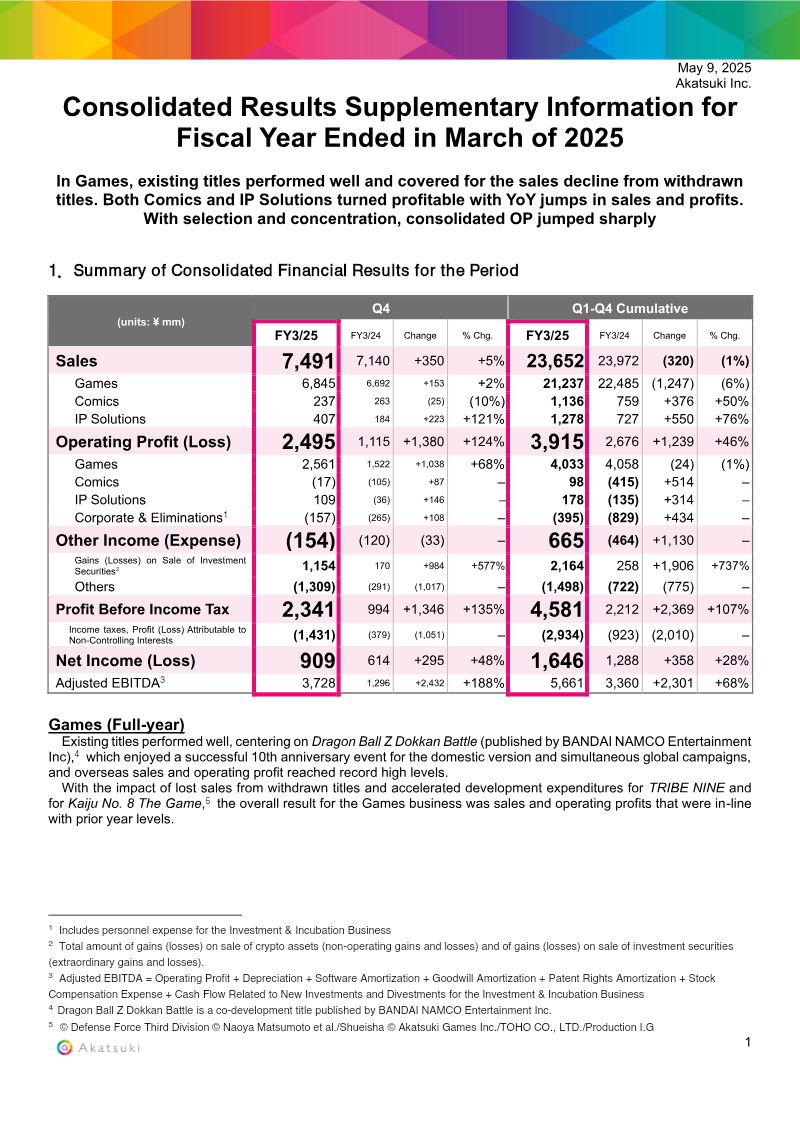
Akatsuki Inc. reported consolidated financial results for fiscal year ended March 2025, showing a modest 5 % increase in sales to ¥23.652 billion compared with the prior year, driven primarily by strong performance of existing games such as Dragon Ball Z Dokkan Battle. Games sales rose 2 % to ¥21.237 billion, while comics and IP Solutions segments returned to profitability with 10 % and 121 % year‑over‑year sales gains, respectively. Operating profit surged 124 % to ¥3.915 billion, largely due to a sharp rise in operating profit from games (68 % increase) and significant gains on the sale of investment securities, which contributed ¥1.154 billion to profit before tax.
Net income increased 48 % to ¥1.646 billion, supported by a 28 % rise in adjusted EBITDA (¥5.661 billion). The company’s balance sheet remained solid, with total assets of ¥54.632 billion and net assets of ¥41.455 billion, while total liabilities decreased to ¥13.177 billion. Cash balances were maintained at ¥33.300 billion, reflecting disciplined working‑capital management.
The results cover the Japanese market and global operations for games, comics, and IP solutions. Methodology includes consolidated financial statements with adjustments for investment and incubation business personnel expenses, and gains on crypto asset sales are classified as non‑operating. Overall, Akatsuki’s selective focus on high‑performing titles and profitable IP solutions has driven a sharp improvement in operating profitability despite the withdrawal of some titles.
- Akatsuki Inc. reported a 124% surge in operating profit to ¥3.915 billion for the fiscal year ended March 2025, driven by a 68% increase in gaming segment profit and ¥1.154 billion in gains from the sale of investment securities.
- Total sales grew 5% year-over-year to ¥23.652 billion, supported by the continued strong performance of existing titles like Dragon Ball Z Dokkan Battle.
- Net income rose 48% to ¥1.646 billion, while adjusted EBITDA increased 28% to ¥5.661 billion.
- The comics and IP Solutions segments returned to profitability, recording year-over-year sales gains of 10% and 121%, respectively.
- The company maintained a strong financial position with ¥33.300 billion in cash and a reduction in total liabilities to ¥13.177 billion.
+1
Akatsuki
Report12 pages
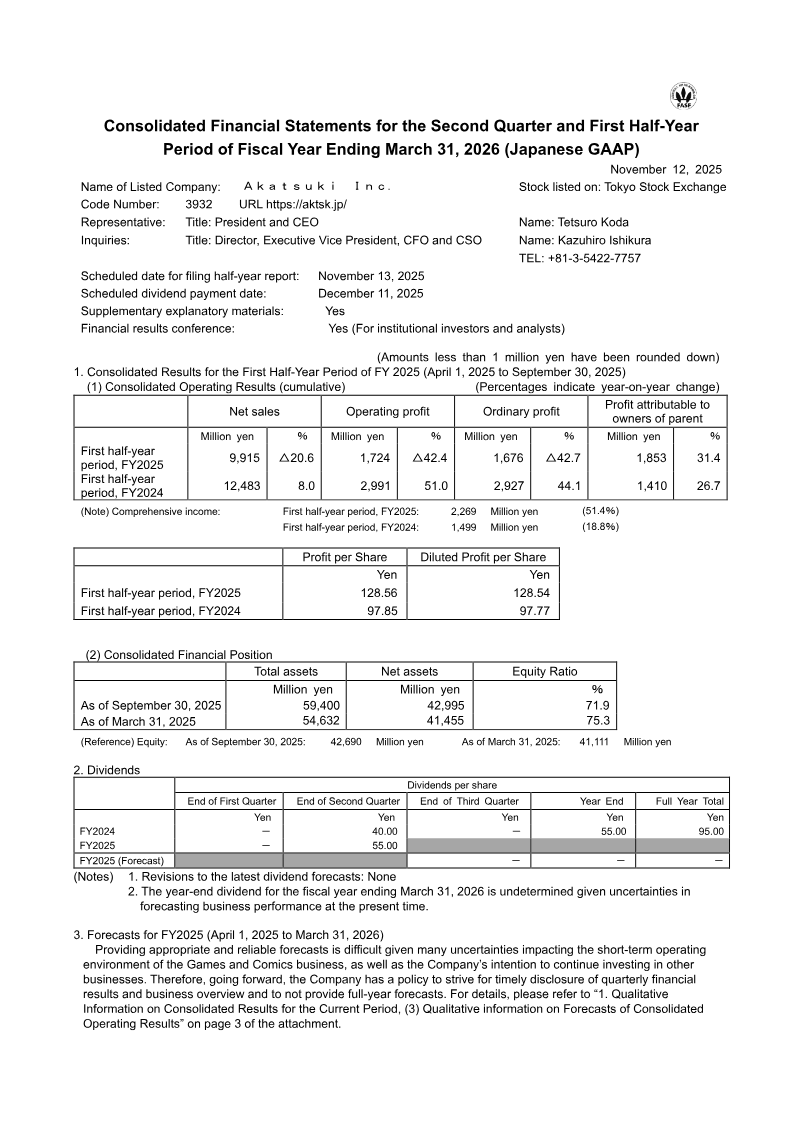
Consolidated Financial Statements: Second Quarter and First Half-Year Period of Fiscal Year Ending March 31, 2026
Akatsuki Inc. reports consolidated financial results for the first half of fiscal year ending March 31, 2026 (April 1–September 30, 2025). Net sales fell 20.6 % YoY to ¥9,915 million, while operating profit declined 42.4 % to ¥1,724 million; ordinary profit dropped 42.7 % to ¥1,676 million, yet net income attributable to parent rose 31.4 % to ¥1,853 million, driven by a higher comprehensive income of ¥2,269 million versus ¥1,499 million the prior year. Profit per share diluted increased from ¥97.85 to ¥128.56. Total assets grew to ¥59,400 million, with net assets rising to ¥42,995 million and equity ratio improving to 71.9 %. Cash flows from operating activities were modest at ¥369 million, while investing cash outflows of ¥5,433 million reflected significant purchases of investment securities and intangible assets. Financing activities generated net inflows of ¥1,775 million, offset by dividends paid of ¥795 million.
Segment analysis shows the Games and Comics business experienced a 23.2 % sales decline to ¥9,257 million and a 41.2 % profit drop, whereas the Entertainment and Lifestyle segment grew sales by 76.1 % to ¥649 million, achieving a 90.7 % profit increase. The Others segment recorded a sharp sales decline and continued losses.
The report notes significant consolidation changes: six new subsidiaries, including CRAYON Inc., were added; Akatsuki Fukuoka was liquidated. Goodwill increased by ¥4,316 million due to acquisitions of Natee and PAPABUBBLE JAPAN. No full‑year forecasts are provided, reflecting uncertainty in the Games and Comics market and ongoing investment plans.
- Akatsuki Inc. reported a 20.6% YoY decline in net sales to ¥9,915 million and a 42.4% drop in operating profit to ¥1,724 million for the first half of the fiscal year ending March 31, 2026.
- Net income attributable to the parent rose 31.4% to ¥1,853 million, with diluted earnings per share increasing from ¥97.85 to ¥128.56.
- The core Games and Comics segment, which accounts for the majority of revenue, saw a 23.2% sales decline and a 41.2% drop in profit.
- The Entertainment and Lifestyle segment showed strong growth, with sales increasing 76.1% to ¥649 million and profit rising 90.7%.
- The company increased goodwill by ¥4,316 million following the acquisitions of Natee and PAPABUBBLE JAPAN, while investing cash outflows reached ¥5,433 million.
+1
Akatsuki
Report4 pages
Consolidated Results Supplementary Information: Q1 FYE March 2026
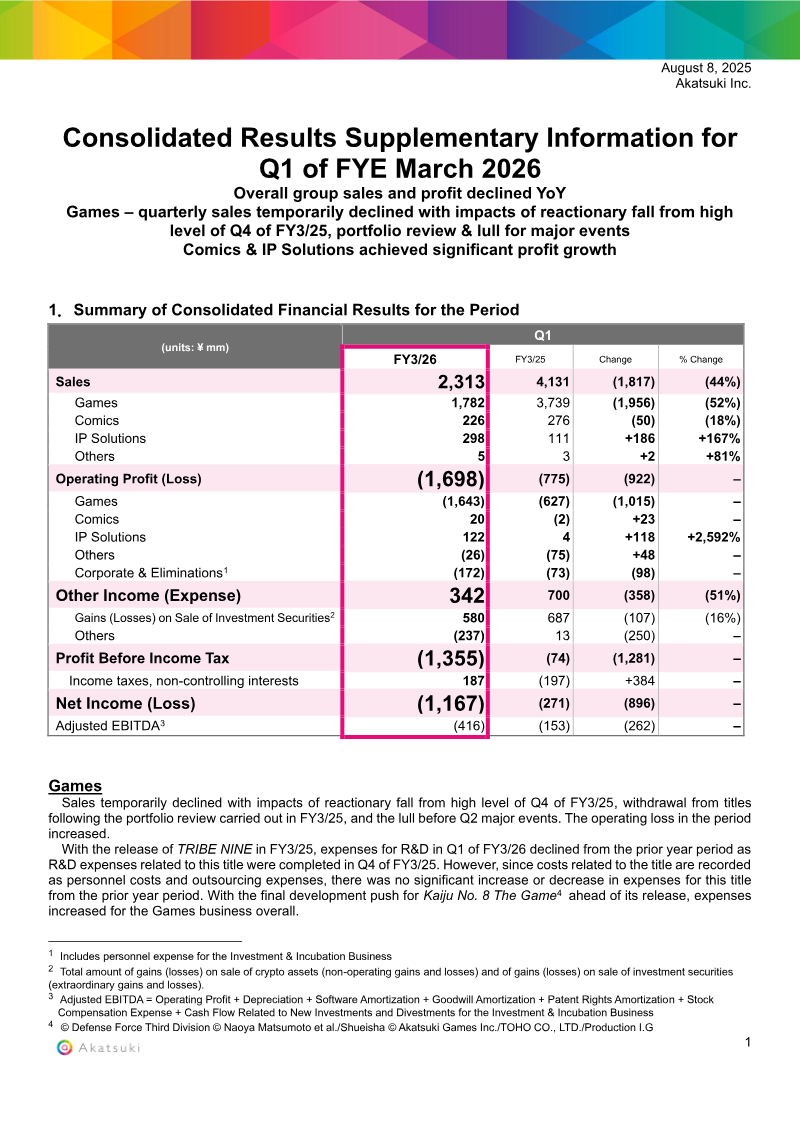
Akatsuki Inc. reported a sharp decline in consolidated sales and operating results for Q1 of the fiscal year ending March 2026, with total group sales falling 44% YoY to ¥2,313 million. The Games segment suffered the largest hit, dropping 52% to ¥1,782 million and recording an operating loss of ¥1,643 million, largely due to a post‑Q4 portfolio review withdrawal and the absence of high‑profile releases. R&D spending for the Games business fell from the previous year as development on “TRIBE NINE” concluded, but costs for the upcoming title “Kaiju No. 8 The Game” increased personnel and outsourcing expenses.
In contrast, the Comics division saw a modest 18% sales decline to ¥226 million but improved profitability, with operating profit rising from a loss of ¥2 million to ¥20 million. The division’s focus on original works and continued service provision to the overseas platform MANGA MIRAI contributed to this turnaround. The IP Solutions unit experienced explosive growth, with sales up 167% to ¥298 million and operating profit soaring 2,592% to ¥122 million, driven by the successful online lottery “Slash Gift” and the inclusion of CRAYON, Inc. in consolidation.
Other income sources shifted, with gains on investment securities decreasing by ¥107 million to ¥580 million. Net income swung from a loss of ¥271 million in FY3/25 to a larger loss of ¥1,167 million in FY3/26, reflecting the combined impact of segment downturns and higher operating losses. Adjusted EBITDA also deteriorated from ¥153 million to a loss of ¥416 million.
The financial data cover the Japanese market, covering all core segments—Games, Comics, IP Solutions, and ancillary services—from Q1 FY3/24 through Q1 FY3/26. The analysis relies on consolidated financial statements, trend tables, and explanatory notes detailing segment performance, expense composition, and investment activity.
- Akatsuki Inc. reported a 44% year-over-year decline in total consolidated sales to ¥2,313 million for Q1 FYE March 2026, resulting in a net loss of ¥1,167 million.
- The Games segment experienced a 52% sales drop to ¥1,782 million and an operating loss of ¥1,643 million, driven by a portfolio review withdrawal and a lack of major new releases.
- The IP Solutions unit achieved significant growth, with sales increasing 167% to ¥298 million and operating profit rising 2,592% to ¥122 million, bolstered by the 'Slash Gift' online lottery and the consolidation of CRAYON, Inc.
- The Comics division improved profitability, turning a ¥2 million loss into a ¥20 million operating profit despite an 18% decline in sales to ¥226 million.
- Adjusted EBITDA for the group deteriorated from a profit of ¥153 million in the previous year to a loss of ¥416 million in Q1 FY3/26.
+1
Akatsuki
Report3 pages
Consolidated Results Supplementary Information: Q2 of FYE March 2026
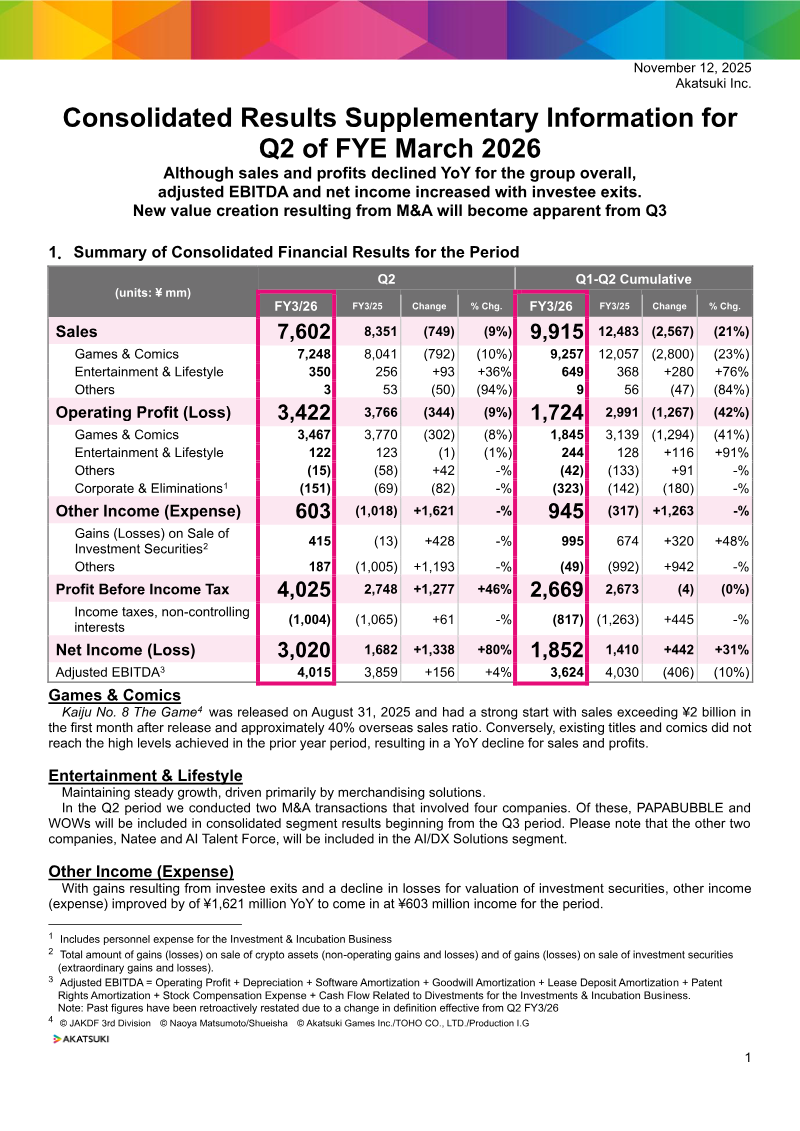
Akatsuki Inc. reported consolidated financial results for the second quarter of fiscal year ending March 2026, noting a 9 % decline in sales to ¥7,602 million and a 21 % drop in cumulative year‑to‑date sales of ¥9,915 million versus the prior year. The Games & Comics segment led the decline with a 10 % YoY fall to ¥7,248 million, while Entertainment & Lifestyle grew 36 % to ¥350 million, and the Others segment contracted sharply by 94 %. Operating profit fell 9 % to ¥3,422 million, largely due to weaker performance in the core Games & Comics unit; however, net income rose 80 % to ¥3,020 million, driven by gains from investee exits and reduced valuation losses on investment securities. Adjusted EBITDA increased modestly by 4 % to ¥4,015 million, reflecting a recovery in operating profitability after the release of new titles.
Key drivers include the launch of “Kaiju No. 8 The Game” on 31 August 2025, which generated over ¥2 billion in first‑month sales with a 40 % overseas share, partially offsetting declines from legacy titles. Two M&A transactions in Q2 added PAPABUBBLE and WOWs to the consolidated segment from Q3, while Natee and AI Talent Force will join the AI/DX Solutions segment. The company’s balance sheet shows a net asset base of ¥42,995 million and cash equivalents of ¥33,272 million, with current liabilities at ¥6,954 million.
Methodologically, the report aggregates data from all operating subsidiaries, restating prior figures to align with revised definitions effective Q2 FY3/26. The analysis covers Japan and international markets, focusing on the Games & Comics, Entertainment & Lifestyle, and AI/DX Solutions segments over a two‑quarter period.
- Akatsuki Inc. reported a 9% decline in quarterly sales to ¥7,602 million, primarily driven by a 10% YoY contraction in the core Games & Comics segment.
- Net income surged 80% to ¥3,020 million, bolstered by gains from investee exits and a reduction in valuation losses on investment securities despite lower operating profit.
- The launch of 'Kaiju No. 8 The Game' on 31 August 2025 generated over ¥2 billion in first-month sales, with 40% of revenue originating from overseas markets.
- Adjusted EBITDA increased by 4% to ¥4,015 million, signaling a recovery in operating profitability following the release of new titles.
- The company expanded its portfolio through Q2 M&A activity, acquiring PAPABUBBLE and WOWs for the Entertainment & Lifestyle segment, and Natee and AI Talent Force for the AI/DX Solutions segment.
+2
Akatsuki
Report11 pages
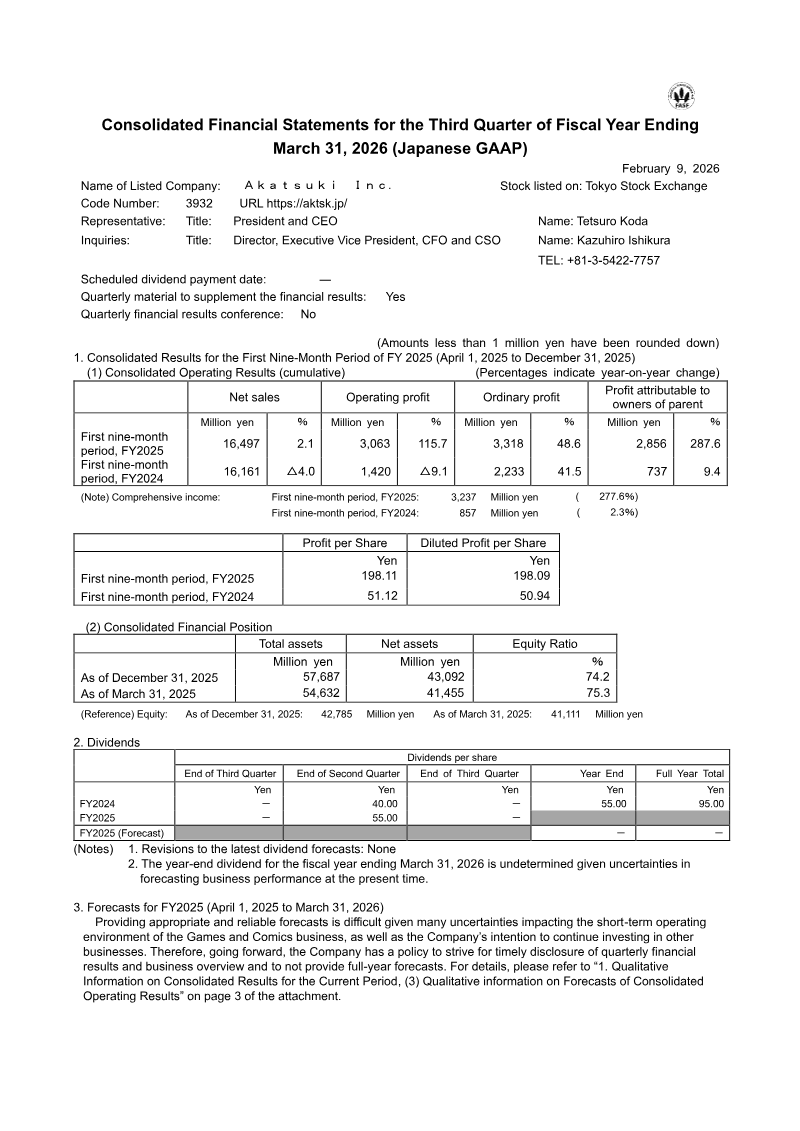
Consolidated Financial Statements for the Third Quarter of Fiscal Year Ending March 31, 2026
Akatsuki Inc. reports consolidated financial results for the first nine months of fiscal year 2025, ending December 31 2025. Net sales rose modestly by 2.1 % to ¥16,497 million, while operating profit surged 115.7 % to ¥3,063 million and ordinary profit increased 48.6 % to ¥3,318 million. Net profit attributable to parent shareholders climbed 287.6 % to ¥2,856 million, yielding diluted earnings per share of ¥198.11 versus ¥51.12 in the prior year. Total assets reached ¥57,687 million, up ¥3,054 million from March 31 2025, with net assets at ¥43,092 million and an equity ratio of 74.2 %. The company’s liquidity remained solid, with cash and deposits at ¥28,377 million and current liabilities down to ¥4,462 million.
Segment performance varied: the Games and Comics business posted a 5.3 % decline in sales but doubled operating profit through cost reductions; Entertainment and Lifestyle achieved a 76.1 % sales increase to ¥1,400 million but saw a modest profit decline; the newly reported AI/DX Solutions segment generated ¥600 million in sales and incurred a ¥112 million loss. The Others segment recorded a sharp 83.1 % sales drop and a ¥51 million loss.
The company added five subsidiaries to its consolidation scope, including CRAYON Inc. and PAPABUBBLE, while excluding Akatsuki Fukuoka after liquidation. No changes to accounting policies were noted. Forecasts for FY 2026 are withheld due to market uncertainties, and the company maintains a policy of not providing full‑year guidance.
- Akatsuki Inc. reported a significant surge in profitability for the first nine months of FY2025, with operating profit rising 115.7% to ¥3,063 million and net profit attributable to parent shareholders climbing 287.6% to ¥2,856 million.
- Net sales grew modestly by 2.1% to ¥16,497 million, while diluted earnings per share increased substantially to ¥198.11 compared to ¥51.12 in the prior year.
- The core Games and Comics business experienced a 5.3% decline in sales but successfully doubled its operating profit through effective cost-reduction measures.
- The Entertainment and Lifestyle segment achieved strong growth with a 76.1% sales increase to ¥1,400 million, though this was accompanied by a modest decline in profit.
- The company launched a new AI/DX Solutions segment, which generated ¥600 million in sales but incurred an operating loss of ¥112 million.
+1
Akatsuki
Report4 pages
Consolidated Results Supplementary Information: Q3 FY3/26
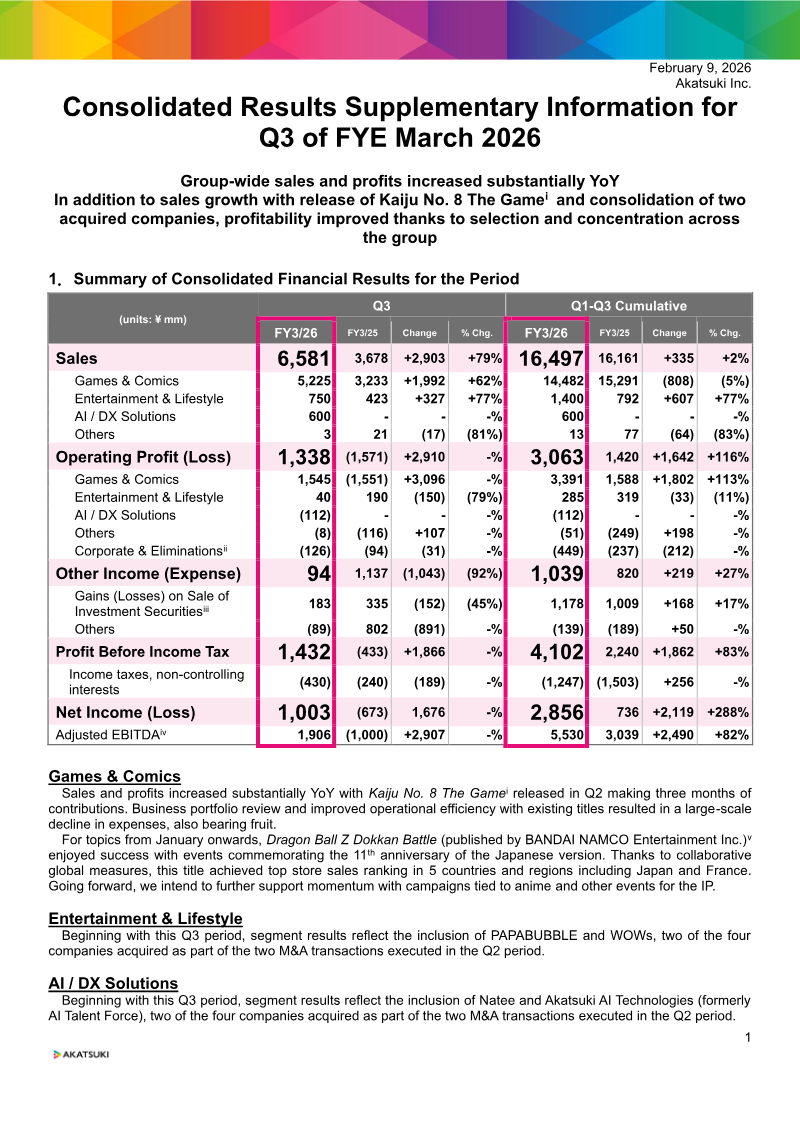
Akatsuki Inc. reported a dramatic turnaround in Q3 FY3/26, with group‑wide sales surging 79 % YoY to ¥6,581 million and operating profit turning from a loss of ¥1,571 million to a gain of ¥1,338 million. The rebound is largely attributed to the Q2 release of “Kaiju No. 8 The Game,” which contributed three months’ worth of revenue, and the consolidation of two acquired entities that broadened the Games & Comics portfolio. Within this segment, sales climbed 62 % to ¥5,225 million and operating profit rose 113 % to ¥1,545 million. The Entertainment & Lifestyle segment also grew 77 % in sales to ¥750 million, driven by the inclusion of PAPABUBBLE and WOWs following Q2 acquisitions. AI/DX Solutions, newly integrated through Natee and Akatsuki AI Technologies, generated ¥600 million in sales but recorded a loss of ¥112 million.
Net income for the quarter reached ¥1,003 million, a 288 % increase from the prior year’s loss of ¥673 million. Adjusted EBITDA expanded 82 % to ¥1,906 million, reflecting strong operating performance and effective cost management. Cash balances rose to ¥33,266 million, while total assets stood at ¥57,687 million. The company’s balance sheet remained solid with net assets of ¥43,092 million and total liabilities of ¥14,595 million.
Methodologically, figures are presented in Japanese yen (millions) and include retroactive restatements from Q2 FY3/26 due to prior period errors. The report covers the entire Japanese market and global operations, focusing on Q3 FY3/26 with cumulative data for FY3/26 versus FY3/25.
- Akatsuki Inc. achieved a significant financial turnaround in Q3 FY3/26, reporting ¥6,581 million in group-wide sales (up 79% YoY) and an operating profit of ¥1,338 million, reversing a prior-year loss of ¥1,571 million.
- The primary growth driver was the Q2 release of 'Kaiju No. 8 The Game,' which contributed three months of revenue and helped boost Games & Comics segment sales by 62% to ¥5,225 million.
- Net income reached ¥1,003 million, a 288% increase compared to the ¥673 million loss recorded in the same period last year.
- The Entertainment & Lifestyle segment grew 77% to ¥750 million in sales, bolstered by the integration of newly acquired entities PAPABUBBLE and WOWs.
- The newly integrated AI/DX Solutions segment, comprising Natee and Akatsuki AI Technologies, generated ¥600 million in sales but incurred an operating loss of ¥112 million.
+1
Akatsuki
Report8 pages
Consolidated Financial Statement: Q1 2019
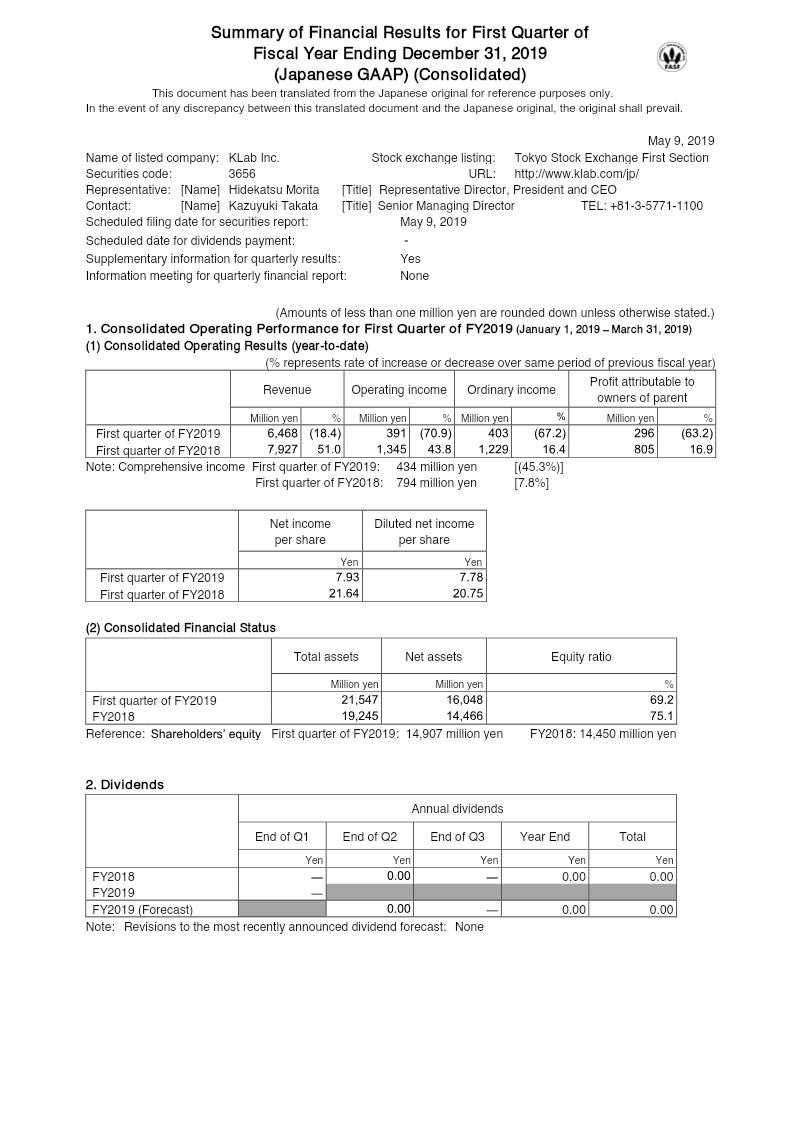
KLab Inc. reported consolidated financial results for the first quarter of fiscal year 2019 (January 1–March 31, 2019). Revenue declined 18.4 % to ¥6,468 million compared with the same period in FY2018, largely due to a drop in sales of the Love Live! School Idol Festival title. Operating income fell 70.9 % to ¥391 million, ordinary income decreased 67.2 % to ¥403 million, and profit attributable to owners of parent contracted 63.2 % to ¥296 million. Net income for the quarter was ¥303 million, a 65 % reduction from ¥805 million in FY2018. Comprehensive income also fell sharply, from ¥794 million to ¥435 million, reflecting a 45.3 % increase in other comprehensive income components.
Total assets rose to ¥21,547 million, up ¥2.3 billion from the prior year’s end, driven by increases in operating investment securities and software in progress. Net assets increased to ¥16,048 million, an addition of ¥1.58 billion, largely due to equity in a newly consolidated subsidiary. The equity ratio declined from 75.1 % to 69.2 %. Current liabilities decreased, while long‑term debt increased, contributing to the shift in leverage.
KLab forecasted FY2019 revenue between ¥32 billion and ¥40 billion, operating income between ¥1 billion and ¥4.5 billion, ordinary income in the same range, and profit attributable to owners between ¥700 million and ¥3.1 billion. The company noted that future results will depend heavily on the success of new game releases and market conditions, and it applied a range‑based presentation for forecasts. No dividends were declared for FY2019, and no significant changes in shareholders’ equity or accounting policies occurred during the quarter.
- KLab Inc. experienced a significant Q1 2019 downturn, with revenue falling 18.4% to ¥6,468 million and operating income dropping 70.9% to ¥391 million compared to the same period in 2018.
- The primary driver for the revenue decline was a decrease in sales for the 'Love Live! School Idol Festival' title.
- Profit attributable to owners of the parent contracted by 63.2% to ¥296 million, while net income fell 65% to ¥303 million.
- Total assets increased by ¥2.3 billion to ¥21,547 million, primarily due to growth in software in progress and operating investment securities.
- The company’s equity ratio declined from 75.1% to 69.2% as a result of shifting leverage, characterized by a decrease in current liabilities and an increase in long-term debt.
+1
KLab
Report8 pages
Consolidated Financial Report: Q2 2020
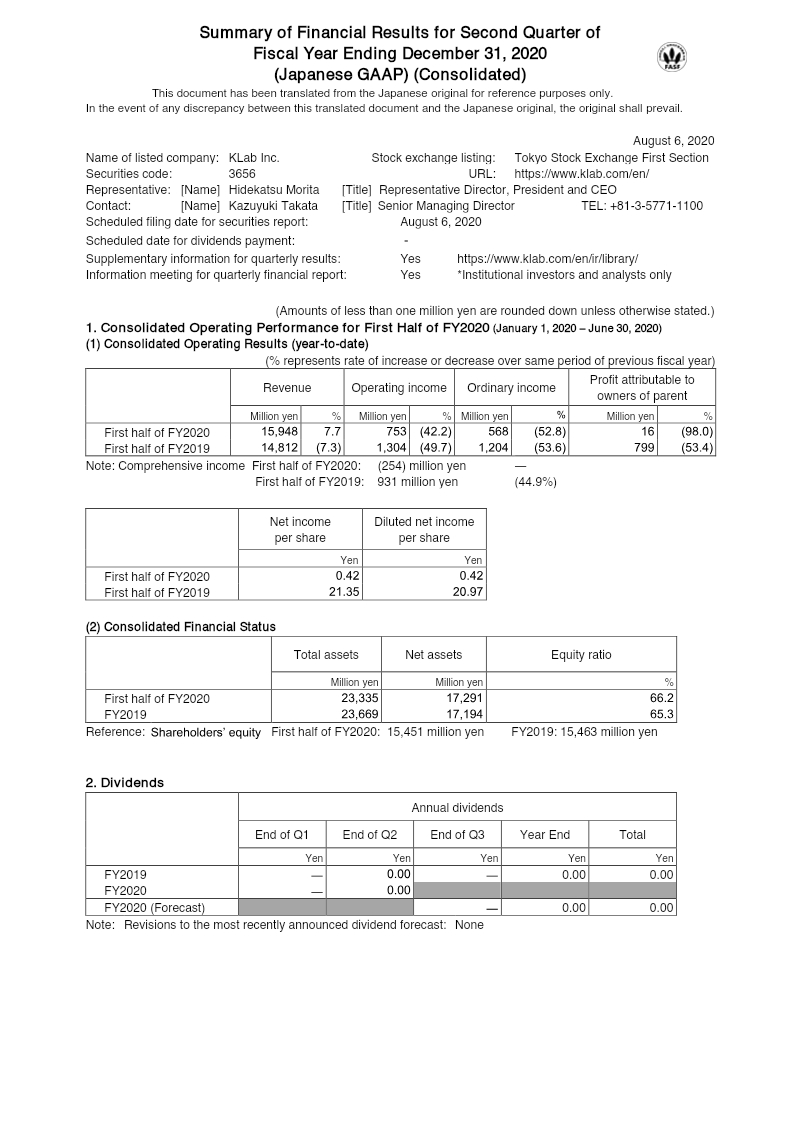
KLab Inc. reports consolidated financial results for the first half of fiscal year 2020 (January 1–June 30, 2020). Revenue rose to ¥15.95 billion from ¥14.81 billion in the same period of FY2019, a 7.7 % increase, driven by growth in the game business and other businesses such as research & consulting. Operating income fell sharply to ¥753 million from ¥1,305 million, a 42.2 % decline, largely due to higher cost of sales and lower gross profit margin. Ordinary income dropped 52.8 % to ¥568 million, and profit attributable to owners of parent fell 98 % to ¥16 million. Net income turned negative, with a loss of ¥44 million versus a profit of ¥21 million in FY2019, reflecting significant foreign exchange losses and impairment charges. Comprehensive income also turned negative at ¥254 million compared with a positive ¥932 million in FY2019, driven by valuation losses on available‑for‑sale securities and foreign currency translation adjustments.
Total assets decreased modestly to ¥23.34 billion from ¥23.67 billion, while shareholders’ equity remained stable at ¥17.29 billion, giving an equity ratio of 66.2 %. Net assets grew slightly to ¥17.29 billion, and the company maintained a strong liquidity position with cash and deposits of ¥6.38 billion. No dividends were declared for FY2019 or FY2020, and the forecasted dividend remained unchanged. The report covers Japan only, covering KLab’s core game development and ancillary businesses, with data derived from consolidated financial statements under Japanese GAAP. The methodology follows standard accounting principles without restatements or significant policy changes during the period.
- KLab Inc. reported a 98% decline in profit attributable to owners of the parent to ¥16 million for the first half of 2020, compared to the same period in 2019.
- Operating income fell 42.2% to ¥753 million, driven by an increased cost of sales and a lower gross profit margin.
- Revenue grew by 7.7% to ¥15.95 billion, supported by performance in the company's core game business and research and consulting services.
- The company recorded a net loss of ¥44 million for the first half of 2020, primarily due to significant foreign exchange losses and impairment charges.
- Comprehensive income turned negative at ¥254 million, impacted by valuation losses on available-for-sale securities and foreign currency translation adjustments.
+1
KLab
Report8 pages
Quarterly Financial Report: Q3 2020
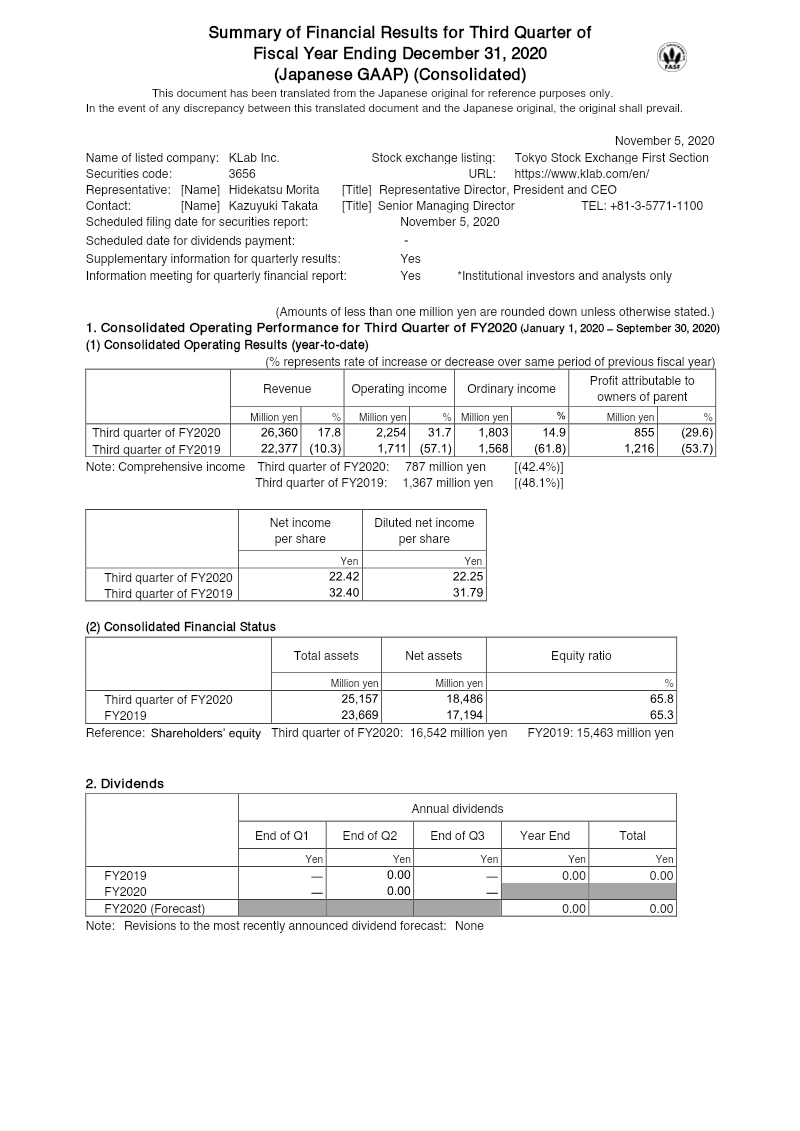
KLab Inc. reports a robust third‑quarter performance for fiscal year 2020, with revenue rising to ¥26.36 billion from ¥22.38 billion in the same period of FY2019, a 17.8 % increase driven by its game business segment. Operating income grew to ¥2.25 billion, up 31.7 % year‑over‑year, while ordinary income reached ¥1.80 billion, a 14.9 % rise. Net profit attributable to the parent fell to ¥855 million, a 29.6 % decline, largely due to higher foreign‑exchange losses and an impairment charge of ¥498.9 million on investments. Comprehensive income for the quarter was ¥787 million, down 42.4 % from ¥1.37 billion in FY2019, reflecting a reversal of the valuation gain on available‑for‑sale securities and foreign‑currency translation adjustments.
Total assets increased to ¥25.16 billion, with current assets up 13.8 % and non‑current assets slightly down due to a reduction in intangible software assets. Net assets rose to ¥18.49 billion, and the equity ratio improved to 65.8 %. Outstanding shares averaged 38.17 million, with no treasury shares held at quarter‑end.
The company maintained a dividend policy of zero for FY2020, with no forecasted dividends. No changes to accounting principles were reported, and the effective tax rate was applied consistently across periods. The report covers Japan‑based operations for FY2020 (January 1–September 30) and compares results to the same period in FY2019.
- KLab Inc. reported a 17.8% year-over-year revenue increase to ¥26.36 billion for the first nine months of FY2020, driven by strong performance in its game business segment.
- Operating income rose 31.7% to ¥2.25 billion, while ordinary income grew 14.9% to ¥1.80 billion compared to the same period in FY2019.
- Net profit attributable to the parent fell 29.6% to ¥855 million, primarily due to foreign-exchange losses and a ¥498.9 million impairment charge on investments.
- Comprehensive income declined 42.4% to ¥787 million, impacted by a reversal of valuation gains on available-for-sale securities and foreign-currency translation adjustments.
- The company’s financial position strengthened with net assets rising to ¥18.49 billion and an improved equity ratio of 65.8%.
+1
KLab
Report9 pages
Q1 2021 Financial Statement
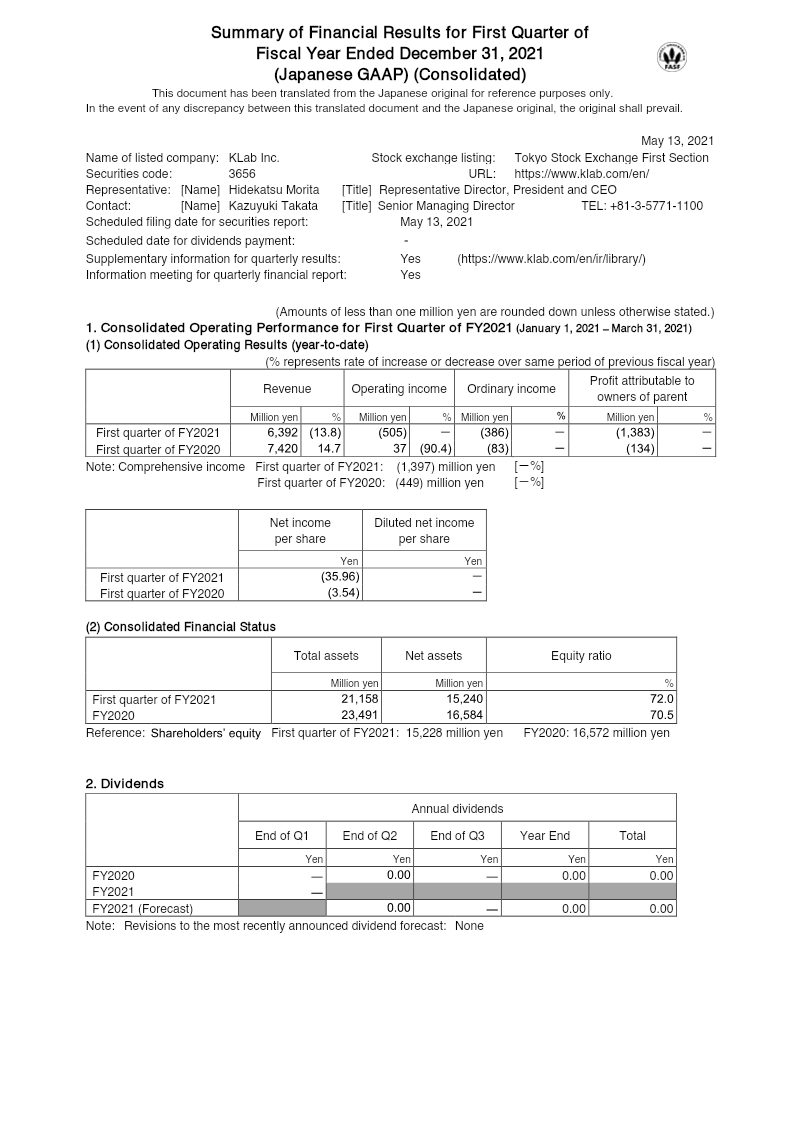
KLab Inc. reported a sharp decline in first‑quarter FY2021 operating performance compared with the same period of FY2020. Revenue fell to ¥6,392 million from ¥7,420 million, a 13.8% drop, while operating income turned negative at ¥(505) million versus a profit of ¥37 million in FY2020. Ordinary income and profit attributable to the parent also swung from a ¥(83) million loss to a ¥386 million loss, reflecting significant impairment charges of ¥1.54 billion on software assets that dominated the extraordinary loss line item. Comprehensive income deteriorated to a ¥1,397 million loss from a ¥449 million loss in FY2020, largely driven by the same impairment and foreign‑exchange losses.
Total assets decreased to ¥21.16 billion from ¥23.49 billion, with net assets falling to ¥15.24 billion and the equity ratio contracting from 70.5% to 72.0%. Cash and deposits were ¥6.38 billion, while current liabilities stood at ¥5.10 billion, leaving a modest working‑capital cushion. No dividends were declared for FY2021, and the company maintained its share‑repurchase program capped at ¥500 million.
The quarter’s financials were prepared under Japanese GAAP, with no changes to accounting principles or estimates. The company’s segment analysis shows the game business as the sole revenue generator, with a reported impairment loss of ¥1.54 billion recorded in this segment. A subsequent acquisition of GlobalGear Co., Ltd. was announced, aimed at expanding KLab’s casual‑game portfolio and global reach.
- KLab Inc. reported a 13.8% year-over-year revenue decline in Q1 2021, falling to ¥6,392 million from ¥7,420 million.
- Operating income swung to a ¥505 million loss compared to a ¥37 million profit in the same period of 2020.
- The company recorded a significant ¥1.54 billion impairment charge on software assets, which was the primary driver of a ¥386 million loss attributable to the parent company.
- Comprehensive income deteriorated significantly to a ¥1,397 million loss, exacerbated by the software impairment and foreign-exchange losses.
- Total assets decreased to ¥21.16 billion from ¥23.49 billion, though the company maintains a working-capital cushion with ¥6.38 billion in cash against ¥5.10 billion in current liabilities.
+1
KLab
Report8 pages
Financial Report: Q2 2021
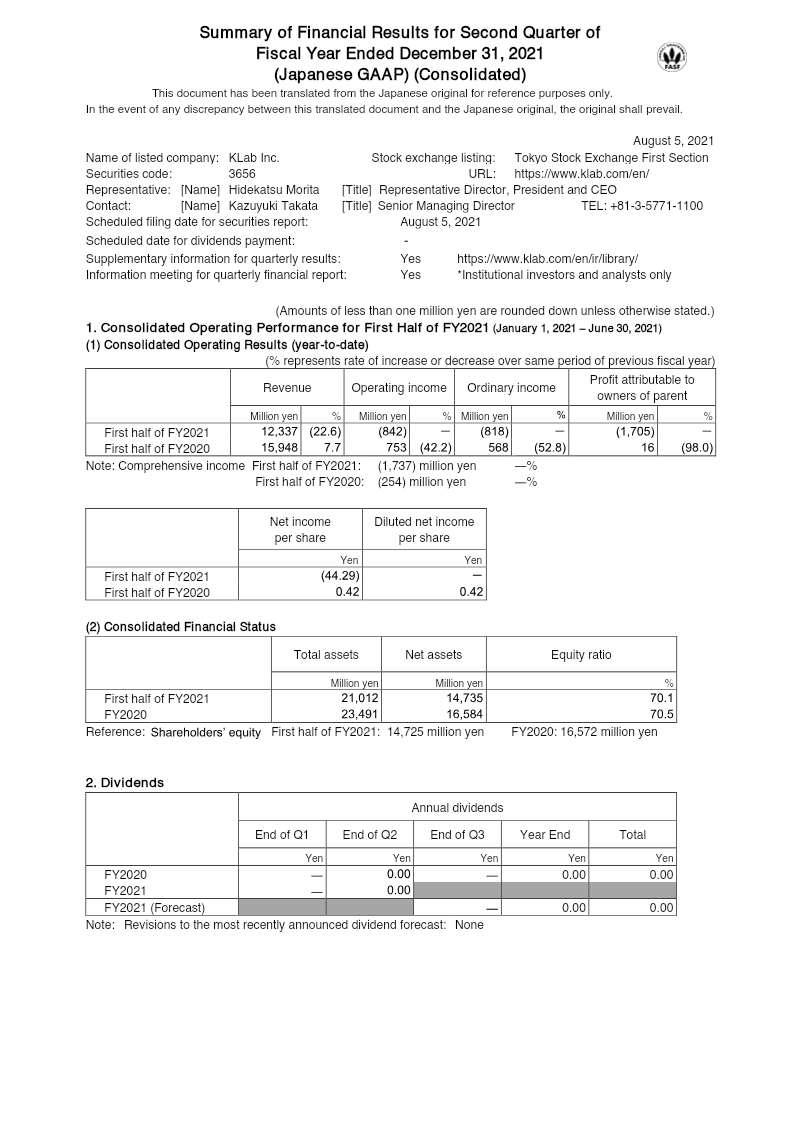
KLab Inc. reports a sharp contraction in operating performance for the first half of fiscal 2021 (January 1–June 30). Total revenue fell to ¥12.34 billion, a 22.6 % decline from the ¥15.95 billion recorded in the same period of FY2020, while operating income turned into a loss of ¥842 million versus an operating profit of ¥753 million in FY2020. Ordinary income and profit attributable to owners of the parent both swung into negative territory, with a loss of ¥818 million and ¥1.71 billion respectively, compared to profits of ¥568 million and ¥16 million in FY2020. Net income for the period was a loss of ¥44.3 million per share, contrasting with a modest profit of ¥0.42 per share in FY2020.
The comprehensive loss widened to ¥1.74 billion, driven largely by a ¥1.54 billion impairment loss on goodwill and other extraordinary losses. Asset‑side, total assets declined to ¥21.01 billion from ¥23.49 billion, while equity fell to ¥14.74 billion, maintaining an equity ratio of 70.1 %. Treasury stock increased to ¥200.985 million after a February acquisition of 286,600 shares.
Revenue concentration remained in the game business segment (≈¥12.13 billion), with a secondary “Other” segment contributing ¥209 million. The company disclosed no dividend for FY2021 and maintained a forecast of zero dividends for the year.
Methodologically, figures are presented under Japanese GAAP, with a consolidated view of all subsidiaries. No changes to accounting principles or restatements were reported for the period.
- KLab Inc. experienced a significant financial downturn in H1 2021, with total revenue falling 22.6% year-over-year to ¥12.34 billion.
- Operating performance swung from a ¥753 million profit in H1 2020 to an operating loss of ¥842 million in H1 2021.
- The company reported a net loss of ¥1.71 billion attributable to owners of the parent, resulting in a loss of ¥44.3 per share compared to a profit of ¥0.42 per share in the prior year.
- A ¥1.54 billion impairment loss on goodwill and other extraordinary losses contributed to a comprehensive loss of ¥1.74 billion for the period.
- Total assets declined to ¥21.01 billion from ¥23.49 billion, though the company maintained a solid equity ratio of 70.1%.
+1
KLab
Report6 pages
GungHo Business Report Vol. 42
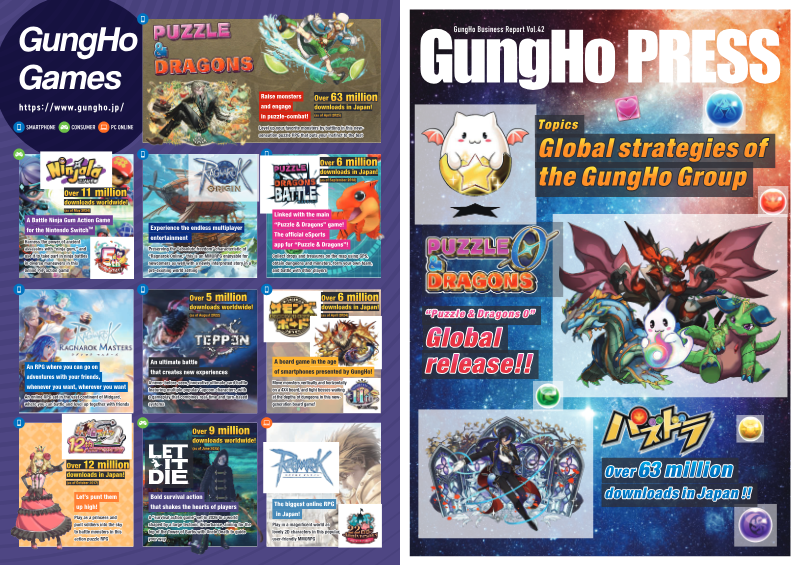
GungHo Online Entertainment’s Vol. 42 report outlines the company’s strategic focus on expanding its two flagship intellectual properties—Puzzle & Dragons and Ragnarok—into global markets while sustaining robust financial performance. The report highlights that Puzzle & Dragons, launched in 2012, has achieved over 63 million downloads worldwide and continues to drive user engagement through frequent events, cross‑media collaborations, and a 13th‑anniversary release in May 2025. The Ragnarok franchise, managed by subsidiary Gravity Co., Ltd., has expanded from its original PC MMORPG roots to mobile and console titles, with recent releases such as Ragnarok X (PC/Android/iOS) and LUNAR Remastered Collection targeting Latin America, Southeast Asia, and other regions.
Financially, consolidated net sales rose from ¥125.3 billion in 2022 to ¥103.6 billion in 2024, with operating profit increasing from ¥27.9 billion to ¥17.5 billion over the same period. Overseas sales ratio climbed from 39.3 % in 2022 to 47.7 % in 2024, reflecting successful international penetration. The company maintained a dividend payout ratio above 30 % and executed treasury‑share repurchases totaling ¥9.86 billion in 2024, underscoring a commitment to shareholder value.
Methodologically, the report aggregates data from internal analytics on downloads, MAU, and revenue across more than 150 countries in 11 languages. It also references quarterly performance metrics and event‑based user activity to gauge engagement. Overall, the document presents a cohesive narrative of sustained growth through IP expansion, diversified platform presence, and disciplined financial management.
- GungHo’s overseas sales ratio grew from 39.3% in 2022 to 47.7% in 2024, signaling a successful shift toward international market penetration.
- Consolidated net sales decreased from ¥125.3 billion in 2022 to ¥103.6 billion in 2024, with operating profit declining from ¥27.9 billion to ¥17.5 billion over the same period.
- The flagship title Puzzle & Dragons has surpassed 63 million global downloads since its 2012 launch and is preparing for a 13th-anniversary release in May 2025.
- Subsidiary Gravity Co., Ltd. is actively diversifying the Ragnarok franchise across PC, mobile, and console platforms, specifically targeting growth in Latin America and Southeast Asia.
- The company maintains a commitment to shareholder returns, evidenced by a dividend payout ratio exceeding 30% and ¥9.86 billion in treasury-share repurchases during 2024.
+4
GungHo Online Entertainment