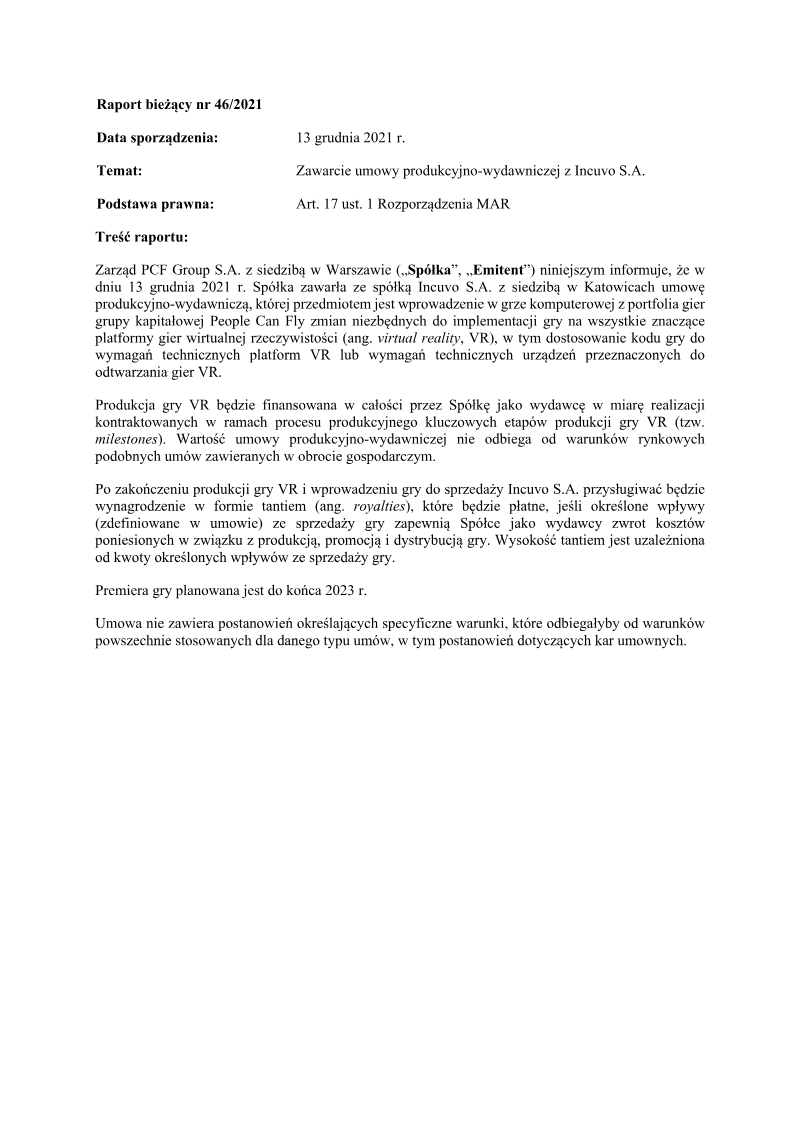
Report1 pages
Zawarcie umowy produkcyjno-wydawniczej z Incuvo S.A.
The report announces that on 13 December 2021 PCF Group S.A., a Warsaw‑based company, entered into a production and publishing agreement with Incuvo S.A. of Katowice. The contract focuses on adapting a title from the People Can Fly portfolio for all major virtual‑reality platforms, including code adjustments to meet VR hardware specifications. PCF Group will finance the entire VR production through milestone payments tied to key development stages, with contract terms aligned to market standards for similar agreements. Upon completion and launch of the VR game, Incuvo will receive royalties contingent on sales revenue that covers PCF Group’s production, marketing, and distribution costs; the royalty rate depends on the defined sales thresholds. The game’s release is targeted for late 2023. No special contractual clauses or penalty provisions deviate from common practice for this type of agreement, ensuring standard industry compliance.
- PCF Group S.A. and Incuvo S.A. signed a production and publishing agreement on 13 December 2021 to adapt a title from the People Can Fly portfolio for virtual reality.
- Incuvo S.A. is responsible for all code adjustments and technical adaptations required to meet the hardware specifications of all major VR platforms.
- PCF Group S.A. will fully fund the VR production through milestone-based payments tied to specific development stages.
- Incuvo S.A. will receive royalties based on sales revenue only after PCF Group S.A. has recouped all production, marketing, and distribution costs.
- The royalty rates for Incuvo S.A. are structured according to defined sales thresholds, with a targeted game release date of late 2023.
+2
PCF Group
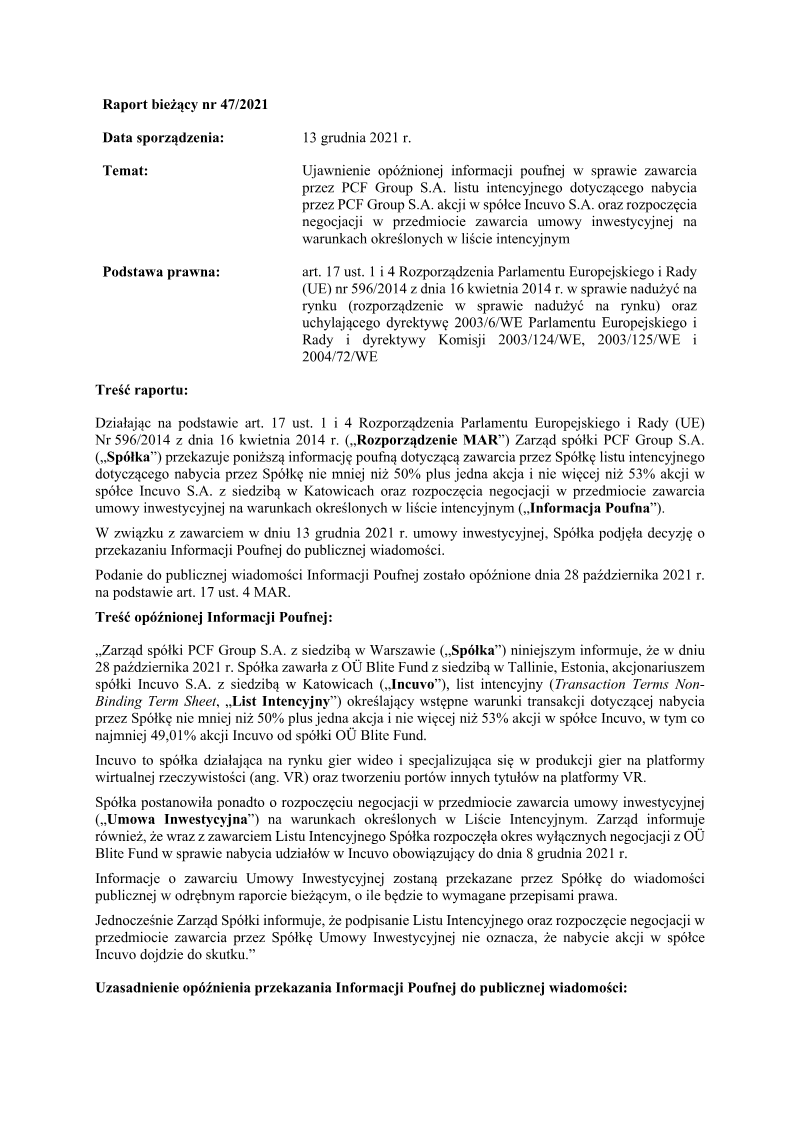
Report2 pages
Aktualny Raport 47/2021: Nabycie Akcji Incuvo S.A.
The report discloses that PCF Group S.A., a Warsaw‑based company, entered into a non‑binding letter of intent on 28 October 2021 with OÜ Blite Fund, an Estonian shareholder of Incuvo S.A., a Katowice‑based virtual reality game developer. The intent is to acquire between 50 % + 1 share and 53 % of Incuvo’s shares, including at least 49.01 % from OÜ Blite Fund. Negotiations for a definitive investment agreement are to commence under the terms outlined in the letter, with an exclusive negotiation period lasting until 8 December 2021. The report explains that the disclosure of this confidential information was delayed until 13 December 2021, citing Article 17(4) of the EU Market Abuse Regulation (MAR). The board justified the delay by arguing that immediate disclosure could jeopardise ongoing negotiations, risk adverse third‑party reactions, and potentially distort market perception of the transaction’s likelihood. The board ensured confidentiality through an access list compliant with MAR Article 18 and pledged to notify the Polish Financial Supervision Authority of the delay. The disclosure clarifies that signing the letter and initiating negotiations does not guarantee a completed share purchase. This communication covers a single transaction involving PCF Group S.A., OÜ Blite Fund, and Incuvo S.A. in the European gaming sector, with a focus on virtual reality titles. The methodology is purely regulatory compliance reporting, based on internal board decisions and MAR provisions.
- PCF Group S.A. has entered into a non-binding letter of intent to acquire a majority stake of 50% + 1 share to 53% in the virtual reality developer Incuvo S.A.
- The proposed acquisition includes the purchase of at least 49.01% of Incuvo S.A. shares currently held by the Estonian shareholder OÜ Blite Fund.
- The parties established an exclusive negotiation period for the definitive investment agreement that lasted until 8 December 2021.
- PCF Group S.A. delayed the public disclosure of this transaction until 13 December 2021, citing the protection of ongoing negotiations and market stability under Article 17(4) of the EU Market Abuse Regulation.
- The company maintained regulatory compliance during the delay by managing an access list under Article 18 of the Market Abuse Regulation and notifying the Polish Financial Supervision Authority.
PCF Group
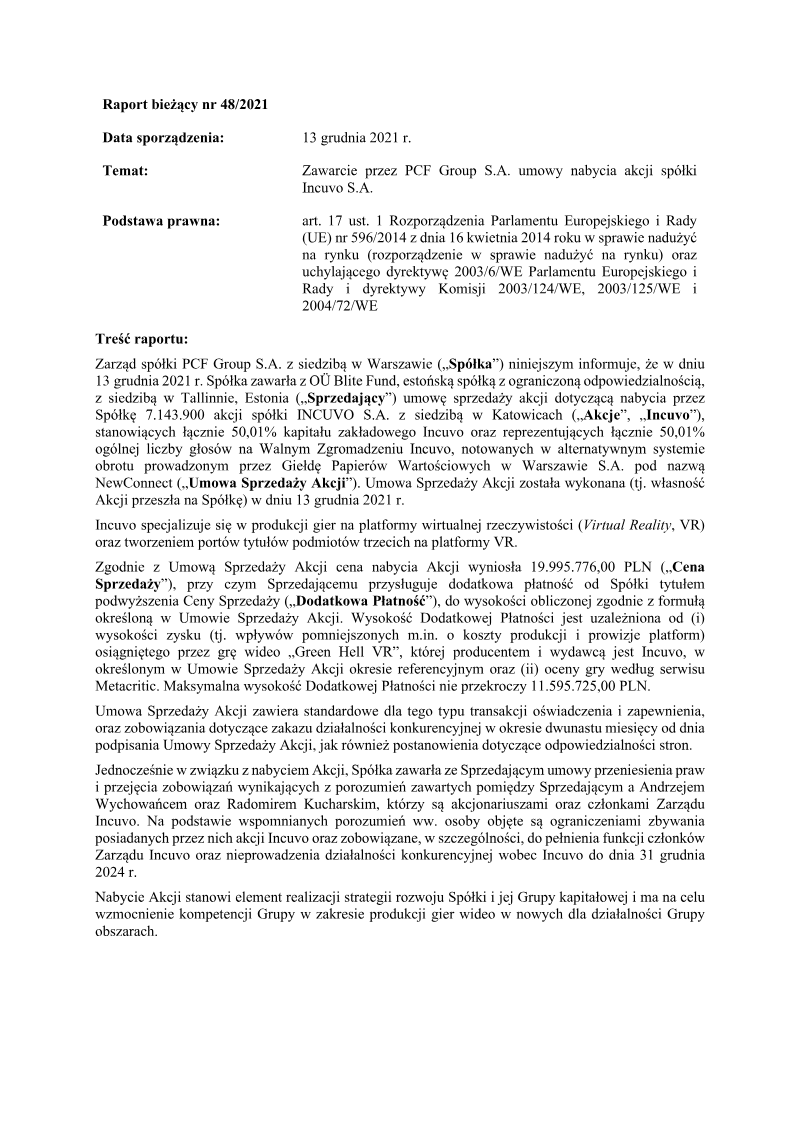
Report1 pages
Current Report No. 48/2021: Acquisition of Incuvo S.A. Shares
PCF Group S.A., headquartered in Warsaw, completed the acquisition of 7,143,900 shares of Incuvo S.A. on 13 December 2021, representing 50.01 % of Incuvo’s share capital and voting rights. The transaction was executed under EU market‑abuse regulation, with the purchase price set at PLN 19,995,776.00 and an additional payment clause that may add up to PLN 11,595,725.00 based on the profitability of Incuvo’s VR title “Green Hell VR” and its Metacritic rating during a specified reference period. Incuvo specializes in virtual‑reality game development and porting third‑party titles to VR platforms.
The agreement includes customary representations, warranties, non‑competition restrictions for twelve months post‑closing, and liability provisions. Concurrently, PCF entered into transfer agreements with Incuvo’s shareholders Andrzej Wychowń and Radomir Kucharski, imposing sale restrictions on their shares and mandating continued board participation while prohibiting competitive activities until 31 December 2024.
This acquisition aligns with PCF Group’s strategic expansion into video‑game production, aiming to strengthen the group’s capabilities in emerging sectors. The transaction covers Poland and involves the NewConnect market of the Warsaw Stock Exchange, reflecting a focused geographic scope within the European VR gaming industry.
- PCF Group S.A. acquired a 50.01% majority stake in Incuvo S.A. on 13 December 2021 for a base price of PLN 19,995,776.
- The deal includes an earn-out provision of up to PLN 11,595,725, contingent on the profitability and Metacritic performance of the VR title 'Green Hell VR'.
- Incuvo S.A. specializes in virtual-reality game development and the porting of third-party titles to VR platforms.
- Key shareholders Andrzej Wychowń and Radomir Kucharski are bound by non-competition agreements and mandatory board participation until 31 December 2024.
- The acquisition is part of PCF Group’s strategic expansion to bolster its production capabilities within the emerging VR gaming sector.
+1
PCF Group
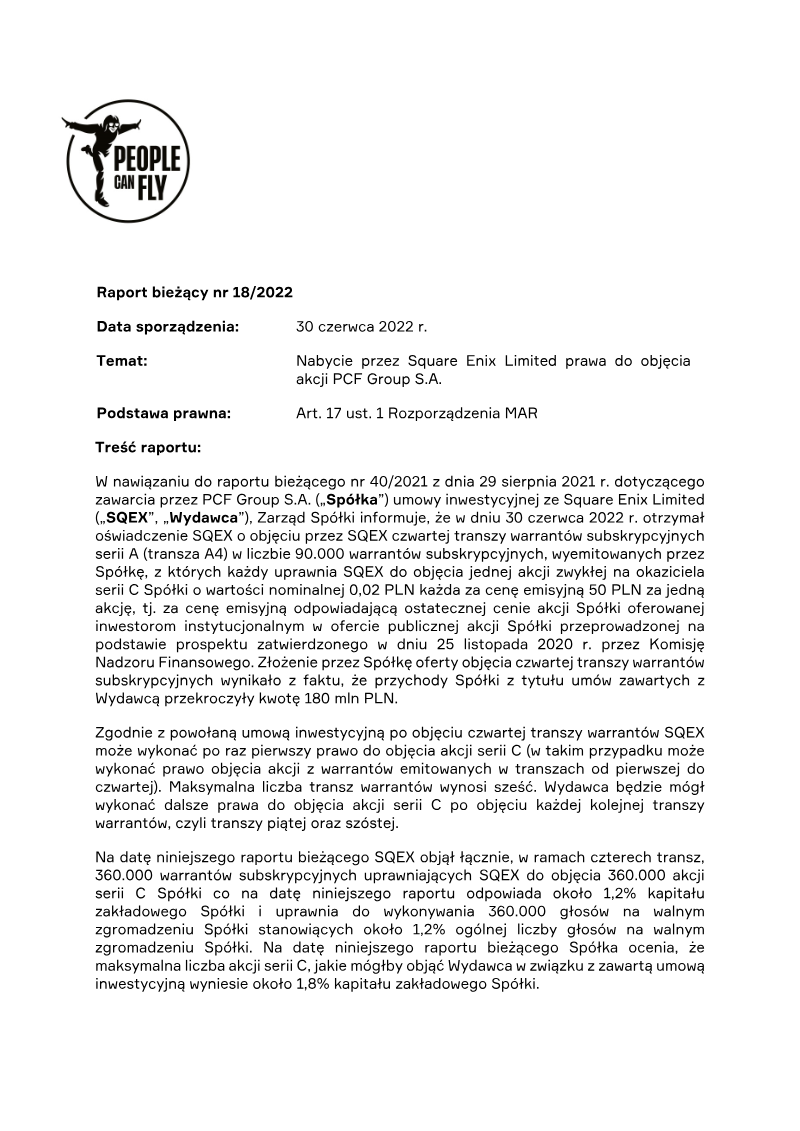
Report2 pages
Raport Bieżący Nr 18/2022: Nabycie przez Square Enix Limited Prawa do Objecia Akcji PCF Group S.A.
The report informs that on 30 June 2022 Square Enix Limited (SQEX) exercised its right to acquire the fourth tranche of 90,000 subscription warrants (Series A4) issued by PCF Group S.A. Each warrant entitles SQEX to purchase one ordinary Series C share at an issue price of 50 PLN, matching the final public offering price approved by the Polish Financial Supervision Authority on 25 November 2020. The issuance of this tranche was triggered by PCF’s revenue from contracts with SQEX exceeding 180 million PLN.
Under the investment agreement, SQEX may exercise its option to acquire Series C shares for each tranche received, up to a maximum of six tranches. By the date of this report, SQEX had accumulated 360 000 warrants across four tranches, allowing the purchase of an equivalent number of Series C shares. This represents roughly 1.2 % of PCF’s share capital and confers the same proportion of voting rights at general meetings. The company estimates that, if all six tranches were exercised, SQEX could ultimately acquire about 1.8 % of the share capital.
The warrants can be exercised until 31 December 2025. PCF currently lacks information on SQEX’s intentions regarding the exercise of these rights. The report is dated 30 June 2022 and follows a prior disclosure (report no. 40/2021) concerning the initial investment agreement between PCF and SQEX.
- Square Enix Limited exercised its right to acquire the fourth tranche of 90,000 subscription warrants from PCF Group S.A. on 30 June 2022.
- The issuance of this fourth tranche was triggered by PCF Group S.A. generating over 180 million PLN in revenue from contracts with Square Enix.
- Each warrant allows Square Enix to purchase one Series C share at a fixed price of 50 PLN, consistent with the 2020 public offering price.
- Square Enix has accumulated 360,000 warrants across four tranches, representing approximately 1.2% of PCF Group S.A.’s total share capital and voting rights.
- The investment agreement allows for a maximum of six tranches, which would result in Square Enix holding approximately 1.8% of PCF Group S.A.’s share capital.
+1
PCF Group
Report2 pages
Current Report No. 22/2022: Agreement on Termination of Production and Publishing Agreement
The report announces that on October 1, 2022, People Can Fly U.S., LLC and its parent PCF Group S.A. entered into a termination agreement with Take‑Two Interactive Software, Inc., ending the 2020 production and publishing contract for Project Dagger. The termination agreement specifies how financial obligations will be settled depending on the eventual release model of the title. If Project Dagger is released through self‑publishing by People Can Fly U.S., the company will pay royalties to Take‑Two on a quarterly basis until cumulative payments equal a predetermined repayment amount of $20 million. If the game is released with a new publisher, People Can Fly U.S. will repay the same $20 million in two equal installments due six and twelve months after launch. No repayment is required if the game never reaches commercial release, regardless of model.
The agreement also confirms that Take‑Two did not exercise its option to acquire intellectual property rights under the original contract, and that the license granted to Take‑Two has expired. Consequently, People Can Fly U.S. retains exclusive ownership of Project Dagger’s intellectual property. Standard termination provisions accompany the agreement, covering general legal and procedural matters. The report covers a single geographic jurisdiction—both parties are headquartered in New York, USA—and pertains exclusively to the Project Dagger title within the video‑game development and publishing sector. No survey or external data sources are cited; the document is a straightforward corporate disclosure of contractual termination and financial settlement terms.
- People Can Fly U.S., LLC and Take-Two Interactive Software, Inc. terminated their 2020 production and publishing agreement for Project Dagger, effective October 1, 2022.
- People Can Fly retains exclusive ownership of the Project Dagger intellectual property, as Take-Two did not exercise its option to acquire the rights and its license has expired.
- If People Can Fly self-publishes Project Dagger, they must pay royalties to Take-Two on a quarterly basis until a total of $20 million is repaid.
- If Project Dagger is released via a new publisher, People Can Fly is obligated to repay the $20 million in two equal installments due six and twelve months after the game's launch.
- No financial repayment to Take-Two is required if Project Dagger fails to reach a commercial release.
+1
PCF Group
Report2 pages
Zwiększenie zaangażowania kapitałowego PCF Group S.A. w spółkę Incuvo S.A.
The report announces that PCF Group S.A., a Warsaw‑based company, has decided to increase its capital participation in its subsidiary Incuvo S.A., a Katowice‑based game developer. On 27 January 2023, the board authorized the issuance of 136,104 new ordinary shares (Series E) at an emission price of PLN 46.13 each, totaling PLN 6,278,477.52. These shares represent approximately 0.45 % of PCF’s share capital and voting rights, and will be fully subscribed by Incuvo’s CEO Andrzej Wychowańcy (87,820 shares) and Vice‑Chairman Radomir Kucharski (48,284 shares). In exchange, the two executives will transfer 1,128,450 Incuvo shares (≈7.90 % of Incuvo’s capital) and 620,428 Incuvo shares (≈4.34 % of Incuvo’s capital) to PCF, thereby raising PCF’s stake in Incuvo from 50.01 % to roughly 62.25 % of both capital and voting rights.
The emission price was calculated using a six‑month average market price of PCF shares (1 June–30 November 2022) and correlated with a fair‑value assessment of Incuvo’s shares by an external auditor. The transaction aligns with PCF Group’s strategy to diversify its game portfolio, expand into virtual reality leveraging Incuvo’s expertise, and enhance publishing capabilities.
Lock‑up restrictions apply to the new shares until the end of December 2024, mirroring conditions from PCF’s 2020 public offering. The board has requested supervisory approval for the pricing, waiver of pre‑emptive rights, and full allocation to the two executives. Further updates will be provided as required by law.
- PCF Group S.A. is increasing its stake in subsidiary Incuvo S.A. from 50.01% to approximately 62.25% of total capital and voting rights.
- The transaction involves PCF Group issuing 136,104 new Series E shares, valued at PLN 6,278,477.52, to Incuvo CEO Andrzej Wychowańcy and Vice-Chairman Radomir Kucharski.
- In exchange for the new PCF shares, the two executives are transferring a combined 1,748,878 shares of Incuvo to PCF Group, representing roughly 12.24% of Incuvo's capital.
- The issuance price of PLN 46.13 per share was determined using a six-month average market price of PCF stock and an external fair-value assessment of Incuvo.
- The newly issued PCF shares are subject to lock-up restrictions that remain in effect until the end of December 2024.
PCF Group
Report5 pages
Aktualizacja strategii PCF Group S.A. oraz Grupy People Can Fly
The update presents the revised growth strategy for PCF Group S.A. and its People Can Fly holding group, adopted by the board on 31 January 2023. The strategy had first been disclosed in the company’s prospectus approved by the Polish Financial Supervision Authority on 25 November 2020 and subsequently updated in a 43/2021 interim report dated 27 September 2021. The current update is attached to the present filing and outlines new assumptions, objectives, and operational priorities for both the parent company and its subsidiaries.
Key points include a renewed focus on expanding market presence, enhancing product development pipelines, and strengthening financial performance through cost optimisation and capital allocation. The strategy also highlights commitments to sustainability initiatives, digital transformation, and talent development across the group’s portfolio. While specific financial targets are not disclosed in this summary, the document stresses alignment with regulatory frameworks and adherence to EU prospectus regulations for any forthcoming equity offerings.
The update applies exclusively within the European Economic Area and the United Kingdom, targeting qualified investors and institutional participants. It is governed by EU Regulation (EU) 2017/1129 on prospectuses and related directives, ensuring compliance with disclosure obligations for non‑public offerings. The filing clarifies that it does not constitute a public offer, contains no promotional content for new shares, and is restricted from distribution in jurisdictions such as the United States, Australia, Canada, Japan, or South Africa. The document also includes standard legal and risk disclosures, emphasizing that forward‑looking statements are subject to uncertainty and should not be relied upon as definitive forecasts.
- On 31 January 2023, the board of PCF Group S.A. and People Can Fly adopted a revised growth strategy to update the previous objectives established in September 2021.
- The updated strategy prioritizes expanding market presence, enhancing product development pipelines, and improving financial performance through cost optimization and capital allocation.
- The group has integrated sustainability initiatives, digital transformation, and talent development programs as core operational priorities across its portfolio.
- The strategy is governed by EU Regulation (EU) 2017/1129 and is intended exclusively for qualified and institutional investors within the European Economic Area and the United Kingdom.
- The filing explicitly excludes the United States, Australia, Canada, Japan, and South Africa from distribution and does not constitute a public offer of shares.
+1
PCF Group
Report7 pages
Current Report No. 11/2023: Disclosure of Delayed Inside Information
The report discloses that PCF Group S.A.’s board initiated negotiations on 19 March 2023 with Krafton, Inc. or its affiliated entity to acquire shares in a capital increase approved by an extraordinary general meeting on 28 February 2023. The proposed investment would grant Krafton a 10 % stake in the post‑issuance capital, and may include future collaboration on specific games. The board delayed public disclosure until 28 March to avoid adverse impacts on negotiation dynamics and potential market misinterpretation, citing MAR Regulation Article 17(4) and EU‑FCA guidance. The disclosure explains that the negotiations do not guarantee a completed transaction, and outlines risk factors such as uncertainty of deal completion and market reaction. The document is restricted to qualified investors within the EU‑EAA, UK, and certain US entities under Regulation S or Rule 144A; it contains no prospectus and is not a public offer. Methodologically, the report relies on internal board decisions and regulatory compliance checks; no external survey or statistical data are presented. The scope is limited to Poland, with implications for capital structure and potential strategic partnership in the gaming sector. The report concludes that any investment decisions must be based on independent research, as the information is not a recommendation or solicitation.
- PCF Group S.A. entered negotiations with Krafton, Inc. on 19 March 2023 regarding a potential capital increase that would grant Krafton a 10% stake in the company.
- The proposed deal includes the potential for future collaboration between PCF Group and Krafton on specific game titles.
- PCF Group delayed the public disclosure of these negotiations from 19 March to 28 March 2023, citing the need to protect negotiation dynamics under Article 17(4) of the MAR Regulation.
- The transaction is not guaranteed, and the company explicitly warns of risks regarding deal completion and potential market volatility.
- The information is restricted to qualified investors in the EU, EEA, UK, and specific US entities, and does not constitute a public offer or a prospectus.
+1
PCF Group
Report6 pages
Raport Bieżący Nr 12/2023: Zawarcie Umowy Inwestycyjnej z Krafton, Inc.
The document announces that Krafton, Inc. has entered into an investment agreement to acquire shares of PCF Group S.A. under a capital increase authorized by the extraordinary general meeting, allowing up to 5 853 941 new ordinary shares of series F at a nominal value of PLN 0.02 each. The agreement obligates Krafton to purchase shares representing 10 % of the company’s capital and voting rights at an issue price of PLN 40.20 per share, with the company guaranteeing allocation upon fulfillment of Krafton’s subscription commitment. The investment contract grants Krafton rights of first negotiation and first refusal on future projects such as Project Victoria or Project Bifrost if released outside a self‑publishing model, and includes anti‑dilution, tag‑along, and drag‑along provisions. Both parties have executed lock‑up agreements lasting until 28 March 2024 and standard representations, warranties, and indemnity clauses. The agreement is governed by Polish law, has a ten‑year term with automatic renewal provisions, and allows Krafton to terminate under specific circumstances such as cancellation of the offer or failure to meet subscription deadlines; no penalties are stipulated. The report, prepared under EU Regulation MAR, is strictly informational and restricted to qualified investors within the European Economic Area, excluding public distribution in jurisdictions such as the United States, Canada, Australia, Japan, and South Africa. It contains forward‑looking statements subject to risks and uncertainties, and disclaims any investment recommendation or guarantee.
- Krafton, Inc. is acquiring a 10% equity stake in PCF Group S.A. through the issuance of 5,853,941 new series F ordinary shares.
- The investment is priced at PLN 40.20 per share, granting Krafton 10% of the company’s total voting rights.
- Krafton holds rights of first negotiation and first refusal on future PCF Group projects, specifically Project Victoria and Project Bifrost, if they are not self-published.
- The agreement includes protective shareholder provisions, including anti-dilution, tag-along, and drag-along clauses.
- Both parties are subject to a lock-up period for their shares that remains in effect until March 28, 2024.
+1
PCF Group
Report6 pages
Current Report No. 23/2023: Investment Agreement Supplement Between Krafton, Inc. and PCF Group S.A.
The report announces that on 14 June 2023, Krafton, Inc. and PCF Group S.A., together with key shareholder Sebastian Wojciechowski, entered into a side‑letter to the investment agreement dated 28 March 2023. The side‑letter stipulates that if PCF Group increases its share capital by issuing up to 2 510 904 new shares before 31 December 2023, Krafton will have the right of first refusal to subscribe for shares that would bring its total holdings to 10 % of the capital and voting rights. The subscription price is fixed at PLN 40.20 per share, independent of the price set for other investors. The agreement does not obligate Krafton to purchase any shares, and the allocation of new shares to other investors remains unaffected.
The document is a regulatory disclosure under EU Regulation 596/2014 and Polish securities law, intended solely for informational purposes. It contains extensive legal caveats restricting distribution outside the European Economic Area and prohibiting any promotional use of the information. The report clarifies that it is not an offer, does not constitute a prospectus, and is limited to qualified investors in the EU, UK, or U.S. under Rule 144A. No financial projections or performance guarantees are provided; the report includes forward‑looking statements subject to risk and uncertainty. The disclosure emphasizes that no manager or affiliated party assumes liability for the accuracy of the information, and any investment decisions must rely on independently verified data.
- Krafton, Inc. secured a right of first refusal to acquire up to 10% of PCF Group S.A.’s total share capital and voting rights.
- The option to subscribe for new shares is valid if PCF Group issues up to 2,510,904 new shares before the 31 December 2023 deadline.
- The subscription price for Krafton is fixed at PLN 40.20 per share, regardless of the pricing terms offered to other investors.
- The agreement is non-binding for Krafton, meaning the company is under no obligation to purchase any shares.
- This side-letter supplements the original investment agreement established between Krafton and PCF Group on 28 March 2023.
+2
PCF Group
Report1 pages
Current Report No. 24/2023: Signing of a Letter of Intent Regarding a Production Agreement
The report announces that PCF Group S.A., headquartered in Warsaw, entered into a non‑binding Letter of Intent on 17 June 2023 with a prominent U.S. entertainment company to develop a virtual‑reality action/combat video game under the code name “Dolphin.” The intent is to negotiate a production agreement with a publisher or its affiliate, under which PCF will act as a work‑for‑hire developer. The publisher’s total budget for the project is estimated between 16 million and 24 million USD, with intellectual property rights ultimately belonging to the publisher within contractual limits. Development is projected to conclude in 2025, with release planned for current and future leading VR hardware platforms. The report clarifies that signing the Letter of Intent does not guarantee a final production contract, and further details will be disclosed in a separate public update. The scope covers the U.S. entertainment partner and global VR platforms, focusing on action/combat gameplay. No survey or statistical methodology is cited; the information derives from corporate governance announcements and contractual estimates.
- PCF Group S.A. has signed a non-binding Letter of Intent to develop a virtual-reality action/combat game codenamed “Dolphin” for a major U.S. entertainment company.
- The project is structured as a work-for-hire agreement, with the publisher retaining intellectual property rights within contractual limits.
- The estimated production budget for the title is between 16 million and 24 million USD.
- Development is scheduled to conclude in 2025, with a target release across current and future leading VR hardware platforms.
- The Letter of Intent does not guarantee a final production contract, and negotiations for a formal agreement are ongoing.
+4
PCF Group
Report1 pages
Raport Bieżący Nr 41/2023: Zawarcie Ugody z OÜ Blite Fund
The report announces that on 21 August 2023, PCF Group S.A. entered into an agreement with OÜ Blite Fund, a limited liability company based in Tallinn, Estonia. Under the settlement, PCF Group S.A. committed to pay Blite Fund 2 050 000,00 złoty as an additional payment for the purchase price of 7 143 900 shares of Incuvo S.A., a company headquartered in Katowice. These shares were originally acquired by PCF Group S.A. through a share sale agreement dated 13 December 2021 between the two parties.
The additional payment represents a full settlement of all mutual claims arising from or related to the share sale agreement. The amount will be recorded in PCF Group S.A.’s income statement for the second quarter of 2023. The settlement is made pursuant to Article 17(1) of the MAR regulation, and it follows a prior interim report dated 13 December 2021. The document provides no further methodological details, as it is a straightforward disclosure of the contractual resolution and its financial impact on the company’s quarterly results.
- PCF Group S.A. reached a settlement with OÜ Blite Fund on 21 August 2023 regarding the acquisition of Incuvo S.A. shares.
- The agreement requires PCF Group S.A. to pay an additional 2,050,000 PLN to Blite Fund as part of the final purchase price.
- This payment covers 7,143,900 shares of Incuvo S.A. originally acquired under a share sale agreement dated 13 December 2021.
- The settlement amount constitutes a full and final resolution of all mutual claims between the two parties related to the 2021 share sale agreement.
- PCF Group S.A. will record the 2,050,000 PLN payment in its income statement for the second quarter of 2023.
PCF Group
Report1 pages
Raport Bieżący nr 51/2023: Wstrzymanie Negocjacji Umowy Produkcyjnej
The report informs stakeholders that the production agreement negotiations for the virtual‑reality action/combat game code‑named “Dolphin” have been indefinitely suspended. The PCF Group S.A., headquartered in Warsaw, had previously entered a non‑binding letter of intent with a prominent U.S. entertainment company on 17 June 2023 to develop the game for VR platforms. On 22 September 2023, the publisher notified the company that work on the project would be halted permanently. Informal discussions suggest the decision is linked to ongoing industry strikes in the United States, creating uncertainty within the entertainment sector. Consequently, all negotiations regarding the production agreement have been put on hold. The report covers a single geographic region—Poland and the United States—and focuses exclusively on the video‑game development segment, specifically virtual reality action titles. No survey or statistical methodology is employed; the information is based on direct communication between company representatives and the publisher. The primary conclusion is that external labor disputes have disrupted the partnership, leading to a suspension of contractual negotiations and project development.
- PCF Group S.A. has indefinitely suspended negotiations for a production agreement regarding the virtual-reality action game code-named “Dolphin.”
- The project was terminated after the U.S.-based publisher notified PCF Group on 22 September 2023 that all work on the title would be halted permanently.
- The partnership originated from a non-binding letter of intent signed between the two companies on 17 June 2023.
- Informal discussions indicate that the project cancellation is linked to ongoing industry strikes in the United States, which have created significant uncertainty in the entertainment sector.
- The suspension of the “Dolphin” project marks a complete cessation of the planned collaboration between the Warsaw-based developer and the U.S. entertainment company.
+2
PCF Group
Report1 pages
Current Report No. 7/2024: Settlement of Bulletstorm VR Production Costs and Termination of Production-Publishing Agreement
PCF Group S.A. has finalized the financial settlement and contractual dissolution regarding the production of Bulletstorm VR. Following the game’s release on January 18, 2024, the publisher and its subsidiary, Incuvo S.A., reached an agreement to settle all remaining production milestones. As part of this financial reconciliation, PCF Group charged Incuvo 871,157.59 PLN to cover development and quality assurance costs incurred during the project’s lifecycle.
The decision to terminate the production-publishing agreement, effective January 19, 2024, stems directly from the unsatisfactory commercial performance of the title upon its launch. Under the terms of this dissolution, Incuvo forfeits all rights to future royalty payments derived from the game’s sales. This restructuring effectively ends the original collaborative framework between the two entities regarding this specific intellectual property.
Moving forward, PCF Group assumes full responsibility for the final product and its ongoing commercialization. While the company retains the option to utilize Incuvo’s resources for potential future development tasks, the publisher now maintains complete control over the title’s lifecycle. This shift in management strategy reflects a broader effort to mitigate the impact of the game’s poor market reception and consolidate oversight of the product’s future development and sales trajectory.
- PCF Group S.A. has terminated its production-publishing agreement with Incuvo S.A. for Bulletstorm VR, effective January 19, 2024, following the game's poor commercial performance.
- PCF Group has assumed full control over the title's ongoing commercialization and future development lifecycle.
- Incuvo S.A. has forfeited all rights to future royalty payments generated by Bulletstorm VR sales as part of the contractual dissolution.
- PCF Group charged Incuvo 871,157.59 PLN to settle outstanding development and quality assurance costs incurred during the project.
- The financial and contractual settlement was finalized following the game's initial release on January 18, 2024.
+2
PCF Group
Report1 pages
Raport Bieżący Nr 15/2024: Ogłoszenie Decyzji o Rozpoczęciu Przeglądu Opcji Strategicznych
PCF Group S.A. has formally initiated a comprehensive review of strategic options to evaluate potential pathways for supporting the long-term development of the company and its capital group. This process is designed to identify and assess various opportunities that could enhance the organization’s growth trajectory, including the potential acquisition of a financial or strategic investor. Furthermore, the review encompasses the possibility of executing corporate transactions that might result in structural changes to the company’s shareholding or capital base.
The scope of this initiative involves active engagement and preliminary discussions with various external entities to explore potential partnerships or investment scenarios. While the company intends to provide selected parties with necessary information to facilitate these evaluations, the process remains in its preliminary stages. No specific outcomes, timelines, or definitive decisions have been established, and the company emphasizes that there is no guarantee that any particular strategic action will be finalized as a result of this review.
Throughout the duration of this assessment, the group remains committed to its existing operational strategy and will continue to execute its current business objectives. Management intends to maintain transparency by disclosing further developments in accordance with regulatory requirements as the situation evolves. This strategic review reflects a proactive approach to capital management and corporate development within the gaming industry, aimed at securing the most advantageous future for the group’s stakeholders.
- PCF Group S.A. has formally initiated a strategic review to evaluate options for long-term growth and capital development.
- The review process includes exploring the potential acquisition of a financial or strategic investor to support the company’s future trajectory.
- Management is considering corporate transactions that could lead to structural changes in the company’s shareholding or capital base.
- The company has begun preliminary discussions with external entities to assess potential partnerships and investment scenarios.
- No definitive decisions, timelines, or specific outcomes have been established regarding the potential strategic actions.
PCF Group
Report3 pages
Raport bieżący nr 18/2024Ujawnienie opóźnionej informacji poufnej w sprawie rozpoczęcia przez PCF Group S.A. negocjacji w przedmiocie zawarcia umowy produkcyjno-wydawniczej z Krafton Inc.
PCF Group S.A. has officially disclosed the commencement of negotiations regarding a production and publishing agreement with Krafton Inc., a Seoul-based publisher. This disclosure follows the formal execution of a Master Services Agreement on September 10, 2024. The company had previously delayed the announcement of these negotiations, which began on July 11, 2024, to protect its legitimate business interests and prevent potential interference from competitors during the sensitive negotiation phase.
The partnership centers on the development of a new game mode for an existing Krafton title, utilizing a work-for-hire model. This collaboration aligns with the strategic objectives outlined by PCF Group in early 2023, which prioritize securing high-quality work-for-hire opportunities with reputable industry partners. The agreement is structured as a framework, with specific operational details, project timelines, and compensation terms to be defined in subsequent statements of work.
Management justified the initial delay in public disclosure by citing the uncertainty of the negotiation outcomes and the risk that premature release could lead to market misinterpretation of the company’s valuation. Throughout the delay period, the company maintained strict confidentiality protocols, including the maintenance of an insider list as required by regulatory standards. The disclosure confirms that the terms of the agreement are consistent with standard industry practices for similar development projects.
- PCF Group S.A. has entered into a formal production and publishing agreement with Seoul-based Krafton Inc. following the execution of a Master Services Agreement on September 10, 2024.
- The partnership focuses on the development of a new game mode for an existing Krafton title under a work-for-hire business model.
- Negotiations for this collaboration officially commenced on July 11, 2024, but were kept confidential until the current disclosure to protect business interests.
- The agreement serves as a framework, with specific project timelines, operational details, and compensation terms to be finalized in future statements of work.
- This deal aligns with PCF Group’s 2023 strategic objective to secure high-quality work-for-hire contracts with reputable industry partners.
+1
PCF Group
Report1 pages
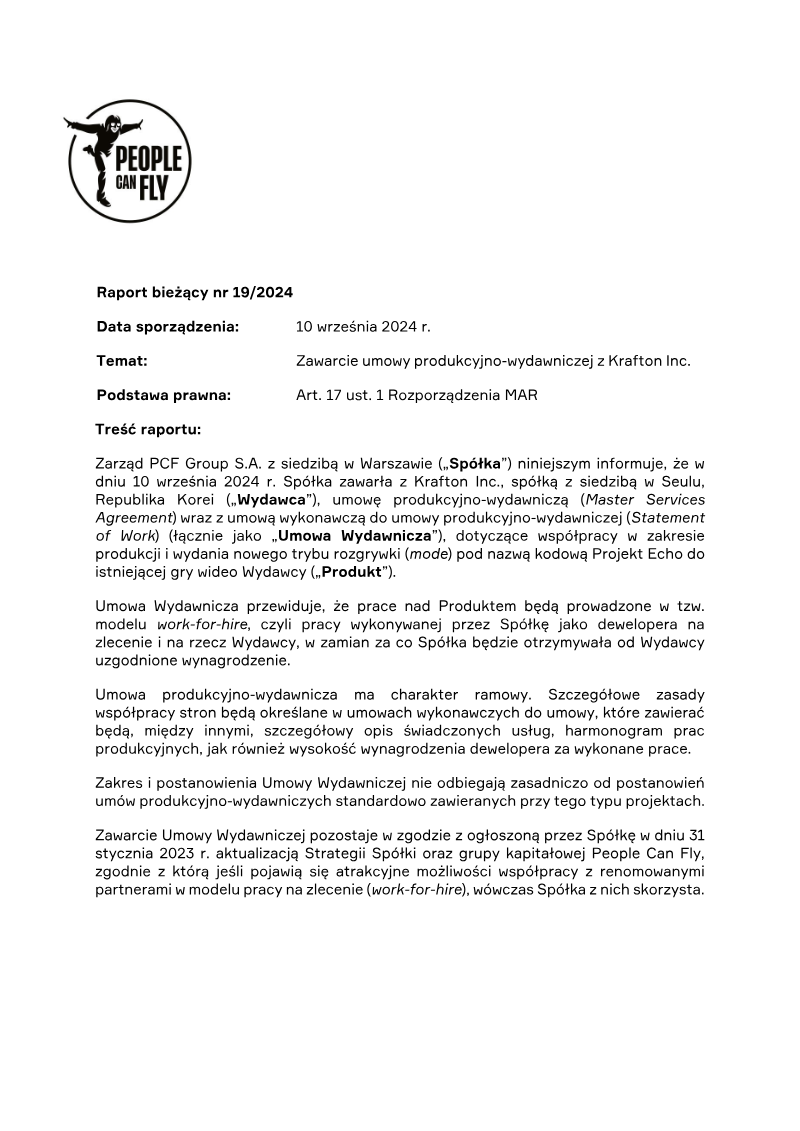
Raport Bieżący Nr 19/2024: Zawarcie Umowy Produkcyjno-Wydawniczej z Krafton Inc.
PCF Group S.A. has entered into a formal production and publishing agreement with the South Korean firm Krafton Inc. as of September 10, 2024. This partnership centers on the development of a new gameplay mode, currently identified by the codename Project Echo, intended for an existing video game title owned by Krafton. The collaboration is structured as a work-for-hire arrangement, wherein the developer provides services and production expertise in exchange for agreed-upon compensation from the publisher.
The agreement functions as a master services framework, establishing the foundational legal and operational terms for the partnership. Specific project parameters, including detailed service descriptions, production timelines, and precise financial remuneration, will be defined through subsequent individual statements of work. The terms governing this engagement align with standard industry practices for international production and publishing contracts, ensuring a conventional approach to project management and intellectual property rights.
This strategic move directly supports the long-term objectives outlined in the company’s updated corporate strategy from January 2023. By securing this contract, the developer continues to execute its stated goal of pursuing high-value collaborations with reputable global partners within the work-for-hire business model. This development reinforces the company’s commitment to diversifying its project portfolio while leveraging its technical capabilities to support established titles in the global gaming market.
- PCF Group S.A. signed a production and publishing agreement with Krafton Inc. on September 10, 2024.
- The partnership focuses on the development of a new gameplay mode codenamed 'Project Echo' for an existing Krafton-owned title.
- The collaboration is structured as a work-for-hire arrangement where PCF Group provides production services in exchange for financial compensation.
- The agreement serves as a master services framework, with specific project timelines and remuneration to be defined in subsequent statements of work.
- This contract aligns with PCF Group’s January 2023 corporate strategy to secure high-value collaborations with global partners.
+1
PCF Group
Report7 pages
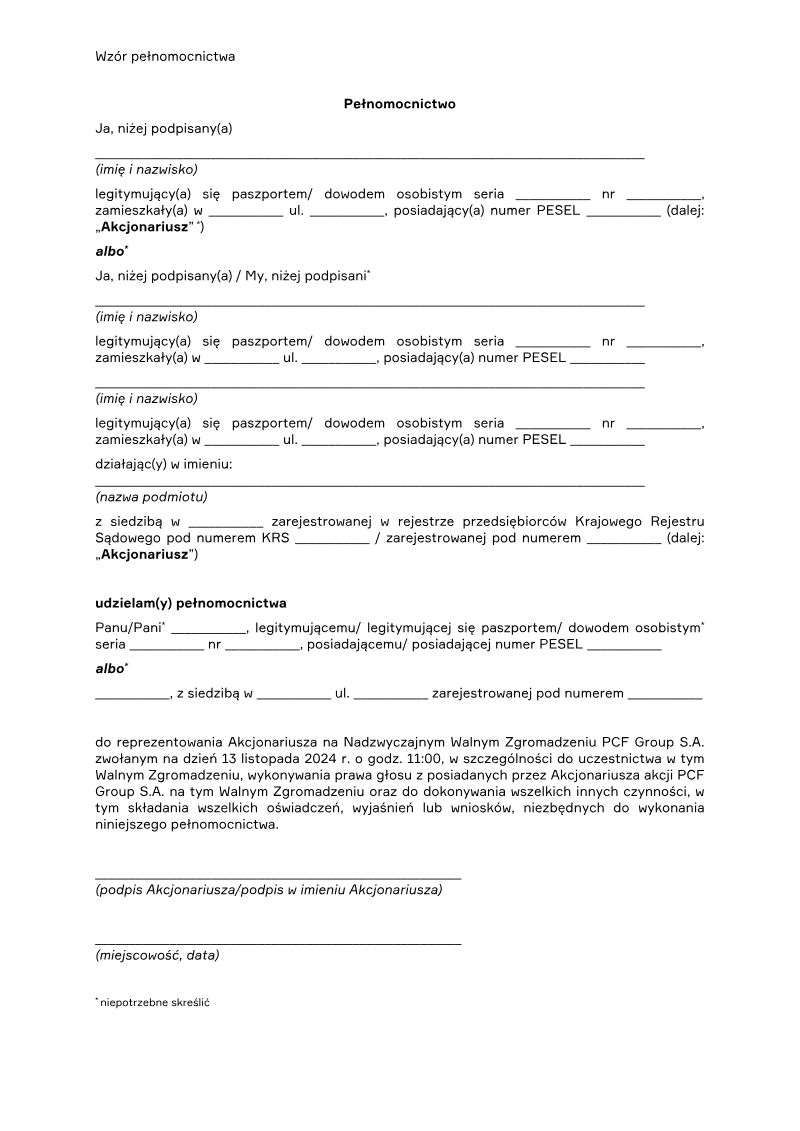
Załącznik do Raportu bieżącego nr 21/2024Wzór pełnomocnictwa na NWZ
The provided text serves as the official proxy voting template for the Extraordinary General Meeting of PCF Group S.A., scheduled for November 13, 2024. The primary purpose of this instrument is to establish a formal legal framework allowing shareholders to appoint a representative to exercise their voting rights and participate in corporate governance proceedings on their behalf. By standardizing the authorization process, the company ensures that all proxy representations comply with regulatory requirements for shareholder participation in high-level corporate decision-making.
The template facilitates both individual and institutional shareholder participation by providing distinct fields for personal identification, such as passport or national identity card details and PESEL numbers, as well as corporate registration data for legal entities. The scope of the authorization is comprehensive, granting the appointed proxy the authority to attend the meeting, cast votes associated with the shareholder’s equity stake, and perform all necessary ancillary actions, including the submission of statements, explanations, or formal motions required during the proceedings.
This administrative document functions as a procedural requirement for the upcoming meeting, ensuring that the company maintains a transparent and legally binding record of shareholder representation. By defining the specific date and time of the meeting, the template serves as a critical tool for maintaining quorum and facilitating the orderly execution of the Extraordinary General Meeting. It reflects standard corporate governance practices within the Polish capital market, providing a structured mechanism for shareholders to delegate their voting power while maintaining clear accountability and legal clarity.
- PCF Group S.A. has scheduled an Extraordinary General Meeting for November 13, 2024.
- The provided document is a standardized proxy voting template designed to formalize shareholder representation for this specific meeting.
- The proxy instrument grants appointed representatives full authority to attend the meeting, cast votes on equity stakes, and submit formal motions or statements.
- The template requires specific identification data, including passport or national identity card details and PESEL numbers for individuals, or corporate registration data for legal entities.
- This administrative tool is intended to ensure regulatory compliance, maintain a transparent record of representation, and assist in achieving the necessary quorum for corporate decision-making.
PCF Group
Report1 pages
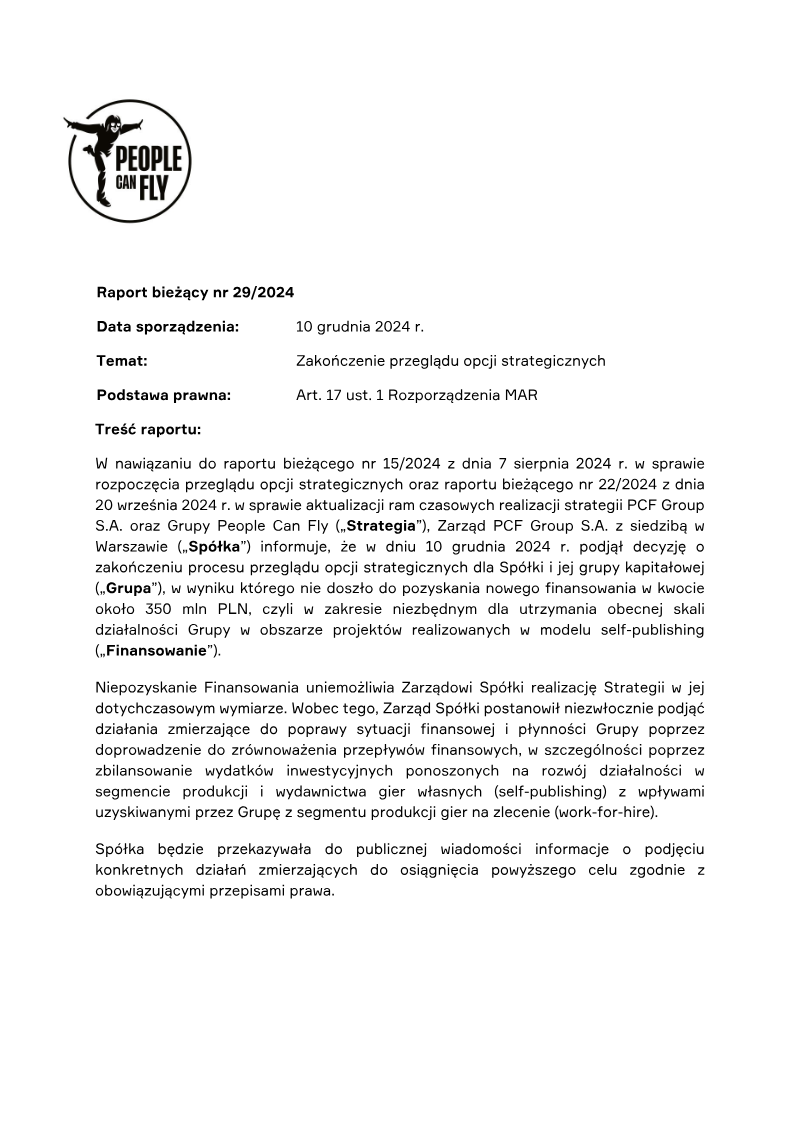
Current Report No. 29/2024: Conclusion of Strategic Options Review
People Can Fly Group has officially concluded its strategic options review process, initiated in August 2024, without securing the necessary capital to sustain its current operational trajectory. The company failed to obtain approximately 350 million PLN in external financing, a sum deemed essential for maintaining the existing scale of its self-publishing game development projects. Consequently, the organization is unable to execute its previously established corporate strategy in its current form.
To address the resulting financial constraints and ensure liquidity, the management board is shifting its focus toward stabilizing cash flows. The primary objective is to align capital expenditures within the self-publishing segment with the revenue generated from the company’s work-for-hire production services. By balancing these two business segments, the firm aims to achieve a sustainable financial equilibrium.
This strategic pivot marks a significant contraction in the company's growth ambitions, moving away from aggressive self-funded expansion toward a more conservative, revenue-dependent model. The company has committed to providing further updates as it implements specific measures to restructure its operations and restore financial stability. Future disclosures will detail the concrete steps taken to align the group’s cost structure with its incoming cash flows from external development contracts.
- People Can Fly Group has officially ended its strategic options review after failing to secure the 350 million PLN in external financing required to maintain its current self-publishing trajectory.
- The company is abandoning its previous growth strategy due to an inability to fund its existing scale of self-publishing game development projects.
- Management is shifting to a conservative financial model that prioritizes stabilizing cash flows over aggressive, self-funded expansion.
- Future capital expenditures in the self-publishing segment will be strictly limited to the revenue generated by the company's work-for-hire production services.
- The organization is currently undergoing a restructuring process to align its overall cost structure with the income derived from external development contracts.
+1
PCF Group
Report1 pages
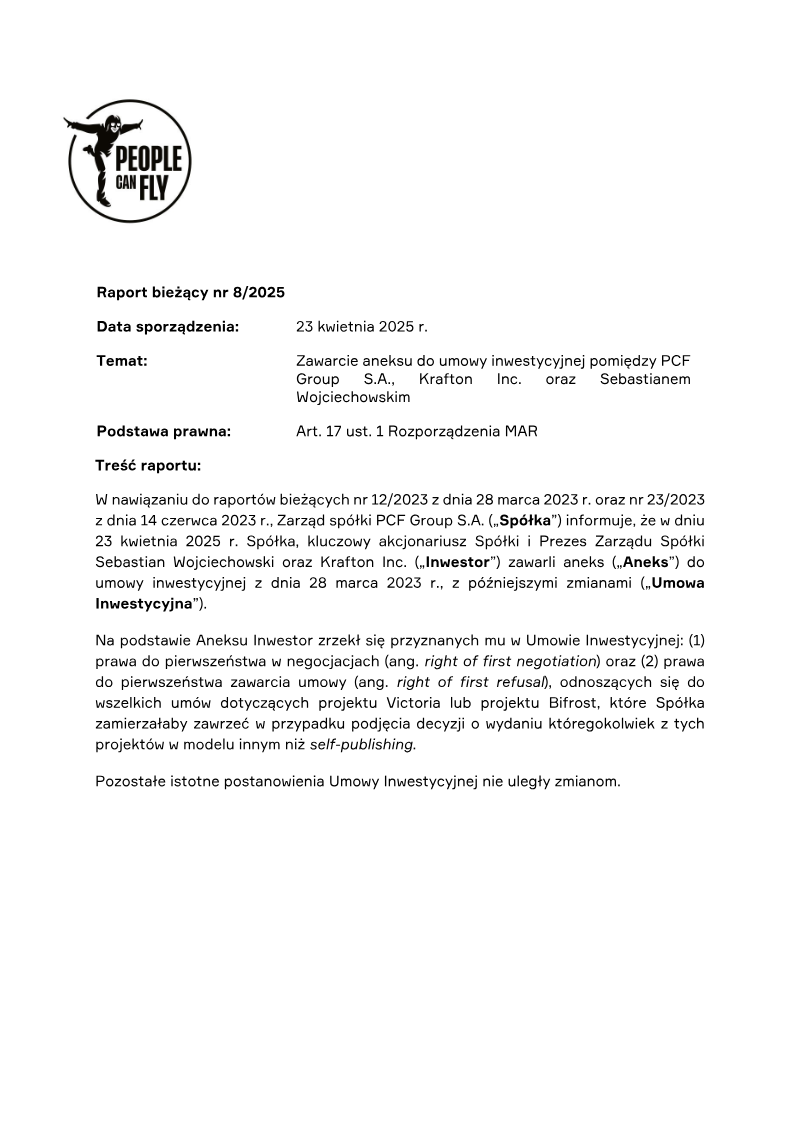
Raport Bieżący Nr 8/2025: Zawarcie aneksu do umowy inwestycyjnej
PCF Group S.A. has formalized an amendment to its existing investment agreement with Krafton Inc. and company CEO Sebastian Wojciechowski, effective April 23, 2025. This legal update modifies the strategic partnership established in March 2023, specifically altering the contractual obligations regarding the future commercialization of two internal development initiatives, Project Victoria and Project Bifrost.
The primary outcome of this amendment is the waiver of specific preferential rights previously granted to Krafton Inc. Under the original terms, the investor held a right of first negotiation and a right of first refusal concerning any third-party publishing agreements for these two projects. By relinquishing these rights, the company gains greater flexibility to pursue alternative publishing models, including potential partnerships outside of the self-publishing framework, without being bound by the investor’s prior veto or negotiation priority.
This adjustment applies exclusively to the governance and commercialization rights of the specified projects within the company’s current development pipeline. All other terms and conditions stipulated in the original 2023 investment agreement remain in full force and effect. This development reflects a strategic shift in the company’s operational autonomy regarding its intellectual property, allowing for broader market engagement as these projects progress toward potential release.
- PCF Group S.A. amended its March 2023 investment agreement with Krafton Inc. on April 23, 2025, to regain control over the commercialization of two internal initiatives, Project Victoria and Project Bifrost.
- Krafton Inc. has waived its right of first negotiation and right of first refusal regarding third-party publishing agreements for both Project Victoria and Project Bifrost.
- The amendment grants PCF Group S.A. increased operational autonomy to pursue external publishing partnerships for these projects without being restricted by Krafton’s previous veto or priority rights.
- This strategic shift allows PCF Group S.A. to explore publishing models beyond its current self-publishing framework for the two specified development projects.
- All other terms and conditions established in the original 2023 investment agreement between PCF Group S.A., Krafton Inc., and CEO Sebastian Wojciechowski remain unchanged and in full effect.
PCF Group