The Marriage
Game
4 documents in the library are about The Marriage, from writers such as DiGRA and Singapore-MIT GAMBIT Game Lab. Each has a summary and key insights with the page they come from.
Connections
Each row is a game or company named alongside The Marriage, each column a document, oldest first. A mark means that document names it. Select a row to see those documents.
Documents about The Marriage
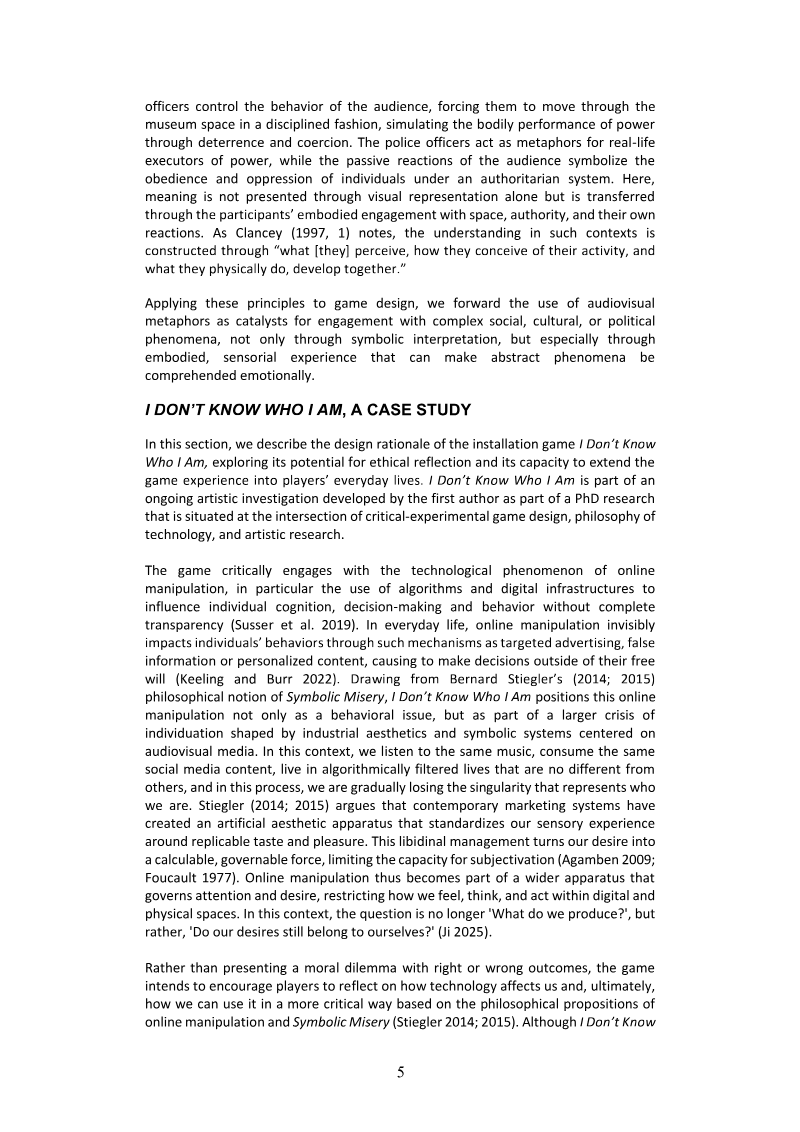
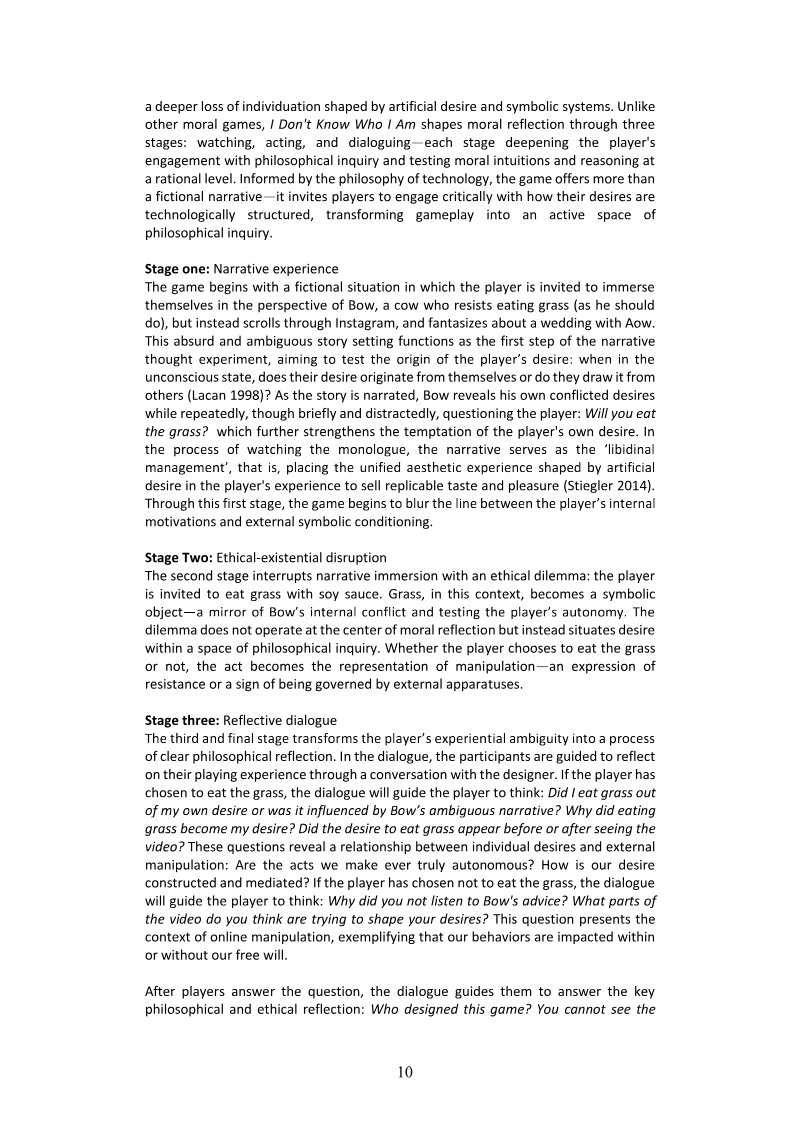
Revisiting the Magic Circle for Critical-Ethical Reflection through Artistic Installation Game Design
The document explores the capacity of game design, specifically through artistic installation games, to cultivate critical-ethical reflection in players.
- The paper argues that installation games can prompt critical-ethical reflection by moving players beyond the 'magic circle,' the boundary separating play from real-world consequence, using narrative thought experiments combined with metaphoric, embodied interaction.
- The central case study, I Don't Know Who I Am, is a single-player installation game in which players inhabit Bow, a cow experiencing identity loss, and face an ethical dilemma about whether to eat grass seasoned with soy sauce.
- The game's structure moves through three stages: narrative immersion, an ethical dilemma, and a closing dialogue with the designer about online manipulation and technologically shaped desire.
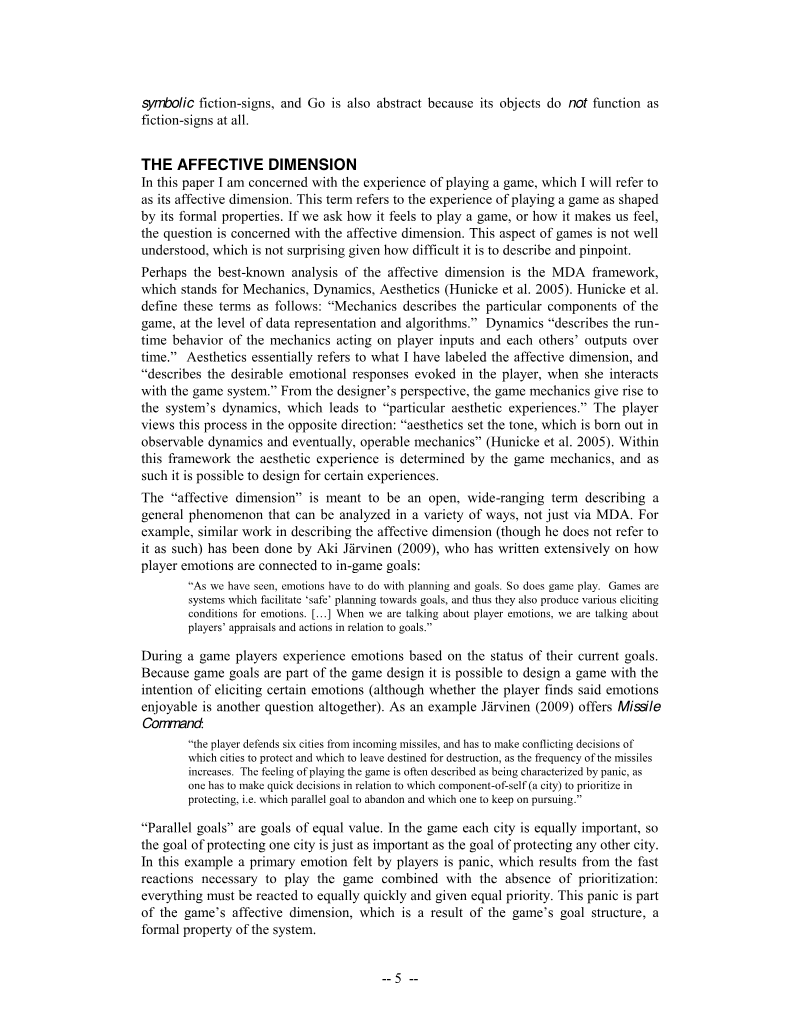
Experiential Metaphors in Abstract Games
The analysis of "Experiential Metaphors in Abstract Games" proposes a critical method for interpreting abstract games, which inherently lack explicit narrative or representational "aboutness."
- Begy argues that abstract games, whose objects function as symbols rather than icons (e.g., Go and Rod Humble's The Marriage, versus the largely iconic Chess), can still carry meaning through experiential metaphor, a cognitive form of structural metaphor grounded in the player's lived experience of play.
- Meaning emerges when players map the affective texture of gameplay (tension, relief, panic) onto other experiences, relying on image schemata and systemic correlations within a game's formal properties.
- Both metaphor and simulation amplify some aspects of their source while masking others, so any interpretation depends on what a game emphasizes or omits.
Mechanisms of the Soul: Tackling the Human Condition in Videogames
"Mechanisms of the Soul: Tackling the Human Condition in Videogames" posits that video games can effectively explore and convey insights into the human condition through three primary design devices: Fictional Alignment, Procedurality, and Experiential Metaphor.
- Games can convey insights into the human condition, and their greatest affective power lies in their rules and player-driven activity rather than in fiction alone.
- Fictional Alignment pairs game mechanics with narrative so that emotions produced by play and emotions depicted in the story reinforce one another, as in God of War II, where mechanics and cutscenes together make Kratos's shame, anger, and yearning for revenge tangible to the player.
- Procedurality, where a game's underlying systems model aspects of experience, succeeds only when players cognitively grasp what the game is modeling, as shown by the grappling-hook sequences and Rod Humble's The Marriage.
A Certain Level of Abstraction
This paper, "A Certain Level of Abstraction," explores the concept of abstraction as a fundamental element of video game design, player decoding, and player optimization.
- Abstraction is a central design element in games: there is no natural level of detail for any action, and the chosen level defines a game and its genre, as shown by Cooking Mama omitting actions like ordering take-out and contrasting with Diner Dash: Flo on the Go.
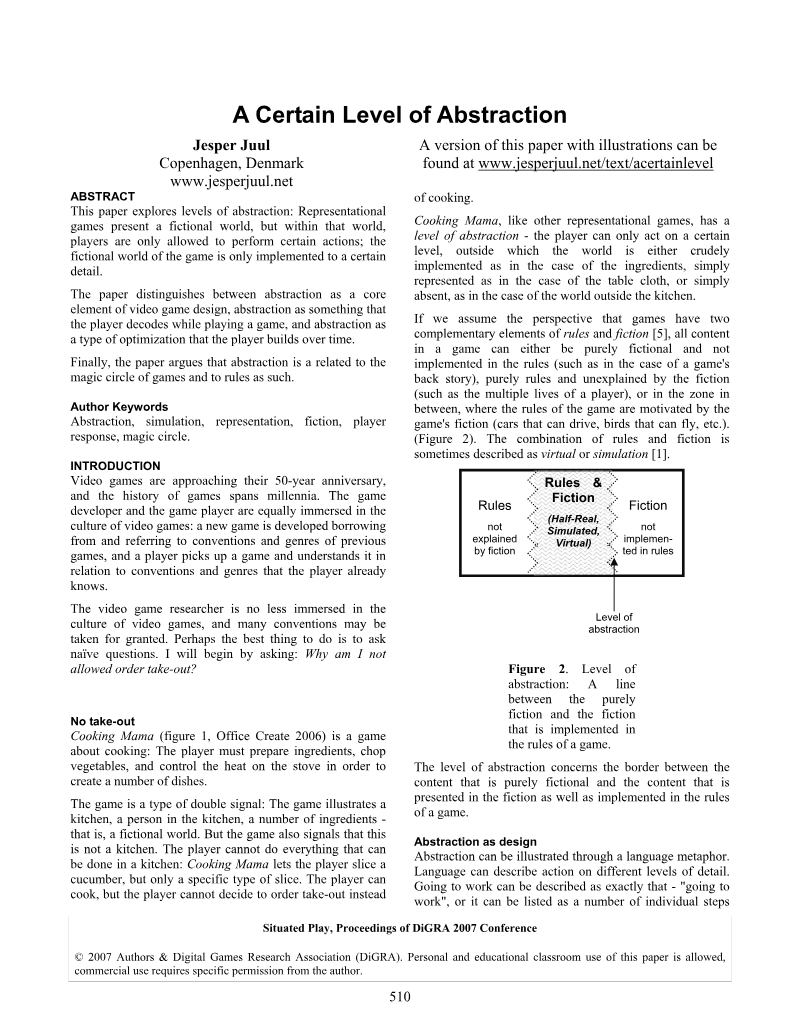
- Juul's framework places game content on a spectrum from purely fictional to purely rule-based, with the most interesting design territory where rules are motivated by the fiction.
- Experienced players recognize genres through learned conventions, while novices rely on the fiction to infer rules, illustrated with real-time strategy titles such as StarCraft and Age of Empires II.