Silent Hill 3
Game
2 documents in the library are about Silent Hill 3, from writers such as DiGRA. Each has a summary and key insights with the page they come from.
Connections
Each row is a game or company named alongside Silent Hill 3, each column a document, oldest first. A mark means that document names it. Select a row to see those documents.
Documents about Silent Hill 3

Article
A Typology of Rumble
"A Typology of Rumble" argues that controller rumble, though ubiquitous in digital games since the late 1990s, has been overlooked in game studies and design literature.
- Controller rumble has been ubiquitous in digital games since the late 1990s but remains overlooked in game studies and design literature, which has focused more on haptics in virtual environments and exergames.
- The study's empirical base is nine single-player action and adventure titles spanning the PlayStation 1 through PlayStation 4 generations, analysed through close play and extended sessions rather than player-response data.
- The central contribution is a two-dimensional typology classifying rumble by feedback source (environment, object, interface, or body, with body subdivided into kinaesthetic, physiological, and extrasensory) and by level of operation (ludic, dramatic, or technical), drawing on semiotic denotation and connotation.
DiGRAJan 2019
Whitepaper7 pages
Building and Reconstructing Character: A Case Study of Silent Hill 3
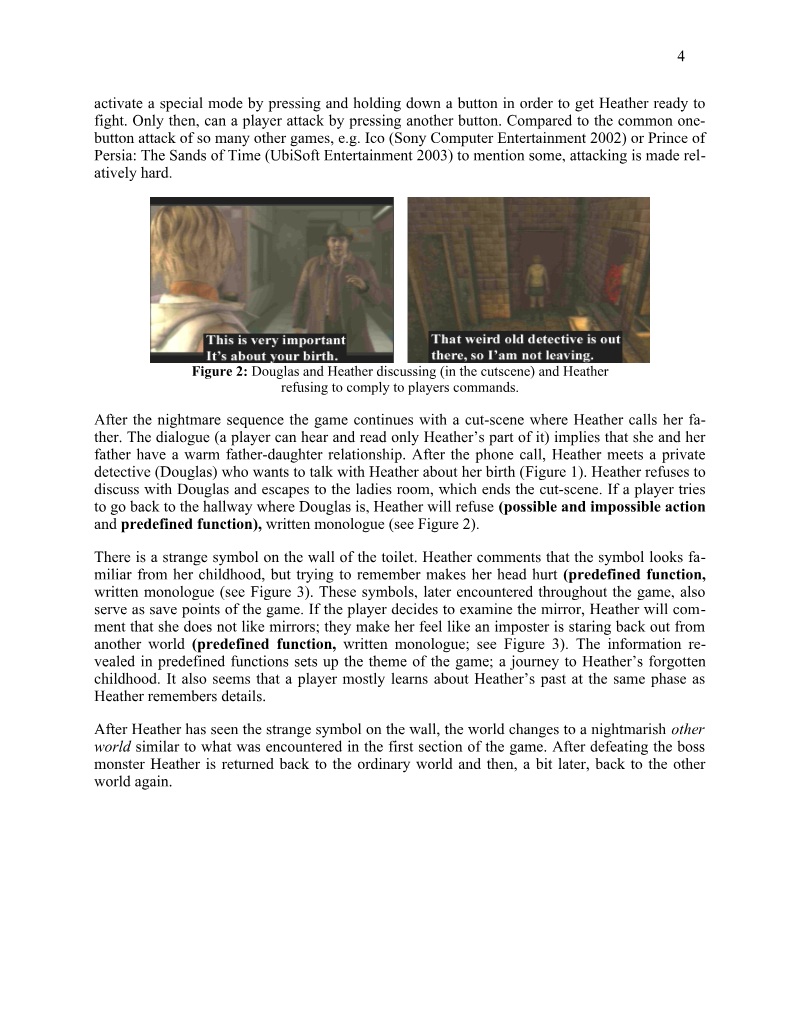
This paper, by Petri Lankoski of the University of Tampere, examines how the player character Heather is constructed in Silent Hill 3, a 2003 survival horror game.
- Predefined functions such as cutscene dialogue and written monologue are the primary means by which Heather's nature is revealed in Silent Hill 3, while goals play only a minor role.
- Possible and impossible actions frequently reinforce the characterization conveyed by predefined functions, operating through the game's control design.
- The opening user guide, the playable nightmare sequence, and the first cutscenes are especially important for setting the player's interpretive expectations of the character.
DiGRAJan 2005