1001 Nights
Game
3 documents in the library are about 1001 Nights, from writers such as DiGRA. Each has a summary and key insights with the page they come from.
Connections
Each row is a game or company named alongside 1001 Nights, each column a document, oldest first. A mark means that document names it. Select a row to see those documents.
Documents about 1001 Nights
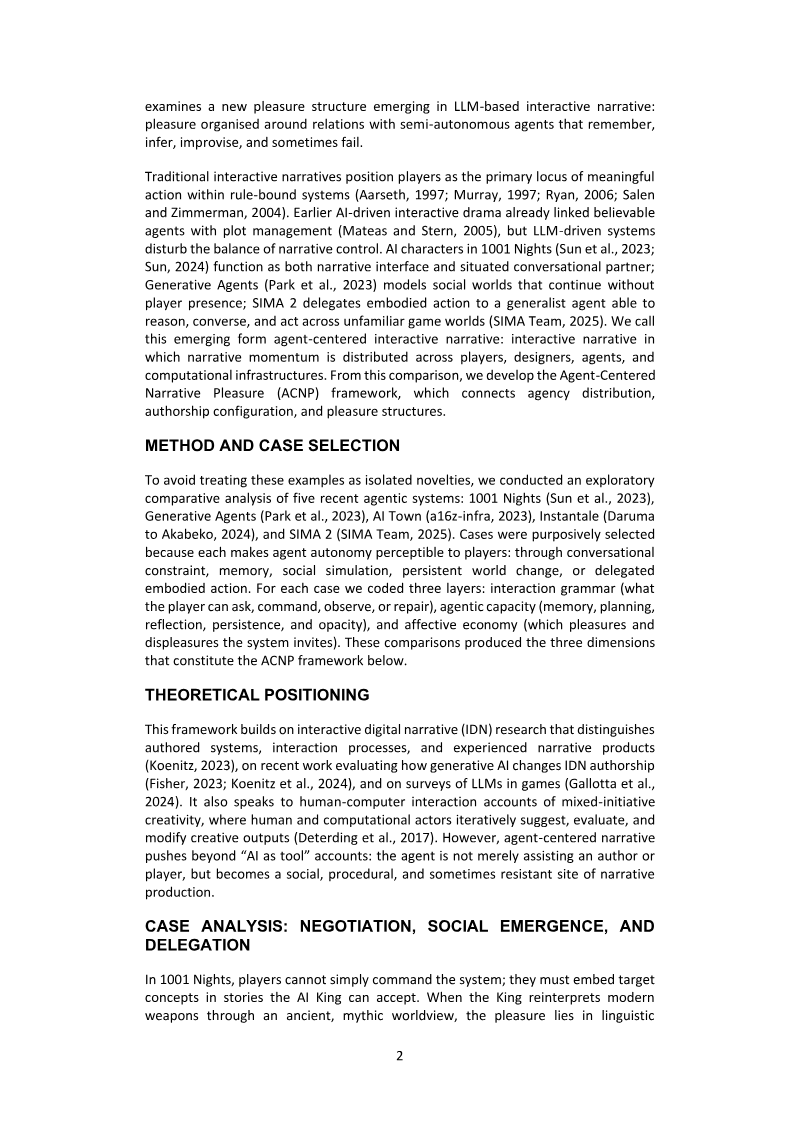
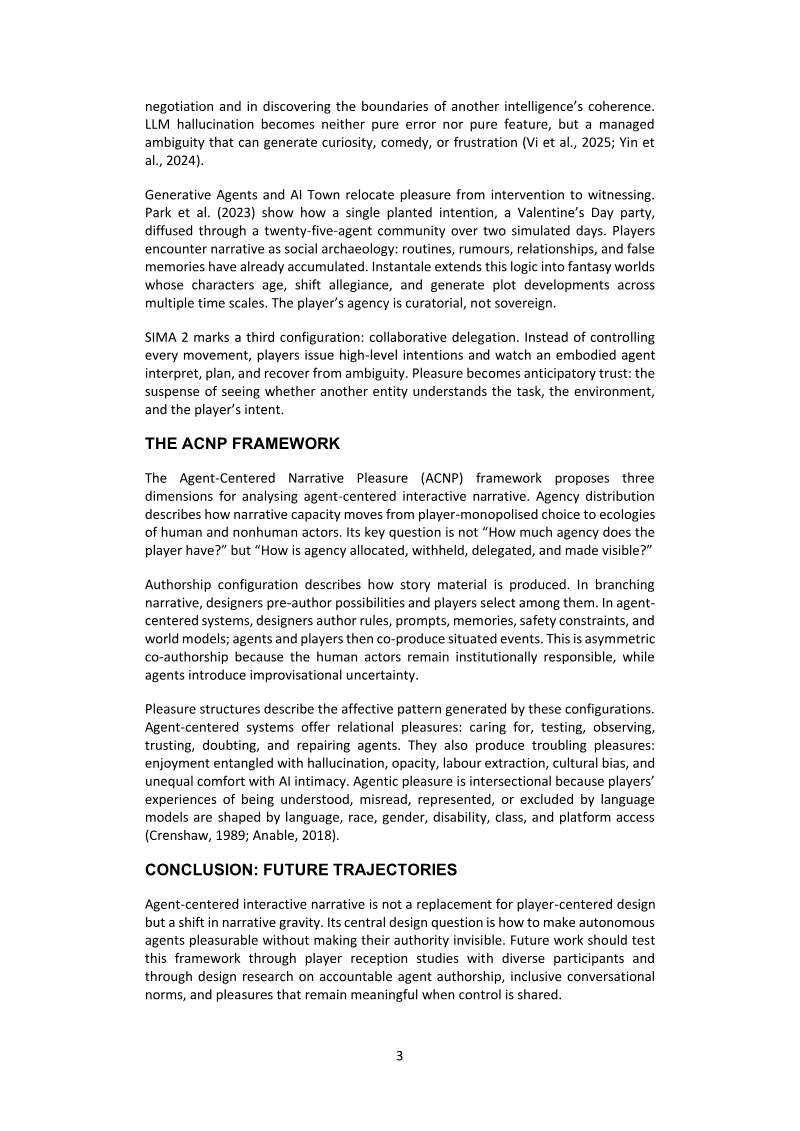
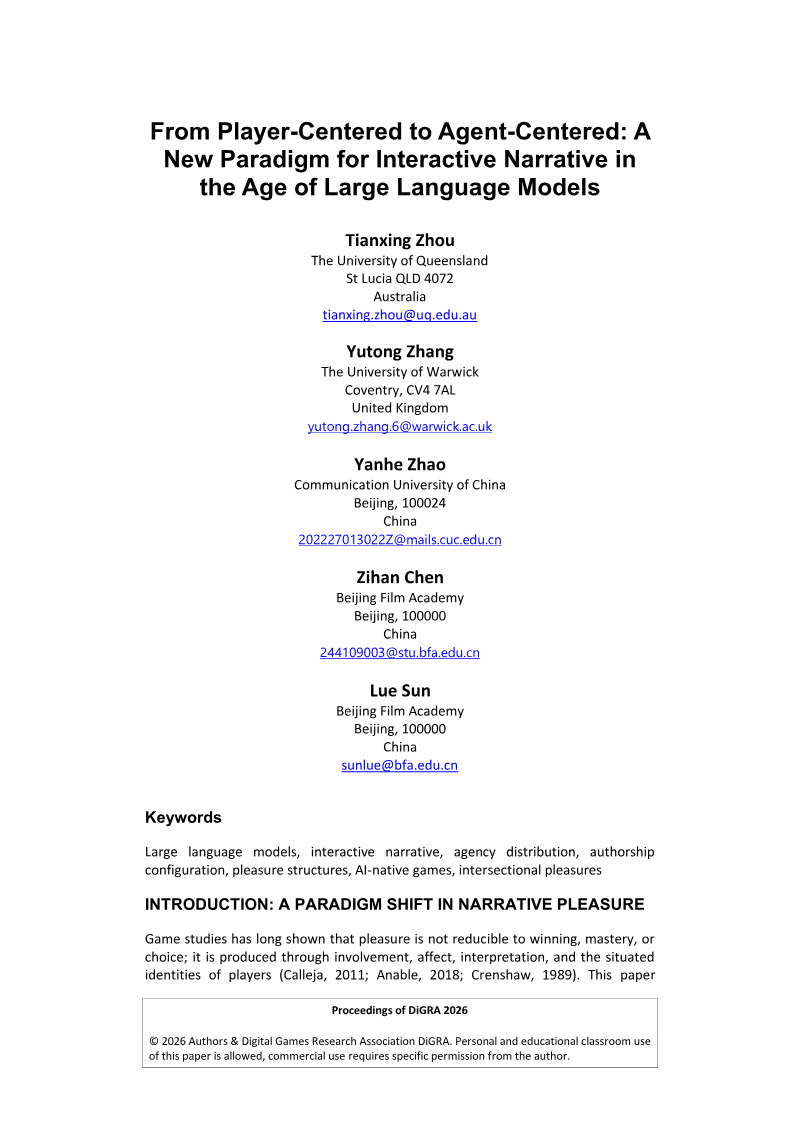
From Player-Centered to Agent-Centered: A New Paradigm for Interactive Narrative in the Age of Large Language Models
This paper argues that large language model (LLM) driven interactive narrative is shifting the locus of pleasure from player-centred choice toward relationships with semi-autonomous agents that remember, infer, improvise, and sometimes fail.
- The paper argues that LLM-driven interactive narrative shifts pleasure from player-centred choice toward relationships with semi-autonomous agents that remember, infer, improvise, and sometimes fail.
- It proposes the Agent-Centered Narrative Pleasure (ACNP) framework, linking three dimensions: agency distribution, authorship configuration, and pleasure structures.
- Its evidence is exploratory and comparative, based on qualitative coding of five agentic systems (1001 Nights, Generative Agents, AI Town, Instantale, SIMA 2), with no survey data or quantitative sample sizes reported.
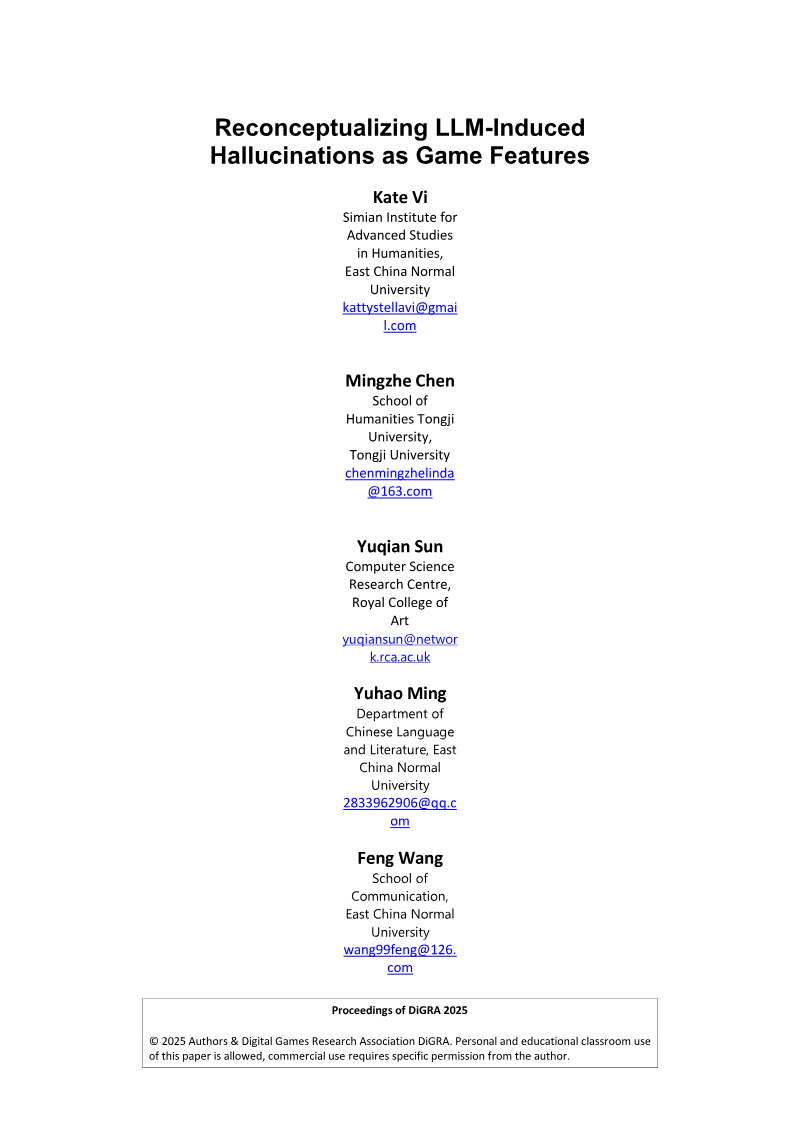
Reconceptualizing LLM-Induced Hallucinations as Game Features
The paper argues that large language model hallucinations, the plausible but inaccurate or fictitious outputs that are typically treated as technical defects, can instead be designed as intentional features of game experiences.
- The paper reframes LLM hallucinations, usually treated as technical defects, as potentially intentional design features for games, using the 'Magic Circle' concept of bounded play spaces to justify them.
- Its authors present the work as a conceptual and design-oriented contribution rather than an empirical study, and explicitly acknowledge the lack of quantitative data on player engagement or hallucination rates.
- Two design strategies are proposed: containing fabrications by limiting verifiable detail, keeping dialogue brief, and maintaining thematic focus, and establishing an irrational or comedic in-game worldview in which unexpected outputs feel characteristic.
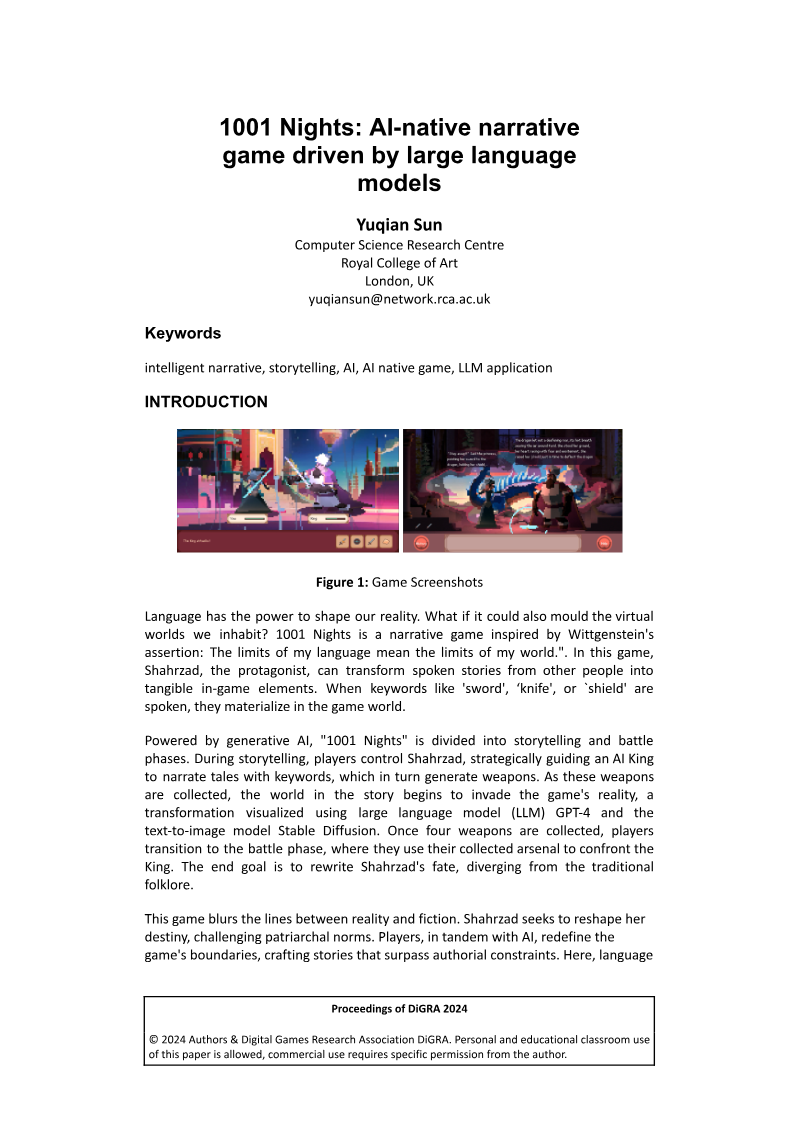
1001 Nights: AI-Native Narrative Game Driven by Large Language Models
"1001 Nights" is a narrative game developed by Yuqian Sun and collaborators at the Royal College of Art in London, built around the premise that language can shape reality.
- "1001 Nights" is a narrative game by Yuqian Sun and collaborators at the Royal College of Art in London, built on the premise that language shapes reality, drawing on Wittgenstein's idea that the limits of language define the limits of one's world.
- The player takes on the role of Shahrzad, transforming stories narrated by an AI King into tangible in-game objects such as swords, knives, and shields, with the overarching goal of rewriting her fate and diverging from traditional folklore to challenge patriarchal norms.
- The game has two phases: a storytelling phase where the player uses keywords to guide the AI King's narration, and a battle phase where collected weapons are used against the King.