1 free read left. Create a free account for unlimited reading + AI research.
Create free account
Where is the Game Industry Today? M&A and Public Game Companies | Pixels & Profits #1
Key insights
7 takeaways- 01Established publishers like Ubisoft and Unity are struggling to balance legacy business models with modern technical demands, while firms like Take-Two Interactive and Electronic Arts maintain stability through diversified, cash-flow-oriented portfolios.
- 02A competitive bifurcation is occurring where top-tier titles dominate market share, while Western incumbents face increasing pressure from Chinese competitors scaling live-service expertise across console and PC.
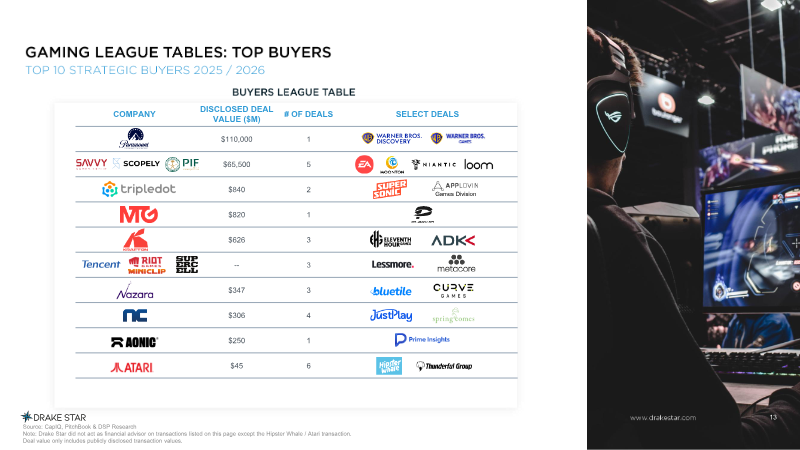
- 03Strategic acquisitions are now prioritizing IP alignment and long-term scale over traditional financial roll-ups, as evidenced by Savvy Games Group’s acquisition of Scopely.
- 04The gaming industry has shifted from an era of unchecked expansion to a disciplined focus on operational efficiency and live-service models due to rising capital costs and difficult user acquisition.
- 05M&A activity has slowed significantly since the 2022 peak, driven by a valuation impasse between private companies holding historical funding valuations and public entities facing tighter capital constraints.
- 06Regulatory scrutiny, exemplified by the Microsoft-Activision merger, continues to complicate large-scale consolidation efforts across the industry.
- 07Generative AI is emerging as a critical tool for enhancing development efficiency and enabling smaller teams to produce complex content, though industry execution remains inconsistent.
Ask AI about this video
Transcript
foreign episode of pixels and profits where we talk about game industry news with the focus on the business of games our Focus for today where are we in terms of the free to play games industry and then two we'll discuss Outlook of major game Publishers and discuss highlights from earnings maybe some key trends and themes I think we're also going to talk a little bit about embracer and kind of some of the big news around that company for those of you who don't know me I'm Joseph Kim CEO of mobile free to play FPS shooter game company Leela games and a long time content creator for game makers we also have two other co-hosts for this segment Matthew contourman and Brian peganov and just for our audience guys maybe you guys could do a quick intro so people know a little bit more about your backgrounds and who you guys are let me go first go for it all right I'm
Brian founder and employee one at the timber advisors the consultancy and advisory business I started about two years ago I do strategy corporate development and funding work for video game development Studios and games at Jason software businesses and I also spend some time with investors on public equities focused on the gaming industry and broader Tech and media thank you hey I'm Matthew I'm the director of research at Round Hill Investments we're a registered investment advisor we issue ETFs and and we have about a dozen ETFs right now plus or minus uh uh we have roughly 600 650 million dollars of assets today um I'm also the portfolio manager on the roundhill generative Ai and Technology ETF ticker chat awesome all right so let's kick this off with what I consider to be a very fundamental question now the mobile games industry and the games industry in general is very dynamic free to play Super Dynamic and so the question is like where are we today and I recently
wrote a newsletter post about the macro shift in terms of like having a zero interest rate environment and living in an Age of Excess to now moving to the age of efficiency and in fact when you look at companies like medin and some of the things that Mark Zuckerberg has talked about you know this is 2023 is the year that Mark Zuckerberg is calling the year of efficiency and I think when we look at the entire Tech sector it's been hit by Massive layoffs and we feel that in the games industry as well and I see it even in India you know an economy that has otherwise been booming and just anecdotally hiring has become tremendously easier in think more globally anecdotally I've been hearing a major shift from major game studios around the world away from like new game development initiatives to focusing on live Ops on things that are more profitable more proven and we've seen a fair amount of M A picking back up as companies struggle to grow in this
current environment now whether that's because of idfa or other issues we can talk about but and that's something that we'll we'll probably discuss later in our conversation today but I thought I could start with opening with this fundamental question thoughts in terms of macro Trends and themes what do you guys think so with this question there's a broad question where are we what do you guys think uh well maybe starting with you Matthew what do you think we're just in this weird Bizarro world that we've been in for like probably the better part of a decade at this point but you know I think for the last six to 12 months you know I I'm I consider myself fairly cynical and you know particularly for public companies CEOs understand what the market rewards them and understand what drives their stock prices and for the last 12 months improving your margins and cutting costs has has driven stock prices and so you know cynically you know you've seen a lot of public companies not just meta
Zuckerberg do it but now pretty much everyone is cutting costs and when they announce Cost Cuts their stock goes up and as long as that's the case that's going to be the focus for these companies and when you take that to a global macro perspective right we have uncertainty around inflation uncertainty around GDP growth uncertainty around interest rates uncertainty around geopolitics and in this you know Tech Cold War that's still going on between the U.S and China and so when you put all that together you can understand why companies and Executives want to you know not be taking too many long-term risky bets in this environment they want to understand what they have and get the most out of it we're going to talk about generative AI later and how that ties in as well but that's also part of the discussion around efficiency and taking advantage of new technology and getting the most out of their resources you have rather than investing more in new resources yeah I think adding to that cost of capital has had huge impacts on the entire economy and gaming is you know certainly not immune um I think it largely makes sense for Publishers and developers to focus on
the Mao and DOW they have or Revitalize IP that's been on the Shelf uh that does bring a much higher success rate or hit rate versus starting from scratch and developing new IP and you just don't want a green light three to five years of work in an uncertain backdrop like this and gaming Publishers particularly immobile have had to make a lot of tough decisions on the Quantum of capital they put to work in UA and adding to that the idfa changes have made attribution like way less clear so there's been a lot of results and I guess I'll just bullet point a few of them generally speaking shrinking down in Mount metrics in some cases offset by stuffing in lower tier GEOS the highest performers have been able to offset Revenue headwinds with expertise and live Ops and monetization and like King inside players some good examples of those and also benefits of scale and then games that have flashed strong growth in Prior years but were driven by like longer payback Windows have suffered the most and this isn't a great backdrop for bringing new players
into games with complex uh fatues and super deep meta games and many of those companies were as Joe mentioned earlier required during the pandemic boom so companies that have managed to raise substantial Equity rounds during the pandemic are a little bit more insulated and they continue to spend into those longer windows but the other kind of like cautionary tale there is that the ECM and IPO businesses have not reserved reserved to normal and uh it's unlikely to for until like probably mid to late next year best case so those companies do need to be diligent and burned they can't do this in perpetuity and you know if we had to like launch those into Equity markets now I think a lot of investors would dump their nodes into valuations that those were done at prior so you know whatever your number is for mobile growth or contraction from 23-24 it doesn't really matter a ton that's only like 20 of the battle and there's always these massive shifts that occur within certain genres and games and things like that and I guess if I could just end with one silver lining to less competitive UA which is driven by cost
of capital it's like potentially better launch Dynamics for highly performed games and you know a company like scopely and Monopoly go is probably a good recent example of this but it's also one other thing I think Joe might be able to be a little bit more uh apt to speak on is just this notion that gaming is Recession Proof and I think we're we're starting to see some signs of that with mobile at least not puking anymore but I do think that will be uh tested in a prolonged like a prolonged higher rates backdrop right um and maybe I could speak on that a little bit so I do think like just my own perspective in terms of giving being Recession Proof is that especially when we think of Premium game products I do think that's Recession Proof just because the value For Your Entertainment dollar is so low but um I think the Nuance there is like when we think about IEP spend especially for like well-driven games or games with like higher RP lower conversion higher rpoo those are the types of games where I think we need to consider IAP spend for those games uh a little bit more
discretionary versus non-discretionary so those will actually be impacted by a recession and things like that I I just wanted to tack on and to your point you know and this is something that we've been making a point of in some of our research is you know the economy is bifurcating between the Haves and have-nots and you've seen it in gaming right you've seen for example Call of Duty you know came out last year and took the wind out of a lot of other games it took the wind out of Apex it took the wind out of other titles what's clear is that the leaders and the best titles are taking away market share and they're taking time spent they're taking the dollars and so um you know from that perspective you're seeing that in the gaming industry but you're seeing it pretty much everywhere in the economy and that's this weird bifurcation that's going on and I think that's part of the reason that people are still trying to figure out if we're going to have a global recession a domestic recession or not it's because on the micro level you look at one company and they're struggling you look at another they're doing very well and it's really hard to kind of parse out
the signal to the noise right now so my own take on where we are today is that I I think the short to medium term theme is basically around efficiency and especially if there's a recession I think we really have to think about um this trend that may play out over the next call it five to ten years where we potentially also not only because of efficiency I think that kind of Turbo charges this trend but I think we I think we've had some structural changes when we look at Global competitiveness because the world is becoming increasingly Global I think education is Shifting towards other parts of the globe and other GEOS where you know it's been more difficult for them to kind of catch up in terms of skill and capability but I do think there may be a Changing of the Guard as old incumbents and even what are considered powerhouses like um you know like blizzard or rock star may start to lose their power as insurgents especially from east from the
East particularly China we've got companies like hoyoverse with dungeon impact and honkai star rail that are both top 10 Revenue games worldwide we've got Lilith game science maybe even fun plus and others that are beginning to rise and dominate and they dominate with efficiency with the killer work ethic 996 or yeah it's uh yeah 996 cost structure Val advantage and the deployment of capital to a scale that a lot of people in the west can't compete with like hoyo versus reportedly spending like 200 million a year on genshin so in that kind of scenario who can compete against that with with what team with what work ethic with what cost structure and so to some degree against these longer term Trends you know resistance is futile so I think today when we think about the West I mean the West still is powerful it's got advantage in terms of current Talent
skill IP art the ability to to be more Innovative than other places but I do think that China and others globally can catch up over time and to not think so is a little bit naive so I do think we continue to see disruption in the West I think that continues to play out over the next five to ten years unless things change but assuming we continue along the same path that we have been going to I do think that it's a different environment we're not in azurp environment anymore in an Age of Excess that we've been living in over the last 10 20 20 plus years and so I think unless something changes it continues that it has before yeah I mean just to your point um you know if you look at some of the Chinese the large Chinese internet companies 10 cent netis they're the largest gaming companies in the world for those that you know don't actually track their revenues but you know tencent wants to get 50 of its Gaming revenue for outside of China you know in
the next several years they're at roughly 25 today obviously that includes Riot that includes supercell so some of that will come from new games from those Studios but you know some of that also comes from their domestic Studios uh which they've also opened you know their own satellite branches in the west but they want to make games based on their IPs for the West for console in particular for PC you know where they don't have as big of a of exposure outside of China we know of them for their mobile expertise but if they can really replicate their live services expertise on Console I think that's going to be a big Awakening for a lot of Western companies because for up until now the risk has been these guys in China are great at mobile they're great at Mobile Live Ops they make the best mobile RPGs that are Shooters that's why everyone's partnered with them but they're not going to do it on HD they're not going to do it on Console in particular and if they're successful there that's going to be a big wake-up call to a lot of people right yeah I think that makes sense and just particularly for older gaming
cohorts like me and probably you guys too we have this kind of love affair with time tested IP and it's it's really hard to disrupt the older folks but uh it's also really easy to disrupt the younger generations and we've seen that with American and on American innovation with things like fortnite Roblox and I guess the other point to say is is like IP doesn't stay on the shelf forever it's not like I guess it's kind of like kimchi right it'll stay in the fridge for a few weeks but if you leave it in there for a few months so just multiply that by 12 uh you know companies like Embrace or Ubisoft like you can't just count on those games printing units for the rest of your foreseeable future you have to keep that Innovation quotient strong and if you lose focus on that that's an easy way to uh dig your own grave and gaming right so you know the the title of of our podcast is pixels and profits and as we you know you guys are two Finance guys but uh as we maybe kind of shift Focus maybe to earnings companies and maybe even starting with a discussion around where we are with respect to m a
and just my own perspective on this is that you know we're kind of coming off this this big run of call it five to ten years led by companies like Zynga and bracer still front MTG companies like that and at least the way that I've interpreted um the the last you know five ten years is that what has what happened and what Zynga kind of really pushed was like doing a lot of these pickups that hit mid-scale companies and and it really started by picking these guys off with like the easy pickups meaning more Lego type of you know kind of plug and play types of companies that you could just kind of plug into your company and um but they got increasingly harder as more and more companies got picked off and Zynga was obviously a clear winner during this environment they got some of the the easiest companies to kind of acquire they kind of led the charge there and but what that led to in my opinion was that a lot of mid-tier scale
companies kind of got hollowed out at least the easy ones and so then um what happened when a lot of the the mid-tier scale companies got acquired was that left more room on kind of like Upstream Downstream so then you'd have to shift to smaller companies or much bigger companies and in terms of the Upstream you know we had a lot of seed funded companies but then as you know market dynamics changed the investing Market got a little bit tougher um I think a lot of startups missed their series A's and so you know we had a lot of companies that got acquired on the cheapest is aqua hires and um and so that's kind of going going um upstream and then Downstream just moving to bigger scale pickups like the the big boy pickups the the scopelys rovios you know Activision we'll see what happens there and that's sort of where we are now but um I think though kind of my perspective on this and feel free to push back on me if you guys think I'm wrong is that
the ocean at this point in terms of fish is kind of you know it's not it's not empty but it's it's it's it's rather sparse and so maybe there's a little bit of a timeout necessary where you know M A activity needs a little bit more time for our for fish kind of like Upstream to get bigger and to populate the ocean and um and then it'll it'll be likely where um more deals will happen but we we need some of these companies to um to kind of get bigger scale so that they they can kind of um we can see more M A activity especially in in the mid-tier scale um and you know when I you know just kind of going through some of the financial uh reporting I saw that you know looking at a company like EA relatively quiet on the m a front for the last six quarters so you know after they kind of jumped in with deals Like Glue and playedemic you know it's been relatively quiet so I do feel like we are kind of like in this different environment now and you know it's it's just a different time
yeah I just wanted to jump in you mentioned Zynga like you know they kind of I'm not gonna say they were the first because M A's always happened but they were kind of the poster child for you know buying these let's call them 100 to 500 million dollar deals that was kind of The Sweet Spot for Zynga once they figured out their m a strategy by the way you had an excellent podcast with Chris petrovich like probably two years ago now which is still if you haven't listened to that about integrating Acquisitions and gaming you got to go listen to that because that's like the textbook for doing it basically um but they had a system in place that they had built over time and they had failed before they figured it out with a couple Acquisitions so it's not like you can just buy something and it works they they had a they had a plan they had a structure in place that made that that that M A roll-up strategy work and they knew what they were going for they were going for companies they were on the verge of basically launching games and effectively they were buying them right at the time as they were scaling and going into UA and so they knew what they were doing and they knew exactly what they were looking for but that middle kind of tier come companies to your
point got thinned out and something left and that's when Zynga kind of got to the point it kind of got helped by covet and they bought Relic but you know they got to the point where there was no growth law they couldn't there was no companies left to buy in that tier and they their organic growth was never really good they weren't great at actually launching games organically for several years before that it was all inorganic and you know and so they tried by being an ad Network and that didn't work and they got billed up by take two you know that was good for them so you know it's it's you know but but they were they were in a tough spot and you're seeing other companies that were these inorganic growth stories M A roll-up stories cost of capital when it went up their Equity currency went down because the stock market went down which is also a big factor in these deals when you don't have the equity kicker that says valuable anymore and and you know just and then you just had the market kind of slow down as well like the gaming Market all that together just put this on pause now hopefully to your point some of these cohort of companies that raised money in 21 in early 22 in a year maybe
two they'll be at that precipice of of kind of that sweet spot where it makes sense for m a again and we're already starting to see it pick up a little bit but you know it doesn't seem like what's happening so far is sustainable I do think that we're still a few quarters away from from a big pickup in capital markets in the gaming sector yeah I think interesting point just a dovetail on what you guys just said particularly around Zenga and them kind of formalizing the strategy behind the mobile gaming roll-up uh the competition got so Fierce that uh buying and leaving alone uh became kind of the the new rage and it became contractual right it's built into earn out structures and things like that so you had these large companies and this is mainly something that was like still front embracer uh they could no longer compete on price they could meet on price but they could say hey uh you can come over here and run your own fiefdom uh three years of burnouts and like you know cohab at it and then really they started to build the functions around supporting those Studios through things like UA and
marketing and live Ops far too late right and at that point it's like the battle is almost over here how are you going to control Studios that are contractually unobligated to listen to you um so I guess just on the broader themes uh from an m a perspective I I think we're going to see more big ticket M A before resumption of this 500 million and kind of blue kind of tickets and the latter of which over the last three years was mainly confined to mobile a largely Financial engineering trades and in most cases unsuccessful for the reasons you guys uh so eloquently pointed out and this very much goes back to the current cost of capital again it's like a broken record and plus you know depressed share prices these deals are just far too expensive against that backdrop and neither management teams nor shareholders are going to get paid for those with share prices like in Prior years so and again with ECM and secondary business the tanker it's just paying across Financial Services Industries and Publishers are going to struggle to raise Capital Now versus prior years regardless of being public
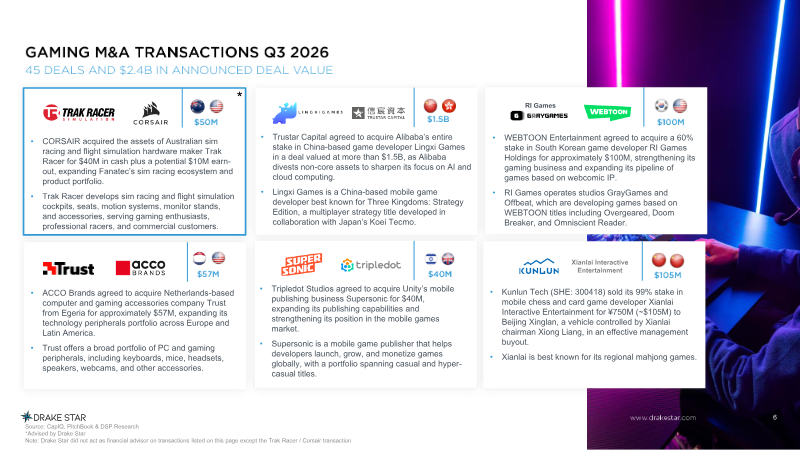
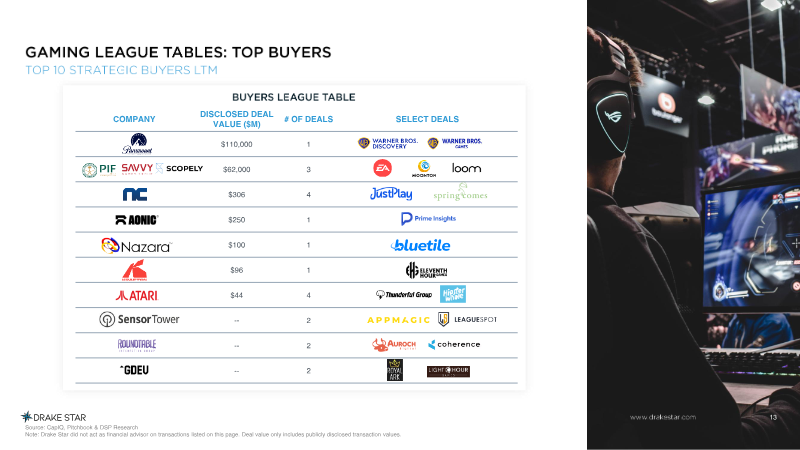
or not as you guys mentioned we're starting to see larger strategic deal flow which we can pick apart on on Merit and valuations but you know with strategic deal flow there's less urgency to over analyze cash returns because the transactions are kind of like materially reshaping the the structure of the acquirer not just the income statement and fund panels so again uh I think we'll we'll kind of return to that lower tickets in Mobile again maybe three to six months from now but my sense is that management teams are waiting out the economic headwinds and hoping for multi-compression and as usual I think they'll probably wait a little bit too long but uh you know that's either here nor there and I just um I pulled some numbers I put some numbers behind kind of where we're at versus where we were in m a in the sector and you know hopefully this helps kind of tie everything together so um so far in the second quarter of 2023 6 billion of deals announced uh it was 1.2 billion a year ago so second quarter of last year is when it kind of fell out when that's when the floor fell out first quarter of 2022 was the peak 85
and a half billion dollars of deals announced even if you take out Activision from that it was still 16 and a half billion because that was Zynga and a few others so it was still large and if you just step away from the dollars and look at the number of deals being done we've only had about 20 deals done this quarter versus 60 a year ago so it's both value and volume are down a lot and so so when we look at it both value and volume of deals in the sector are down year on year and and so that's telling us that it's still kind of quiet people aren't dipping their toes and I agree with Brian it'll still be a couple quarters before we really see it and the most exciting company these were fortunate that they were able to raise funds you know a year two years ago at elevated valuations so a they are funded they don't need money right now necessarily and B they're investors and their Insight the the employees are anchored at a much higher evaluation than what's available on the market they're not going to take a Down Round because they don't have to and so that's also part of the reason that there's
this impasse got it should we talk about specific names or that like recent transactions do you guys want to yeah have any opinions on some of these recent transactions that have happened absolutely you want to start with the Rovio yeah what do you guys think I think this makes a ton of sense strategically for Sega I mean I'm a Roblox fan all right I've been bullish on Roblox basically since it went public it was good and it was not good for me for a while um you can go read a lot of our thesis on the metaverse on our website but you know I I when if you look at what's the number one most actively played third uh you know third-party IP on Roblox it's Sonic it's the Sonic game from gamefam there is so much easy pickings for Sega to do its magic again with its third party Partners on Roblox with the Rovio IP with Angry Birds alongside them just being better at mobile right which they aren't at so they get all the Strategic
know-how for mobile growth mobile UA from Rovio and I think there's this huge opportunity for Angry Birds on Roblox which is completely untapped yeah I think uh Sega Sammy is an interesting little company I mean they're they're not just a video game company they have this big kind of business and arcades and Pachinko and slots it's also their free to play business is super heavy Japan it's like 88 uh overseas is the remaining 12 and it's very condensed in this mid hardcore range um and mobile is only 38 of total revenue so Rovio materially increases uh the Mobile Share outside of Japan and pushes that almost to 50-50 um Rovio for it's all its challenges has actually been pretty relatively stable as of late uh they never really did the grip and rip it UA model um it's two and a half times revenue is about in the low teens mid-teens ebitda multiple um there's also this strong alignment on IP and Licensing businesses uh that goes to feature films and games and studio
and theme parks and it also gives Sega really strong access to a really good development Market in Helsinki in decent publisher functions outside of just Japan and that casual experience that they're missing like Sonic is a 30 year old iconic IP and it's making some traction on Roblox but it's really nowhere on mobile platforms and they're not the only Asian in a publisher that has a challenge with that right like Nintendo is very similar and I guess most importantly in my opinion is that it provides a ton of insulation to public markets which is really tough on Rovio employees and I would argue that it's been you know it was just not very well built to be a public company it's just too small it's not their fault it's just like scale matters in that business I would also I would just also just add briefly um you know when you when you just think about this transaction I believe that playtika offered more money per share than than Sega did for Rovio I got to go back and check what the last offer was it was either competitive or it was slightly more I
also think that's a whole other discussion that we don't have to have today but you know playtika did a lot of Acquisitions in the nordics they built a reputation for being very aggressive on Cost Cuts yeah I can tell you exactly why no and and because it happened because they absolutely did it and so you know I'm trying to be politically correct to some degree I don't want to piss off too many people today but you know it's it's clear that that was an issue in these discussions because they got rejected three times by Rovio and then Sega comes in with a competitive or slightly under bid and they found a deal together yeah so as a former Sega exec I I can tell you that I do think like Sega is very friendly especially they're very management friendly as opposed to you know what we've heard at least from platika and so clearly I I think where um where Rovio is coming from is that they want to be they want to to work with somebody that's more hands-off and they want to operate as they've been
operating now um I think that you guys brought up a lot of great points I'm a little bit more neutral not as positive on on the acquisition I I think so the strategy that you guys are talking about absolutely makes sense I think everything that you guys have raised makes sense the thing that I am more concerned about is that are we living in an age of efficiency Rovia is not efficient and so and you know so I I think that this is where if if we are actually moving into this new era of efficiency I think this is where Killers matter right if you are a killer you're gonna you're gonna do well I don't see Rovio as a killer right and so I think that's where I do think Rovio is a little bit you know it's you know kind of Finnish European culture they're you know uh good in an age of access I'm a little bit more concerned and by the
way I'm a huge Sega and Rovio fan just to be clear but I'm I'm concerned there may it may be a little a little too soft right now for for today's environment I totally get your point you know we're talking about operating efficiently and and knowing what you have and taking the most of it and I don't think well Rovio employees won't say it but I think everyone externally whether you're a financial analyst you're a strategic person you look at Rovio and you say there's too much bloat there's lots of subscale franchises that probably need to be you know put away and and Shrink those teams down put them into things that that are generating you know ebitda and it's it may not have I mean I think the reason the Sega deal got done is because they promised whether it was you know a handshake agreement or it's in print that they promise not to do that yeah I guess like the bloat thing is certainly uh something to be focused on and there are is ample room for execution misses but at least on the numbers Rovio is actually more profitable than Sega Sammy so it's actually it's a pretty good fit from a fundamentals perspective but yeah
something got to keep an eye on is is Rovio had a good track record over the last three or four years of launching big hits like absolutely not um but you know is there a good organic flow to uh for Sonic on mobile maybe and that's probably the most important thing that that folks need right now in Mobile is good organic flow right you guys have thoughts on scopely Savvy absolutely yeah I think like this one's pretty useless to validate on fundamentals um scopely you know plus or minus a billion dollars in bookings and bought for five billion cash 4.9 billion in cash so there's there's really no payback period that matters in this scheme but Savvy made a big splash with ambitions to put 40 billion to work in gaming um historically they've been just buying up non-controlling stakes and big public companies like Activision and EA with zero operational input and passive and what they bought was pretty good mobile diversity diversification uh instant scale one of the more capable mobile Publishers in the business with ambitions also in PC and console uh
proven management team that Excel excels in corporate business development and Licensing and you know I would kind of expect going back to the prior discussion on m a uh scopely to kind of lead the way on mobile going forward they're not going to wait around the hoop for valuations to over compress like some pure public plays and they have just kind of like this unlimited checkbook now so it's fun to watch for sure I think to Brian's point you know we're going to sit here and talk about the ebitda synergies and a creation but none of that is relevant for Savvy games group their mission is to make Saudi Arabia a hub for game development in the Middle East and to get people to move there they don't care how much money they burn doing it and so you know when you think about it that way this deal makes a lot of sense you're buying a very established publisher who knows what they're doing and then if you can go out and attract you know small development teams to move to Saudi Arabia and the new city they're building in the desert I think it's called neom if I'm correct right if they can start a track and UAE is doing the same thing
with crypto Bros you know if they can attract the talent the economy will benefit because there's more talent and more money flowing in through those businesses and then they have the Western business acting as the publisher until they build that up domestically that's what this is about and from that perspective it makes a lot of sense if if you don't care about losing money and about the valuation you're paying for it yeah I don't have anything to add besides yeah I I think outside of strategic reasons I don't I don't think it makes any sense about it like there was no one else that they could that fits the bill that scopely fits right they want someone who's a mobile publisher and anyone else that basically checked those boxes was already acquired right Zynga glue a few others are basically already gone and so there wasn't much left other than scopely from a large established mobile publishing organization in the west at this point that was independent and if you're scoby's management team and you're looking at the ECM calendar and things like that you have a decent path to get to the public markets I think you know
not super profitable but profitable enough they had the scale the growth Trends would kind of normalize post-pandemic boom over the next you know six months call it or whatever and they could make it into institutional but then you have like 5 billion in your face like you're not going to get that in your Market you know even a year from now if you grow 20 so you might as well just hit that bid and remember it's 5 billion today plus whatever amount they're going to give you to invest and grow the business on top of that right it's it's not just The Upfront check it's it's you know the the checkbook is open and as we'll talk about with the Embrace related public markets are a kind of a show to operate into it's like it it's the double you know the deadly you know any thoughts on Activision guys where which way is this this going now you want to start I think on Activision precedent is against them right because it's very difficult historically to overturn the cma's decision it's going to take a lot of work because the UK
courts just haven't ruled against the CMA in in any large fashion percentage-wise and so the the numbers are against them I I personally think the ruling is stupid I don't think that cloud gaming is is relevant to the conversation and if they're saying that it's not an impact on the console market and it's not going to affect the competitiveness there like that's enough for me I don't see how I personally don't see a world where cloud gaming is a standalone Market I see it as an enabling technology for what we already have it's just going to be part of HD and you already see that today right I can literally pick up my phone and play my Xbox games from my phone Sony just announced a handheld where you can play your your PS5 games on a handheld steam has the steam deck right you know these kind of cloud gaming Cloud streaming devices are just ancillary to what we already have and so I think from that that's the argument they're going to make at least is that this is not a distinct Market this is the same Market just different access and that and that's how they're going to try to sell and get it overturned but I
do think it's going to be tough I wanted math starts he's so sharp and Regulatory uh I am a big fan of Philip Spencer I'm on record of saying that multiple times and you know I want to believe this narrative that Microsoft is the place for developing games and for long Horizons and kind of the greater good in the industry um that being said redfall was a little bit of a disappointment for me I don't think Sony would do that um they're going to take some some punches on that for sure um and we also have to take into context like where Activision was when this deal was first consummated right like the shares were ultimate multi-year low uh there were some uh more like stuff that we don't really necessarily need to dive into on like just uh HR and Optics kind of things and it made a ton of sense there was a gap to fill in revenues and you know coming out of that Activision is kind of performing at like this Breakneck speed like Activision is now relevant on mobile with Call of Duty King is performing extraordinarily well um they have a really good pipeline blizzard may or may not get its mojo back we have Diablo 4 coming not too far
away uh but at a high level like you know the cloud gaming stuff aside I don't want to see the games business devolve into Netflix right and what I mean by that is I don't want to see this huge loss of Economics to developers in a world where gaming success is driven solely on time spent and I think AI has a part in this too um the other thing I note is like Activision is now trying to hire for like corporate development and other other Central functions and that's not something you typically do when you're about to be engulfed into a bigger organization so I think it's kind of a toss-up and that hang up that we mentioned about this this uh thumbs down from the UK um on this the fears around game stream business it I don't really see that being like a potential cure that Microsoft doesn't really care about it's like UK is also just a relatively small gaming Market versus North America and the broader Europe so I don't really see that as a needle mover um and I guess you just rap with I'm not like of the view that if Activision goes away the bid for other large Mega caps goes up materially um and that big Tech kind of makes this
huge land grab towards uh um needing to to buy content I I don't believe that 20 billion dollar plus companies need an end game liquidity strategy and I believe it is healthier for the gaming ecosystem for IP partners for employees and for investors and I do hope we see more uh sustainable companies emerge from the coming years in the public market so I don't really have it's kind of a coin flip because you know that's 70 billion dollars too that Microsoft can have back um there's other things out there to be done with that kind of money and and I do think Activision like I said they can be supportive in in a public environment because they are the fundamentals are just scorching hot right now yeah I I think the the discussion of what's good for the industry versus like what's good for the stock price or two different things right because I I think that you know Activision is not going to get the price they got in the deal if if the deal breaks right the deal you know I think everyone's pending somewhere in the in the 60s plus or minus for the stock price when the deal breaks so you know that's that's below you know the
deal price for sure I think 95 a share right so um you know that that hurts and but I agree I mean I I my thesis has always been that if this deal goes through I think Amazon takes out someone I think you know someone else comes in possibly like an NBC Universal JK I know you have views on them but you know I I I think I think that I mean I know they had talks potentially the rumors were at least they had dogs with EA at one point recently so you know I I think that there would be some consolidation in broadly interactive media not just video games with these larger players but I do think that the industry is better served not just being rolled up into Mega caps got it and maybe before we jump into specific names we could have a quick discussion on AI too like you know everyone's talking about AI Nvidia in particular just exploding I know Matt you've been looking at Nvidia quite a lot and the word on the street is that there may be some stuff more gaming AI cross gaming
related coming up but uh what what are your current thoughts Matt so I'll talk about Nvidia and then I'll talk about Ai and gaming and I'll just basically quote Strauss elnick because because he said it best two quarters ago on the earnings call but basically what Nvidia came out and said is that they did about 4.2 billion dollars of data center Revenue in the most recent quarter ending ending April and for the July quarter they basically expect that to double so they basically are expecting sequential growth of 80 and they expect to basically be at a run rate of well they didn't put numbers on it but the extrapolation is they'll be close to a 10 billion dollar quarterly run rate by the fourth quarter so by the January ending quarter so this is like exponential growth in data center GPU and this is entirely fueled by generative AI demand what we're seeing from training large language models and then implementing them with inference but it's also about Supply I think we're at a time where they're fortunate that the PC market and the smartphone market are just stinkers and tsmc has excess capacity right now because if this was
2021 tsmc is running at 100 utilization those sales aren't coming that that demand those orders aren't getting filled for three quarters so you know you're not looking at this hockey stick growth you're looking at just the backlog being built really large but we saw this with other companies we saw Triple ordering at that time because people were just putting in orders for and hope we said we wouldn't curse but there we go people were putting in orders for stuff and then um you know just waiting to see what came through and then they would cancel the ones that didn't come through so you know we're in an environment where they're fortunate that the supply chain isn't so backed up or they can fill those orders now I think what's interesting about seeing this from Nvidia or even Marvel today we're recording this day after Nvidia earnings but Marvel just printed they're looking for basically a doubling of AI Revenue this year and a doubling of AI Revenue next year so going from 200 million to 400 million to 800 million dollars on a revenue base of 2 billion so also very large numbers relative to the size of the company I think what this is telling us is that generative AI is is real and there's real fundamentals
behind it and I am guilty I've been uh a big proponent of themes like the metaverse which are long-term investment plays decade out we're looking at this transformation but it gets hyped up and the stocks prices and everyone jumps in in it and there's really no fundamentals to back it up right now there's real fundamentals backing up generative AI right now we're seeing it in the chip space first because we have to build the infrastructure to power this but we're even going to start seeing it in pretty much every sector of the economy Jamie dimon just said JP Morgan is going to build their own chat bot to replace customer service reps you know uh you know and for gaming I'll I'll just again I said I'll quote straight out Sonic this is like the implementation of the calculator right the calculator was just a tool to make people more efficient it didn't do your job for you it enabled you to do more with what you have and that's exactly what we're going to see now and I use chat GPT to help me write emails or help me write blog posts or you know we were coming up with a name for this podcast and and I just like give me 10 examples or whatever make me
a list so it's great at prototyping and just coming up with things that that would take you as a human being longer to do it's not smart it's not trained to be smart it doesn't think like we do but it's a tool that can help you gain efficiencies in your workflow and so there's all this concern that chat GPT and generative a are going to come and take your jobs I don't necessarily believe that's true but I what I do fundamentally believe is that if you don't learn how to use generative AI tools and Technologies someone else who does will take your job right yeah I think just touching on that Nvidia print uh that was just more violence than guidance uh and I'm sure there's going to be some concerns on like choppiness or pull in but if you're of the belief that VC investment into AI is going to Bloom from here much of the Opex for these companies is going to be Tech and tools not head count and those checks are going to go straight into video and they're going to go straight to compute and storage companies and this is going to be really good for even like just AWS and Azure workloads so
we're seeing that trickle through the market already Nvidia is really the tip of the spear and there's been some appreciation I already paid to companies that are able to offer like DTC apps leveraging Ai and monetizing but I think broadly speaking the market is going to need to play catch-up to the broader semi-supply chain including semicap and memory and components and I guess just from the pure Game Dev perspective uh you know the job market has changed quite a bit year over year with the power shifting back to the corporate side versus most of the talent side through the pandemic and we're continuing to see a volume of layoffs across the games industry tree and broader Tech and of course this impacts like our friends and our colleagues and our families and from that perspective I can certainly see why the proliferation of AI tools and Tech can be like super discomforting but at the same time I've also seen a few instances in the startup Arena where really Talent teams that aren't nearly as well capitalized as a large publisher are able to leverage tools for for coding help and art and narrative work that's just it's just straight up saving them time and that
there wasn't an opportunity for a full-time employee there in any way and it's also increasing the skill sets of those folks so I do think AI is going to Spur you know a new wave of innovation in games making and also cut back on some of the grind and crunch that I think especially JK is familiar with these things there's also like this this finance and corporate perspective that I think has the tendency to get overblown where the overlords are all of a sudden able to make like a triple A FPS game in a few months with a fraction of the staff and suck up all the economics but like at a high level game making is not an easy business and I don't think that gives enough credit teams that are able to make successful differentiated games and experiences and I do think that the potential to make games quickly and cheaply will exist and will continue to exist but we've already seen that play out in the mobile gaming development spear overseas right there's been a proliferation of derivative games uh and that isn't like a risk that the industry hasn't weathered before so yeah I'm very much the belief that you know we need to take this kind of day by day but at a high level I think that's it's pretty
exciting yeah and just to and since I'm more on the pixel side you guys are kind of like the finance profit guys but maybe I could provide a little bit more Nuance in terms of some of the themes that I totally agree with you on Brian um which is that I do think we are going to start we're gonna see um I think impact to game development teams but it's not all gonna be at the same place at the same time and so I do think like shorter term we're probably going to see impact to like art teams first let's call it within the next two to five years and it's kind of like you know I mean there was a structural shift in UA and kind of a Performance Marketing of the past five years and that gutted a lot of teams by by half and there was like for some teams just to shift to Outsourcing and I think similarly we'll see that kind of phenomenon hit art teams especially like concept and eventually like production art fairly soon and it's just amazing how fast the technology is moving so that even two to five years
might be conservative but I don't know sometimes I feel like even when the capability is there sometimes adoption might be slow so we'll we'll see exactly how fast that diffuses but I think also art related the next thing that's going to hit I think is animations right and so I I you know there are animations can take a lot of time and resource and I know you know you guys are fans of Call of Duty but in a game like Call of Duty where you might have like 6 000 animations just for locomotions and where suddenly you know maybe you can get that done by you know one or a few people who trains a model characterize animations presses go and you've got a bunch of stuff that normally would have taken a big team lots of time lots of money um and then I I think the other thing that where there's been a lot of talk is like and I haven't seen it personally but there's been a lot of talk by various people saying that AI is going to be able to take a regular or you know maybe even bad or mediocre programmer
into a 10x programmer and you know that's probably more from what I've seen I haven't seen it yet but if that's more medium long term call it like five to ten years then I do think that what the impact of that will do is accelerate structural Advantage for geofavorable favorable regions like China or India where you've got you know um generally lower capability or expertise but then with the help of AI they're all of a sudden be being able to compete with like your you know four to six hundred K staff software engineer in California you know or even possibly like I mean you're talking about India in in China today which are already markets but now you even bring in Southeast Asia Latin America potentially sub-Saharan Africa like places where Game Dev doesn't really even exist to a large degree yet so you know it does open that up I think that that scenario is is fairly optimistic look I think that
there's a lot of things that game devs always want to do and pro you know ideas get shut down because it's not cost you know it just doesn't work out with the cost structure well with generative AI if you get that 25 efficiency gain that Goldman's calling out for knowledge workers globally within a decade now those things that were previously cost prohibitive are now within the budget and so you're able to do more with what you have it goes back to our efficiency conversation and I think that's why corporate executives are so you know bold up on the on generative AI it's because we just we just talked a lot about efficiency in doing more with what we have now we have a tool that lets us do that so let's just go all in on this and see what we get out of it yeah there's actually a concept that I've been talking about ever since like 2010 which I think AI finally enables to a much stronger degree which is something that I call kind of large Vector to small Vector development and what I mean by that is like by Vector I mean like the the amount of resource time energy effort it takes to build
something right and I think what we've seen is that you you've got platforms like Roblox and um and like uefn and things like that which takes care of a lot of things like the back you don't have to be an expert in backend in devops and all these different kinds of capabilities and services and so by just learning Lua like the the moat the the barrier to being able to take something from idea from concept into into a entertainment experience is dramatically shortened so long Vector to small vector and I think with AI I think we're going to increasingly see that where you know maybe you're not a programmer maybe you're you know you're just like an artsy farts type of you know liberal arts type of person but you've got an incredible idea but because of AI you're able to kind of then be able to deliver that entertainment experience where you couldn't have done that before when I when I was doing the into the metaverse podcast you know I talked to
Roblox people Nvidia Unity the conversation always came down to one of the key points was always how do we get creative tools to as many people as possible in the most no code environment as possible and this was 2020 2021 well we didn't know that we were talking about at the time it's exactly this right generative AI is the technology that enables text to World creation this is the technology that unlocks the creative economy because now you don't need to know Lulu you don't have to know I forget what the coding language is on uh you know on Epic right you don't have to know these coding languages you just gotta say put a motorcycle in the world make it red and if you have an idea of what you want now you can build it and it's going to take time to get the Kinks out but that is super exciting when you're starting to think about you know the whole ugc economy yeah and I do think like the other thing the one other concept or the implication I think from that like even if if you're able to take a large Vector development and and
decrease it by let's say uh you you make that cost 10x I think you 100x the opportunity right so like you know it's not like a symmetrical sort of you know caught you know reduction in cost to expansion and opportunity well guys let's let's talk about something that's been I you know I'm seeing a lot of people talk about but we could talk about an Embrace her maybe some of these other public names where you know it's you know I I think you guys you guys actually like listen in on some of these earnings calls like I'll I'll read transcripts and I'll review stuff but you guys are actually really dialed in and so maybe we can dive into that and starting with embracer but you know feel free to talk about any of their names that that you think are interesting I know we were going to start off by saying something positive at least by every company referring to so I I just will start there I heard Dead Island 2 was okay so I haven't played it yet but maybe I will at some point in time for for the fiscal year ending march so
there there's there's the positive spin now we can explain why the stock was down 45 right I think I have and one other positive thing to say in that this was probably my favorite quote of any earnings cold ever seen uh up until late last night we had amazing cash flow and so now I'll break into my main point which is that you don't guide on verbal commitments or even non-binding turn sheets okay one of the main Comforts around definitive talks is you have penalties and cures in place uh should something follow through for whatever reason and you know this this is just kind of vapor now so for the folks that aren't aware of what happened like they had a two billion dollar verbal commitment for a six-year kind of development cycle that just evaporated mysteriously the night before their conference call um you know and I've I guess I've always been of the belief that it takes a special tool set to run a video games company public setting we've alluded to that so much already uh it's super clear now that it's just not present at embracer um and there's this Nuance or this kind of notion in in finance of like the
Penalty Box and this certainly Takes the Cake from cdpr on the worst ever conference call and this is an infinite Penalty Box okay the thing about this and you know this management team may never have the trust of the public markets ever again like this might be the end of lars's ability to have the trust of the stock market we'll find out I mean if they can execute and turn the ship around you know they'll start to build it back they're doing some some stuff with Amazon and some stuff with Lord of the Rings stuff so you know who knows maybe maybe some stuff works the business gets back on track and you know they are still growing ebitdon X here it's just not growing by as much as they thought it was because they took out this this you know multi-billion SEC couple hundred million dollars of ebitda from from this deal that was supposed to happen so you know I I think when once the dust settles they just need to execute to win back the Market's trust but if things don't turn around like you could be talking about this being the end of his ability to run the company do you guys have any speculation on on
what that two billion dollar or who who that two billion dollar like you know it there's not a lot of companies that can swing that around is that Savvy or is it are we going there Matt I mean I'll go there like it's just it's speculation it's completely unfounded so start the rumor mill like you know part of me thinks it might it could have been like I'll say it could have been and why it would make sense it could have been Sony Sony's looking for external mobile development Partners they said that in their management briefing which was the same day as embracers earnings and if you go to the slide deck that Jim Ryan used the only slide that's not like a fancy schmancy graphic is the slide where they say they're looking for development partners because it looks like that one was you know put together at the last minute which you could then interpret as saying well maybe they had a deal and that fell apart but Sony is a Smooth Operator they don't operate like that so you know it you know probably not but you know start the rumor mill you can always throw out Savvy because they'll be involved in everything um you know it's it's notable that they put a billion dollars into Embrace her
last year now they're down 80 on it so you know who know who knows exactly what what if that was if that was the deal if they backed out because they had scopely now if you know if if it was they were in talks with scopely before and now Savvy told them it's like there's there's so many possibilities that can go on and without any definitive you know Insight from anyone involved in discussions we may never know but you know those those those if if if the news came out tomorrow and said it was one of those like be okay yeah that makes sense I don't have anything to add to that just just noting again that it's just extraordinarily unusual to have a verbal commitment hanging out that long and then entering it into a company's guidance and you know that's always going to catch up to you and clearly it did today I don't need to kick people when they're down or whatever I'm sure they're doing enough that themselves but it's just a cautionary tale that you know you don't even need to tell any other public company this because they just they said they simply wouldn't do it uh yeah that's that's embracer okay that Island too it's I heard it's okay you guys should go out and play it Brian you want to drive the discussion around
different names that you think are interesting to talk about I think uh you know I might as well just chat about Ubisoft real quick I think like you know I'll just start off by saying that I've been playing uh Assassin's Creed games over the past few weeks just because it's on Microsoft Game Pass and it was uh free to download and everything like that um they have gotten incrementally better than when I stopped playing them two or three years ago and I think it's it's a nice franchise to have in the mix and they're clearly putting efforts towards developing that in the future the most interesting thing for me at Ruby's Ops is kind of the pipeline so just I had a line by line here and you guys can tell me from crazy um Assassin's Creed Mirage I think that should be well done kind of back to the basics it's an annual franchise for them they could probably print what they need to on titles uh Avatar Frontiers is kind of worth keeping an eye on that's done by Massive entertainment on the Snowdrop engine that's the same Studio as division titles and Far Cry 3. um generally speaking Ubisoft is pretty good at like these gorgeous open world maps
um and I think the organic flow uh movie timing and success will be really important to keep an eye on there R6 mobile I'm a huge pass on I think uh you know it's really late to get to the market now on a high def mobile FPS skull and bones is kind of a knit for me half a decade development but the ironic part here is like Ubisoft is really good at these boat battle things but it's just really like a feature in games and it's if they did it really well in Assassin's Creed whatever else but it's just like I think sea of Thieves ate their lunch there and I've seen a couple startups developing games that are kind of similar uh that I think I'm a lot more positive on with more persistent worlds and collection mechanics and team based play then I'll kind of cap it off with division Resurgence I always play these games because they're Co-op and they've showed promise in the past but like my hang up on Commercial viability is that they kind of devolve into these bullet spin sponge messes and and they could probably use they got like JK on it uh really super hardcore metas um division for what it's worth was
ahead of its time we were even chatting the other day about how they kind of set the foundations for extraction Shooters but you know ubisoft's going to be a story about execution fundies are a mess and I guess that being said in terms of just what I'm looking at for earnings right now I'm not super overblown curious about fundamentals which sounds ridiculous but given where we are with the economy like flatish game Trends and selectively lower gamer engagement I've been paying way more attention to narrative shifts and Catalyst past versus just numbers and fundamental so Matt over to you on Ubi with Ubisoft Ubisoft Ubisoft you can pronounce whatever you want the the problem has always been execution and they don't have scale within any franchise except for Assassin's Creed I don't think there's any other franchise in their portfolio now maybe Avatar and you didn't mention Star Wars is also being done by Massive maybe those are the ones that get them over the hump but whatever thresholds you think is big enough to justify the return on investment call it 10 million units they only really have one franchise that you can Bank on
Assassin's Creed where every game is going to sell at least 10 million units right and so I think I think the bigger problem in JK you pulled these numbers and you ran them and you wrote about it it's like you look at their revenue per employee it's like less than half pretty much everyone else including even like embracer at this point like and so it's it's just they they don't get full advantage of the resources they have they don't have franchises at scale and I don't know what fixes that because they don't seem to care they just think that they can keep whacking away and eventually division will be a 10 million plus unit franchise they think that Rainbow Six will be this massive franchise and it kind of is but on on multiple platforms and really get that hockey stick on mobile right their view is that they just keep doing what they're doing and it will work and you know that's literally the definition of Einstein insanity you know I think that they need and and I don't know when it happens because they've gone through this so many times but they you know skull and bones is a great example any other company would have killed that
three times over at this point and it's gone basically they've restarted what twice the development cycle on that game has been thrown out started twice over so it's just like some of the decisions you just have to question and you just have to think would other companies make these decisions I think that Assassin's Creed they have down to a formula they know what they're doing I think it's two out of every three years because they have two teams building it working on a three year death cycle and they plan to increase their head count in Assassin's Creed that's great make Assassins free to 20 million unit game instead of a 10 million unit game make that your Tempo franchise but you have to look at things like look I'm even a fan of Mario Rabbids it was my favorite switch game how much money are you spending on that South Park right they made a South Park game like cool fun I'm a South Park geek but the ROI on that the justification financially I just don't think is there moving over to take two um the house that Strauss built right so if we look at what's happening there I mean they the stock went up a lot after earnings but it wasn't necessarily the fundamentals you know Brian you want to
dive in and then we can kind of Jibber Jab of what they what they said yeah I mean the current quarter is a little soft versus God and expectations but you know it didn't matter uh this is always the point in time that the the hedge fund Consortium waits for and that's whenever we start hearing a little bit more about what GTA 6 looks like from a forward guidance perspective um Zynga of course kind of inline-ish their expects and softness and RCS from PC and console I think like the part that is going to be a little bit more interesting this cycle this time around and by cycle I mean GTA cycle which essentially is take two is that uh you know this time it has a giant mole business inside of it and if you ask any investor over the past eight or nine months like what their favorite stock name was before the Zynga transaction it was always take two right you're gonna own this into the GTA 6 cycle but now it's just like it's not good or bad or whatever and kazenga has its merits and maybe maybe it works from here or not but it's just not as clean of a story anymore um and it's for what it's worth like it's hard-pressed to say that GTA 6 won't break all sorts of sales records
for units instead of another five plus year stretch of just printing silly money and I do firmly believe that and I do want to be an owner of that over that course of time um the one thing I also mention is just it's really hard to dive in on Pipeline on take two these days there's nothing of note really outside of that dream of GTA 6 which could slip by the way wouldn't be the first time but there's a lot of launches pinned on fiscal 23 through 25 87 in fact in their presentation but less than 10 percent are named and and like like any other publisher all those are subject to hit rate I will say just because we talked about embracer like relative to embracer this is the way to give long-term forward guidance when you have a known commodity in Grand Theft Auto and you have high visibility they would not be coming out unless they were highly confident that basically Grand Theft Auto as a holiday uh 2024 game right I mean it's it's basically plugged in for that unless something drastic happens in the development process at this point and so
they're coming out and basically saying that they expected them and that's how they're putting the 8 billion or whatever number of bookings in in in in in in the market because they are extremely confident that that is coming it's not a handshake agreement for two billion of Revenue and and so it's just a nice contrast what we talked about with embracer but Brian's absolutely right like hedge funds used to love this stock because you could ride the GTA cycle the Red Dead 2 cycle that was big too now you've got Zynga which you know it's stable it does its thing but you don't get that cyclicality it's not as tradable it's it's more Steady Eddy beta growth right and so it it makes it less attractive to hedge fund investors who want volatility who want to ride those Cycles but maybe I could put push back a little bit on the Zynga acquisition and you know not not to be too negative and whatever but if we believe that you know a lot of as we had discussed earlier in the podcast that a lot of zynga's growth came off of M A and you know they were clearly I mean that strategy had
basically played itself out and you know they were kind of flailing around for growth like right they bought an MMP and they were trying to do stuff with Relic and with idfv and I mean nothing that they were trying was landing and so to the point you made Matthew uh they they got bailed out um a lot of the the mobile pipeline whether it's Star Wars hunters or other games you know it sounds like it's not going great I mean you know I I can I can see Zynga being relatively steady-ish to like maybe lower slower growth moving in the future but I don't know it has it is ebitda it prints cash flow like that's at least it does that because there's been Acquisitions that have been done before where they're diluted to ebitda diluted to cash flow and you never get your money back at least from that perspective you can always look at it and say even if the revenue synergies the IP sharing all the stuff they talked about doesn't work but you probably won't they'll at least get their money back because Zynga has ebitdon cash flow
right I mean people forget that there was several years after Activision bought King and King is different because they had one big game but a lot of ebitda but that business did not grow for several years it basically didn't grow and from they bought it until 2020 they you know on ebitda basis so but it's still printed money it just didn't live up to the expectations but at least you're getting something in return you're getting cash flow in return and Zynga does give that to take two I would say if I if I could agree with JK at one point there and we brought this up earlier the really complex Fatu games with really deep meta games are not in a great every place in this market to attract new Gamers for one reason because they've already been through you know the UA motion for five or six years or whatever and if you're going to find those players over that course of time you've already found them and I would challenge like investors out there that maybe haven't played some of those games give them a try see if you can put up with the half hour it takes to figure out the economy and things like that so at a high level I don't think this was always just a hedge fund hotel that people rode through Cycles it was like a duration play too because if you could
hold that name for three to five years you knew Strauss was going to make you money on GTA or rock or red dead or whatever else the story's a little bit muddier now I don't like it quite as much but it's still near the top and packing order because it's just like frankly not much left in gaming yeah and maybe one other comment I can make is that sometimes like the the I don't call it the financial perspective is that you get these synergies right and I I think like there was some thinking around that when um Activision acquired King that maybe maybe there'd be synergies between mobile and blizzard and things of that nature but you know word on the street is that they actually it may not even be friendly it may actually be the opposite of friendly in terms of you know some of these teams trying to work together and being forced into the same rooms and um if I understand uh the word on the street on take two it may be you know again maybe not adversarial but I do think like the development of synergies between mobile and HD and you know leveraging
IPS in different ways across different platforms you know I I think that uh that may not that may not happen uh to the extent that some Finance guys are believing that that will occur it turns out that match three Developers don't know how to make mobile Call of Duty I mean who would have thought right my finance brand can't handle this I think the other part that's worth noting too is that if you're looking at Studios like a small giant or a peak to develop a new hit game the economic incentive for creatives inside of a company like that that's been acquired a long time ago just doesn't exist they're not going to do it there they're going to do it somewhere else they're going to do it on their own um so just something to keep in mind the games as they are they'll be stableish they'll print money uh it'll make overall fundies look good and more importantly I think it kind of Smooths the flows that you'd see from like the revenue from take two over the course of time those values were pretty um unattractive but you always knew something was coming to lift it up who's next Unity where's Dave Chappelle
um no it's uh it's interesting because I know people are going to talk about Nvidia and how much they talked about AI but Jr definitely gives Jensen a run for his money yeah I I couldn't agree more I think this is just one of those those names that kind of launched out in that 2021 time frame that you know just kind of got ahead of itself a little bit and has settled more to like a rational level it's still kind of an expensive stock I think the thing is that that are most uh acute to me is doubling down on one billion dollars of ebitda by the end of 2024 run rates that suggests something like 250 million in ebitda and Q4 and let's keep in mind this company is still not yet profitable um the create business also detailed down quarter of recorder and there's some fluctuation and Nuance there with increased pricing we all know they pass through uh pricing increases to most of their customers some of those haven't rolled through yet so you're counting on that reinvigorating growth in the second
half alongside growth in uh grow which is the business they bought that was formerly named iron source so certainly some room for execution uh misses there's also this impact of layoffs and morale that is not unique to Unity so that's something I can really pin them on but I do want to like chat a little bit about uh chat a little bit about Ai and unity and I think that you know Unity is seen as a super easy uh tool for game devs but Game Dev specialists and the thought here is that if you can broaden that user base through ease of use and accessibility through chat tools perhaps that translates into more customers down the line um but there's also the Counterpoint to that and if games can be made by less people that would translate into less licenses and seats and in that scenario it's really important for Unity to capture more value in the chain uh increase pricing or shift like their new AI or other products to more radical or volume driven pricing and I think that's probably the thing we've got to keep an
eye on yeah I mean aside from being bowled up on on AI Jr was built up on consumption pricing I think it's kind of a rock and a hard place for them right because existentially to grow and be this company they want to be they need to change their business model to consumption base because they'll never not just gaming if you do believe in the metaverse in Real Time 3D everywhere they're never going to capture a large percentage of that end Market Tam as a subscription software vendor they need the model that epic has which is revenue sharing profit sharing because then you're capturing a percentage of the End Market and so it's it's just it's it's kind of like they're damned if they do damned if they don't if they if they change their pricing to consumption based a lot of the devs who like Unity because of the predictable cost are going to find an alternative potentially they're going to be upset they're not going to want to be on Unity anymore or they go to Epic because now unreal is a better technology it's more advanced and it's now cost comparable
because I'm not saving money anymore so you know there's a lot of conversations that happen there or you stick with your pricing and you never live up to the expectations that were baked in your IPO yeah I think one danger is just um what I view as kind of missed execution so especially on the engine side I'm not going to speak too much on like the ad Network side or other parts of unity's business but as a game Studio that uses Unity it's been very disappointing to see so many other friends in the industry kind of switching out of unity going to Unreal and I mean the value prop has always um well currently is that you know if you're building for mobile if you don't have a highly skilled technical team that can code in C plus plus and things like that that you know Unity makes more sense for you but um you know when I see some of the um I don't know the the lack of stronger execution against initiatives like dots and and you know supporting more data oriented programming uh capability when
I see that you know unreal is just more fully featured and like the feel of games that you can make and unreal is just better and I mean it's like in theory you can can make this the the same graphical Fidelity in unity or unreal but the lift to get there in unity is just harder and so I don't know I I do also think that you know we speak about the age of efficiency I don't think unity's there so I would you know and again this I'm speaking as a fan and as a customer and somebody who really really really wants Unity to succeed but man if they could only execute better you know I would be a much happier customer so I hope that comes and uh but yeah I I think in the I don't know it it does seem like change needs to come to Unity um I think um whether bringing in more of a technical um lead uh or something to to help drive better
execution in in terms of the engine part of the business would be um a lot better it would help the business a lot more I mean that's why they brought in Mark Whitton to run create right I mean they brought him in a year ago so I don't know if it's too early to say that it hasn't worked or not but he did come in to bring in a more technical person in that role there's a new head of the grow business which is the admon and plus iron Source right and new CFO so they aside from Jr they have turned over the management Suite I think it's just kind of are these the right people is always going to be the question but you know I think I think we'll find out I don't think it'll take too long for us to find out I would say too I think you know absent the pandemic boom and the markets acting like they were at that time I struggled to think that Unity was ready for IPO or perhaps maybe too subscale it might be a better fit inside of a larger company at some point uh that has more dedication to
um not only like gaming but being committed to the tools and Tech and improving the software over time versus being too over focused on company fundamentals you wouldn't know the company the company is too small from the market cap when it came out but like now you're starting to see that a little bit it just doesn't have sufficient scale to to do the kind of things that are necessary under the guise of the public markets like an adobe would have made sense like a large creative software company maybe even like a sales force right you know a company like that that has strong execution record on their products both organically and organically what's next EA we can be positive for once yeah yeah look uh banner year for FIFA the last year officially the FIFA brand um that includes mobile where it carried the rest of the mobile portfolio growth uh Apex HD coming on engagement despite lots of competition and competitive Shooters um Sims users up sharply they also shift into free to play so probably smart for
the the franchise given how late it is in that cycle um Star Wars Jedi choppy-ish launch on PC but otherwise very well received this this year um and I would say just EA has always been extraordinarily prudent with guidance around titles like this and a reasonable assumption they will beat expectations uh pipeline Super Sports focused um but again they very much typically deliver against expectations the mobile titles I wouldn't lean too far in on and again EA typically doesn't so this is kind of super boring um but the biggest question for EA for me next year is whether or not the P for brand matters and we won't really be able to get a beat on that until September or October launch and a man that I think they're guiding for like Ellis they're getting like low single digit growth so plug in like three percent which is really actually super strong because this was a record year for FIFA and remember the the winter World Cup basically extended the tale of the launch engagement right because they launched FIFA in September and you normally start to Trail off throughout the year that's just the Cadence of the
game but because of the December World Cup they definitely got a much bigger boost in that quarter to FIFA and that made it the most successful FIFA of all time right and so for them to come out and say they expect EA Sports FC next year to grow three percent on top of FIFA last year not only is that them saying that the brand of FIFA doesn't matter but we think that the World Cup boost we can still we can still lap that and still grow I think that's those two things together are quite encouraging and granted the guidance was for FIFA overall I don't believe it was console only so FIFA online in Asia is doing really well that doesn't get talked about that's the Nexon joint venture in Korea 10 and 10 cent in China but then also mobile right so when you kind of put the pieces together like it may not be the cleanest story ever but it's still very encouraging that they're looking at the franchise and saying even without the FIFA brand even with this comp we still think we're going to beat our best year ever do you guys think that someone else picks up the FIFA license and goes
head-to-head it's just gonna doesn't matter yeah it does it doesn't matter even if it did you know it takes an extraordinary long time and I mean Jake he doesn't need to tell him that but uh to build a game that that's that polished and has that long-up history with fans and things like that I think the more likely scenario is if it disappoints a bit they find a way to come back together again uh but maybe not in such a usury context the Champions League tried to do this several years ago to EA they went to Konami and gave the Champions League to PES and it did absolutely nothing and then they came crawling back and did a deal with EA like all right you know good Saudi Arabia sign a deal with FIFA and be like yeah we're going to spend all this money and make a game sure it's gonna take you five years and it's not going to be as good and you're never going to make your money back but go for it you'll eventually come crawling back to EA if you want your money he got hit a hot take last up is Apple oven
so like this one for me was entirely a positioning trade um shares have taken quite a beating someone of a consensus short like mobile is dead UA is over the model has changed new paradigm and all this stuff uh but you know Mac can probably go to the funnies a little better than I can but uh big beat on ebitda uh growth in the uh the publishing software business and all good again back to a more rational market cap given how profitable the company is from a total total uh you know income statement perspective and you know it's now it's worth debating yeah we'll see how sustainable what they what they print it is you know beyond just the next quarter but it it at least to your point positioning people were short the stock going into this you know UA was dead Long Live UA right that's that's kind of the Mantra right now it's it's entirely evident that and JK you did a good podcast about this recently right it's you know we gotta stop blaming Apple we gotta stop blaming UA is dead because people are figuring
it out so go be creative and figure it out because it's clear that there's ways to do this now in the post idfa world we can't just sit here and blame Apple for the next five years because that's not going to work right so whatever they figured out they figured out and it was working the stock jumped 24 it's still down what 80 from the IPO or from the post IPO high so like you know we're talking about you know it still retrace a lot and people that bought it there are still way underwater but at least what they're showing is that they are committed to Cost Cuts they're committed to Growing ebitda they're focused on their software business they're no longer really investing in in the in their own apps in their game business um so they're getting the valuation uplift of a real software player now they're no longer this hybrid flywheel or Eric Seifert what is it uh content Fortress it's no longer a Content Fortress play they are good at admon they're good at Tech they have a technology Advantage versus some other peers in the market they are leaning into it I guess the thing to that I think about on this one is again this
was a 2021 IPO if I'm if I'm not mistaken uh and they had the benefits of the pandemic to a games business that they had done mostly through inorganic transactions so uh looking forward to the next couple years are they satisfied with being a software business that helps other businesses grow while de-emphasizing or selling off Studio assets or did they try to mature into something bigger or you know whatever else they obviously try to tie up with unity which didn't happen but that actually would have been a pretty interesting combo right um that to me looked like it was more out of weakness than out of strength right because they they basically came in at the 11th Hour and if you read something like the proxy statements the SEC filings you can see like some of the emails and phone calls and it's it's actually quite telling that basically like once Unity announced iron source and mind you those deals no Brian you did this right those deals don't happen overnight those deals are months in the works right and so when they announce it
and and you know CEO of apples and calls up Jr and says I want to call with you and then says I'm bidding for your company that's out of position of weakness he's worried about his business at that point right and so um sure there was synergies Financial engineering that could have worked in that deal but you know I I I look at that and I'm just like you get worried when a company starts doing crazy rash things like that because if they're worried how can you be confident in the stock at that point if I had to surmise uh what happened there uh they probably saw a giant Gulf that was about to impact their business and did not see a path where they could weather that storm and they are a relatively new public company and didn't want to disappoint people in some respects so they had to make drastic moves but instead like to their credit they took their lumps they weathered through it they didn't make up a two billion dollar deal off of a verbal agreement and now things are a little
bit better and I think it's important to note that with respect to app Lovin the fundamental thesis behind um you know Adam faroogi's sort of uh vision for the company failed right so he wanted to make app 11b the Netflix of apps and there was a reason why they went and bought an MMP and there was a reason why they bought all these game studios which now that thesis didn't pan out right and so now I think he's got to try to figure out what he does and I I think to your point Brian you mentioned these you know game Studio assets doesn't really make sense to be part of App 11 anymore in my opinion I I don't I don't know where that the the you know now now that that thesis is is kind of fallen through um I would expect that they I mean I I don't know if they can get a good price for it but I would expect them to try to you know divest themselves from from all the games they've tried for the last few quarters there's just been there's no bites there's no bids like that right now yeah also games only a game's
business too also sets you up with an in a weird position to your customers right because in some respects you're competing with them with lower quality products that you acquired or derivative products yeah there's been a history of some you know uh I was just gonna say they did they did stop investing new incremental dollars in those businesses so like from an r d growth perspective from a cash flow perspective like at least they're no longer incrementally at drag on the p l of app Lovin um I think they would like to sell them if they got the right price they just haven't no one's at the bid yet right all right well if that's a sales name should we end with just like things for any anything that people should be watching out for in any like predictions or you know hot takes or anything like that from you guys and we didn't do enough hard takes I think uh we should maybe just chat quickly about uh what we think about
um some of these public companies like the other other the Counterpoint or the Counterpoint to like lower share prices is the potential for Acquisitions and I think that's probably going to wrap up on I would say that my Targets in order of uh some sort of likelihood or whatever or that are least interesting uh potentially now would be uh Ubisoft or CD project take two in unity are my outliers because they're kind of chunky but that's that's kind of what I'm focused on igaming is getting large in the US and it's already kind of large in Europe High gaming is legal real money games so like Social Casino but with real money now I think it's I forget the number I think it's legal in 27 states in the U.S with visibility to over 30. so plus or minus 50 of the population sports betting is 35 States now and the visibility to about two-thirds of the population going forward so I am Brown hill we have the Round Hill sports betting and I gaming ETF there's your plug but um you know so in in you know that's
interesting because you just saw Aristocrat come out and buy Neo games which specializes in basically what looks like hyper casually instant gamesy real money eye gaming like you know Lottery type stuff so it's quite interesting how a lot of these companies in the eye gaming space are replicating a lot of what was done in Mobile across the spectrum of of quality from hyper casual instant games all the way up to you know real Social Casino real whale hunting so you know that's interesting because if if you know if if that really does take off that's competing directly with Social Casino for money because I know that you know people will say no blah blah blah but at the end of the day why would I play a fake casino and I can possibly make real money right like at some point that behavior might shift and that's a risk for Social Casino which is a large part of the mobile game yeah I mean I think as we've seen retrenchment in the industry I do think that like the remaining call it Big swinging dongle in the in
the room is the Saudis right and so I I feel like to your point on Ubi I do think there needs to be some changes I don't know if the Saudis are the ones to affect that change but I it does feel like if the G brothers are allowed to be left in control maybe something happens there um you know uh Elon just come in and clean the house like you did at Twitter I heard of an idea recently which was maybe like the Saudis could like potentially put scope lead together with EA if they allow Andrew Wilson to stay in control and try to do something along those lines and then um uh just word on the street look out for WB gaming some something might happen because I figured that uh I mean that's not surprising either because I mean when a t was trying to get rid of HBO and Warner Brothers that was was on the Block at that point that business is you know now it's Warner Brothers Discovery
it's perpetually over leveraged and underperforming on their metrics so we'll always look to carve off anything that has value just talking my book on big transactions over small ones strategic over Financial engineering agree all right guys well this was a little bit of a longer uh pod but thanks so much Brian Matthew uh hopefully let's let's let's keep rolling let's let's do this again and uh you know just to clarify just to clarify it's profits p-r-o-f-i-t-s we're not Sears into the future and we're probably gonna be wrong with most of the things we say I think it's spelled different right awesome all right guys and uh yeah for our audience we'll catch you next time thanks guys that's good [Music]
Summary
The global gaming industry has transitioned from an era of unchecked expansion fueled by low interest rates to a disciplined period defined by operational efficiency, cost-cutting, and a strategic pivot toward live-service models. This shift is driven by rising capital costs and the difficulty of user acquisition, forcing companies to prioritize proven intellectual property and margin improvement to satisfy public market expectations. A competitive bifurcation is currently underway, where top-tier titles dominate market share while Western incumbents face mounting pressure from highly efficient, globalized competitors, particularly those from China, who are successfully scaling live-service expertise across console and PC platforms.
Mergers and acquisitions have slowed significantly from the 2022 peak, hampered by a valuation impasse between private companies anchored to historical funding rounds and public entities facing tighter capital constraints. While the market remains quiet, the focus has shifted away from mobile-focused financial roll-ups toward strategic acquisitions that emphasize IP alignment and long-term scale. High-profile transactions, such as the acquisition of Scopely by Savvy Games Group, illustrate a move toward prioritizing market presence over traditional payback metrics, even as regulatory scrutiny complicates large-scale consolidation efforts like the Microsoft-Activision merger.
Technological advancement, specifically generative AI, is emerging as a critical tool for enhancing development efficiency and enabling smaller teams to produce complex content. While companies like Nvidia benefit from the infrastructure demand, the industry remains divided in its ability to execute. Established publishers like Ubisoft and Unity face significant operational hurdles, struggling to balance legacy business models with the need for scalable franchises and technical consistency. Conversely, firms like Take-Two Interactive and Electronic Arts demonstrate the stability of diversified, cash-flow-oriented portfolios. Ultimately, the industry is moving toward a future where success is determined by the ability to leverage AI for production, maintain lean operations, and navigate the competitive threats posed by emerging sectors like real-money iGaming.