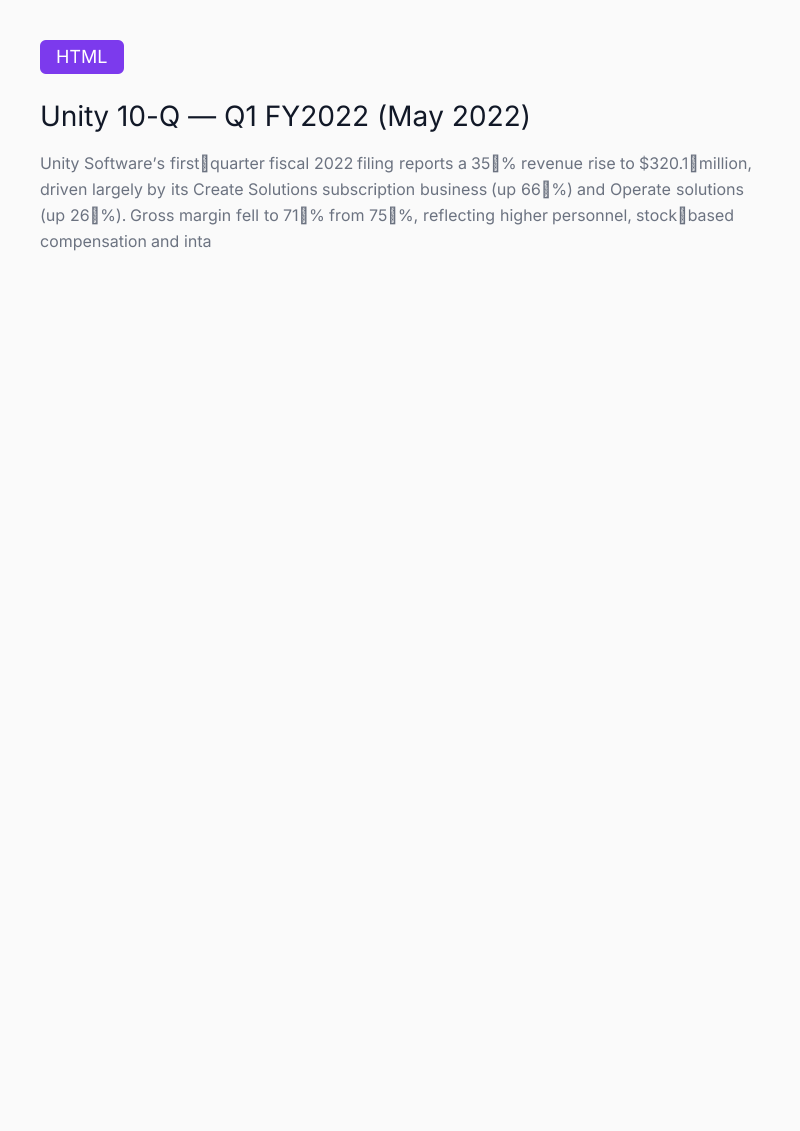
Unity Software’s first‑quarter fiscal 2022 filing reports a 35 % revenue rise to $320.1 million, driven largely by its Create Solutions subscription business (up 66 %) and Operate solutions (up 26 %). Gross margin fell to 71 % from 75 %, reflecting higher personnel, stock‑based compensation and intangible amortization costs. Operating expenses increased across R&D (44 % jump), sales‑marketing (49 %) and G&A (15 %), resulting in a net loss of $177.6 million, or $0.60 per share. Cash on hand improved to $1.16 billion, supported by operating cash flow of $101.3 million despite a $35.5 million outflow from investing activities.
The company’s balance sheet shows significant deferred revenue ($60.6 million) and remaining performance obligations of $553.5 million, with 37 % expected to be recognized within the next year. Capital structure includes $1.7 billion of 0‑% convertible senior notes due 2026, non‑interest bearing but potentially accruing special interest if reporting or trading conditions fail. Unity has entered into capped‑call transactions to mitigate dilution, costing $48.1 million and treated as equity.
Risk disclosures highlight exposure to third‑party platform changes, regulatory shifts (GDPR, CCPA/CPRA, export controls), competitive pressures from in‑house solutions, and the challenges of integrating multiple acquisitions. Legal risks include intellectual‑property litigation, open‑source compliance, and privacy‑law enforcement that could impose fines up to 4 % of global revenue. The company’s transition to a full public entity adds compliance burdens under Sarbanes‑Oxley and internal control requirements, while anti‑takeover provisions may limit shareholder influence. Overall, Unity’s growth is underpinned by substantial R&D and sales investment but remains vulnerable to cost escalation, regulatory compliance costs, and market‑dependent demand for its Create and Operate platforms.
Unity · 2026
Unity · 2026
Unity · 2026
Unity · 2025
Unity · 2025
Unity · 2025
Unity · 2025
Unity · 2025
Unity · 2024
Unity · 2024
Unity · 2024
Unity · 2024
Modern Times Group · 2026
AppLovin · 2026
InvestGame · 2025
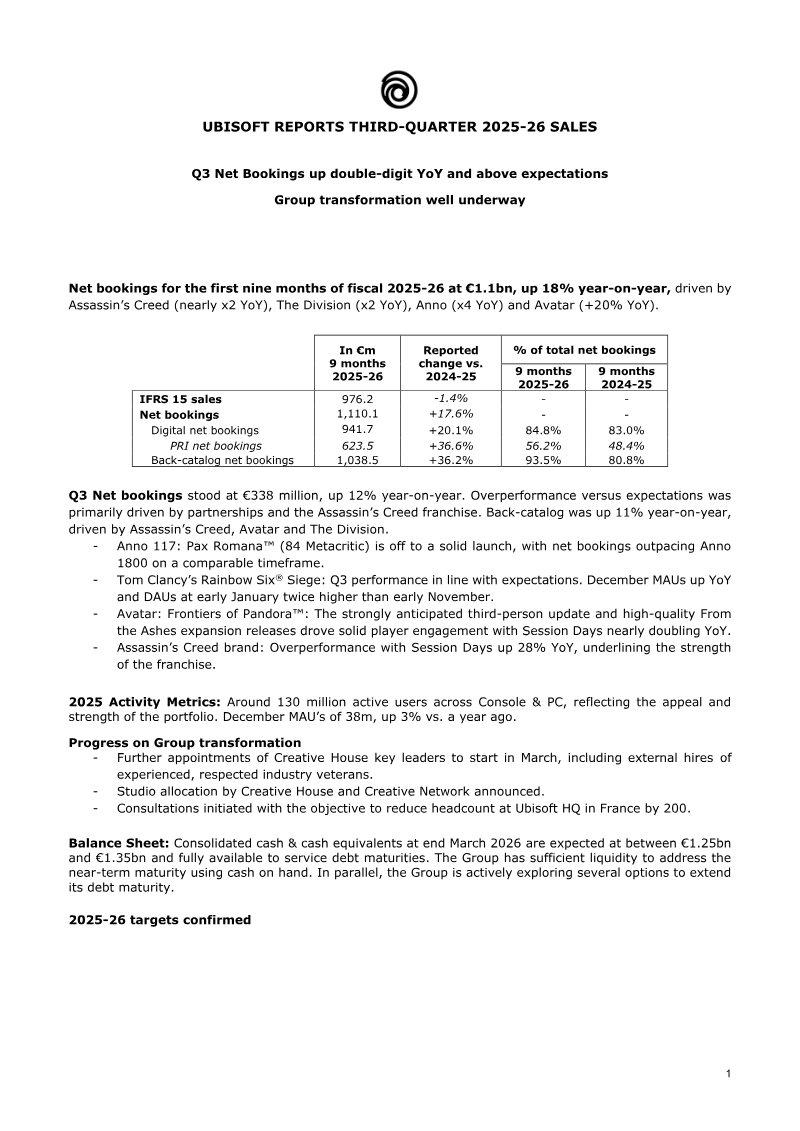
Ubisoft · 2025
G5 Entertainment AB · 2024
Paradox Interactive · 2024

PitchBook · 2024
Bandai Namco · 2021
King · 2021
GREE · 2020
GREE · 2019
GREE · 2017