ArticleGameMakers
Trends That Will Define Gaming in 2026: And 1 Nobody Wants to Talk About
10 Feb 20261 pages~10 min full read
The gaming industry is currently navigating a period of profound structural change, characterized by an increasingly saturated market and shifting player expectations. The primary thesis is that the traditional barriers to entry—the industry's "moat"—are eroding, forcing studios to adapt to a landscape where software production costs are collapsing and player patience is at an all-time low. Success in 2026 and beyond will depend on a studio’s ability to leverage artificial intelligence, maintain rapid iteration cycles, and foster deep, authentic community engagement.
Key findings indicate that the supply of new applications is surging, with iOS app releases increasing by 60% year-over-year as of late 2025, largely driven by AI-assisted development. Simultaneously, demand-side dynamics have shifted toward "progression compression," where players demand immediate value and gratification, leaving little room for traditional, slower-paced game loops. Small, agile teams of 1 to 20 people are emerging as the most successful entities by treating community feedback as a core development methodology rather than a marketing afterthought.
The analysis highlights that AI integration is no longer optional but an existential requirement for survival. While some industry participants remain hesitant, the adoption of AI-native workflows is viewed as inevitable, mirroring the historical transition of online dating. Studios that fail to embrace these tools to enhance quality, uniqueness, or mystery will likely struggle to remain competitive. Ultimately, the industry is moving away from massive, slow-moving development cycles toward a model defined by speed, smart resource allocation, and the cultivation of loyal player bases that serve as the primary engine for growth.

GameMakers · 2026
GameMakers · 2026

GameMakers · 2026
GameMakers · 2026

GameMakers · 2026
GameMakers · 2026

GameMakers · 2026
GameMakers · 2025
GameMakers · 2025

GameMakers · 2025
GameMakers · 2025
GameMakers · 2025
Newzoo · 2026
Aream & Co · 2026
Take-Two Interactive · 2026
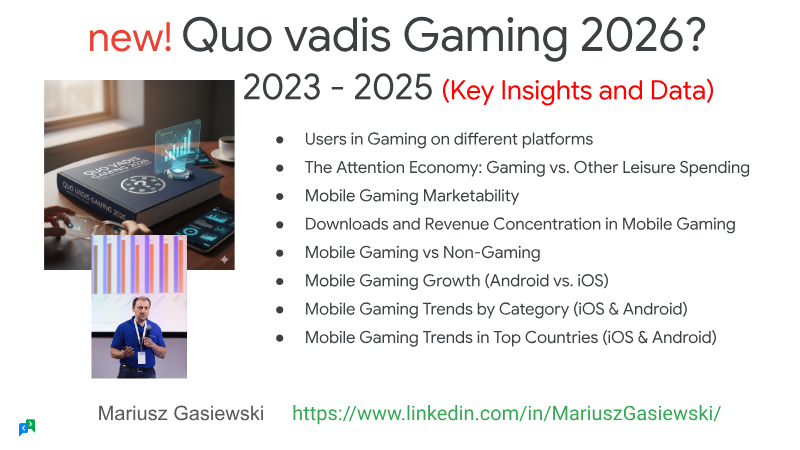
InvestGame · 2026
Epyllion · 2026
Basic Roots Consulting · 2025

AlixPartners · 2025
Boston Consulting Group · 2025
Take-Two Interactive · 2025
Newzoo · 2025
Xsolla · 2025
Aream & Co · 2025