1 free read left. Create a free account for unlimited reading + AI research.
Create free accountWhitepaper European Conference on Games Based Learning (ECGBL)
1 free read left. Create a free account for unlimited reading + AI research.
Create free accountWhitepaperEuropean Conference on Games Based Learning (ECGBL)
The paper argues that the choice between abstraction and realism in serious games should not be a single binary decision. It should be a set of deliberate, calibrated design choices.
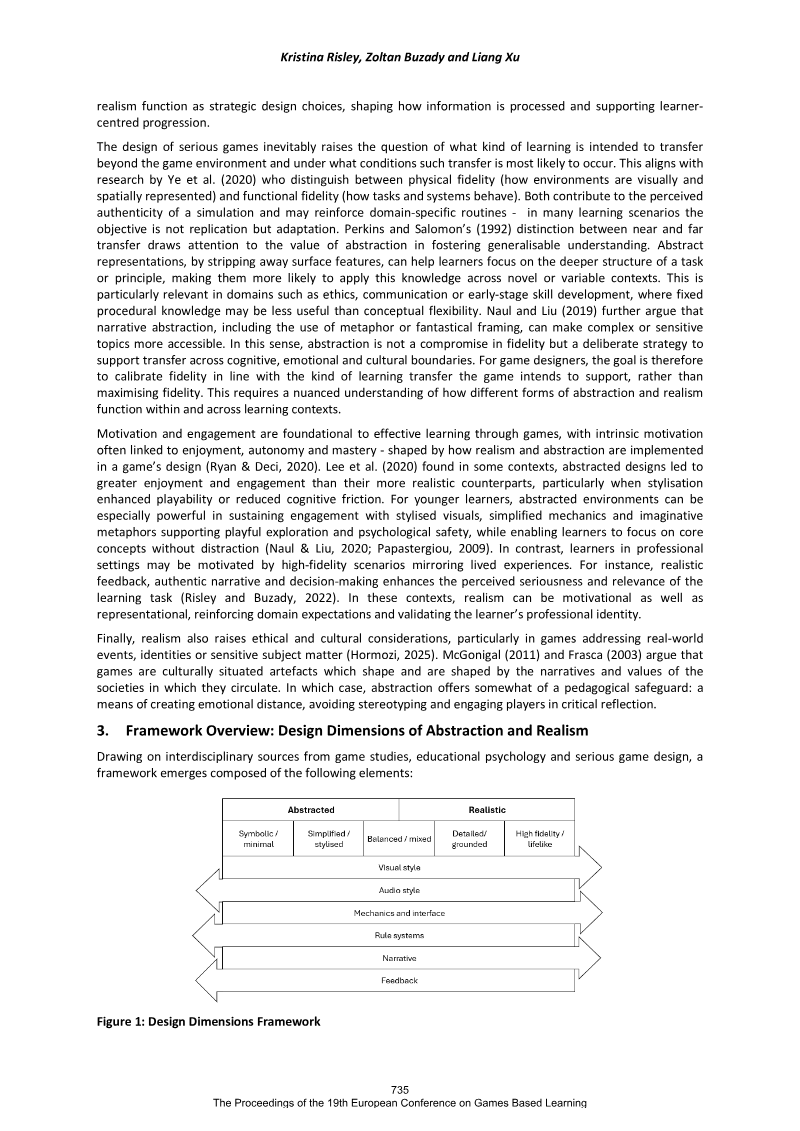
This paper argues that the choice between abstraction and realism in serious games for learning should not be treated as a single binary decision but as a set of deliberate, calibrated design choices. Drawing on theories such as Cognitive Load Theory and the distinction between near and far transfer, the authors propose a conceptual framework built on six design dimensions: visual style, audio, mechanics and interface, rule systems, narrative, and feedback. Their central premise is that abstraction reduces extraneous cognitive load and can support generalisation, while realism fosters situated learning and professional credibility, and that each serves different learners and contexts.
The analysis of these dimensions is illustrated through examples. Realistic mechanics and rule systems, such as flight simulators and the workplace decision scenarios in FLIGBY, are presented as supporting procedural and situated transfer. Abstracted designs, exemplified by the metaphorical "spirit power" system and minimalist visuals in Cipher, are shown to reduce cognitive load and to promote conceptual understanding and engagement, particularly among younger learners. The authors conclude that effective serious games typically blend fidelity levels across dimensions in line with pedagogical goals, and they offer a six-dimension assessment matrix on a spectrum from abstract to realistic.
The scope of the work is primarily theoretical and conceptual. The framework and matrix are presented as foundations for future empirical research rather than as validated instruments, and the paper offers no quantitative findings of its own. Its supporting reference base spans serious game success factors, game engine selection, fidelity in simulation-based games, and cognitive load theory. The practical takeaway for designers is that each design element should be selected deliberately according to audience and learning objectives, rather than pursuing a uniform position at either end of the spectrum.
European Conference on Games Based Learning (ECGBL) · 2026



European Conference on Games Based Learning (ECGBL) · 2026
European Conference on Games Based Learning (ECGBL) · 2026



European Conference on Games Based Learning (ECGBL) · 2026



European Conference on Games Based Learning (ECGBL) · 2026



European Conference on Games Based Learning (ECGBL) · 2026



European Conference on Games Based Learning (ECGBL) · 2026



European Conference on Games Based Learning (ECGBL) · 2026



European Conference on Games Based Learning (ECGBL) · 2026



European Conference on Games Based Learning (ECGBL) · 2026



European Conference on Games Based Learning (ECGBL) · 2026



European Conference on Games Based Learning (ECGBL) · 2026
European Conference on Games Based Learning (ECGBL) · 2026



European Conference on Games Based Learning (ECGBL) · 2026



European Conference on Games Based Learning (ECGBL) · 2026