1 free read left. Create a free account for unlimited reading + AI research.
Create free accountWhitepaper DiGRA
1 free read left. Create a free account for unlimited reading + AI research.
Create free accountWhitepaperDiGRA
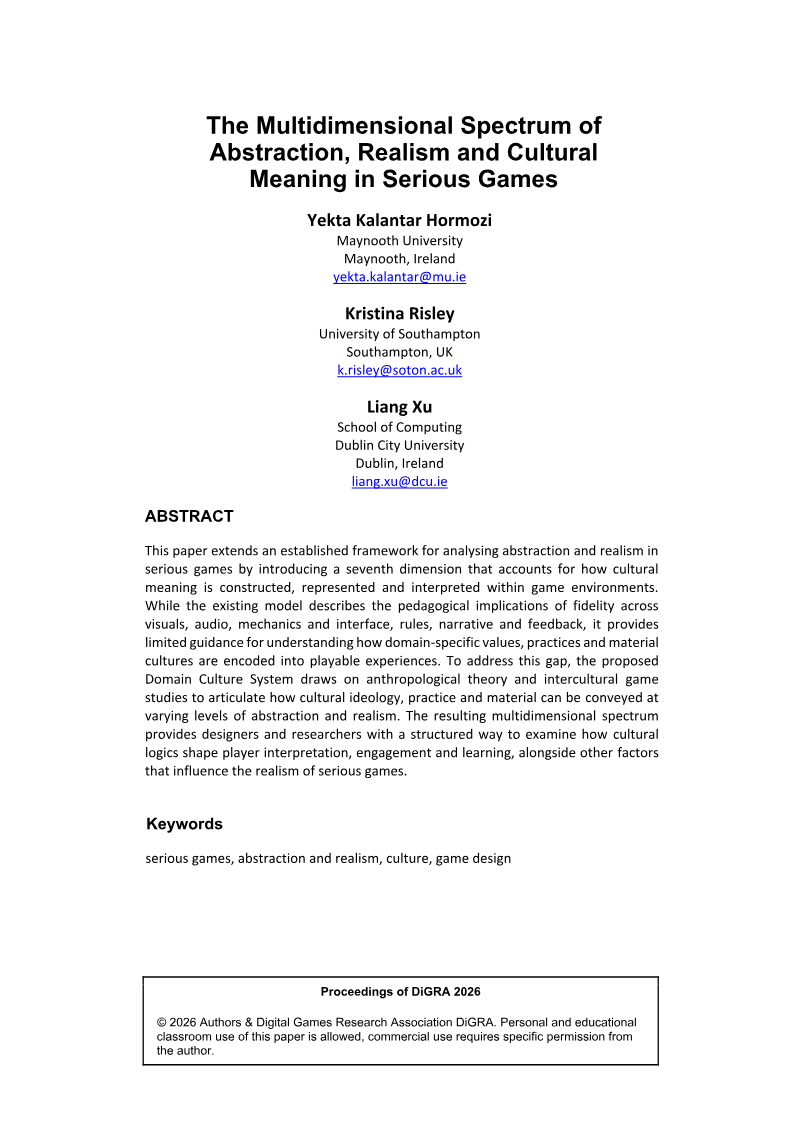
Current abstraction-realism frameworks cover visual, audio, mechanical, rule-based, narrative and feedback fidelity. The paper argues that culture should be treated as a seventh design dimension.
This paper argues that existing abstraction-realism frameworks for serious games, which focus on visual, audio, mechanical, rule-based, narrative, and feedback fidelity, leave out cultural meaning, and that culture must be treated as a seventh design dimension. Building on prior work by Meershoek and colleagues and Shliakhovchuk and García, the authors contend that abstraction does not make a game culturally neutral, since players bring the values, practices, and norms of their own domain to every interaction. The stated research question concerns how culture functions as a dimension of abstraction and realism, and the scope is restricted to serious games designed for learning.
The central conceptual contribution is the Domain Culture System, which treats culture as an interconnected system of ideology, practice, and material rather than as isolated features. The authors draw on Shliakhovchuk and García's systematic review of 72 studies, which found that culturally embedded serious games can improve knowledge, attitudes, and perceptions, with outcomes depending on how cultural meaning is represented in gameplay. Supporting illustrations from Meershoek et al. (2014) show cultural norms overriding design intent: a German supply-chain game collapsed within five minutes, while a Taiwanese trading game ran for hours without bankruptcies under collectivist expectations.
The proposed framework rests on three principles: coherent ideology, flexible abstraction of practice and material, and accurate, authentic, or inspired representation. Examples including Body Interact, FLIGBY, and Discovery Tour: Ancient Egypt are offered to show how these principles might be applied, though the paper's evidence is largely conceptual and argumentative rather than empirical. Its substantive output is a design matrix mapping how each of the seven dimensions shifts along an abstract-to-realistic continuum, calibrated to learning goals and audience. The paper reports no original quantitative data, so its value lies chiefly in offering a structured vocabulary for designers and researchers who need to account for cultural meaning alongside technical fidelity.

DiGRA · 2026

DiGRA · 2026



DiGRA · 2026



DiGRA · 2026



DiGRA · 2026



DiGRA · 2026



DiGRA · 2026



DiGRA · 2026

DiGRA · 2026



DiGRA · 2026



DiGRA · 2026

DiGRA · 2026
European Conference on Games Based Learning (ECGBL) · 2026