1 free read left. Create a free account for unlimited reading + AI research.
Create free account
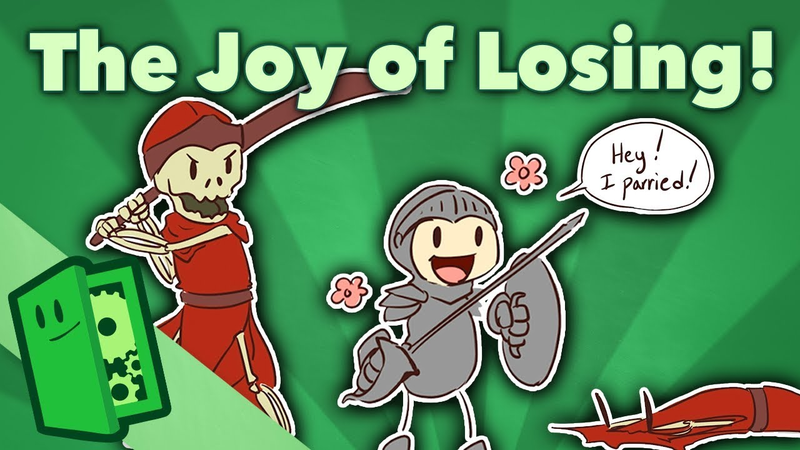
The Joy of Losing - Learning to Have Fun Playing Games - Extra Credits
Key insights
6 takeaways- 01Reframing defeat as a diagnostic tool allows players to identify mechanical and strategic mistakes, providing a clearer roadmap for improvement than victory does.
- 02Adopting a growth mindset shifts the focus from the final score to the process of learning, transforming potential frustration into excitement for future matches.
- 03Losing provides a unique environment to develop essential soft skills, such as leadership, conflict resolution, and team coordination, which are as critical as mechanical proficiency.
- 04Tying self-worth exclusively to winning in multiplayer games is unsustainable because the inherent design of these systems guarantees that a significant portion of the player base must lose in every match.
- 05The current gaming culture's overemphasis on victory fosters a toxic environment characterized by irritability and poor sportsmanship, which degrades the overall health of the community.
- 06The gaming industry should prioritize the act of playing itself as the primary source of enjoyment to create a more sustainable and engaging player experience.
Ask AI about this video
Transcript
winning. A game shouldn't be only fun when you're winning. Can't only be fun when you're winning. As an industry and as a community, we seem to have forgotten this. We've forgotten the importance of finding the joy in losing. Real quick up top, please give a warm EC welcome to Kelsey, who's doing guest art for this episode. Thanks, Kelsey. In games today, we put a huge emphasis on winning. We've moved it from being the goal of most games to the raison d'être of most games, especially in multiplayer environments. In many multiplayer games, we've let winning become more important than having fun. We've let it eclipse the joy of the game itself. Time and time again, we've all run into players that aren't having fun unless they're winning. And when they're losing, they're actively having a bad time. Losing makes them angry, irritable, or sometimes even mean. It puts people in a bad mood, the very
opposite of the thing we usually sit down to play games for. But as hokey as the saying "Winning isn't everything" is, it's kind of true here. Like, what's really at stake in these games? For most of us, exactly nothing. Nothing materially changes in your life if you crush a particular round or if you get steamrolled. Heck, in most games, you can usually just pick back up and try again at no cost whatsoever. Even if you're playing on ladder, those few points up or down don't really mean anything, and they certainly shouldn't ruin your day. And losing isn't actually a bad thing. It's often how we improve. It's easier to learn what you did wrong and what you could do better from a losing game than from a winning one. And it's much easier to gloss over those mistakes and just assume you did everything right because you won. And you know what? That's where the real joy is, in getting better. At least that's where it should be.
Those of you who have played any of the FromSoftware games know the joy that can be found in losing. If when you lose, you saw one small thing you could do better. Or if you came up with a new strategy to try next time. That should be the feeling that we take to every game that has winning and losing. If you're playing Dota or Counter-Strike, League or Overwatch, FIFA or Madden, that's the feeling that losing should bring. Sure, it's a little disappointing that you lost. But then you get to think about the ways you know you could have done better and get super excited about jumping into that next game because you want to try your ideas out. You immediately get the chance to test your new hypothesis and see where you were right and where you were wrong. That is exciting. Because winning is just a yardstick, just a measuring tool to tell you if you've improved your play. It's how you test all thoughts you have about how you might get better and know if you were
right. But that's all it is. It has no inherent value in and of itself. Now, I know there's going to be a contingent of people out there who will say they get frustrated when they lose even when they're playing well. When they lose because someone on the team wasn't good. And yes, I absolutely agree that when someone is actively trolling, that's frustrating and disappointing. Though more disappointing in humanity than the game, but I digress. When other players are just uncoordinated or maybe not that great at whatever you're playing, that's an opportunity to improve as well as a leader and a mentor. I've seen teams filled with people who are mechanically unskilled at a game trounce teams of highly skilled players because they had one person who helped the team coordinate and rallied them when they were down. And that's something you can get better at as well. You can get better at being that person. Your team never groups up? What can you say or how can you signal more effectively so that people actually do?
Your team ignores the objective to just get into brawls? How can you bring them together to focus on the goal of the game? Or maybe it's just people getting into a defeatist attitude when things go a little bit against them. How do you rally them to give it one more go? These are as much skills in a team game as fast mouse work or clever builds. And getting better at them is an amazing feeling. The most rewarding games I've ever had weren't the ones where I did the coolest shot or stole the objective. They were the ones it was clear that the team was about to give up and something I said got them to group up and give it one more go. And in all seriousness, it didn't really matter if we still lost. It felt like we gave it our all and that feels amazing. We can't invest our self-worth in just winning. Just achieving victory in some arbitrary game. Not only is that not healthy at all, but it also bucks against a fundamental truth. In most multiplayer games, at least half of the
people are losing all the time. No form of entertainment should be miserable for half of its audience or make half of its audience feel bad about themselves. So, we have to find the joy not in winning, but in improving or just in playing the game itself. Because if you're not playing for the gameplay, the hook you're playing for is as much of an illusion as any free-to-play treadmill or MMO grind. And we can't fall for that because games shouldn't be about rage or disappointment. Games should never cause you to toss the controller or to shout at another person. They're meant to engage us and much of the time to be fun. A winning is everything mentality just to toxicity. So, we need to find the joy in losing, in being beaten in a really good game, in seeing other people's incredible displays of skill, or in learning about the game itself. We need to find the joy in simply playing, win or lose, because when
you're not having fun, it's time to stop. GG, everyone. GG.
Summary
The modern gaming landscape suffers from an overemphasis on victory, where winning has become the primary objective rather than a byproduct of the experience. This mindset creates a toxic environment where half of the player base is perpetually miserable, as the inability to derive satisfaction from anything other than a win leads to frustration, irritability, and poor sportsmanship. Because multiplayer games are inherently designed so that a significant portion of participants must lose, tying self-worth to the outcome of a match is fundamentally unsustainable and detrimental to the overall health of the gaming community.
Instead of viewing defeat as a failure, players should reframe losing as an essential tool for growth. Defeat provides a clearer diagnostic of one’s mistakes than victory, offering a roadmap for mechanical and strategic improvement. By shifting the focus from the final score to the process of learning, players can transform disappointment into excitement for the next match. This approach encourages a growth mindset, where the joy of the game is found in testing new hypotheses, refining skills, and appreciating the high-level play of opponents.
Furthermore, losing serves as an opportunity to develop soft skills, such as leadership and team coordination. Even when teammates are uncoordinated or struggling, an individual can practice effective communication, conflict resolution, and morale-building. These interpersonal skills are as vital to success as mechanical proficiency and offer a profound sense of accomplishment regardless of the final outcome. Ultimately, the industry must move away from the "winning is everything" mentality to foster a more positive, engaging, and sustainable culture where the act of playing itself remains the primary source of enjoyment.
























Comments