1 free read left. Create a free account for unlimited reading + AI research.
Create free accountWhitepaper European Conference on Games Based Learning (ECGBL)
1 free read left. Create a free account for unlimited reading + AI research.
Create free accountWhitepaperEuropean Conference on Games Based Learning (ECGBL)
The paper argues that neoliberal market logic, state control and uncritical open-source advocacy clash with critical Global Citizenship and Development Education.
This paper, authored by Paul Keating of the Technological University of the Shannon, examines the tension between the values embedded in commercial computer games and the principles of Global Citizenship and Development Education. Its central argument is that the ideologies shaping the games industry, whether neoliberal market logic, state control, or uncritical open-source advocacy, are at odds with critical development education, yet games can still be reclaimed as spaces for decolonised, socially progressive learning. The work is aimed at development educators, games designers, and policymakers, and is grounded in an interdisciplinary literature review spanning education, game design, colonialism, and activism, conducted alongside doctoral research and NGO project work over a seven-year period to 2024. Its analysis adopts a postcolonial lens informed by critical pedagogy.
The paper traces the historical development of simulation games in education, from 1960s games such as Inter-Nation Simulation and Simulated Society through to late-1980s titles such as Save the Whale, before examining how commercial "world-building" and "4X" games have frequently embedded colonial, militaristic, and exploitative narratives. It also documents the rapid growth of the gaming sector, accelerated by the COVID-19 pandemic, and the corporate push toward a integrated "Metaverse." Key concerns include corporate consolidation exemplified by Microsoft's acquisitions of Minecraft's developer and Activision Blizzard, Facebook's reversal of commitments made during its purchase of Oculus, and the exploitation of precarious labour and the recruitment of young people into extremism through gaming platforms.
On governance, the author notes that the European Union has identified competing models of control, namely state regulation, open access, and corporate control, with the United States and China pursuing divergent approaches, while open-source activists advocate a more democratic alternative. The paper concludes by proposing decolonising principles for designing games in this field, including values-based design, alliance with existing grassroots movements, solidarity with marginalised communities particularly in the Global South, grounding in development education methods, and deliberate transference of learning from virtual to physical contexts.
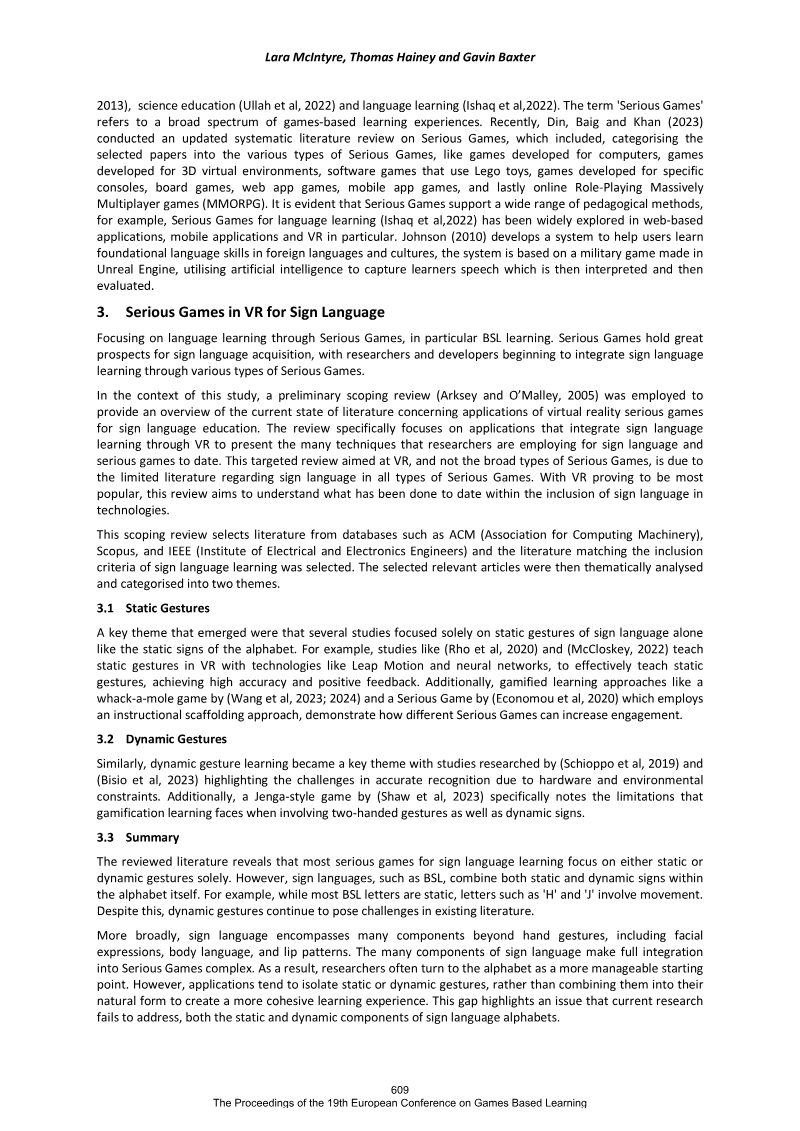
Each row is a game or company this document names, each column a document, oldest first. A mark means that document names it. Select a row to see those documents.
European Conference on Games Based Learning (ECGBL) · 2025
European Conference on Games Based Learning (ECGBL) · 2025
European Conference on Games Based Learning (ECGBL) · 2023
European Conference on Games Based Learning (ECGBL) · 2022
European Conference on Games Based Learning (ECGBL) · 2025
European Conference on Games Based Learning (ECGBL) · 2022