Related Documents

Report
How Different Generations Engage with Video Games Today
Gaming has evolved into the primary entertainment medium for younger generations, with 94% of Gen Alpha identifying as game enthusiasts. This shift signifies a transition from gaming as a solitary hobby to a multi-dimensional "way of life" that encompasses playing, viewing, and socializing. While mobile gaming maintains universal appeal across all age groups, younger cohorts like Gen Alpha and Gen Z are significantly more likely to engage across multiple platforms and participate in virtual social environments. These younger players demonstrate high spending conversion rates, with approximately 60% investing in games, often driven by a desire for social immersion and diverse genres such as Adventure and Battle Royale. In contrast, older generations like Gen X and Baby Boomers exhibit more utilitarian engagement patterns. These cohorts primarily favor casual puzzle-solving titles and are motivated by achievement, mastery, and time-saving mechanics. While 70% of younger players are "player-viewers" who consume gaming video content for entertainment and social connection, older players use video content more informationally, such as for reviews or tutorials. This generational divide extends to brand discovery; younger players are increasingly open to discovering new brands within game worlds, making the medium a vital marketing tool for reaching modern consumers. The global gaming landscape is characterized by both universal franchises and distinct regional preferences. Major titles like Call of Duty, Fortnite, and Genshin Impact maintain a massive international presence, yet markets such as China, Japan, and South Korea continue to support region-specific hits like Honor of Kings and Lineage. Across these diverse geographies, the 2023 data highlights that gaming has become a central pillar of social interaction and brand engagement, particularly as younger generations integrate virtual experiences into their daily identities and consumption habits.
NewzooJan 2023
Report
Gamer Generations Report: How Different Generations Engage with Games 2021
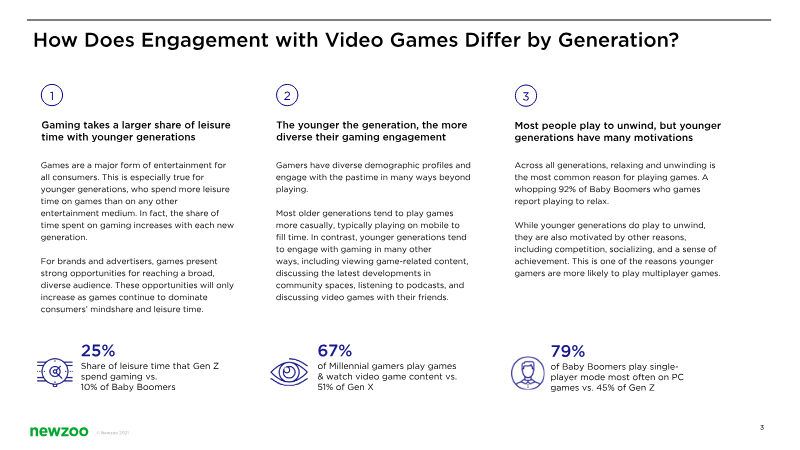
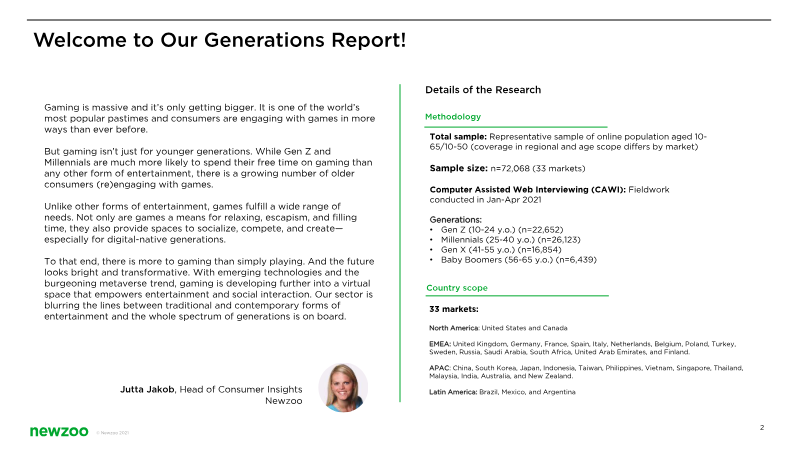
Gaming has evolved into a primary form of entertainment that transcends age groups, though engagement patterns vary significantly by generation. Younger cohorts, specifically Gen Z and Millennials, now prioritize gaming over traditional media like television or social media, spending approximately 25% of their leisure time on the medium. While 81% of Gen Z identifies as gamers, the hobby maintains a strong foothold among older populations, with 42% of Baby Boomers participating. This data suggests that gaming has become a focal point for global leisure, offering brands extensive opportunities to reach diverse audiences across 33 surveyed markets. The depth of engagement is highly correlated with age. Younger generations exhibit multi-dimensional behaviors, including viewing game-related content, participating in online communities, and utilizing games as social hubs. For Gen Z and Millennials, streamers and content creators serve as major cultural influences, with over two-thirds of these groups both playing and watching gaming video content. In contrast, older generations like Gen X and Baby Boomers engage more casually, primarily using mobile platforms to fill time or unwind. Their motivations are largely practical, often seeking out reviews or "tips and tricks" rather than social or competitive experiences. The industry is currently shifting toward the metaverse, characterized by virtual spaces that host non-gaming activities such as concerts and social gatherings. Approximately 70% of Gen Z gamers expect to spend time in game worlds without actively playing the main game, signaling a move toward digital persistence and self-expression. While younger players favor sandbox and battle royale genres that empower creativity, all generations express interest in metaverse features like free advertiser-sponsored content and avatar customization. This research, based on a sample of over 72,000 respondents, concludes that gaming is no longer just a pastime but a foundational component of modern social identity and digital interaction.
NewzooJan 2021


Report
Essential Facts About the U.S. Video Game Industry
The U.S. video game industry has evolved into a mainstream, multigenerational pastime that encompasses 190.6 million weekly players. Findings indicate that 61% of the American population plays at least one hour of video games per week. The demographic profile of the average player has shifted significantly over the last two decades; the average age is now 36, compared to 29 in 2004. This aging player base has fostered a strong culture of family gaming, with 83% of gaming parents playing alongside their children to strengthen bonds and improve communication. Technological advancements have fundamentally altered how and where Americans engage with games. Mobile devices are now the primary platform, used by 78% of players, a dramatic increase from 33% in 2012. Furthermore, the rise of internet connectivity has transformed gaming into a social hub, with 88% of players engaging in online gameplay and 72% agreeing that video games create a sense of community. Beyond entertainment, players report significant mental health and cognitive benefits, with over 75% of adults agreeing that games provide stress relief, mental stimulation, and joy. Economically, the industry remains a powerhouse, contributing nearly $66 billion to the U.S. GDP in 2023 and supporting over $101 billion in total economic impact. Total consumer spending reached $57.2 billion during the same period. The data, gathered by YouGov via a survey of 5,000 respondents and supplemented by qualitative ethnography, highlights that 63% of players view video games as providing the highest value for their money compared to other entertainment media. This comprehensive look at the 2023-2024 landscape confirms that video games are an inclusive, essential component of American social and economic life.
Entertainment Software AssociationJan 2024


Report
Essential Facts About the Video Game Industry 2022
The 2022 Essential Facts About the Video Game Industry provides a comprehensive analysis of the American gaming landscape, asserting that video games have become a vital tool for social connection, skill-building, and mental well-being. The central thesis posits that the high levels of engagement sparked during the pandemic have become permanent fixtures of American life, with 90% of players maintaining or increasing their playtime since the pandemic's peak. The findings are based on a February 2022 study conducted by The NPD Group, which surveyed approximately 4,000 Americans. The data reveals that 66% of Americans—roughly 215.5 million people—play video games at least weekly. The player base is diverse and aging, with an average age of 33; 48% of players identify as female and 52% as male. While smartphones remain the most popular device (70%), the majority of players utilize multiple platforms. Puzzle and arcade games lead in popularity, though preferences shift by generation, with older adults specifically valuing games for cognitive stimulation. Social connectivity is a primary driver of modern gaming habits. The research shows that 83% of players engage with others, and 46% have met a significant other or close friend through gaming. Beyond entertainment, 97% of Americans see games as beneficial, citing stress relief and the development of cognitive and teamwork skills. Parents also view the medium favorably, with 77% playing games with their children weekly and 84% expressing awareness of ESRB ratings to manage household gaming habits. Economically, the industry reached $60.4 billion in total U.S. sales in 2021, driven largely by content spending. Purchase decisions are primarily influenced by game quality and price, with 67% of players engaging in in-game purchases. The scope of the report covers the 2021-2022 period, focusing on U.S. demographics, market trends, and the evolving social role of interactive entertainment.
Entertainment Software AssociationJun 2022