1 free read left. Create a free account for unlimited reading + AI research.
Create free accountWhitepaper European Conference on Games Based Learning (ECGBL)
1 free read left. Create a free account for unlimited reading + AI research.
Create free accountWhitepaperEuropean Conference on Games Based Learning (ECGBL)
The study is situated at a medium-sized manufacturer of safety-critical components. It targets manual assembly work where rigid assistance systems may increase cognitive strain over time.
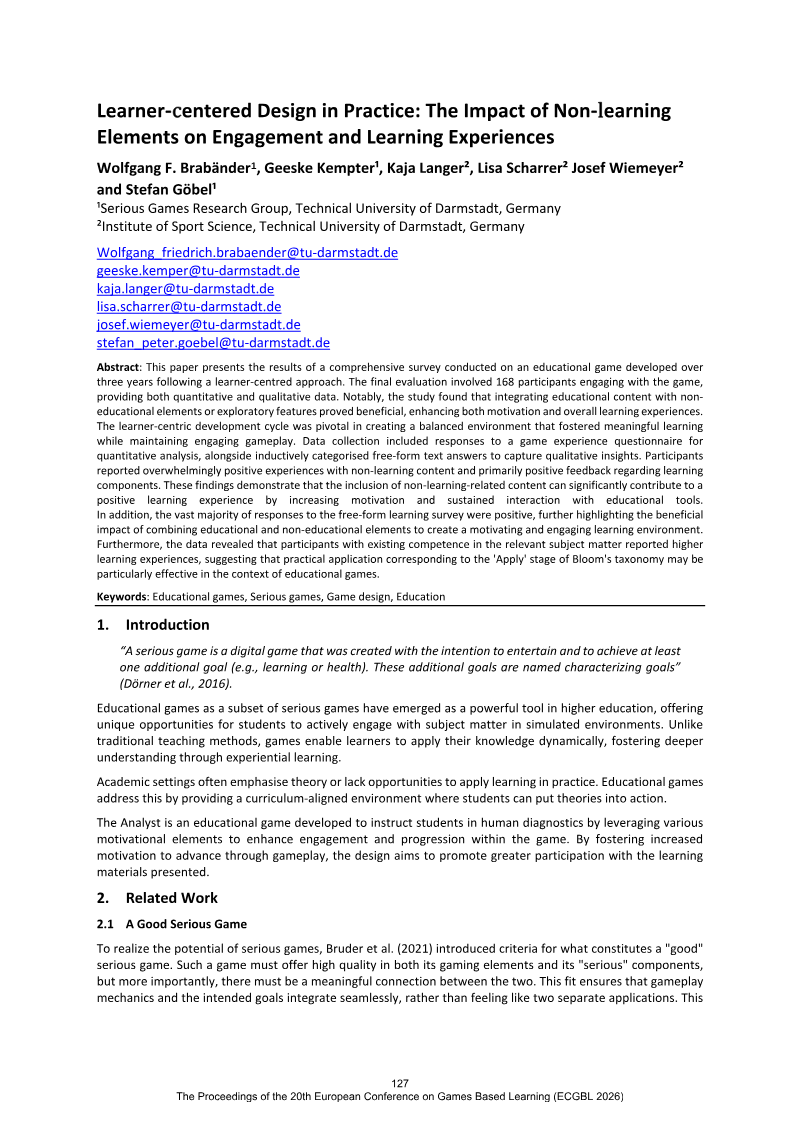
This paper presents a system design and study protocol rather than empirical results, aiming to test whether tailored gamification can sustain motivation and autonomy in manual assembly work where rigid assistance systems may increase cognitive strain over time. Its central argument is that fixed instructional support can become counterproductive as operators gain expertise, and that gamified elements, which show early performance gains in prior work, may later raise stress unless they adapt to the individual. The authors frame the contribution around a flexible, user-driven approach grounded in self-determination theory, tailored gamification, and the expertise reversal effect.
The proposed platform centers on an eight-level information-support model in which users select their own level of guidance rather than having it advanced automatically. Gamification is built on 56 challenge scenarios combining eight support levels with seven difficulty stages, time benchmarks scaled between 1.25 and 0.75 times baseline, badges, coins, a shop, and a Prestige mechanic that multiplies future earnings. The planned evaluation pairs behavioral logging of task times and error events with standardized questionnaires covering usability, technology acceptance, workload, and user engagement, followed by a multi-month field study.
The work is situated at a medium-sized manufacturer of safety-critical components, and its motivating evidence draws on prior literature reporting task-time reductions of roughly 15 percent with 3D instructions, about 50 percent error-rate reductions with projection-based guidance, and 20 to 35 percent assembly-time reductions with pick-to-light systems. No empirical findings from the proposed system are yet reported, so its conclusions remain provisional, pending the long-term field evaluation the authors describe.

European Conference on Games Based Learning (ECGBL) · 2026



European Conference on Games Based Learning (ECGBL) · 2026

European Conference on Games Based Learning (ECGBL) · 2026



European Conference on Games Based Learning (ECGBL) · 2026



European Conference on Games Based Learning (ECGBL) · 2026



European Conference on Games Based Learning (ECGBL) · 2026



European Conference on Games Based Learning (ECGBL) · 2026



European Conference on Games Based Learning (ECGBL) · 2026



European Conference on Games Based Learning (ECGBL) · 2026



European Conference on Games Based Learning (ECGBL) · 2026



European Conference on Games Based Learning (ECGBL) · 2026



European Conference on Games Based Learning (ECGBL) · 2026
European Conference on Games Based Learning (ECGBL) · 2026
European Conference on Games Based Learning (ECGBL) · 2026

European Conference on Games Based Learning (ECGBL) · 2026