1 free read left. Create a free account for unlimited reading + AI research.
Create free account
Superstar Session: How to Enhance the Gaming Experience Through Content Micro-personalisation
Key insights
6 takeaways- 01Micro-personalization leverages centralized player data and AI to transition from generic engagement models to highly tailored, context-aware experiences.
- 02Studios can manage technical complexity by using behavior-based player clustering, which enables targeted content delivery at scale without requiring individual-level processing.
- 03Predictive analytics should be used to identify potential churn, allowing developers to gain actionable insights into the specific causes of player disengagement.
- 04Implementation requires a dual-model framework that integrates machine learning with business-oriented rules to provide real-time suggestions, such as gear recommendations or personalized in-app purchase offers.
- 05Real-world application in titles like The Respawnables demonstrates that micro-personalization strategies directly correlate with increased transaction volume and sustained revenue growth.
- 06Rigorous experimental design is essential for validating the efficacy of personalization interventions to ensure they effectively optimize the broader player experience.
Ask AI about this video
Transcript
uh we're gonna go on to a another um another super star session that was this one was uh from from old friends and this is this is from uh a brand new addition to the show new friends uh in the form of of jump um who are going to talk to us about how to enhance uh the gaming experience through content micro personalization um so what we've got i've got a new uh a new friend of the show uh i'd like to welcome which is um the data science directorate jump carlos uh de las hello yeah [Music] yeah i suppose my spanish goes let's not push it on but sir absolute pleasure
absolute pleasure to to have you here um and we're only a bit late but don't we have your full time that's this is how these shows go there's always a uh on run so yeah you're gonna be talking to us today about um enhancing the gaming experience through through uh micro personalization of content and that's correct fantastic um and we're about to worry about so you're speaking to us from just uh so audience now you you're in madrid or barcelona where nearby madrid yeah beautiful beautiful awesome do you have snow yeah i i'll share the screen now yeah you can share the screen and go for it okay so thank you chris and greetings everyone my name is carlos aloceras and i want to share with you my vision about how data-driven decisions can improve the way in which we interact with our users okay the idea here is not only to get an increase in in in transactions or
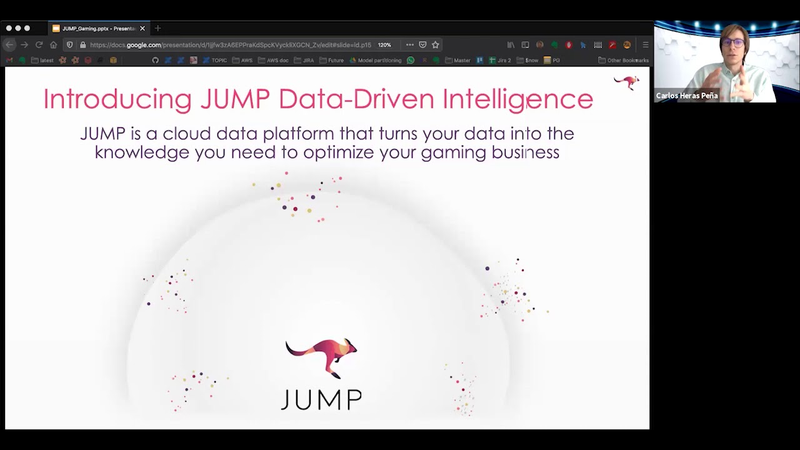
in use which is of course one of the most important company kpis but we are also going to be talking about how to save in the experience of the users in new ways to accomplish several different goals which could go uh with integration with the system with new inventory rotations etc different goals so my company's name is jambas crusade we are a company whose traditional domain is not gaming it's streaming video entertaining this is pretty different from gaming but we are starting to adapt some of our production effective products that have problem goals on some of our clients and we are trying to translate them into the gaming industry okay i'm not here to talk about jump however uh i must give you a keep resuming of how we who we are uh to give you context okay because i want you to not only uh listen to what i
propose to you but to believe that it can actually integrate pretty efficiently with your assistance okay so that's why i'm gonna to be talking a little bit about who we are what how we don't and why do we feel confident on what i propose okay this is going to be done over the first three four slides uh however as i was saying the focus of this talk is showing you how the information you generate about the users the frequency by which they engage with your games the way they use them the degree of expertise they demonstrate during their plays the way they interact with our with other users even the technical user experience the device they use for gaming is providing all this information that might come from a lot of different sources perhaps they they usually are used for your core functions you call decision inputs
but i am gonna show you new ways to use it okay so first of all let's just contextualize we live at a time of gaming boom market share of gaming devices and markets is booming a lot especially for free to play games which have seen a dramatic increase over the last decade and naturally as market boom so those competition so usually uh what you have to do to strive in this domain is not only to to to achieve what other players have achieved during the last years but you also have to to deal with some new strategies okay and so the solutions with the bicep jump are based not only on business intelligence but also on artificial intelligence the idea he here is to give you an edge by generating automatic knowledge at an user level which can then better be derived into actions
okay however this promising part leads to some challenging situations for example the fact that we might be dealing with multiple data sources usually fragmented over different repositories or technical platforms the fact that we when we want to generate insights we are bound to attend to large number of analytic dashboards the fact that we find too often that there is a long time to incite an action this means that because of all the other challenges i just say when you want to to take a specific actions looking at your data you might have a long time of analysis to centralize or do data to understand all the different graphics or understand all the different plots before you can translate that information into a specific market action okay so what we envision here is
on one side the unification of all those data sources in a single place called a data lake a warehouse whatever you want to call it but most importantly the construction of laser focused business oriented insights okay i'm not saying that you will have to be in all the dashboards you might have on the company right now and just believe what we are going to serve you what i'm saying here is that what we can do is we can ingest all the related data that you need for this kind of insights these kind of decisions and we can present a single dashboard in which you could understand everything you need at a glance okay of course for other kind of analysis of your company you are still going to need all the other dashboards but we are talking here about unification of data which is not often trivial for all companies okay by doing this what we i want to achieve
is instant visibility of your information so that you can get your insights and translated into specific impacts at a glance or much more easy than before okay so jump is a cloud data platform that turns your data into knowledge so that you can optimize your decisions basically how do we do that or how we do that on gaming okay so we have a couple key proposals one of those is to increase monetization of all your free to play games by offering in-app purchases a conceptual personalization by player by customer okay the other of the proposals we have is to achieve more loyalty between your plans inclusions this is done by probate providing a disengagement prediction okay so what we are going to provide you
is a system which is going to tell you one and who which of you users are in danger of just disengaging completely with your experience okay once you have your knowledge all that is left is to turn those insights into action by creating a target marketing campaigns okay this could be on a a channel of choice different strategies different whatever but the important thing here is to having the insights to understanding which users are on the brink of this engagement and by understanding what is more use useful for them through personalization okay it is worth noting that the clients we currently work with are numerous scattered worldwide through all continents and some of them entire one players of the media industry both in the united states the latin american market the asset market and european market it has only been very recently that jump jumped if the pawn is allowed
into the gaming sector okay we are very confident of our success because we are carrying all the state-of-the-art technical expertise we obtain on the media sector and then we are adding of those up tons of gaming specific insights we are obtaining by iterating closely with our name our new gaming customers okay but in out of that presentation how do we do all of that okay to put everything in a nutshell what we aim to do is we extract the data about your customer behavior and items catalog from your own storage systems that might be a single storage system of a dolphin of them okay then we run our algorithms and generate per user predictions finally we expose those predictions by means of an api or a download okay this is the basic states but then of
course in app integrations are also available and we are we are talking with our current customers the best ways to to to create those integrations okay in order to check this in a little more technical perspective okay we could say that the ways to get your data could be a either a downloadable source that or a port that you send to us so that we can download your data or we also have the the the option of installing a software developer kit which will capture uh on real time all the information that we that is critical for us and then send it to us depending on your state of the art your technical requirements etc one solution might be more optimal than the other after we have all your data basically what we are gonna do is we generate innate purchases
recommendations for all of your players okay we as i say we are going to run off artificial intelligence algorithms and we just translate those onto recommendations for each of the users at the user level then what we could do is to solve our purchase our recommendations let's just say to your players throw the api and track the personalization monetization impacts versus those users that have not been recommended okay the idea here is to carry out a b testing or abb testing abc testing etc so that we can measure perfectly if the personalizations we are providing are improving different kpis okay now this is where things get interesting all of this has been the introduction of what we want to do
sorry for the lighting uh on a more technical perspective how do we do that okay on one hand we have the player profiling player profiling allows you to understand how your players use your your application how they use your game your several games your whatever you you are providing to them and understand that not as a static snapshot but as evolution over time okay so basically we are going to give you a profiling of different ways your users interact with your game different parts or stages of the the game in which they may be involved and the evolution of these stages over time so you understand how much time your players spend on different stages of the of the the gaming workflow okay and if the some of those
stages are getting a greater disengagement as a lower disengagement different motivations for that disengagement etc now uh after we have gone through the flyer profiling what is more important here is to to to fit the model with different data okay so we can train our models here i have selected or i have highlighted the players clustering so we could group different players with similar behavior based on their profiles to create a different segments in which we could train the the models okay usually uh training all the training our models with all the available data is not the best approach but rather we might want to specialize different models in different kind of users okay however there is a double double side of this which is uh the initial implementation we we force out that we
plan was to to give a personalizations players clustering players disengagement prediction and most importantly a player in that purchases personalization at upper user level reality when is that when we face this integration with our our first gaming customers we realized that many of them didn't have or they had technical limitations in order to implement a recommendation at a user level okay so what we did is in order to ease the changes that our customers need to overcome to integrate our solution is we created different clusters of users as we said with similar behavior and then we train the models for each of those clusters and generate predictions or recommendations for each of those clusters so they could have an easier
time by just creating different stores for each of the clusters instead for each of the users okay i my deep down into into this idea but it is basically a technical limitation and how do we overcome that now when we are talking about model training and prediction there are two main model branches as i said model disengagement and the personalizer when we are talking about this engagement we have a a difference here from our more traditional subscription many entertainment businesses in which we usually have a cancellation event we will know when an user activates a subscription for a streaming service and we know when they cancel it but in gaming this does not happen they install your game start playing at some point in time they are just going to stop using it
so the disengagement model what is trying to achieve is to understand the different patterns of your users and provide a prediction of which of those users are likely going to disengage at a time interval at a time or iso okay so the idea here is that you are going to be talking about partners but these engagement charters what's the usefulness of this basically that you can adapt uh some aspects of your game or you can just create some marketing campaigns or with a a focus on the fact that they are not interacting with the game in the same way anymore and trying to to retain them okay the idea here is not only to have a list of the users that are going to disengage but also most crucially is to have a number of reasons of why they are disengaging okay this is critical because it's the fact or this is the point that
is going to allow you to propose uh the best action to retain them okay as i said these actions could be marketing campaigns or could just be some specific kind of gifts inside the game or i don't know whatever because here the the gaming domain is so broad that each of the customers of the games might require different approaches but the idea is that we have the information that is going to allow you to take those those actions driven by data not by just a hunch okay this is the disengagement model but we also have a i believe that my screen has changed sorry for that okay i'm going to start presentation again i don't know what happened
sorry for that yep uh here okay here we are i don't know what they just do are you still seeing the screen and everything's all right in there chris it's all good don't worry about it it's uh it's live don't worry it's it's fine yeah it's probably just uh accidental okay so i'm gonna continue yeah i was i just finished explaining the disengagement modeling okay and i'm going to explain the personalizer now a personalizer or recommendation system usually just recommends user you are thinking about netflix for example they are going to recommend a contents that you have not watch already okay and they may think that is interesting for
you as a user okay so the thing here is that this uh this way of facing recommendations is not going to work well for gaming okay why this is not going to to work well if you you probably you are not a lot into matching learning but here let's just say we are making the productions or the recommendations by uh understanding two different uh branches of the content okay one of those branches is the similarity content so basically we understand the content that has been watched by each of the users and we are able to provide a score of for all the rest of the catalog by getting the similarity between the contents watched by the user and other contents that are just similar by understanding similar by different information we have metadata of that content okay point is this basically does not
translate to gaming depending on the game we might be recommending different things but the most critical or easy to understand example is our store items okay we might have in-game items that could be purchased even either with real money or virtual money and all those items have metadata okay but you are not going to buy something that is exactly the same of other items you already bought okay so basically this does not translate to gaming the other way we generate recommendations in the video entertainment context is by using a machine learning algorithms that understand the patterns of consumption for each of the players okay so basically we have a player a player or a customer that has a watch a an amount of content we translate that into a pattern
and we try to find other users that have a construction pattern which is similar okay and then we recommend okay if you have watched all of this content and there's a lot of other users talk about what's more or less the same content than you but they also watched something else i might recommend you okay you might want to watch this other content okay problem is this is not translated well for gaming either okay so we have to migrate all of these concepts for the gaming industry just to understand machine learning algorithms are very good at the detected patterns automatically you throw them all the information you have then perform some feature selection and finally you let the model decide what's important for them and generate good predictions afterwards you can query the models in different ways to determine those what are those patterns
what was important for them we're recommending something does not work okay what we do is we mix matching learning models with business oriented rules so you can decide when and how to use personalizations depending on the motivation fit into the uh artificial intelligence models okay this is the definition or what this is what it leads to personalization channels and a personalization channel is basically i'm going to recommend you those items whatever they are in the contents of your of your game but i'm going to recommend you because of this this and this okay this is a a critical change okay because it is similar as with this engagement in which it's not only useful to know which users are disengaging but also why they are doing so so you can adjust the message they are impacting with the user in the recommendation ecosystem it is the same i'm going to recommend you those
matching guns or those hand grenades or those medi packs or whatever you are recommending because of a series of reasons and having those reasons orienting those machine learning algorithms to take into account specific kinds of patterns you are going to be able for example to pop up the the recommendation of you might want to to have a medi-kit because for example you used to have uh several medicines before each play and you have run out of them are you sure you want to go into the play without having purchasing some to have an example another example of a personalization channel is we have observed that the players that have beat you in the last 10 games have purchased this kind of weapon so you might want to counter fax them with this kind of armor that is very very effective about that
kind of weapons this is what we are i'm talking about when i talk about personalization channels you orient what is the model going to to to understand what is going to detect the patterns they are going to detect and you are going to generate for each of the users you are going to generate recommendations based on each of those personalization channels okay now on top of that just imagine that we also have access to the catalog of items to be recommended along with their metadata we can create an extra layer of intelligence for the model allowing us to calculate similarities between all those items the same way we did for content that was going to be watched on a subscription environment so we can calculate similarities between our items and fit into the model so the model is not going to contemplate each of the items as isolate entries all different between
them but we can create a network of entities so the model is going to understand or have more information about how these items relate between them okay and we are able to make more much more richer recommendations very very easy to understand example we might have different shotguns that vary with the level or just by the cost so we might understand that you will have a a perfect score or the best score if you bought the most expensive satcom but because of the time at which you are during your game experience you might not have the level or you might not have you know the experience or you just are very far from the the amount of money virtual or or not virtual that you need to to buy this shotgun so instead of recommending you the top
of the the top of the level gets so good we might change that for something more affordable for you as a user and now understand that this is if we are taking into account that the objective of our recommendation is to increase the number of transactions increase the the the the exact uh the short-term revenue let's just say but if we want to implement different strategies uh as to we want to rotate for example the catalog of items because we want to to motivate users to be using all the weapons we have developed not only the same ones we might feed the the model with this information and we might make it easier for all users to purchase different options okay to purchase some things or some items that do not have a strong presence
of the ecosystem right now this is also done by using the the catalog metadata we can understand what the user needs but instead of giving them the the top of the i don't get the word right now okay but the best item of that of that kind we might recommend them a similar one but that is for some reason is not very present on the ecosystem and we might we might want to boost them those are all ideas okay but let's just understand that we can create very very specific personalization strategies and push them to our players finally and the the not the most important part but the the part that we cannot skip anyhow is the personalization impact okay we need to measure and have a very good visibility of all those all those metrics or and how
those disengagement actions that you took all the recommendation strategies that you are applying how are they impacting okay whatever are the kpis you want to bust but you need to have them uh very uh let's just say you need to to measure them correctly okay if you haven't done a lot of experiment designs okay when you are mixing recommendations from a system as an artificial intelligence system with the real marketing campaigns or in-game strategies that you are applying measuring the performance is not as easy as it might seems okay let's just have the very easy example of a model that is gonna tell you telling you that a number of users are very prominent to disengage and then you just
try to force them to to engage again with the game by gifting them with a number of items okay how are going to measure how are you going to measure if those uh users were really going to disengage or not you have changed their perspective of the game by inducing an impact okay so what you have to do is to have a good design a good experiments design that is going to telling you on one hand how effective is going to be the model okay how good is the model of predicting based on the data and how good or how effective are the actions that you have taken those are two different effects that have been measured currently if you have a good experiment design okay now i'm just going to give you some examples of uh what are the kpis the player profiling
could be based on this could be for example revenue the virtual cast they have a what in app purchases they are performing what are the kind of items they have used the number of items they have used what's their level but not only their level but how often they level up what is their win loss ratio etc etc depending on what you're getting about those kpis might vary drastically okay but here i'm just stating some of the most useful ones uh well as i said if you as a company might have some technical limitations to implement the facts of having different recommendations for each channel for each user what we have devised is just a applied clustering that could have a number of recommendations per channel but for each of the clusters of players so you reduce drastically the the
technical impacts or the stress of your system when just giving the recommendations to each of the users okay more examples of personalization channels i just say you could take actions to create impacts for players at the brink of disengagement you could recommend enough purchases similar to the ones both by opponents who defeated uh each of the players consumables the players usually buy a farm run out of or are almost running out off you could recommend improv improvements to the players current equipment you could recommend items purchased by next level players or players that are performing better than you but on the same play style you can just recommend items according to individuals players style of game users who have been playing less than a certain amount of time uh might need some boosting or some
geas to to get them again on on the spin running the spin okay etc have the feeling that i talking too much this is what have a opponency like this one ah and well finally uh you could measure the impact of your different actions based on a different number of kpis of course you have the the increasement or decreasement of the number of transactions that you have not only transactions but you can be looking at the revenue the customer left in value etc etc you might be trying to boost some kind of items or you are trying to boost the fact that your users use all the items on your catalog you might be trying to measure their attention that you're getting on your or your
players etc etc ah and i i almost forgot because we are we are modelizing the disengagement of your users of course in order to do that you have to measure the engagement of your users so your impacts could be measured not only on raw kpis but also on the if the engagement of the users has increased or decreased over time due to each of the actions you took okay now just to buff it out because i believe i'm running out of time already just uh telling to you that our most or the fanciest example of our experience implementing the solutions i have been exposing is a customer called digital legends we implemented several of those solutions in one of their three player games
called the respondables okay and basically we we were able to increment and measure a percentage of border revenue and transactions volume right now what we are trying to do is we are working closely in new iterations with them uh in which we don't only want to prove the the the capability of the efficiency of the models deployed but now we are trying to work into ways to not only increase the business kpis but to integrate with them to boost specific areas of the user's experience okay as i said we are not only going to go after specific revenue or transactions kpis but we are going to investigate how we could change the user experience or how could we affect to the gaming ecosystem by using this kind of recommendations okay um basically this is everything i want to to talk with you
i believe i more or less got there 20 minutes i had to talk perhaps a little bit more so i don't know if chris if you have collected some questions i um unfortunately carlos i didn't want to interrupt you you were in such a good flight we've gone for about 35 minutes i'm afraid okay that's okay don't worry about it it's okay we're all friends we're all relaxed here but um so i'm going to have to there's a couple of questions but i'm going to have to ask them to talk to you in the discord um after this or or to your meat to match but um okay thank you so much for the insight i mean it sounds really fascinating and it's great i think ai is very exciting um it it i think it'd be really interesting to see as well to learn from you what you've learned from the other industries obviously we're very focused on the game space here but seeing how you've worked with other other entertainment apps and and tools and bringing that into games i think is great we always want new ideas and and uh and inspiration coming in so carlos will be available in discord to ask chats and to to get more about jump which is a
great a platform i'm sure we'll be hearing a lot more about about uh them in um in the years to come so welcome welcome to the games industry you're very you're very welcome thank you fantastic thanks so much you
Summary
Micro-personalization serves as a critical strategy for modern game developers to enhance player retention and revenue by leveraging data science and artificial intelligence. By unifying fragmented player data into a centralized platform, studios can transition from generic engagement models to highly tailored experiences. This approach relies on analyzing granular player metrics, including purchase history, win-loss ratios, and specific play styles, to provide context-aware recommendations that align with a user’s current progression and technical needs.
The implementation of these systems requires a dual-model framework that combines machine learning with business-oriented rules. Developers can deploy personalization channels that offer real-time suggestions, such as specific gear to overcome gameplay hurdles or affordable in-app purchase alternatives. To manage technical complexity, studios can utilize behavior-based player clustering, which allows for the delivery of targeted content at scale without requiring individual-level processing for every user. This methodology also incorporates predictive analytics to identify potential churn, providing actionable insights into the underlying causes of disengagement.
Rigorous experimental design remains essential for validating the efficacy of these interventions. Real-world applications, such as those observed in titles like The Respawnables, demonstrate that micro-personalization directly correlates with increased transaction volume and sustained revenue growth. By shifting the focus toward optimizing the broader player experience through data-driven insights, developers can foster deeper engagement and create more responsive, personalized gaming environments. This strategic integration of technology and business logic represents a significant evolution in how games are managed, moving beyond static content delivery to dynamic, player-centric ecosystems.













Comments