Skillz’s FY 2024 filing outlines a strategic pivot toward profitability, driven by aggressive cost discipline and a focus on its core skill‑based gaming platform. Revenue fell 42 % to $139 million, largely due to a sharp decline in entry‑fee income and the elimination of advertising revenue following the Aarki spin‑off. Operating expenses were cut by roughly $300 million through a 56 % reduction in sales‑and‑marketing spend and a 46 % cut in R&D, yet the company still posted an $11.5 million impairment of right‑of‑use assets and a $68.8 million loss from adjusted EBITDA in 2023, reflecting ongoing liquidity pressures.
The company’s market position rests on a developer SDK that promises rapid integration and automated LiveOps, supported by proprietary anti‑cheat and data‑science tools. With over 16,000 registered developers and a monthly active user base of about one million, Skillz claims high engagement and a 95 % CSAT for cash players. However, regulatory exposure is significant: the platform operates in 45 U.S. states with cash‑prize contests, relies on geofencing to comply with evolving skill‑gaming laws, and faces potential fines up to 4 % of global revenue under GDPR, CCPA, and COPPA. Additional risks include cyber threats, third‑party service disruptions (e.g., AWS), and internal‑control weaknesses that have prompted an adverse audit opinion on financial reporting controls.
Financially, the company remains heavily leveraged with $129.7 million of senior secured debt rated CCC+ and restrictive covenants that could limit future financing or dividend policy. A $65 million share‑repurchase program has already bought back over 4 million shares, but further capital raises may be necessary to sustain growth and meet listing requirements. Overall, Skillz’s trajectory hinges on maintaining platform integrity, navigating a complex regulatory landscape, and achieving sustainable cash flow while addressing material internal‑control deficiencies.
Skillz · 2026
Skillz · 2025
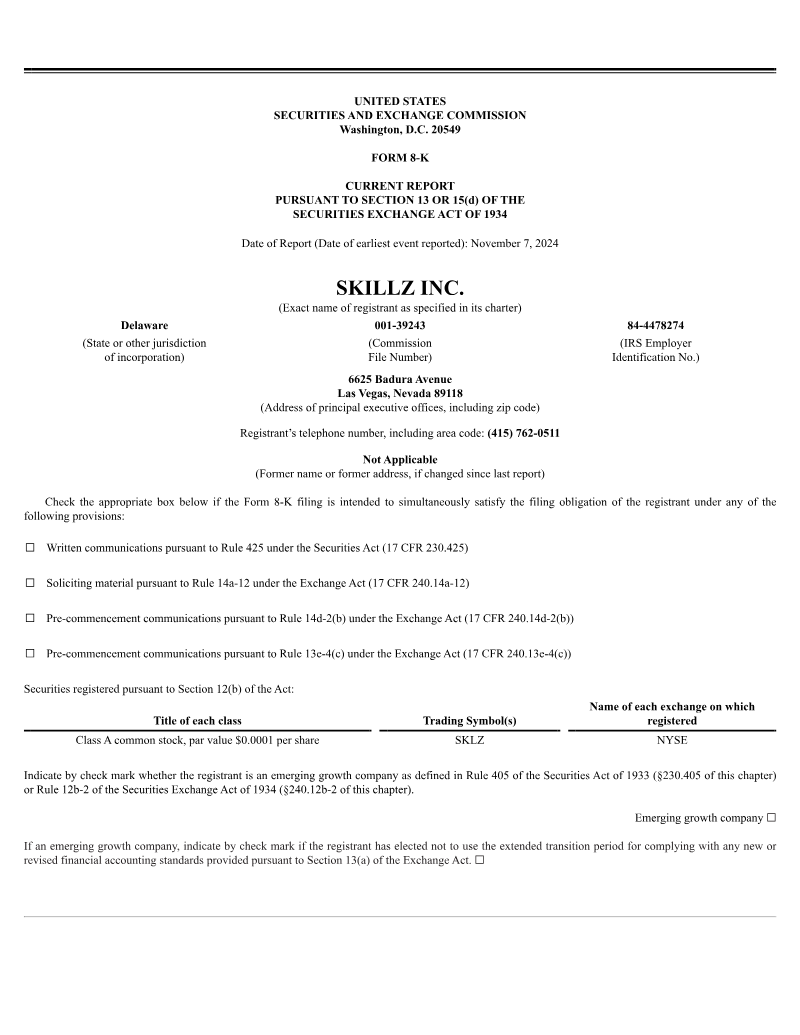
Skillz · 2024
Skillz · 2023
Skillz · 2022
Skillz · 2021

Modern Times Group · 2026

AppLovin · 2026

InvestGame · 2025

G5 Entertainment AB · 2024
Bandai Namco · 2021
King · 2021
Niko Partners · 2019

HPvX Partners
Playtika
Playtika Holding
Modern Times Group
Playtika Holding