1 free read left. Create a free account for unlimited reading + AI research.
Create free accountArticle Eludamos: Journal for Computer Game Culture
1 free read left. Create a free account for unlimited reading + AI research.
Create free accountArticleEludamos: Journal for Computer Game Culture
The article notes that 39 of the 100 highest-grossing mobile game publishers in 2023 were Chinese.
This article examines Chinese mobile "palace games," reskinned titles such as Game of Sultans (Mechanist Games), which reuse near-identical mechanics while replacing their settings with Middle Eastern, Ottoman, or other Oriental motifs for Western audiences. Its central argument is that these reskins both reproduce Orientalist tropes, including fetishized harem imagery and amalgamated historical stereotypes, and reflect the extractive labor and platform dependencies of a US-dominated global app economy. Drawing on critical theory from Said, Bhabha, and Dirlik, the author frames reskinning as a ternary West–Middle East–Far East relationship in which Orientalist fantasies are produced in China for Western consumption, while acknowledging that Chinese copycat and shanzhai practices can unsettle Western notions of originality.
The study draws on thirteen months of autoethnographic fieldwork as a localizer at a Guangzhou mobile game company, supplemented by industry data. Its evidence points to reskins as standardized, low-cost templates in which cosmetic changes sustain monetization, even when problematic representations are embedded in core mechanics and generate localization tensions. The article situates this practice against the backdrop of Chinese developers' prominence in the market, noting that 39 of the 100 highest-grossing mobile game publishers in 2023 were Chinese.
A significant portion of the analysis concerns platform power. Opaque App Store Optimization on Apple and Google stores pushes developers toward imitation, with interviewees explaining that icon designs follow current store "meta" and competitors' visuals. Apple's transparency data, which records 1,435 of 1,474 government-related app removals as involving China, further illustrates the constraints imposed by censorship and high commission fees. The author ultimately concludes that reskins are ambiguous: they reproduce Orientalist representations and labor inequities, yet they also destabilize information asymmetries within the global app economy.
Each row is a game or company this document names, each column a document, oldest first. A mark means that document names it. Select a row to see those documents.

Eludamos: Journal for Computer Game Culture · 2026

Eludamos: Journal for Computer Game Culture · 2026

Eludamos: Journal for Computer Game Culture · 2026

Eludamos: Journal for Computer Game Culture · 2026

Eludamos: Journal for Computer Game Culture · 2026

Eludamos: Journal for Computer Game Culture · 2026

Eludamos: Journal for Computer Game Culture · 2026

Eludamos: Journal for Computer Game Culture · 2025

Eludamos: Journal for Computer Game Culture · 2025

Eludamos: Journal for Computer Game Culture · 2025

Eludamos: Journal for Computer Game Culture · 2025

Eludamos: Journal for Computer Game Culture · 2025
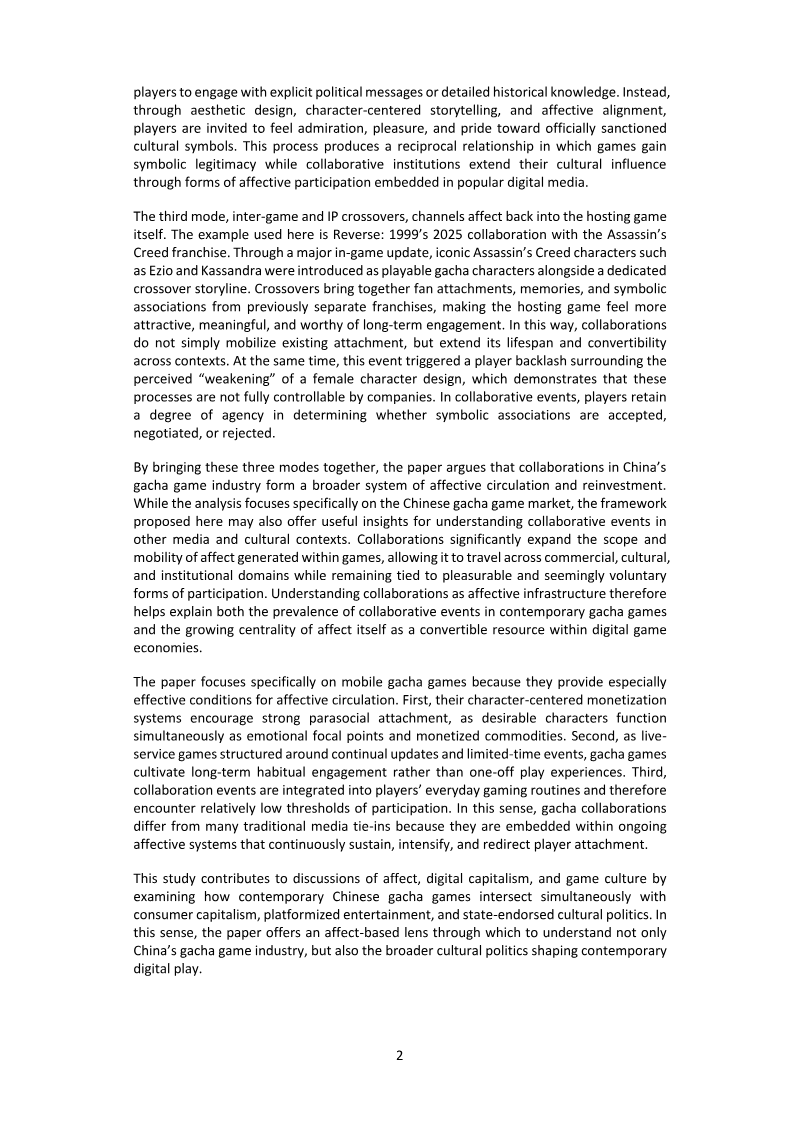

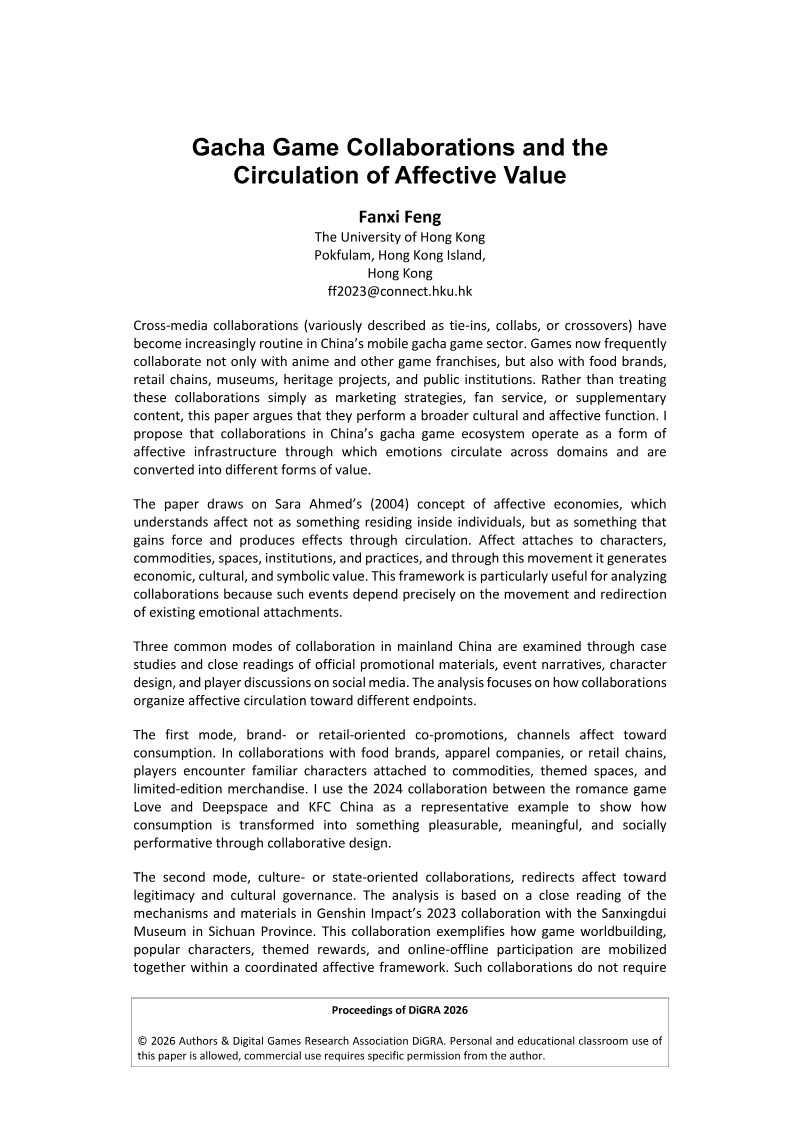
DiGRA · 2026