Updated Mar 17, 2026 by PCF Group
What can I help with?
AI-powered answers with citations from the library.
What can I help with?
AI-powered answers with citations from the library.
Legal · April 21, 2022
PCF Group S.A. demonstrates a governance strategy that balances standard public company transparency with the specific operational realities of a high-end AAA game development studio. While the firm adheres to the majority of the 2021 Best Practices for GPW Listed Companies, it intentionally diverges from several key recommendations regarding environmental, social, and governance (ESG) integration and board composition. Specifically, the company rejects formalized gender diversity quotas, such as the recommended thirty percent threshold for management and supervisory boards, opting instead for a merit-based recruitment model. Furthermore, it does not currently publish detailed ESG performance metrics, citing the relatively low environmental impact inherent to the digital entertainment industry. Operational governance reveals a reliance on lean internal structures, which results in certain compliance gaps. The company lacks dedicated departments for internal audit and risk management, preventing the Supervisory Board from providing formalized assessments of internal controls. While the firm maintains robust investor communication and independent oversight, it does not yet offer electronic participation in general meetings or provide preliminary financial estimates. These omissions are attributed to perceived technical and legal risks, though there is a stated intent to evaluate electronic meeting capabilities in the future. Recent adjustments indicate a move toward closer alignment with regulatory expectations. The company committed to implementing live broadcasts of general meetings and has updated its internal regulations to require supervisory review of all management board resolutions. Future incentive programs are expected to incorporate both financial and non-financial objectives, ensuring that executive compensation remains tied to long-term sustainability. Overall, the governance profile reflects a transition period for the developer as it matures within the public market while maintaining its focus on technical excellence and meritocracy over rigid administrative frameworks.
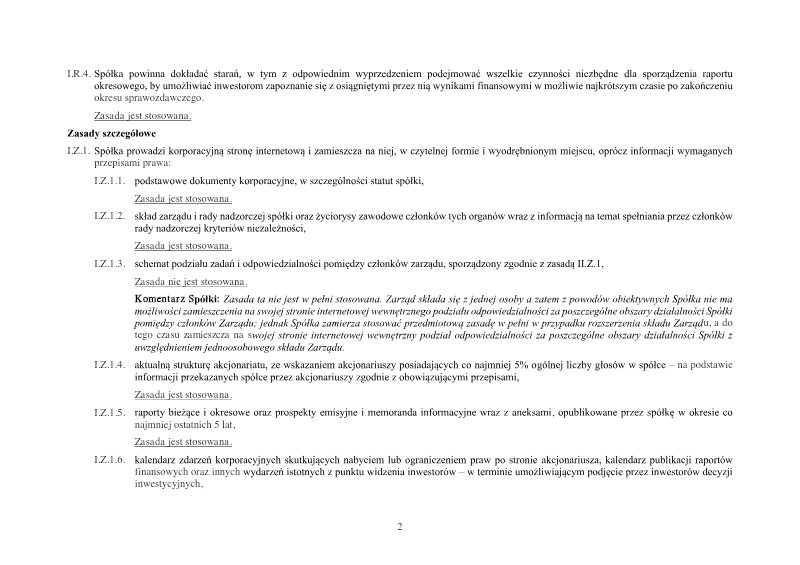
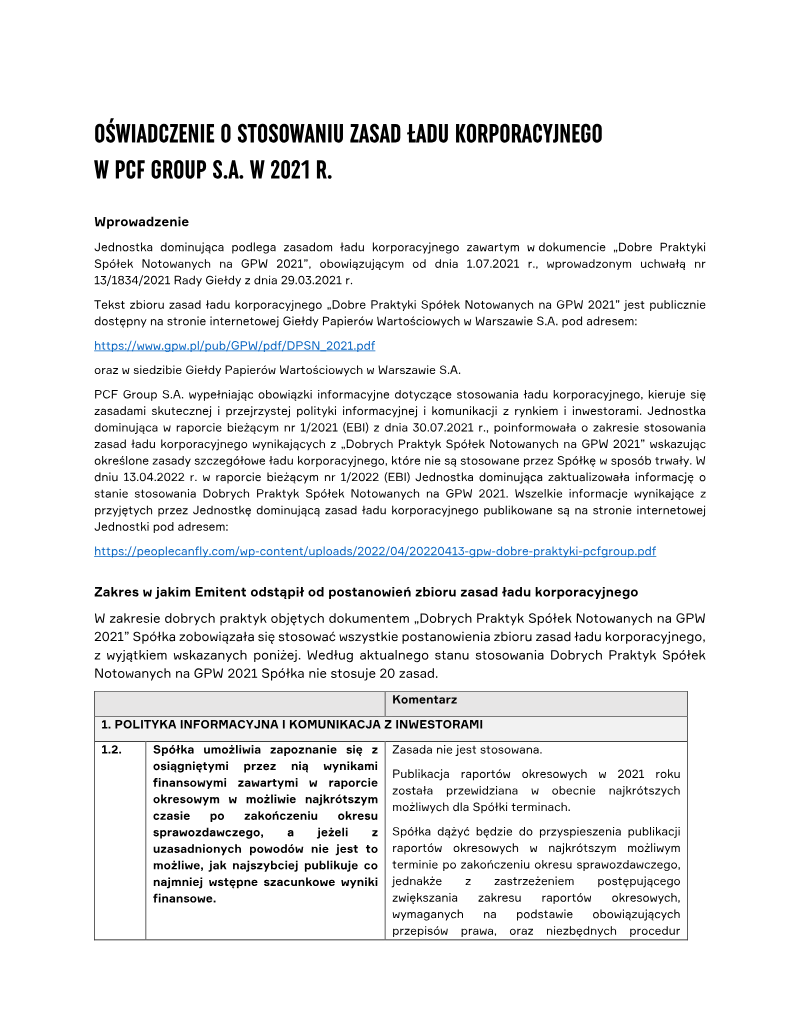
PCF GROUP SA (1/2022) PCF Group Spółka Akcyjna - informacja o stanie stosowania Dobrych Praktyk 2021 Raport Bieżący nr 1/2022 Na podstawie par. 29 ust. 3 Regulaminu Giełdy Papierów Wartościowych w Warszawie S.A. PCF Group Spółka Akcyjna przekazuje informację o stanie stosowania Dobrych Praktyk 2021 Zarząd spółki PCF Group S.A. z siedzibą w Warszawie ("Spółka") przekazuje informację o zmianie sposobu stosowania zasad 1.6. i 2.4. Dobrych Praktyk 2021 oraz o wystąpieniu okoliczności uzasadniających zmianę treści wyjaśnień dla zasad 4.7., 4.8. oraz 4.9.1. POLITYKA INFORMACYJNA I KOMUNIKACJA Z INWESTORAMI 1.1. Spółka prowadzi sprawną komunikację z uczestnikami rynku kapitałowego, rzetelnie informując o sprawach jej dotyczących. W tym celu spółka wykorzystuje różnorodne narzędzia i formy porozumiewania się, w tym przede wszystkim korporacyjną stronę internetową, na której zamieszcza wszelkie informacje istotne dla inwestorów. Zasada jest stosowana. 1.2. Spółka umożliwia zapoznanie się z osiągniętymi przez nią wynikami finansowymi zawartymi w raporcie okresowym w możliwie najkrótszym czasie po zakończeniu okresu sprawozdawczego, a jeżeli z uzasadnionych powodów nie jest to możliwe, jak najszybciej publikuje co najmniej wstępne szacunkowe wyniki finansowe. Spółka nie stosuje powyższej zasady. Publikacja raportów okresowych w 2021 roku została przewidziana w obecnie najkrótszych możliwych dla Spółki terminach.
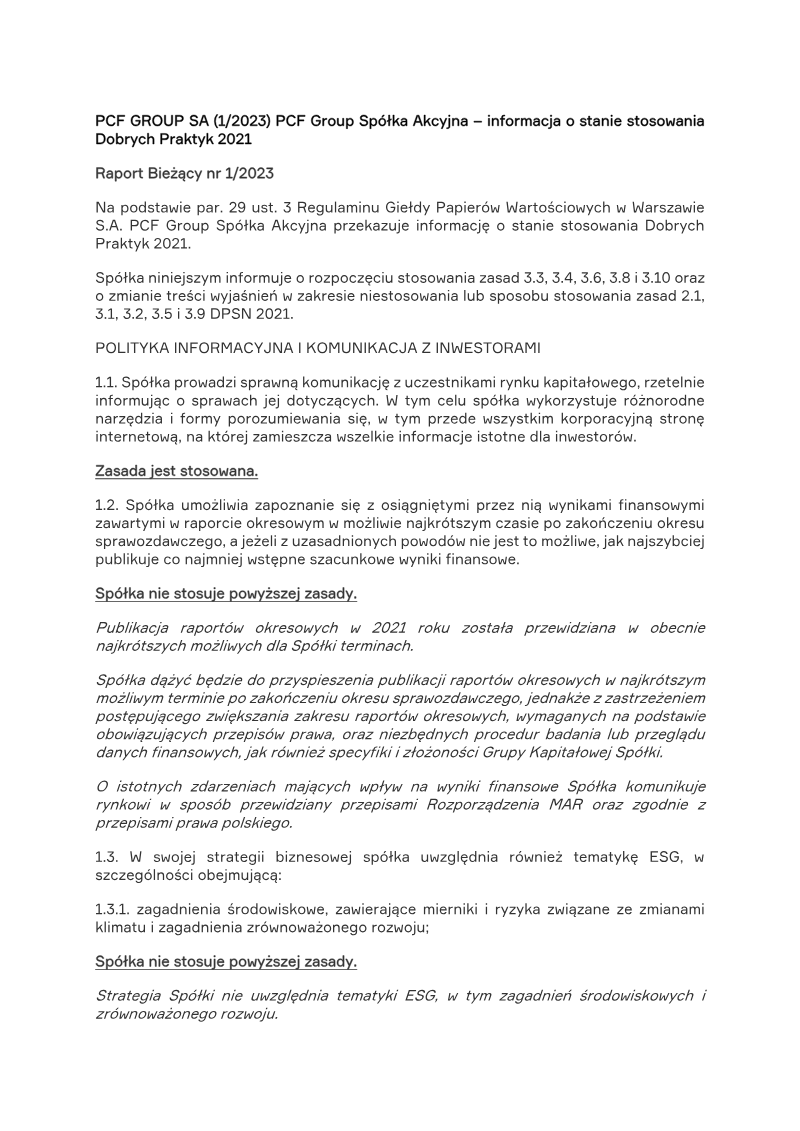
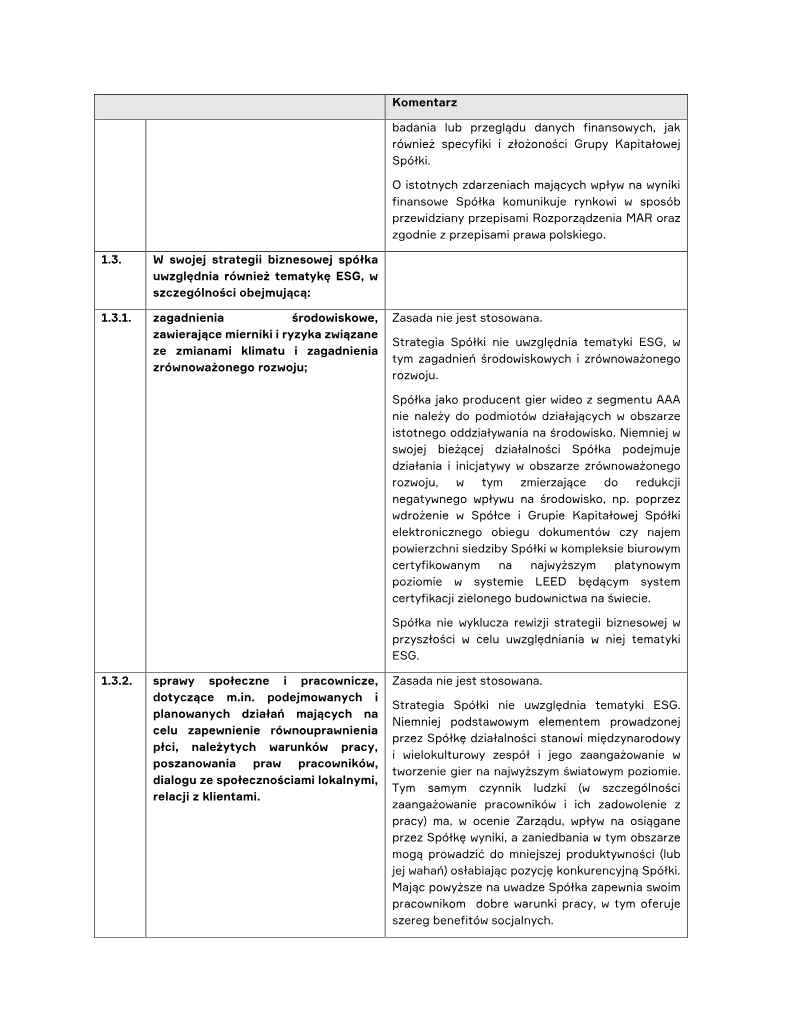
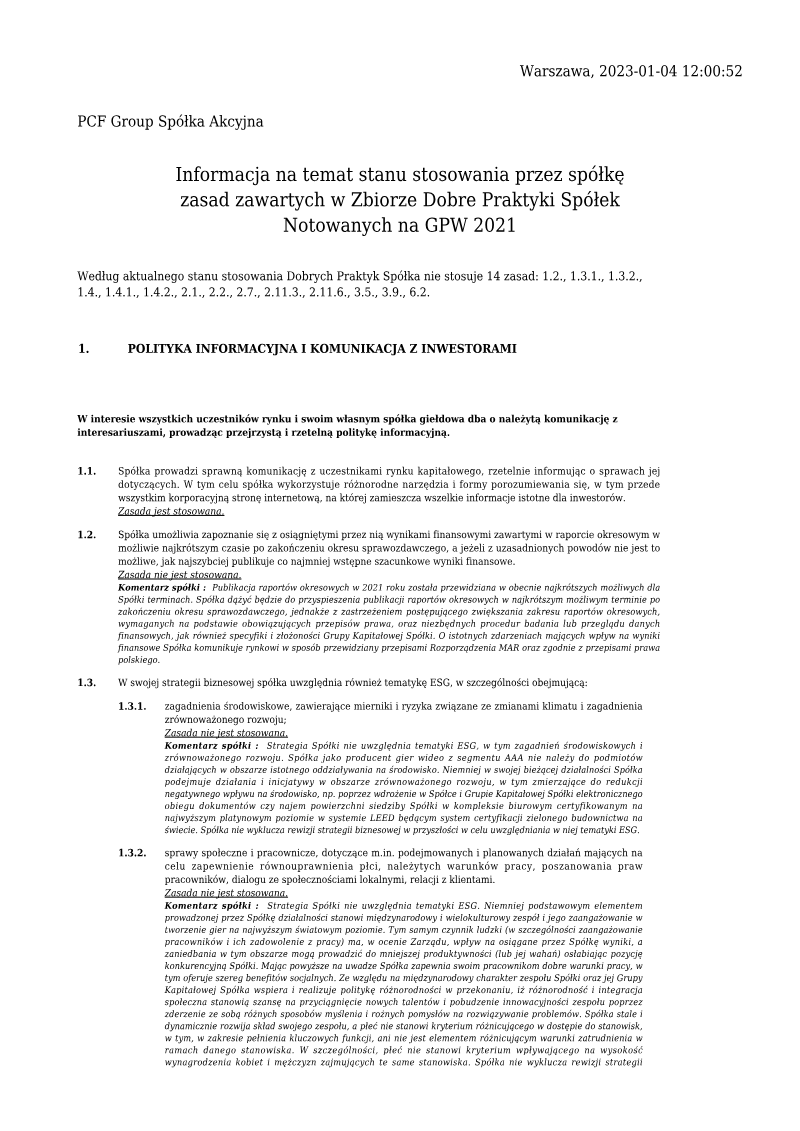
a jeżeli z uzasadnionych powodów nie jest to możliwe, jak najszybciej publikuje co najmniej wstępne szacunkowe wyniki finansowe. Spółka nie stosuje powyższej zasady. Publikacja raportów okresowych w 2021 roku została przewidziana w obecnie najkrótszych możliwych dla Spółki terminach. Spółka dążyć będzie do przyspieszenia publikacji raportów okresowych w najkrótszym możliwym terminie po zakończeniu okresu sprawozdawczego, jednakże z zastrzeżeniem postępującego zwiększania zakresu raportów okresowych, wymaganych na podstawie obowiązujących przepisów prawa, oraz niezbędnych procedur badania lub przeglądu danych finansowych, jak również specyfiki i złożoności Grupy Kapitałowej Spółki. O istotnych zdarzeniach mających wpływ na wyniki finansowe Spółka komunikuje rynkowi w sposób przewidziany przepisami Rozporządzenia MAR oraz zgodnie z przepisami prawa polskiego. 1.3. W swojej strategii biznesowej spółka uwzględnia również tematykę ESG, w szczególności obejmującą: 1.3.1. zagadnienia środowiskowe, zawierające mierniki i ryzyka związane ze zmianami klimatu i zagadnienia zrównoważonego rozwoju; Spółka nie stosuje powyższej zasady. Strategia Spółki nie uwzględnia tematyki ESG, w tym zagadnień środowiskowych i zrównoważonego rozwoju.
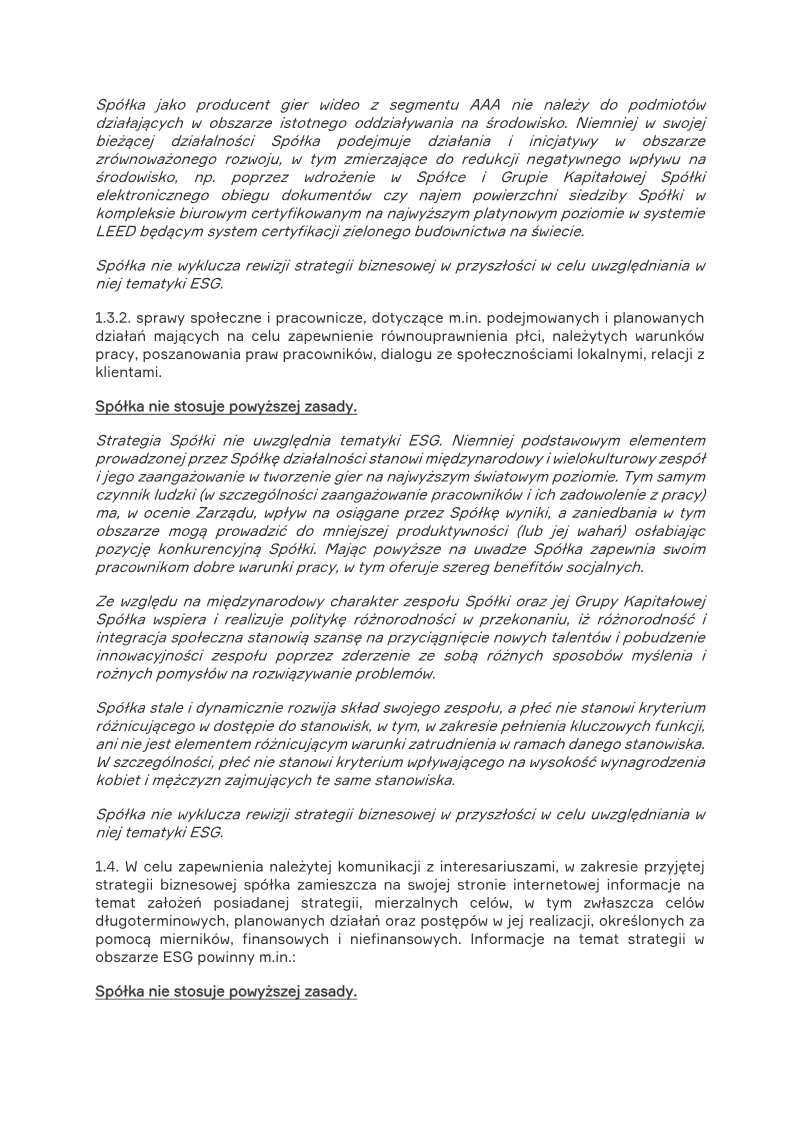
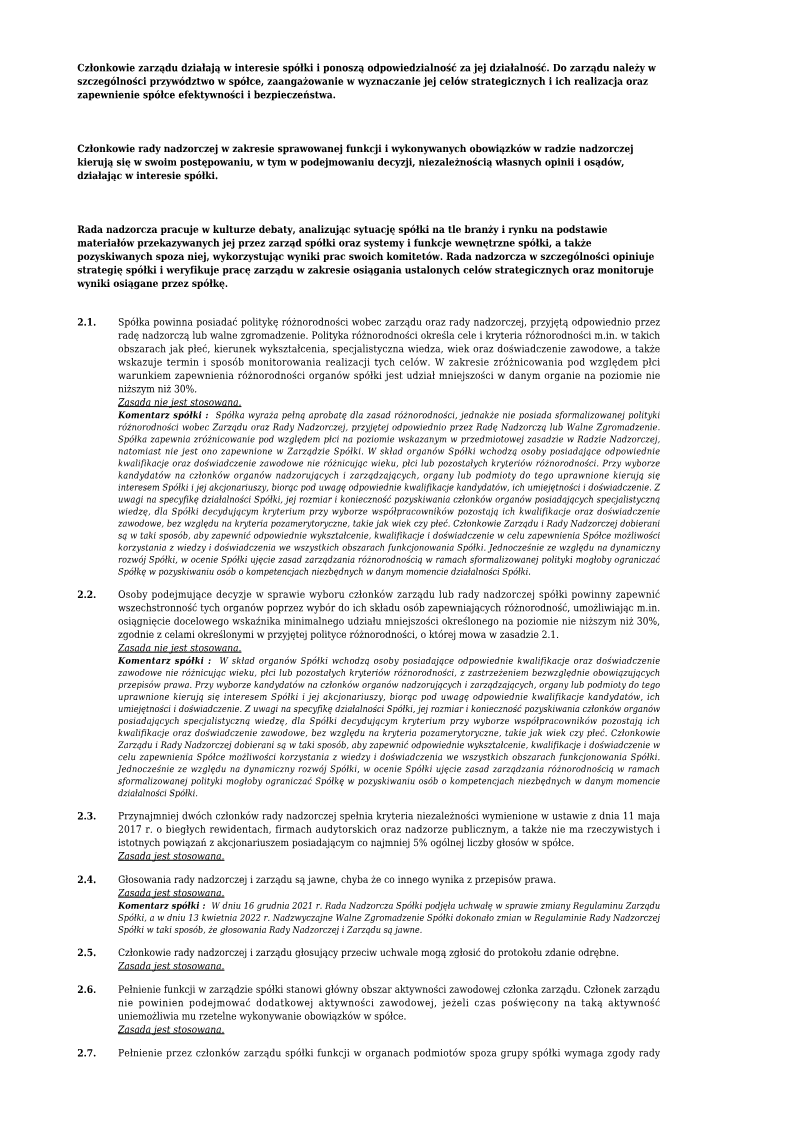
Spółka jako producent gier wideo z segmentu AAA nie należy do podmiotów działających w obszarze istotnego oddziaływania na środowisko. Niemniej w swojej bieżącej działalności Spółka podejmuje działania i inicjatywy w obszarze zrównoważonego rozwoju, w tym zmierzające do redukcji negatywnego wpływu na środowisko, np. poprzez wdrożenie w Spółce i Grupie Kapitałowej Spółki elektronicznego obiegu dokumentów czy najem powierzchni siedziby Spółki w kompleksie biurowym certyfikowanym na najwyższym platynowym poziomie w systemie LEED będącym system certyfikacji zielonego budownictwa na świecie. Spółka nie wyklucza rewizji strategii biznesowej w przyszłości w celu uwzględniania w niej tematyki ESG. 1.3.2. sprawy społeczne i pracownicze, dotyczące m.in. podejmowanych i planowanych działań mających na celu zapewnienie równouprawnienia płci, należytych warunków pracy, poszanowania praw pracowników, dialogu ze społecznościami lokalnymi, relacji z klientami. Spółka nie stosuje powyższej zasady. Strategia Spółki nie uwzględnia tematyki ESG. Niemniej podstawowym elementem prowadzonej przez Spółkę działalności stanowi międzynarodowy i wielokulturowy zespół i jego zaangażowanie w tworzenie gier na najwyższym światowym poziomie. Tym samym czynnik ludzki (w szczególności zaangażowanie pracowników i ich zadowolenie z pracy) ma, w ocenie Zarządu, wpływ na osiągane przez Spółkę wyniki, a zaniedbania w tym obszarze mogą prowadzić do mniejszej produktywności (lub jej wahań) osłabiając pozycję konkurencyjną Spółki. Mając powyższe na uwadze Spółka zapewnia swoim pracownikom dobre warunki pracy, w tym oferuje szereg benefitów socjalnych.
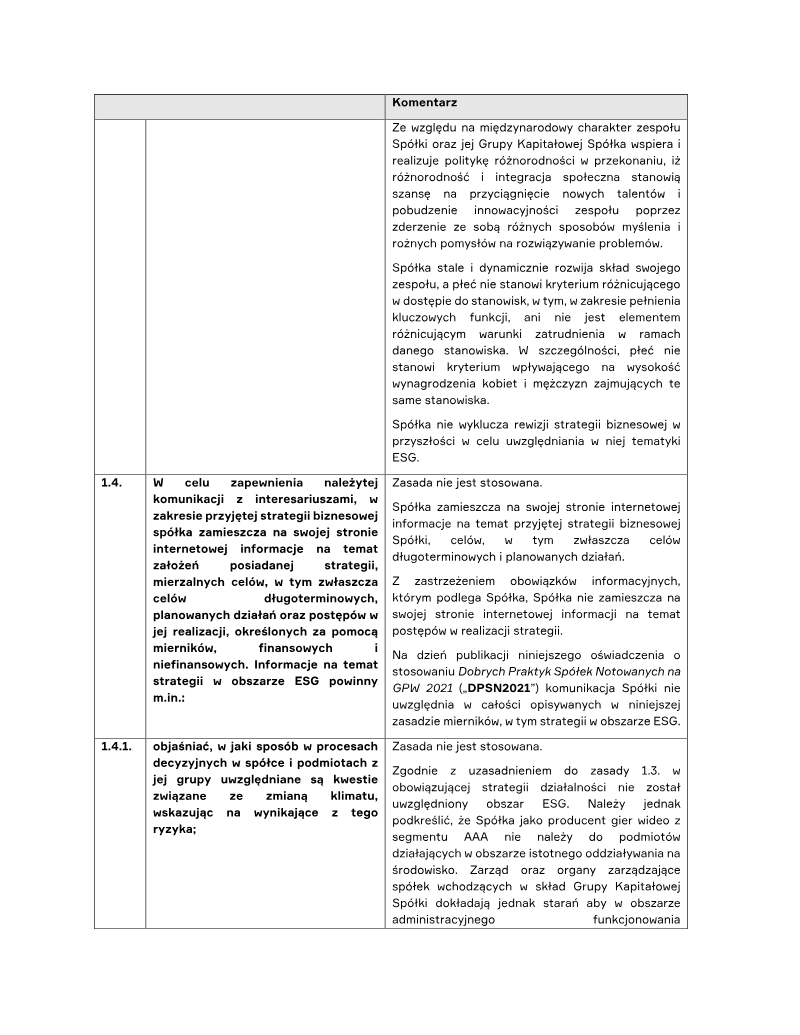
wpływ na osiągane przez Spółkę wyniki, a zaniedbania w tym obszarze mogą prowadzić do mniejszej produktywności (lub jej wahań) osłabiając pozycję konkurencyjną Spółki. Mając powyższe na uwadze Spółka zapewnia swoim pracownikom dobre warunki pracy, w tym oferuje szereg benefitów socjalnych. Ze względu na międzynarodowy charakter zespołu Spółki oraz jej Grupy Kapitałowej Spółka wspiera i realizuje politykę różnorodności w przekonaniu, iż różnorodność i integracja społeczna stanowią szansę na przyciągnięcie nowych talentów i pobudzenie innowacyjności zespołu poprzez zderzenie ze sobą różnych sposobów myślenia i rożnych pomysłów na rozwiązywanie problemów. Spółka stale i dynamicznie rozwija skład swojego zespołu, a płeć nie stanowi kryterium różnicującego w dostępie do stanowisk, w tym, w zakresie pełnienia kluczowych funkcji, ani nie jest elementem różnicującym warunki zatrudnienia w ramach danego stanowiska. W szczególności, płeć nie stanowi kryterium wpływającego na wysokość wynagrodzenia kobiet i mężczyzn zajmujących te same stanowiska. Spółka nie wyklucza rewizji strategii biznesowej w przyszłości w celu uwzględniania w niej tematyki ESG. 1.4. W celu zapewnienia należytej komunikacji z interesariuszami, w zakresie przyjętej strategii biznesowej spółka zamieszcza na swojej stronie internetowej informacje na temat założeń posiadanej strategii, mierzalnych celów, w tym zwłaszcza celów długoterminowych, planowanych działań oraz postępów w jej realizacji, określonych za pomocą mierników, finansowych i niefinansowych. Informacje na temat strategii w obszarze ESG powinny m.in.:
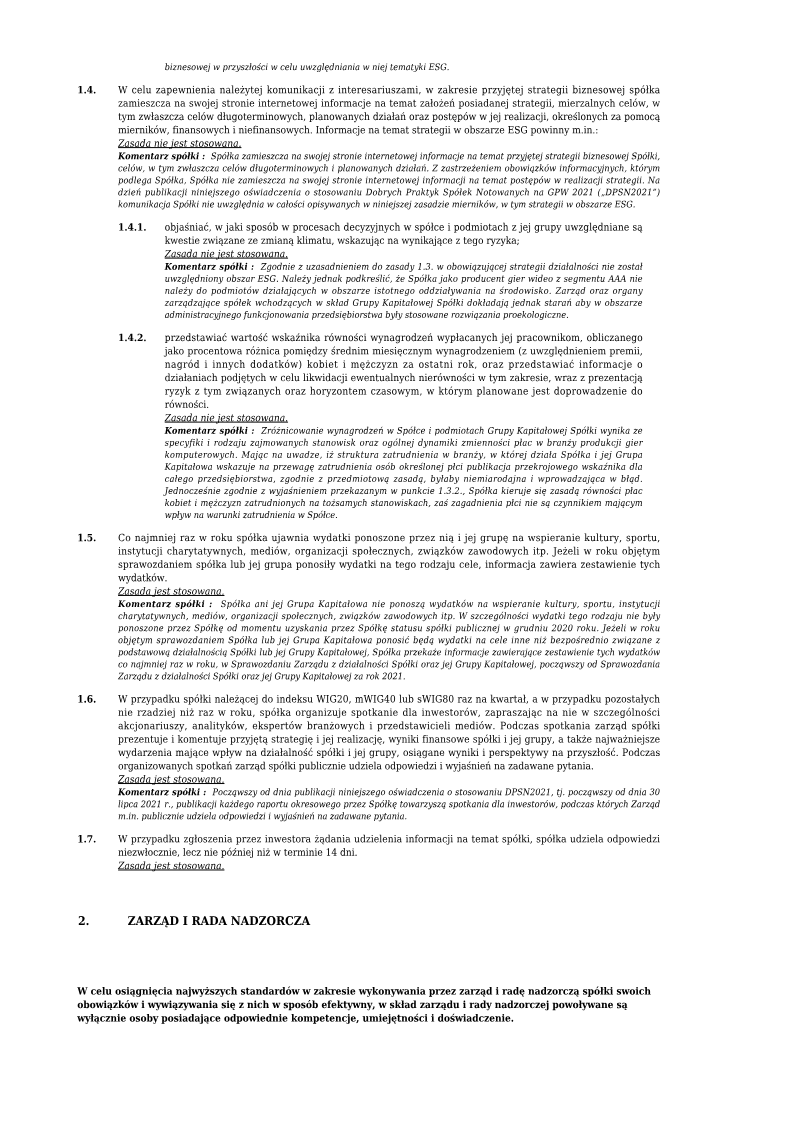
netowej informacje na temat założeń posiadanej strategii, mierzalnych celów, w tym zwłaszcza celów długoterminowych, planowanych działań oraz postępów w jej realizacji, określonych za pomocą mierników, finansowych i niefinansowych. Informacje na temat strategii w obszarze ESG powinny m.in.: Spółka nie stosuje powyższej zasady.
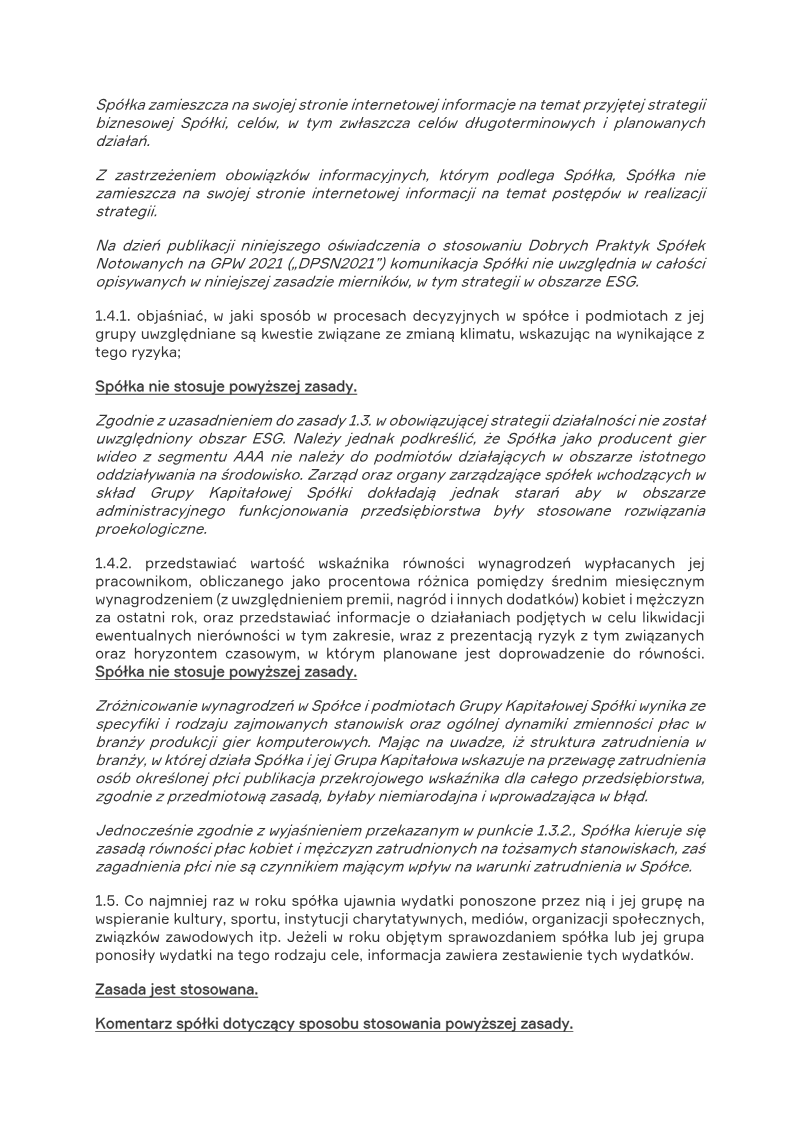
Spółka zamieszcza na swojej stronie internetowej informacje na temat przyjętej strategii biznesowej Spółki, celów, w tym zwłaszcza celów długoterminowych i planowanych działań. Z zastrzeżeniem obowiązków informacyjnych, którym podlega Spółka, Spółka nie zamieszcza na swojej stronie internetowej informacji na temat postępów w realizacji strategii. Na dzień publikacji niniejszego oświadczenia o stosowaniu Dobrych Praktyk Spółek Notowanych na GPW 2021 („DPSN2021”) komunikacja Spółki nie uwzględnia w całości opisywanych w niniejszej zasadzie mierników, w tym strategii w obszarze ESG. 1.4.1. objaśniać, w jaki sposób w procesach decyzyjnych w spółce i podmiotach z jej grupy uwzględniane są kwestie związane ze zmianą klimatu, wskazując na wynikające z tego ryzyka; Spółka nie stosuje powyższej zasady. Zgodnie z uzasadnieniem do zasady 1.3. w obowiązującej strategii działalności nie został uwzględniony obszar ESG. Należy jednak podkreślić, że Spółka jako producent gier wideo z segmentu AAA nie należy do podmiotów działających w obszarze istotnego oddziaływania na środowisko. Zarząd oraz organy zarządzające spółek wchodzących w skład Grupy Kapitałowej Spółki dokładają jednak starań aby w obszarze administracyjnego funkcjonowania przedsiębiorstwa były stosowane rozwiązania proekologiczne.
PCF Group S.A., operating as People Can Fly, maintains a high level of transparency and shareholder engagement while navigating the transition toward full compliance with the Best Practice for GPW Listed Companies 2021. As of early 2023, the AAA game developer adheres to the majority of governance standards regarding board independence, internal systems, and shareholder relations. The company facilitates electronic participation in general meetings and provides bilingual broadcasts to ensure accessibility for its investor base. While it recently established an internal audit function and committed to a five-year external audit cycle, certain gaps remain in formalized risk and compliance departments, which the company intends to address in future reporting cycles. The primary areas of non-compliance center on formalized ESG strategies and diversity policies. The company currently excludes environmental and social issues from its formal business strategy, arguing that its operations as a software developer have a relatively low environmental impact. Furthermore, the company has opted not to implement a structured diversity policy for its Management or Supervisory Boards, preferring to maintain flexibility in recruitment by prioritizing specialized professional qualifications over specific gender or age metrics. Despite the absence of a formal policy, the company emphasizes a commitment to gender pay equality and merit-based advancement. Regarding executive compensation and related-party transactions, the company follows established standards for transparency and oversight. Remuneration for the Supervisory Board remains independent of short-term financial results, and procedures are in place for external valuations of significant transactions. Although the company’s statutes do not currently require General Meeting approval for all related-party transactions, it maintains rigorous internal oversight through the Supervisory Board. These governance practices reflect a balance between meeting the regulatory expectations of the Warsaw Stock Exchange and maintaining the operational agility required in the competitive global gaming industry.
PCF Group SA maintains a selective approach to the 2021 corporate governance standards for companies listed on the Warsaw Stock Exchange, balancing regulatory expectations with the specific operational needs of a global AAA game developer. The governance framework emphasizes transparent investor communication, independent oversight, and shareholder accessibility. Notable implementations include the appointment of an internal auditor to oversee risk and compliance systems, the facilitation of electronic participation in general meetings, and the provision of real-time bilingual broadcasts for shareholders. While the company encourages dividend payments, such distributions remain contingent upon financial stability and the strategic necessity of reinvesting capital into development projects. Strategic deviations from established best practices are primarily driven by the company’s assessment of its industry-specific impact and organizational size. Management has opted not to integrate formal ESG targets into its business strategy, asserting that game development carries a low environmental footprint. Furthermore, the company rejects formalized diversity quotas for its Board and Management, prioritizing specialized professional qualifications and technical expertise over demographic metrics. This philosophy extends to the decision not to publish a gender pay gap index, which the company argues would provide a misleading representation of its specialized employment structure. Operational oversight remains centralized, with the company foregoing separate departments for risk management and compliance in favor of integrated internal controls. While the company lacks a formalized long-term incentive program, it maintains a commitment to aligning future compensation structures with sustainable value growth. These governance choices reflect a prioritization of professional meritocracy and operational flexibility over the adoption of standardized administrative frameworks, ensuring that corporate policies remain aligned with the specific demands of the high-budget software development sector.
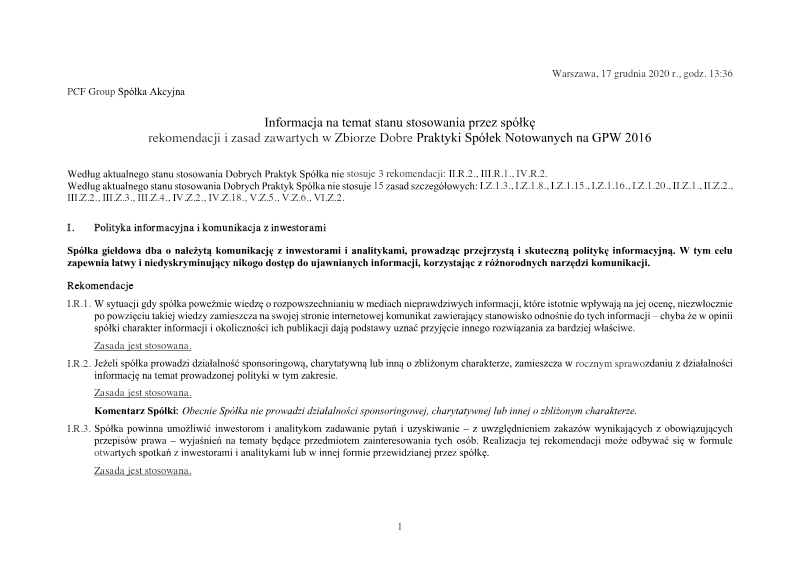
PCF Group S.A. maintains a framework of corporate governance that aligns with the majority of the Best Practice of GPW Listed Companies 2016, though it maintains several strategic deviations rooted in its organizational structure and recent transition to public markets. As of late 2020, the company’s governance model is characterized by a single-member Management Board, which precludes a formal division of responsibilities and centralizes risk management, compliance, and internal audit functions. Rather than establishing dedicated internal units for these oversight roles, the company relies on the direct supervision of the Management Board and the Audit Committee to ensure operational integrity. A significant area of non-compliance involves the absence of a formalized diversity policy. The company prioritizes merit-based recruitment and professional qualifications over specific gender or age targets for its governing bodies. Furthermore, technical and historical limitations impact transparency; the company does not provide real-time public broadcasts of General Meetings or a five-year historical financial data set in a processable format, citing its recent adoption of International Financial Reporting Standards as the primary cause for the latter. Regarding shareholder rights and executive compensation, the company adheres to statutory guidelines but bypasses certain optional recommendations. Notable exceptions include a share nominal value of 0.02 PLN, which is significantly lower than the recommended 0.50 PLN, and the lack of a dedicated compensation committee. While a formal remuneration policy is in place, stock-based incentives currently lack a minimum two-year vesting period. Despite these omissions, the company maintains standard protocols for managing conflicts of interest and ensures that significant related-party transactions follow established legal requirements, even in the absence of specific internal bylaws requiring additional Supervisory Board approval.
PCF Group S.A. navigated its first full year as a listed entity in 2021 by balancing the "Best Practice for GPW Listed Companies 2021" with the operational demands of a rapidly expanding AAA video game developer. While the organization committed to these governance standards, it formally opted out of twenty specific principles, primarily regarding ESG integration, formalized diversity policies, and internal audit structures. Management justifies these deviations by prioritizing professional qualifications over demographic quotas and citing the specialized nature of the gaming industry, though it maintains high workplace standards through LEED-certified facilities and informal risk management systems. The governance framework is characterized by significant concentrated control held by a "Group of Authorized Shareholders" led by Sebastian Wojciechowski. This group retains 70.65% of voting rights and possesses personal rights to appoint a majority of the Supervisory Board, provided they maintain a 40% ownership threshold. Furthermore, Wojciechowski holds the personal right to appoint the President of the Management Board, a body he led as a single-person entity throughout 2021. While no formal restrictions on voting rights exist, a substantial portion of Series A shares remains subject to four-year lock-up agreements following the 2020 initial public offering. Financial oversight and transparency are managed through a five-member Supervisory Board and an Audit Committee featuring independent experts in finance and gaming. Although the company lacked a dedicated internal audit department in 2021, the Management Board maintained financial reporting risk systems that received no negative feedback from external auditor Grant Thornton. The organization is currently transitioning toward higher transparency standards, with plans to implement real-time streaming of general meetings and more formalized internal reporting to align with evolving regulatory expectations for public companies in Poland.