Updated Mar 23, 2026 by McDonald's Corporation
Report
Published by McDonald's Corporation
McDonald’s Corporation’s first-quarter 2025 financial results reveal a period of modest contraction, characterized by a 1.0% decline in global comparable sales. When adjusted for the impact of Leap Day in the prior-year period, global performance remained essentially flat. The company reported consolidated revenues of $5.96 billion, a 3% decrease compared to the same quarter in 2024. Diluted earnings per share fell to $2.60, representing a 2% decline, though non-GAAP figures excluding restructuring charges indicate a more stable underlying performance. Regional performance varied significantly across the company’s global footprint. The U.S. market experienced a 3.6% decrease in comparable sales, primarily driven by lower guest counts. International Operated Markets saw a 1.0% decline, influenced by mixed results and weakness in the United Kingdom. Conversely, International Developmental Licensed Markets posted a 3.5% increase, bolstered by strong performance in the Middle East and Japan. Despite these regional fluctuations, the company maintained significant engagement through its digital ecosystem, recording approximately 8 billion in systemwide sales to loyalty members during the quarter across 60 markets. Operating income for the quarter reached $2.65 billion, a 3% decrease that reflects ongoing restructuring costs associated with the company’s internal modernization efforts. These results were influenced by lower margins in both franchised and company-owned operations. Management continues to emphasize the brand’s 70-year history of agility and value-driven menu innovation as a strategy to navigate current consumer uncertainty and capture market share. The reported data covers the three-month period ending March 31, 2025, and relies on standard GAAP financial reporting alongside constant currency adjustments to isolate underlying business trends from foreign exchange volatility.
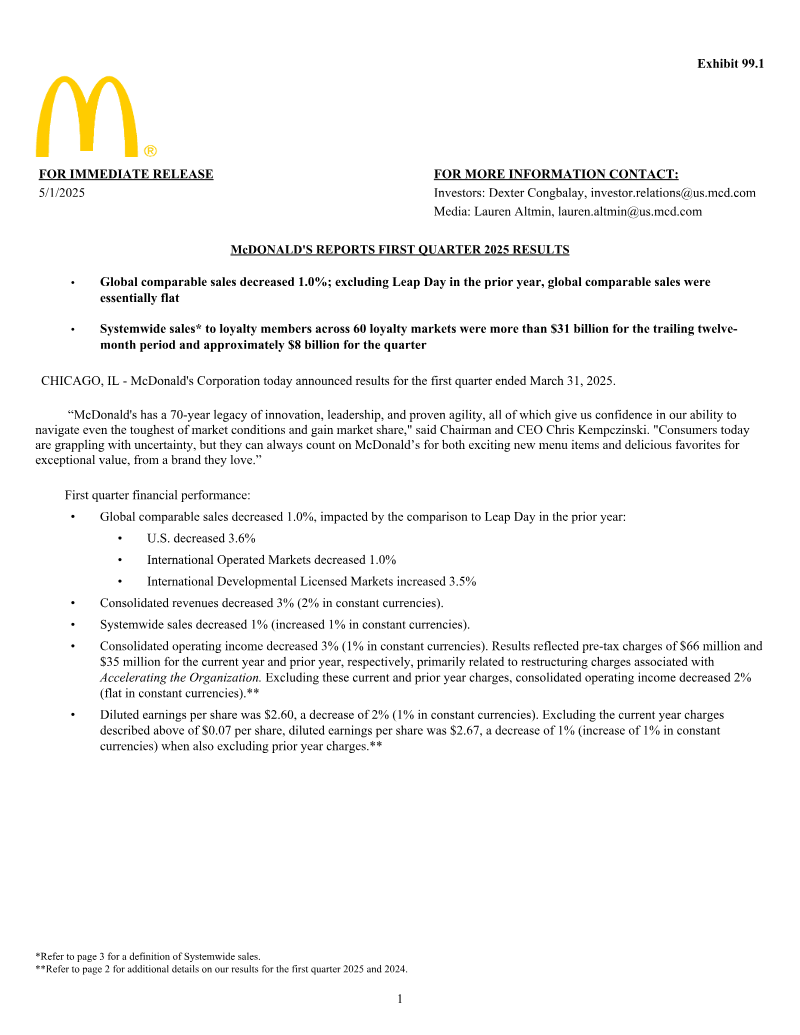
Exhibit 99.1 R FOR IMMEDIATE FOR IMMEDIATE RELEASE FOR MORE INFORMATION CONTACT: 5/1/2025 Investors: Dexter Congbalay, [email protected] Media: Lauren Altmin, [email protected] McDONALD'S REPORTS FIRST QUARTER 2025 RESULTS • Global comparable sales decreased 1.0%; excluding Leap Day in the prior year, global comparable sales were essentially flat • Systemwide sales* to loyalty members across 60 loyalty markets were more than 31 billion for the trailing twelvemonth period and approximately 8 billion for the quarter CHICAGO, IL - McDonald's Corporation today announced results for the first quarter ended March 31, 2025. “McDonald's has a 70-year legacy of innovation, leadership, and proven agility, all of which give us confidence in our ability to navigate even the toughest of market conditions and gain market share," said Chairman and CEO Chris Kempczinski. "Consumers today are grappling with uncertainty, but they can always count on McDonald’s for both exciting new menu items and delicious favorites for exceptional value, from a brand they love.”
even the toughest of market conditions and gain market share," said Chairman and CEO Chris Kempczinski. "Consumers today are grappling with uncertainty, but they can always count on McDonald’s for both exciting new menu items and delicious favorites for exceptional value, from a brand they love.” First quarter financial performance: • Global comparable sales decreased 1.0%, impacted by the comparison to Leap Day in the prior year: • U.S. decreased 3.6% • International Operated Markets decreased 1.0% • International Developmental Licensed Markets increased 3.5% • Consolidated revenues decreased 3% (2% in constant currencies). • Systemwide sales decreased 1% (increased 1% in constant currencies). • Consolidated operating income decreased 3% (1% in constant currencies). Results reflected pre-tax charges of $66 million and $35 million for the current year and prior year, respectively, primarily related to restructuring charges associated with Accelerating the Organization. Excluding these current and prior year charges, consolidated operating income decreased 2% (flat in constant currencies).** • Diluted earnings per share was $2.60, a decrease of 2% (1% in constant currencies). Excluding the current year charges described above of 0.07 per share, diluted earnings per share was 2.67, a decrease of 1% (increase of 1% in constant currencies) when also excluding prior year charges.**
es).** • Diluted earnings per share was $2.60, a decrease of 2% (1% in constant currencies). Excluding the current year charges described above of 0.07 per share, diluted earnings per share was 2.67, a decrease of 1% (increase of 1% in constant currencies) when also excluding prior year charges.** *Refer to page 3 for a definition of Systemwide sales. **Refer to page 2 for additional details on our results for the first quarter 2025 and 2024.
COMPARABLE SALES Increase/(Decrease) Quarters Ended March 31, 2025 2024 U.S. (3.6)% 2.5 % International Operated Markets (1.0) 2.7 International Developmental Licensed Markets 3.5 (0.2) Total Company (1.0)% 1.9 % • Comparable Sales: All segments were impacted by the comparison to Leap Day in the prior year. • U.S.: Comparable sales results were primarily driven by negative comparable guest counts. • International Operated Markets: Comparable sales reflected mixed results across the markets, primarily impacted by negative comparable sales in the U.K. • International Developmental Licensed Markets: Positive comparable sales were primarily driven by the Middle East and Japan. KEY FINANCIAL METRICS - CONSOLIDATED Dollars in millions, except per share data Quarters Ended March 31, Inc/ (Dec) Excluding 2025 2024 Inc/ (Dec) Currency Translation Revenues 5,956 6,169 (3) % (2) % Operating income 2,648 2,736 (3) (1) Net income 1,868 1,929 (3) (2) Earnings per share-diluted 2.60 2.66 (2) % (1) % Results included pre-tax charges of 66 million, or 0.07 per share, for the three months ended March 31, 2025 and $35 million, or $0.04 per share, for the three months ended March 31, 2024, primarily related to restructuring charges associated with the Company's internal effort to modernize ways of working (Accelerating the Organization). Excluding the above items, operating income performance was primarily driven by lower Franchised and Company-owned and operated margins. NET INCOME AND EARNINGS PER SHARE-DILUTED RECONCILIATION Dollars in millions, except per share data
o modernize ways of working (Accelerating the Organization). Excluding the above items, operating income performance was primarily driven by lower Franchised and Company-owned and operated margins. NET INCOME AND EARNINGS PER SHARE-DILUTED RECONCILIATION Dollars in millions, except per share data Quarters Ended March 31, Net Income Earnings per share - diluted Inc/ (Dec) Inc/ (Dec) Inc/ Excluding Excluding 2025 2024 (Dec) Currency Inc/ Currency Translation 2025 2024 (Dec) Translation GAAP 1,868 1,929 (3) % (2) % 2.60 2.66 (2) % (1) % (Gains)/Charges 51 27 0.07 0.04 Non-GAAP 1,919 1,957 (2) % — % 2.67 2.70 (1) % 1 %
THE FOLLOWING DEFINITIONS APPLY TO THESE TERMS AS USED THROUGHOUT THIS RELEASE Constant currency results exclude the effects of foreign currency translation and are calculated by translating current year results at prior year average exchange rates. Management reviews and analyzes business results excluding the effect of foreign currency translation, impairment and other charges and gains, as well as material regulatory and other income tax impacts, and bases incentive compensation plans on these results because the Company believes this better represents underlying business trends. Comparable sales and comparable guest counts are compared to the same period in the prior year and represent sales and transactions, respectively, at all restaurants, whether owned and operated by the Company or by franchisees, in operation at least thirteen months including those temporarily closed. Some of the reasons restaurants may be temporarily closed include reimaging or remodeling, rebuilding, road construction, natural disasters, pandemics and acts of war, terrorism or other hostilities. Comparable sales exclude the impact of currency translation and the sales of any market considered hyperinflationary (generally identified as those markets whose cumulative inflation rate over a three-year period exceeds 100%), which management believes more accurately reflects the underlying business trends. Comparable sales are driven by changes in guest counts and average check, the latter of which is affected by changes in pricing and product mix. Systemwide sales include sales at all restaurants, whether owned and operated by the Company or by franchisees.
The 2026 State of Gaming analysis demonstrates a shifting landscape in which mobile gaming remains the largest driver of downloads—approximately 50 billion in 2025—but its growth rate is slowing. Revenue, however, continues to climb as monetization models mature and lifetime value deepens, especially within hybrid‑casual titles that now generate the most incremental income. In contrast, PC and console platforms experience record revenue growth, with Steam’s premium segment up 32 % and blockbuster releases such as Battlefield 6 capturing significant market share from incumbents. Shooter downloads on these platforms have plateaued, suggesting new titles are primarily cannibalizing existing audiences rather than expanding the category. Genre‑specific dynamics reveal that strategy games are the only mobile genre to grow in downloads, driven by 4X titles from Eastern developers. Action and shooter games dominate PC/console gains, while hyper‑casual remains the largest download engine but shows a notable lift in time spent, particularly in Tier 2 markets. Casual titles face declining day‑7 retention, indicating a stickiness challenge that could erode long‑term player value. Live‑ops and acquisition strategies have evolved toward retention‑focused events, multi‑tier season passes, and expedition‑style rewards. These mechanisms now represent the most reliable revenue drivers across competitive genres such as RPG, action, and simulation. Advertising spend remains concentrated on social channels—YouTube, Facebook/Instagram—and high‑attention formats like video, playable, and rewarded ads. Battlefield 6’s pre‑launch spend surpassed Call of Duty titles, leveraging Facebook, Reddit, and desktop display, while its post‑launch strategy pivoted to YouTube with cinematic, celebrity‑hook creatives. Geographically, the U.S. market shows a skew toward lifestyle and puzzle categories despite lower IAP shares, whereas casino titles exhibit higher spend‑to‑revenue efficiency. Overall, the industry is moving from acquisition toward deeper monetization per user, with indie shooters and simulation titles gaining traction amid intense competition in the shooter segment.
1. Market trajectory What direction is the PC and console market heading in 2026? 8 What direction is the PC and console market heading in 2026? 2. Attention & value allocation Where do players spend time and money on PC and console? 17 3. Market concentration What happens if you are not a top-20 game? 45 4.
The interim filing presents the fourth‑quarter 2025 financial results for a midcore‑casual gaming group, emphasizing a record‑setting revenue run and the successful execution of a transformation agenda that includes the integration of the Plarium acquisition and the rollout of a new district structure in early 2026. Revenue reached SEK 3,123 million, reflecting 108 % organic growth year‑on‑year and a 25 % increase on a constant‑currency basis, while adjusted EBITDA rose to SEK 717 million, delivering a 23 % margin that matches the full‑year figure. Unlevered free cash flow amounted to SEK 878 million, with a cash‑conversion rate of 66 % and a leverage ratio of five times EBITDA, underscoring robust liquidity and disciplined capital management. User‑acquisition spending accelerated, representing 38 % of quarterly revenue—up from 37 % in the prior quarter—and grew 76 % on a reported basis, driven by heightened investment in original studios, new casual titles, and the racing franchise. The direct‑to‑consumer channel expanded by 600 basis points to 32 % of total revenue, reflecting a strategic shift toward higher‑margin in‑app purchases. Across the fiscal year, the company posted a 9 % organic revenue increase, with word‑games, racing, and RAID franchises delivering the strongest quarter‑end performance. Operating cash flow for the quarter stood at SEK 840 million, while adjusted net income was SEK 1,390 million, translating to an adjusted EPS of SEK 11.33. The financial outcomes exceed guidance and position the firm to meet its medium‑term outlook, with a pre‑IPO study for PlaySimple concluded and the midcore transformation progressing as planned.
A well‑designed in‑game offer system is presented as the most potent driver of lifetime value and average revenue per paying user. By integrating a limited set of synergistic offer types—login bonuses, triggered prompts, endless streams, “1 + X” bundles, battle‑passes, stamp‑cards, and curated bundles—and optimizing their frequency, timing, pricing, segmentation, and economic balance, developers can achieve conversion rates as high as ninety‑six percent on login offers and lift repeat‑purchase value by roughly twenty percent through endless offers. Conversion is shown to be a function of repeated exposure rather than a single impression; players typically require about seven viewings before taking action. The most effective moments to surface offers are at login, during “out‑of‑currency” events, after level failures, or in high‑momentum gameplay phases. A dynamic, tiered pricing ladder that escalates after each purchase and regresses after periods of inactivity—exemplified by a seven‑tier structure ranging from under one dollar to ninety‑nine dollars—enables precise alignment with player spend propensity while avoiding both under‑monetization of high‑potential users and alienation of low‑spenders. Segmentation must extend beyond basic recency and frequency metrics to incorporate geographic tier, acquisition source quality, and player progression. Lower‑tier regions demand adjusted price ladders and reduced offer frequency, whereas high‑quality acquisition channels justify more complex bundles. Early‑game players respond best to inexpensive, simple offers, while mid‑ and late‑game users can be presented with higher‑value packages. Anchoring the entire shop around a stable, low‑priced entry pack establishes a reference point that shapes perceived value across all offers. Collectively, these principles apply to mobile and casual games operating globally, reflecting current industry practices and data from recent case studies. Implementing the outlined framework promises measurable improvements in monetization efficiency, player satisfaction, and overall revenue performance.