1 free read left. Create a free account for unlimited reading + AI research.
Create free account
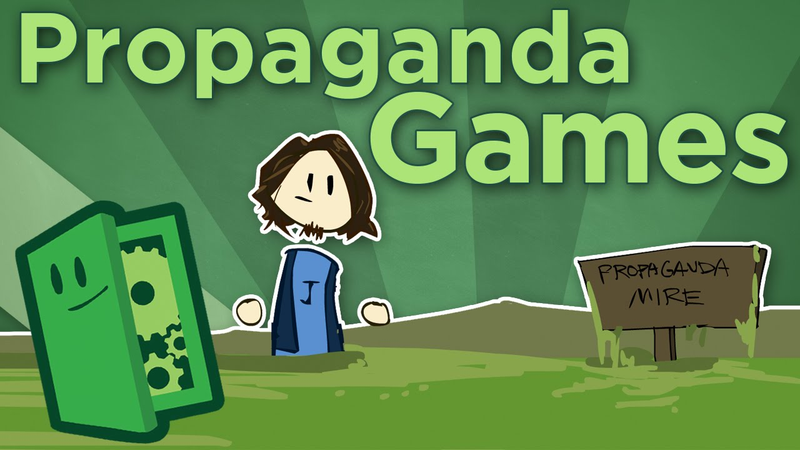
Propaganda Games - Ethical Game Design - Extra Credits
Key insights
6 takeaways- 01Video games function as powerful tools for ideological influence because the sense of agency and choice inherent in gameplay encourages players to internalize the worldviews presented by the game mechanics.
- 02The most significant risk to players is not overt propaganda, such as the recruitment tool 'America’s Army' or the extremist 'Zog’s Nightmare,' but rather 'lazy design' in mainstream titles that subtly normalizes prejudice.
- 03Mainstream games often utilize Skinner box techniques to mechanically incentivize the killing of specific ethnic or religious groups, effectively training players to accept harmful stereotypes through repetitive reward loops.
- 04RPG design frequently reinforces gender bias by creating mechanics that force female characters into sexualized roles to achieve optimal performance, reflecting unexamined cultural assumptions by developers.
- 05The analysis of military shooters and RPGs from the early 2000s to 2011 demonstrates that designers often unintentionally communicate values by failing to critically evaluate the political and cultural questions their games avoid.
- 06To mitigate the influence of harmful design, both developers and players must practice greater vigilance by critically analyzing the underlying assumptions embedded within game mechanics.
Ask AI about this video
Transcript
Yay, this will be fun. Before we go diving into the subject of propaganda games, I do have one caveat to mention. The games we've chosen to talk about in relation to this topic are all several years old, and this is intentional. Their age doesn't diminish their value as examples, but it does limit the additional attention and hits that this episode may generate for some of these products. I don't want to give some of these things traffic. They don't deserve it. A little warning going in, some of this stuff is pretty vile. And with that, here we go. As you know, we spend a lot of time talking about the power of the video game, its unique position as the first interactive mass medium, and its growing global influence as a cultural force. Lots of exciting stuff. But with that exciting stuff comes some unpleasant stuff as well. We love to talk about the incredible possibilities for the future that games offer us. We talk about them as an emerging art form, a new way to explore the human condition, and a leisure activity that'll soon be more common than watching TV. But unfortunately, the very
things that make this medium powerful can also make it dangerous. Its strength as a tool for exploring who we are can also make it a powerful instrument for indoctrination. One of the greatest things about games is how they provide us with choice. They give us agency over our actions. They make us believe that we are in control and we are deciding our destinies for ourselves. Even in simple games like Super Mario Brothers, whether we succeed or fail is in our hands, and how we go about doing so is a choice that each one of us gets to make. Of course, no game gives us truly unlimited choice, and many games only include the illusion of it. But what if a game were to willfully deceive, or to try and trick the player into thinking that the choices they made were their own when they were actually tightly constrained for other real-world purposes? What if the choices within a game were carefully crafted to all exist from a specific mindset, or a specific outlook on life? What if they got you so wrapped up in making these choices that you didn't think about the perspective you were making these choices from? That would be a propaganda game. James started researching this subject a while ago to prepare for a lecture he'd he'd giving. Here's what he had to say. When I first started thinking about this subject, I was looking at a game called
Harpooned: Japanese Crustacean Research Simulator. It's a send-up of Japanese whale research, as whale research in Japan is often accused of just being a cover for the whaling industry to protect it from international regulations. In Harpooned, you ride around harpooning dozens of whales, turning them into whale burgers in the name of research. Playing it made me feel pretty much how you'd expect, amused but also a bit upset that this is something people actually get away with. I decided to do some research on the controversial issue itself. And after much reading and some thought, I decided, "All right, I'm okay with this game. I've done my research and I'm fine with these guys lampooning something that's actually happening." I was about to leave it at that and put it out of my mind when I was struck with a question. Was I really only okay with this because I agreed with the conclusion they reached? After all, I'd like my nieces and nephews to still be able to see a whale in their lifetime, so I had no problem with the game's message, but would I have even realized it if I did? If I hadn't overthought this, would I have looked into it? Would I have even realized the way the game's mechanics tried to lead me to a specific conclusion and way of thinking? And most importantly, had this already happened to me other places without me realizing it? That was a scary thought. I began to
cast about the internet looking for other games to explore this principle. The obvious first choice was, of course, America's Army. For those of you who never played it, it's a recruitment tool made by the US military. It was built with tax dollars and developed in-house by army personnel. It actually does a remarkable job of teaching things like medical training and still manages to be pretty engaging at the same time, but it did make me extremely uncomfortable. Now, I know too many military families to have anything but respect for the people on the ground, but still though, the game itself was disquieting. It was a game designed as a military recruiting tool aimed at people still in high school, given away for free so that people who couldn't afford a console or a full-priced first-person shooter could still play. It both teaches things a soldier needs to know and reinforces military ideals, but never once does it really question the moral dilemmas that anyone entering the army today will have to face. It acknowledges the physical danger of the situation, but carefully avoids the larger questions that come with holding a gun. Hoping to further understand my discomfort, I decided to show America's Army to a particularly jingoistic acquaintance of mine. If it says America, he's pretty much all for it. But, he's also an intelligent guy, and I wanted his take. I showed him the
game, and he endorsed it wholeheartedly. He said it was a great way to reach out to those kids with no direction in their lives. Okay, interesting. I then showed my friend some games similar to the Special Force series, a set of games made by Hezbollah in which you take on the role of the Arab fighter for Hezbollah fighting the Israeli Defense Force. It plays like any modern war FPS, but with the roles reversed. And this time, the guy was horrified. He said, "This is why we have to be careful what games we let kids play." Well, I had learned all I needed to. Like any propaganda, games aren't effective when you think about them as such. But, what about when you don't? I dug deeper and started to really wade into the mire of what a propaganda game can mean. I found games like Anti-Japan War Online, a quote patriotic MMO made by the Communist Youth League, set in the 1937 to 1945 conflict between Japan and China. It's an MMO where the mobs you grind are Japanese men. The developers have talked about how they made the Japanese models subtly uglier in order to express the superiority of the Chinese. But, it really hit me when I tried the most loathsome, repulsive, disgusting game I'd ever played, Zog's Nightmare. Zog stands for the Zionist
Occupied Government, and is a game put out by neo-Nazi hate groups. It's one of the most pathetic, repugnant displays of maldirected hate I'd ever seen. I wasn't even able to get all the way through. I try to never shy away from a product, no matter how noisome and hateful, if it'll lead to clarity and shared understanding in the end. But, I stopped at the point where you're dropped into a prison to beat homosexuals and African Americans to death with your bare hands. Please don't Google this game. Just don't give them the traffic. I usually say all knowledge has value, but honestly, what we've said here is probably all the exposure you're going to want to this disgusting mess. But, it was while playing this game that I had one real revelation, that propaganda games, while terrible, aren't the real danger, at least not yet. They are something to be aware of, because being aware of them means that we can recognize them, and then we can resist them. The real danger lies in lazy design, in and propensity to accidentally indoctrinate. For example, think about how many shooters today use Muslims as the default enemy. They've kind of become the American Indian for our generation. And much as we look back now and cringe at the old Westerns that glorify the wholesale slaughter of Native Americans, someday I
expect we're going to probably look back with horror at this huge pile of shoddily made modern conflict games in which the main activity is shooting anybody with a turban on their head. But what really makes this dangerous is that we're using all the Skinner box techniques and all the compulsion mechanisms we've talked about before to incentivize the killing of people of a specific origin. Now, if this sort of thing was happening in a true propaganda game, we'd notice it. We'd see it. We'd think, "Oh, hey, that's propaganda." And then it wouldn't be able to affect us. But they're not, so our defenses aren't up. I think back to the days when Gears of War had come out, way back before Call of Duty 4 took the world by storm and ushered in the age of the modern war games. Looking back, I don't remember hearing a fraction of the racial slurs related to Muslims or Arabs used as a generic put-down on Xbox Live. I mean, it was way after 9/11 and the US was in two Middle Eastern wars, but I rarely heard that particular kind of slur flying around. And now I hear them regularly. And maybe that's just my experience. I mean, I don't have any official statistics to give on that. But speaking for myself, I've heard enough of it to start feeling concerned. Look, my point is there's danger in mechanically incentivizing actions in the game without thinking about what those actions mean. By making the goal
of these games to kill people of other races, you're training people by fooling them into thinking they're choosing. It's their choice to pull the trigger. They earned that head shot. They made that kill. And because of those compelling moment-to-moment choices, you successfully divert them away from thinking about the larger questions. Why am I killing these people? Are they really my enemies? We see it again with sexualization. It may not seem like a big deal if you're male, but you know how in many RPGs, as you level and get better gear, the men's armor tends to get bulkier and more ornate while the women's armor tends to get more and more revealing, right? And this would be fine if the aesthetics were decoupled from the mechanics, but in many of these games, the more revealing clothing is mechanically better somehow, which effectively means to succeed in this game as a female character, you must make yourself more and more of a sex object. I know it's not what the designers were thinking when they made it, but that's what their mechanics are communicating. This is what I'm talking about when I say lazy design. Now, don't misunderstand me. I'm not saying that games can desensitize us to violence or turn us into killers. Those are areas where we have some pretty strong mental barriers built up, but they can certainly have as much effect as any other piece of culture, be it the news media or Hollywood. So, just be vigilant
and watch for games that state a point of view rather than laying out a space of possibility for you to explore. If we're careful and we look at the broader picture of the game's painting and examine what questions it doesn't ask as thoroughly as what questions it does, we can call out propaganda games and protect ourselves from the subtle dangers of lazy design. And let me tell you, no designer is perfect. No one can completely remove their point of view when creating. Even when building a totally neutral space of possibility, the boundaries of that space are defined by our biases and our limitations. So, to those of you designing out there, no one expects you to be perfect, but things do get a whole lot worse when we don't try. More on that next week. See you then.
Summary
The primary purpose of this analysis is to examine how video games function as tools for ideological influence, distinguishing between overt propaganda and the more insidious risks posed by lazy, unexamined game design. The central thesis posits that because games provide players with a sense of agency and choice, they are uniquely positioned to shape player perspectives. When designers fail to question their own cultural assumptions, they risk reinforcing harmful stereotypes or political agendas, effectively training players to accept specific worldviews under the guise of voluntary gameplay.
The analysis highlights several examples of overt propaganda, including recruitment tools like America’s Army, ideologically driven titles such as the Special Force series, and hate-group-produced software like Zog’s Nightmare. These examples demonstrate how games can be used to promote specific political or extremist agendas. However, the analysis concludes that the greater danger lies in mainstream titles that utilize "lazy design." By mechanically incentivizing the killing of specific ethnic or religious groups—often using Skinner box techniques to reward players for these actions—mainstream games can subtly normalize prejudice. The analysis also notes similar issues in RPG design, where mechanics often force female characters into sexualized roles to achieve optimal performance, communicating values that designers may not have intentionally endorsed.
The scope of this discussion covers the global video game industry, focusing on the evolution of modern military shooters and RPGs from the early 2000s to 2011. The methodology relies on qualitative observation and critical analysis of game mechanics rather than quantitative survey data. The analysis concludes that while no designer can be entirely free of bias, the industry must move toward greater vigilance. By critically evaluating the questions a game asks—and, more importantly, the questions it avoids—players and developers can better identify and resist the influence of both intentional propaganda and unintentional, harmful design.


















Comments