1 free read left. Create a free account for unlimited reading + AI research.
Create free account
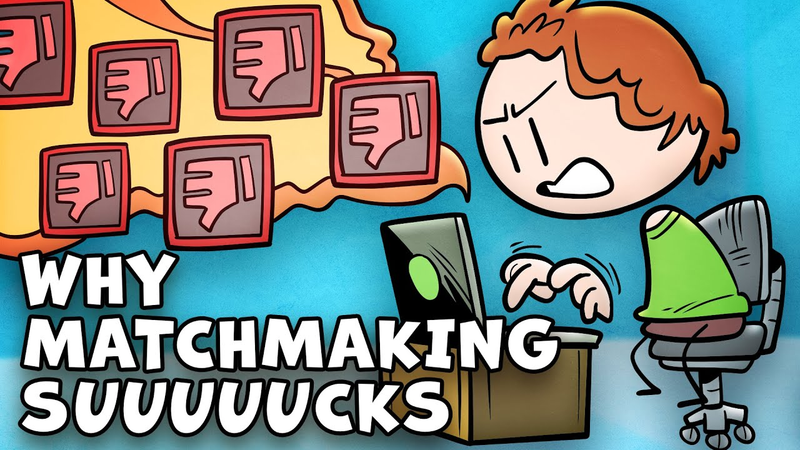
Why Matchmaking Sucks... and How It Could Be Fixed.
Key insights
7 takeaways- 01The available player pool for a match is drastically reduced by technical and design factors, such as platform exclusivity, regional server requirements, and game mode fragmentation.
- 02A theoretical population of 100,000 players can shrink to fewer than 200 viable candidates once concurrent matches and latency requirements are applied.
- 03The industry is increasingly utilizing machine learning to optimize matchmaking parameters in real-time based on fluctuating population density.
- 04Matchmaking is fundamentally constrained by the conflict between three competing variables: network latency (ping), queue times, and skill-based parity.
- 05Expanding the acceptable skill-gap range is a common industry tactic used to fill lobbies quickly and prevent excessive wait times.
- 06Developers prioritize low ping and short wait times over skill balance because player retention drops significantly when queue times exceed a few minutes.
- 07Integrating engaging side activities or mini-games during the queue can mitigate 'queue fatigue' by improving the psychological perception of wait times.
Ask AI about this video
Transcript
It is a truth universally acknowledged that where there is a matchmaking system for a multiplayer video game, it must be in want of critique. Oh, ain't that the truth? Seems like every other day we hear about players revolting or trashing a game because its matchmaking is terrible. And you KNOW WHAT? THEY ARE kind of right. Matchmaking usually is terrible. But this isn't necessarily as so many Steam review scholars will tell you, because the devs did a terrible job or weren't trying. It's because it's an incredibly hard problem. A problem that actually asks you to solve two simultaneous smaller problems that are at odds with each other. So today, let's talk about why matchmaking really sucks. Thanks so much to Henson Shaving for changing the way I battle my beard for the better. Okay, for our argument, let's say that you've got a pretty successful game called, I don't know, like Hecknomancer's Dance Match of Death or something, right? And you're anticipating that there'll be around 100,000 folks playing your game at once. Great. Time to design some easy-peasy matchmaking systems, right? Well, not
quite yet. Let's say you don't want to match PC and console players against each other because you feel the differences in controller layout makes for unfair matches or you simply can't support cross-platform play. That means, because in our beautifully tuned hypothetical game, everything is split perfectly even, that your matchmaking pool is now 50,000. But wait, an average match takes about 9 minutes, which means that most of your active players are actually going to be in games at any given time, leaving you now with a pool to matchmake from of about 5,555 in any given minute. Okay, that's fine. We can still do a lot with that. But then we do actually have five different game modes, and you know, each game mode needs its own matchmaking pool because we can't match players across different ones. Okay, so that leaves us with around 1,111 players to match between. We're already down to a match pool of about 1% of your online players. And so far, this is just the mandatory stuff, stuff that you can't avoid. I mean, we haven't even discussed any matchmaking techniques that actually improves the player experience yet. Because if you want your
players to have an actually good experience, you're going to have to cut things down even further. For starters, at the very least, you're going to want your players to have a reasonable ping in their matches. So, you have to divide up the world into regions. Let's say in our hypothetical game, you decide on six regions. The general range being between three and 10, depending on how big your player base is in certain areas, just how important ping is in your game, and just how much you care about your players speaking the same language when they jump into a match. In our scenario, this leaves you with a pool of about 185. Yet, that still is the bare minimum we can do with matchmaking to use it to make a better in-game experience. We can also try to match by player skill to make sure that new players aren't getting matched with veterans, and that the game is an appropriate challenge for everyone. But, this is where things start to get complicated because we usually do this by taking your ELO or matchmaking rating and trying to pair you against people close to you in that rating. Now, I'm not going to go too much into how matchmaking ratings work because we did a video on that years ago, where you can notice I was still finding my voice on this channel. Excuse me. Wow, that was a flashback. But,
suffice to say, it is a single numerical value that represents, air quotes, how good you are. So, now, we take those 185 people who are around and available for you to queue up with and check to see if any of them are near your skill level. But, of course, since we're down so many people, it's unlikely that anyone's an exact match, much less that we can find an entire team to match you with or against. So, each second, we expand the range of what is an acceptable match. So, say if at second one, we'll take anyone within five points of you, by second 10, maybe we've expanded it to be anyone within 15 points. And this keeps going until we can fill out a full set of players to match against each other, which is why the higher up in a ladder you climb, the longer your queue times are. As you rank up in your games, you enter an even more exclusive club, and it's going to take longer and longer for the matchmaking to expand to find anyone to match you against. So, here you are with ping, player skill, and queue length all pulling your matchmaking system in opposite directions, and developers have to weigh those. What's most important? That you can get in a game quickly, that you get into a fair
match, or that you get into a match where your ping is good enough that the game seems engaging and smooth to play? Well, the answer is usually ping is most important, then queue time, then quality of match, which is why you get wildly unbalanced matches at times. Now, you might be out there saying, "Well, I mean, I would be willing to wait a bit longer to get better matches." But then you, my friend, would be in the minority. Of course, each game and gaming community is different, but most developers do have clear metrics on how long is too long for their games, how long it takes before people quit and go do something else. For most games, anything more than a few minutes and your audience starts to scram, which of course exacerbates the problem leading to the death spiral of your game. So, in the end, ping and queue time win, which is a shame because it keeps us from doing the really neat things, like, for example, ensuring every group gets to queue up with at least one person who's gotten a lot of the equivalent of the good sportsmanship ratings from other players, or making sure that everyone gets the exact role or character that they want to play. But how do we solve this? Well, a lot is being done with machine learning right now to shave margins off your queue times. Learning
how many people are playing in a region at any given time might help determine what the minimal acceptable ping is for an area in a given hour. If not many people are playing in your local region at your 3:00 a.m., we might automatically let the match maker raise the acceptable ping by a dozen milliseconds or start with a wider spread of skill levels as an acceptable match. But the more interesting solutions, for my money, are the efforts people are putting in to combat queue fatigue, which leads me to an old story about why humans put mirrors in elevators. It goes something like this. When elevators were invented, they solved an incredible problem. They let people build bigger and taller buildings than ever before. But of course, people on the upper floors complained about how slow the elevators were. So, elevator manufacturers put their best engineers on the job, but they couldn't make them faster without also making them unsafe. So, someone hit on a alternative solution. What if we gave folks something to do when they were in the elevator? And since humans love to look
at themselves, fix their hair, etc., why not put in a mirror? And voila, the problem was solved. Look and shop, kiddo. GG easy. So, using that logic, giving the player more and more interesting things to do while they wait for a queue goes a long way towards buying you the time you need to add in those extra features to your matchmaking equation to make every match as good as possible. And I know it can be a bit frustrating to get cut off whatever side activity you were engaging in when your match pops up, but still, I do think this is where we're going to see a lot of improvement in the next few years when it comes to making matchmaking at least feel like it sucks less. And in that spirit, while we wait for the next episode of Extra Credits to load. Wait, 2 weeks? Are you kidding me? Trash servers. Uh what, sorry? Old habits. It's time for the mini game of paying the bills with razors. Haha. Heck yeah. I don't got to tell you that buying razors today just sucks, right? Because all of these big companies that make the quadruple bladed moisture strip coated gimmick infused nonsense cartridges really only produce those things to jack up prices for something
that you have to buy over and over and over again. Well, thanks to Henson Shaving, I never have to put up with that crap again because they've taken their know-how from crafting parts for things like the Mars rover and the ISS to now tackle something a little closer to home, aka giving you the closest shave humanly possible. Instead of making cheap handles and then charging you a bunch of cash for replacement cartridges, Henson instead crafted a precision engineered safety razor designed to hold the blade at exactly the optimal angle of 30° from your skin. Then combine that with how securely the blade is held with zero wobble, mind you, and how minimally the blade is exposed, and it basically takes the guesswork out of getting a super close shave without a ton of waste or cost. Now, full disclosure, we know that something like this probably appeals most to those of you who consider overall cost of ownership, aka total lifetime cost, versus only looking at how much you pay up front. And the Henson AL13 is definitely more expensive than the cheap handles you could get at the drugstore or whatever, but the flip side of that equation is that the replacement blades are only 10 cents
each, making your overall cost of use just absolutely cheaper in the long run. And you know, in that spirit, we can actually shave off a little extra for you. Ooh, that sounded a bit better in my head. Because if you head to our link below and choose one of their cool handles and pack of 100 blades to throw in your cart, right? Then use our code EXTRA CREDITS at checkout, you're going to see the cost of those 100 blades drop to zero, meaning you're going to get years' worth of blades absolutely free. Love to see it. It's so cool. Once again, thank you so much to the fine folks at Henson Shaving for sponsoring this episode, and yeah, I'm just super pumped to be working with them, because I do use their product, and I do really believe if you are looking for the best possible way to remove hair from your body, you absolutely cannot go wrong with their stuff. A million big old thanks to Skyler Homes, Kuya Koy, Joseph Blame, Dominic Valenciana, Casey Musgraves, Arclight Games, Angela Valenciana, and Amaziah Turk for being fantastic, legendary patrons.
Summary
Matchmaking in multiplayer video games is a complex engineering challenge that forces developers to balance competing priorities, often resulting in player frustration. The primary thesis is that matchmaking is not inherently broken due to developer incompetence, but rather because it requires solving multiple conflicting variables simultaneously, including network latency (ping), queue times, and skill-based parity.
The process begins with a total player base that is rapidly fragmented by technical and design constraints. Factors such as platform exclusivity, game mode variety, and regional server requirements significantly reduce the available pool of players for any given match. For example, a hypothetical population of 100,000 players can quickly dwindle to fewer than 200 viable candidates once accounting for concurrent matches, game mode selection, and regional ping requirements. Developers must then weigh these factors, typically prioritizing low ping and short queue times over match quality. Because player retention drops significantly if wait times exceed a few minutes, developers often expand the acceptable skill-gap range to fill lobbies, leading to the unbalanced matches that players frequently criticize.
To address these systemic issues, the industry is increasingly turning to machine learning to optimize matchmaking parameters based on real-time population density. However, a more promising approach involves mitigating queue fatigue. By drawing a parallel to the use of mirrors in elevators to distract passengers from wait times, the analysis suggests that integrating engaging side activities or mini-games while players wait can buy developers the time needed to prioritize higher-quality, more balanced matchmaking without driving users away. Ultimately, improving the player experience requires shifting the focus from purely technical speed to managing the psychological perception of the waiting process.



















Comments