1 free read left. Create a free account for unlimited reading + AI research.
Create free accountArticle Eludamos: Journal for Computer Game Culture
1 free read left. Create a free account for unlimited reading + AI research.
Create free accountArticleEludamos: Journal for Computer Game Culture
Print advertisers face pressure to stand out in a competitive attention economy. The link between playfulness and print advertising had not previously been studied.
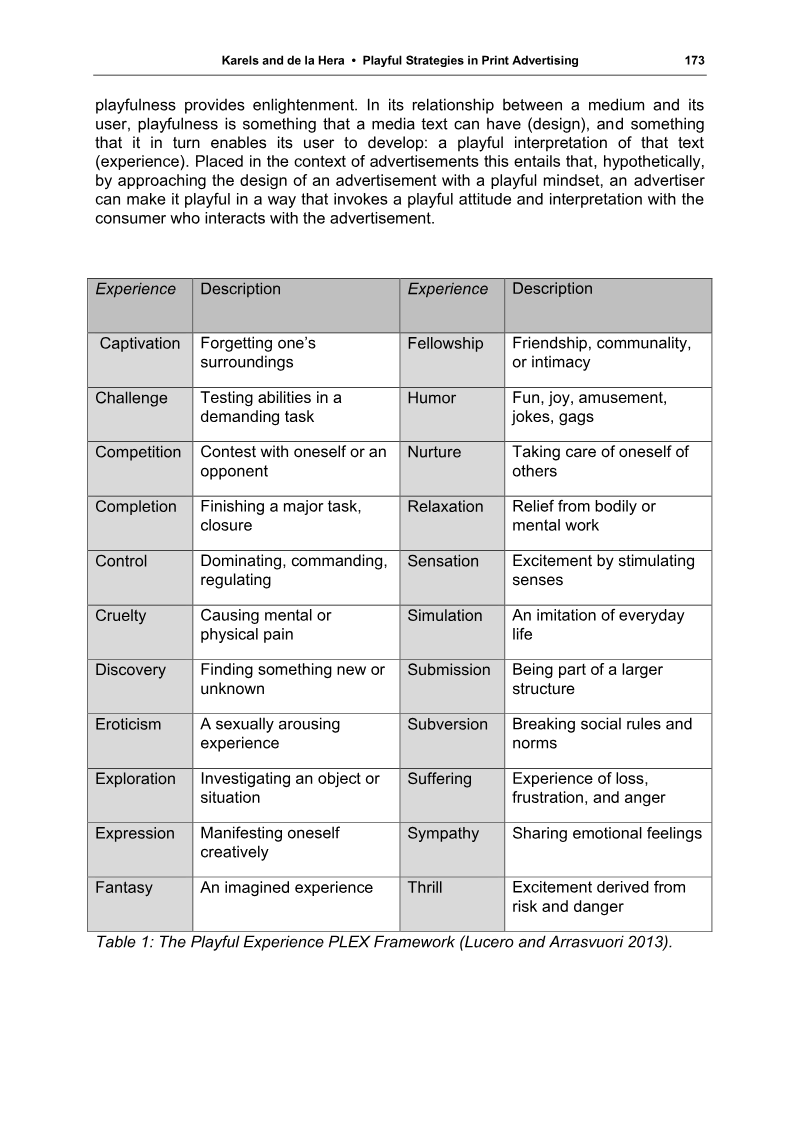
Karels and de la Hera's study examines how playfulness is deployed in print advertising, situating its inquiry at the intersection of the ludification of culture and the competitive attention economy. Because consumers increasingly expect playful, interactive experiences, print advertisers face pressure to stand out, yet the connection between playfulness and print advertising had not previously been studied. Drawing on theorists such as Huizinga, Caillois, Raessens, and Sicart, the authors frame playfulness as an attitude that can be applied to non-play contexts, with particular attention to paidic play.
To investigate this, the researchers analyzed 100 award-winning print advertisements from Ads of the World published in 2019 and 2020, selected through purposive sampling and maximal variation from roughly 58,000 candidates. Applying a six-step thematic analysis informed by Sicart's characteristics of play, Anderson's principles of seductive interaction, and the PLEX framework, they identified three principal strategies. The first is playful visual design, including disruptive, eye-catching, and topical or personal imagery that instills a playful mindset in viewers. The second is pleasurable interactive experience, achieved through delayed or implied punchlines that invite audiences to actively complete the meaning, a process the authors argue aids message retention. The third is dark playfulness, in which serious subjects such as sex trafficking and drunk driving are treated with negative-valence experiences and subversive humor.
The study concludes that print advertising borrows interactive playfulness traditionally associated with digital media, thereby extending the ludification-of-culture thesis beyond digital contexts. It also contributes to the PLEX framework by proposing guilt as a playful experience category and by arguing that thrill can carry a negative valence when derived from risk imposed on others. The authors caution, however, that exploiting consumers' inclination toward play raises ethical concerns that advertisers should weigh.

Eludamos: Journal for Computer Game Culture · 2026

Eludamos: Journal for Computer Game Culture · 2026

Eludamos: Journal for Computer Game Culture · 2026

Eludamos: Journal for Computer Game Culture · 2026

Eludamos: Journal for Computer Game Culture · 2026

Eludamos: Journal for Computer Game Culture · 2026

Eludamos: Journal for Computer Game Culture · 2026

Eludamos: Journal for Computer Game Culture · 2025

Eludamos: Journal for Computer Game Culture · 2025

Eludamos: Journal for Computer Game Culture · 2025

Eludamos: Journal for Computer Game Culture · 2025

Eludamos: Journal for Computer Game Culture · 2025