Updated Mar 17, 2026 by Niko Partners
What can I help with?
AI-powered answers with citations from the library.
What can I help with?
AI-powered answers with citations from the library.
Report · January 1, 2022
Published by Niko Partners
Southeast Asia represents one of the world’s fastest-growing video game markets, characterized by a young population, improving infrastructure, and a rapidly expanding digital economy. Data indicates that the six major countries in the region—Indonesia, Malaysia, the Philippines, Singapore, Thailand, and Vietnam—account for approximately $5 billion in market size and 270 million gamers. While this represents 6% of total Asian games revenue, the region is projected to maintain a compound annual growth rate of 8.6% through 2025. Esports serves as a primary driver for this growth, with over 200 million viewers and gamers in the region. Approximately 60% of Southeast Asian gamers are strongly drawn to esports, and 42% are classified as competitive arena gamers. This interest has led to the integration of esports into major regional athletic events like the SEA Games. Furthermore, the audience is becoming increasingly diverse; female gamers now make up 40% of the total gaming population, with growth rates in this demographic outpacing the general market average. In specific markets like Indonesia and Singapore, women comprise nearly half of the gaming audience. The region has also emerged as a pioneer in blockchain and play-to-earn gaming, exemplified by the success of titles like Axie Infinity, which reached over one million daily active users. However, the market faces unique challenges, including parental skepticism, fluctuating government regulations regarding game approvals and bans, and complex cultural sensitivities. Successful expansion requires navigating diverse religious and social landscapes, as localized content can significantly boost revenue while cultural oversights can lead to public backlash or censorship. Ultimately, Southeast Asia offers significant opportunities for global stakeholders, provided they adopt localized strategies rather than a one-size-fits-all approach.
Southeast Asia’s Games Market This Insights Article is a collaboration between Niko Partners and gamescom asia. Introduction: Niko’s analysis on Southeast Asia’s games market size Asian gamers have contributed to the massive growth of the global video games industry. Niko Partners estimates the total mobile and PC game revenue in Asia will reach US$82 billion in 2022, or 55% of the global games market, with at least 1.47 billion gamers in the region. Asia’s gigantic economies dominate: China, Japan, and South Korea, for example, while the six major countries of Southeast Asia (Indonesia, Malaysia, Philippines, Singapore, Thailand, and Vietnam) represent 6% of Asia’s games revenue and 19% of Asia’s gamers. While seemingly small in comparison, these Southeast Asian countries boast US $5 billion market size and 270 million gamers. With an estimated compound annual growth rate (CAGR) of 8.6% between 2020-2025, Southeast Asia is one of the fastest growing regions for the games market in the world. Supported by its young populace, rapidly rising economies, and upgraded infrastructure, the region provides promising ground for the games market to continue to thrive. Through our research, Niko also found that the majority of Southeast Asia’s gamers are playing games responsibly and contributed to the region’s share of the global games industry growth.
and upgraded infrastructure, the region provides promising ground for the games market to continue to thrive. Through our research, Niko also found that the majority of Southeast Asia’s gamers are playing games responsibly and contributed to the region’s share of the global games industry growth. The Southeast Asian games industry has begun to take part in shaping the metaverse, pan-entertainment IP and transmedia which is leading to a convergence between games and entertainment. We expect to see more traditional brands, entertainment properties and artists take advantage of live service games in 2022. On the flip side, we expect to see more collaboration between video game IP holders and traditional entertainment such as movies, TV, and comics. This bi-directional approach will further engage gamers in the future. Esports in Southeast Asia Esports is an important segment of the games industry, especially in Southeast Asia where there are over 200 million esports viewers and gamers as mentioned in Niko’s Asia Esports Report. Esports is becoming a part of mainstream entertainment. Esports was included as a demonstration sport in 2018’s Asian Games in Indonesia and later included as a medal title for the first time at the Olympic Committee-sanctioned Southeast Asian Games (SEA Games) in the Philippines in 2019. Esports continued to be a focal part of the 2021 SEA Games in Vietnam, as well as the upcoming 2022 IESF World Championship in Bali and the 2023 SEA Games in Cambodia.
a medal title for the first time at the Olympic Committee-sanctioned Southeast Asian Games (SEA Games) in the Philippines in 2019. Esports continued to be a focal part of the 2021 SEA Games in Vietnam, as well as the upcoming 2022 IESF World Championship in Bali and the 2023 SEA Games in Cambodia. The region boasts prominent esports organizations, such as Team Flash, Fnatic, and EVOS Esports. Southeast Asian countries have also presided or will hold major global tournaments such as Dota 2 The International, Mobile Legends: Bang Bang World Championships, and Free Fire World Series. Southeast Asia is a subregion that is worth to note, with Niko’s research noting that 60% of the region’s gamers strongly drawn to esports. Furthermore, 42% of gamers in Southeast Asia fall into the segment of competitive arena gamers who love esports and other competitive games. It is not surprising to find that community tournaments are very popular in Southeast Asia as they get to promote livelihood and income to the communities. They serve as the training ground for aspiring amateur players who want to break into the professional scene.
Over the last 5 years, Niko has closely monitored the explosion in esports across Asia, and since 2018 we have tracked the major esports competitions in each Asian market we cover, recording tournament data as a means to understand leading trends across the region. In 2020 we made this database available through our Asia Esports Tracker, a detailed view of esports in Asia by the numbers. Female Gamers in Southeast Asia Southeast Asia’s gaming audience is increasingly diverse—although men still outnumber women in many gaming segments, the gap is quickly narrowing. Year over year growth rates of female gamers significantly outpace average growth rates for all gamers. Women make up about 40% of gamers in the region, but in key markets like Indonesia and Singapore the gap is much smaller with women comprising nearly half of the total gaming audience. Representation is nearly identical among mobile gamers, but in segments like PC and console gaming there is still some ground to cover. Female gamers are important to the bigger picture of Southeast Asia’s gaming market as it attracts new players and spectators.
half of the total gaming audience. Representation is nearly identical among mobile gamers, but in segments like PC and console gaming there is still some ground to cover. Female gamers are important to the bigger picture of Southeast Asia’s gaming market as it attracts new players and spectators. The growth and expansion of female gaming—and by extension, female esports—in Southeast Asia has also resulted in the proliferation of all-female tournaments. This is not only an opportunity of those who are players of esports but also sponsors to widen their target audience. In 2020, Vietnam has held their first all women PUBG Championship. On a regional level, Zeppeto held Point Blank Southeast Asia Ladies Tournament Season One and Two with a total prize pool of US$10,000.<sup>1</sup> One of the most prominent female esports organizations in Asia is the Singapore’s Female Esports League (FSL). Founded in 2012, the organization has reached millions. This year, FSL is holding their eight-month-long Valorant tournament from March to October. Furthermore, one of the most significant efforts that can be seen is the addition of women category to the 2021 SEA Games League of Legends: Wild Rift medal event, although this doesn’t mean female players can’t participate in other categories. Blockchain Games in Southeast Asia
March to October. Furthermore, one of the most significant efforts that can be seen is the addition of women category to the 2021 SEA Games League of Legends: Wild Rift medal event, although this doesn’t mean female players can’t participate in other categories. Blockchain Games in Southeast Asia Blockchain technology has been around since the 1980s, but it has only recently gained widespread attention because of the rise in the popularity of cryptocurrency, such as Bitcoin and others. An important use of blockchain technology is in video game development, what is referred to as blockchain gaming. Niko Partners sees this as a disruptor for game development and monetization design trends worldwide. As often is the case, the first notable instances of this trend emerged in Southeast Asia, such as with the Vietnamese game Axie Infinity. Blockchain games’ play-to-earn model makes them an attractive source of income and investment. The model allows players to earn money by playing, receiving rewards, and trading digital assets for cryptocurrencies, which they can then trade for fiat money and spend in real life. This opens a new monetization model, which should be integrated with the game design and development. As free-to-play games use several more traditional monetization models, the new model will potentially be a big disruption to the existing ones.
Southeast Asia represents a rapidly accelerating segment of the global esports market, characterized by high growth rates in both viewership and revenue. Between 2019 and 2024, the region is projected to see a compound annual growth rate (CAGR) in audience size that significantly outpaces global averages, with year-over-year increases reaching as high as 18.2%. This expansion is driven by a mobile-first gaming culture where 82% of the online population plays mobile games and 39% of players identify mobile as their primary platform. Key markets fueling this trend include Indonesia, Vietnam, the Philippines, Thailand, Malaysia, and Singapore. The regional ecosystem is heavily influenced by mobile-centric titles, specifically Mobile Legends: Bang Bang, Garena Free Fire, and PUBG Mobile. These three games accounted for roughly half of all global esports hours watched for those titles on Twitch and YouTube Live during the first half of 2021. Revenue streams in the region mirror global trends, with sponsorship serving as the primary contributor, supported by media rights, publisher fees, and digital goods. Government intervention also plays a critical role in market maturation, with initiatives like the Youth Esports Program in the Philippines and the integration of esports into the 30th SEA Games as a medal event. Data for these findings was sourced from Newzoo’s 2021 Global Esports and Live Streaming Market Report and Consumer Insights. The methodology utilized a Major City Approach for most Southeast Asian nations to represent active internet users aged 10-50, while Singapore data covered the general online population within that age bracket. The findings conclude that improved internet infrastructure and the accessibility of mobile devices are the primary catalysts for long-term engagement and the continued attraction of non-endemic brand sponsorships to the region.
Asia has established itself as the epicenter of the global gaming industry, driven by a mobile-first population exceeding 1.5 billion players. The region’s market is characterized by the dominance of free-to-play models, which account for nearly 99% of mobile revenue and all top-grossing titles. While China and Japan lead in total revenue, Japan maintains the highest value per user with an average revenue per download of $12.84. Growth is increasingly fueled by the female demographic, which expanded to 500 million players by 2019 and contributes nearly 40% of total mobile gaming revenue. This shift necessitates more inclusive storylines and diverse development teams to capture a demographic that is currently outgrowing its male counterpart. The competitive landscape is defined by the rapid ascent of mobile esports, with Asia generating 68% of the sector's global revenue. Southeast Asia, in particular, has seen a 244% increase in tournament prize pools, signaling a transition from casual play toward complex, competitive genres like MOBAs and Battle Royales. Despite high interest, a significant gap remains between esports viewership and active participation, representing a massive untapped opportunity for developers. Success in these markets requires sophisticated monetization strategies, such as hybrid models combining gacha mechanics, battle passes, and rewarded video ads to accommodate varying income levels across the territory. Navigating the Asian market demands deep localization that extends beyond language to include cultural customs, religious sensitivities, and technical optimization for diverse hardware. While Japan and South Korea remain dominated by local developers and legacy RPG franchises, India and Southeast Asia offer high-growth potential for international titles that provide "lite" versions for accessible play. To achieve long-term engagement, developers must leverage local influencers and community-driven gameplay, ensuring that titles resonate with the specific pop culture trends and infrastructure capabilities of each unique sub-region.
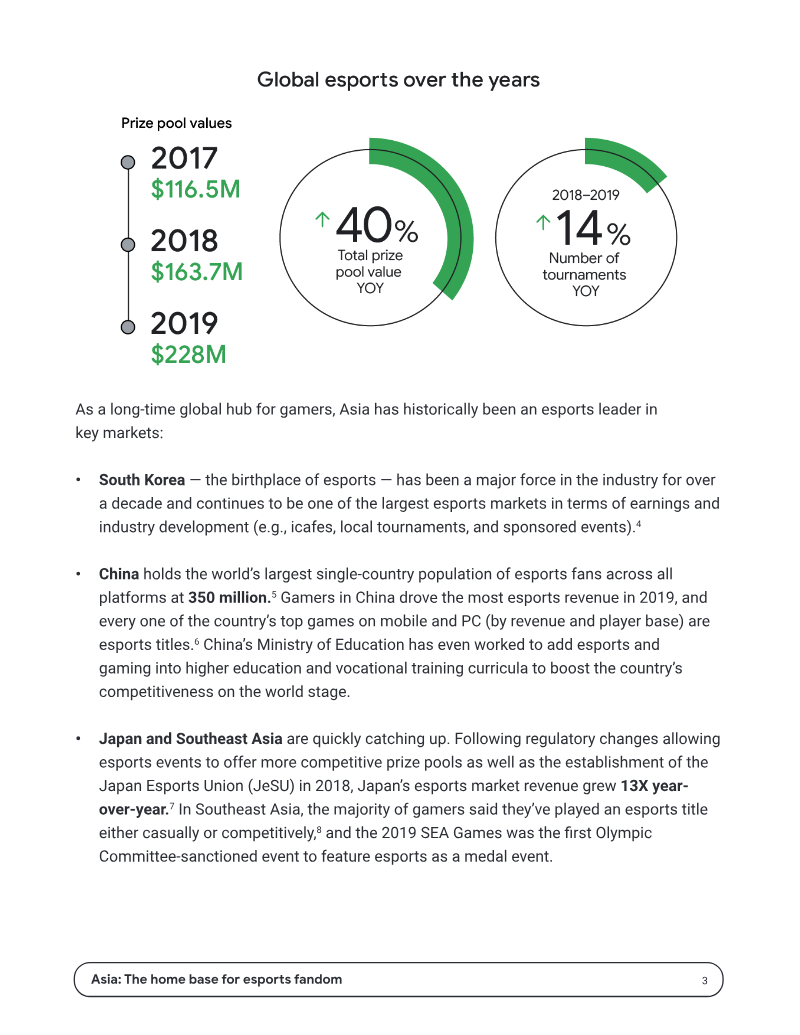
Mobile esports has emerged as a primary driver of player engagement and revenue across Asia, signaling a shift from traditional PC and console dominance to a mobile-first competitive landscape. The central thesis posits that Asia is the global epicenter of this evolution, fueled by a massive population of 1.5 billion gamers and a robust infrastructure of internet cafes, local streaming platforms, and increasing 5G penetration. By lowering hardware barriers to entry, mobile technology has transformed casual players into "player-fans" who both compete in and spectate high-stakes tournaments. Key data points highlight the scale of this growth, with global esports prize pools increasing 40% between 2017 and 2019 to exceed $228 million. In 2019 alone, mobile esports generated $19.5 billion in global revenue, with Asia accounting for 68% of that total. China remains the largest single market, boasting 350 million esports fans, while Southeast Asia saw a 244% increase in tournament prize values between 2018 and 2019. The COVID-19 pandemic further accelerated these trends, with gamers in Asia spending up to 75% more time playing and viewership in China doubling during lockdowns. The scope of this analysis covers major Asian markets including China, South Korea, Japan, India, and Southeast Asia, focusing on the period between 2017 and 2020. It examines industry segments ranging from hardware manufacturing and 5G infrastructure to specific game genres like MOBAs and Battle Royales. Methodology relies on primary data from Niko Partners, including consumer panels of over four million users, executive interviews, and market modeling to provide a comprehensive outlook on the region's competitive gaming trajectory.
Southeast Asia solidified its position as the world’s second-largest mobile gaming market by downloads in early 2025, reaching 1.93 billion installs. While the region currently ranks seventh globally in revenue at $625 million, it demonstrates significant monetization potential fueled by expanding digital payment infrastructure and rising smartphone penetration. Indonesia serves as the primary volume driver with 870 million installs, while Thailand leads the region in consumer spending, generating $162 million. This growth is increasingly supported by publishers based in Singapore and Vietnam, who have emerged as a dominant global force, contributing over 5.8 billion installs to the international market through a mix of hypercasual hits and competitive titles. Market dynamics reveal a shift toward high-engagement genres and localized content strategies. Although casual arcade and simulation games drive the highest download volumes, monetization is concentrated in Strategy, MOBA, and RPG segments. Mobile Legends: Bang Bang remains the regional revenue leader, sustained by hyper-local live operations and community engagement. Simultaneously, the 4X Strategy genre is experiencing rapid expansion, highlighted by a 77.7% revenue surge for titles like Last War: Survival. Conversely, traditional MMORPGs have seen a decline of nearly 20%, making way for Open World Adventure RPGs and sophisticated strategy games that leverage deep social and competitive mechanics. The regional landscape is characterized by distinct national preferences and the global expansion of local firms. Vietnam has become a powerhouse for survival-themed hypercasual games, while Thailand shows a unique affinity for realistic sports simulations. Established titles like Garena Free Fire continue to dominate global charts by blending cultural relevance with nostalgic collaborations. Ultimately, the region’s trajectory is defined by a transition from high-volume downloads to sophisticated monetization, driven by a combination of community-led activations and the strategic global influence of Southeast Asian publishers.