Updated Mar 17, 2026 by Niko Partners
What can I help with?
AI-powered answers with citations from the library.
What can I help with?
AI-powered answers with citations from the library.
Report · July 1, 2020
Published by Niko Partners
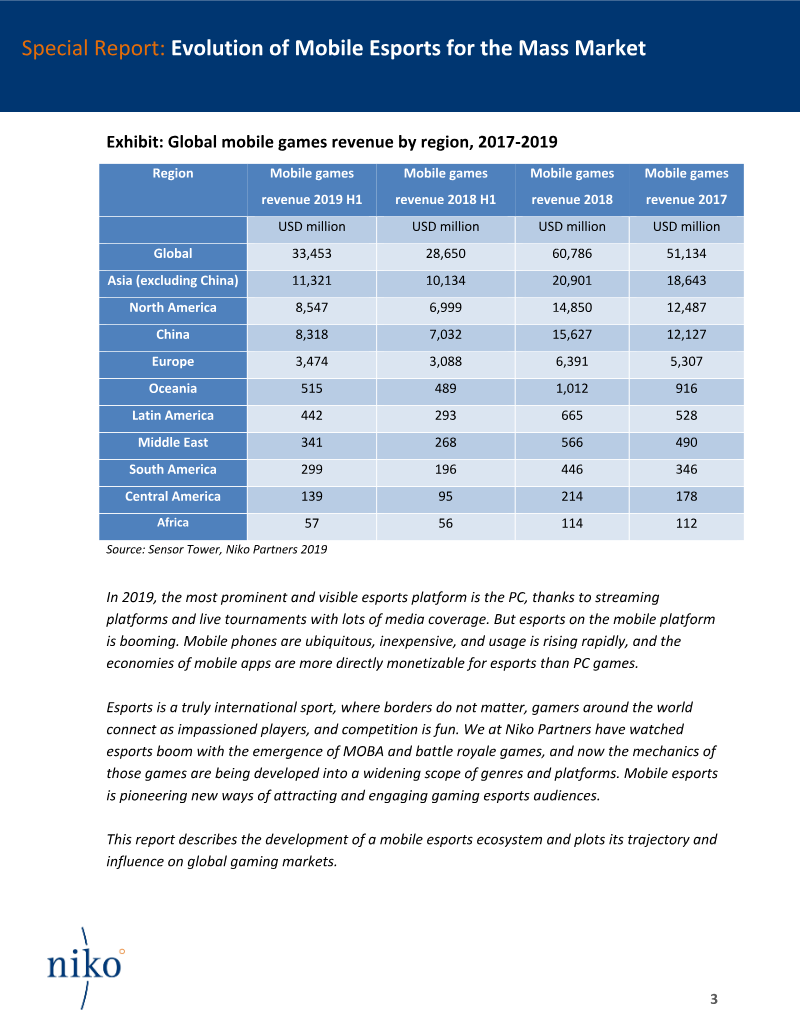
Mobile esports has emerged as a primary driver of player engagement and revenue across Asia, signaling a shift from traditional PC and console dominance to a mobile-first competitive landscape. The central thesis posits that Asia is the global epicenter of this evolution, fueled by a massive population of 1.5 billion gamers and a robust infrastructure of internet cafes, local streaming platforms, and increasing 5G penetration. By lowering hardware barriers to entry, mobile technology has transformed casual players into "player-fans" who both compete in and spectate high-stakes tournaments. Key data points highlight the scale of this growth, with global esports prize pools increasing 40% between 2017 and 2019 to exceed $228 million. In 2019 alone, mobile esports generated $19.5 billion in global revenue, with Asia accounting for 68% of that total. China remains the largest single market, boasting 350 million esports fans, while Southeast Asia saw a 244% increase in tournament prize values between 2018 and 2019. The COVID-19 pandemic further accelerated these trends, with gamers in Asia spending up to 75% more time playing and viewership in China doubling during lockdowns. The scope of this analysis covers major Asian markets including China, South Korea, Japan, India, and Southeast Asia, focusing on the period between 2017 and 2020. It examines industry segments ranging from hardware manufacturing and 5G infrastructure to specific game genres like MOBAs and Battle Royales. Methodology relies on primary data from Niko Partners, including consumer panels of over four million users, executive interviews, and market modeling to provide a comprehensive outlook on the region's competitive gaming trajectory.
For most gamers, the only thing better than playing is being able to share the experience. And since the early days of PC and console games, people have been eager to come together and compete, conquer challenges, and join a global community of players and fans. In the last decade, esports — organized video game competitions between fully fledged professional teams or amateur players — transformed gaming on a global scale by turning it into a spectator sport. Esports events and tournaments engaged the community in an entirely new way by going beyond the game itself to invite fans into an immersive live experience, whether in-person at local events or shared with millions via live streaming platforms such as YouTube and Twitch. And as COVID-19 lockdowns forced internet cafes (icafes) to close and gamers to follow the action from home, players and fans have more time than ever to engage with their favorite esports titles. By helping foster a dedicated audience of player-fans, esports has propelled many of the world’s top titles like “Fortnite,” “PlayerUnknown’s Battlegrounds (PUBG),” and “Mobile Legends: Bang Bang” to unprecedented levels of success. But more importantly, it’s revealed that driving meaningful user engagement is about more than designing a great game — it’s about competition, completion, challenge, and community. As mobile technology catches up to its PC and console counterparts, mobile esports is quickly taking the spotlight, and gamers in Asia are stealing the show. Home to more than 1.5 billion gamers<sup>1</sup> and a fast-growing mobile population, Asia is poised to show the world that mobile esports is the next evolution in player-fan engagement.
onsole counterparts, mobile esports is quickly taking the spotlight, and gamers in Asia are stealing the show. Home to more than 1.5 billion gamers<sup>1</sup> and a fast-growing mobile population, Asia is poised to show the world that mobile esports is the next evolution in player-fan engagement. Asia: The home base for esports fandom Looking back on the first organized esports events, it’s hard to believe players would one day compete for million-dollar prizes. But as more people around the world gained access to the internet and the world of esports, investments from sponsors and retailers have skyrocketed. In just the last year, there have been 14% more esports tournaments staged around the world after falling 5% between 2017 and 2018.<sup>2</sup> Global prize pools have also grown by 40% since 2017, eventually exceeding a quarter-billion dollars in 2019<sup>.3</sup> Asia: The home base for esports fandom 2
Prize pool values 2017 $116.5M 40% 20182019 2018 Total prize % $163.7M pool value Number of YOY tournaments YOY 2019 $228M As a long-time global hub for gamers, Asia has historically been an esports leader in key markets: • South Korea — the birthplace of esports — has been a major force in the industry for over a decade and continues to be one of the largest esports markets in terms of earnings and industry development (e.g., icafes, local tournaments, and sponsored events).<sup>4</sup> • China holds the world’s largest single-country population of esports fans across all platforms at 350 million.<sup>5</sup> Gamers in China drove the most esports revenue in 2019, and every one of the country’s top games on mobile and PC (by revenue and player base) are esports titles.<sup>6</sup> China’s Ministry of Education has even worked to add esports and gaming into higher education and vocational training curricula to boost the country’s competitiveness on the world stage. • Japan and Southeast Asia are quickly catching up. Following regulatory changes allowing esports events to offer more competitive prize pools as well as the establishment of the Japan Esports Union (JeSU) in 2018, Japan’s esports market revenue grew 13X yearover-year.<sup>7</sup> In Southeast Asia, the majority of gamers said they’ve played an esports title either casually or competitively,<sup>8</sup> and the 2019 SEA Games was the first Olympic Committee-sanctioned event to feature esports as a medal event.
pan’s esports market revenue grew 13X yearover-year.<sup>7</sup> In Southeast Asia, the majority of gamers said they’ve played an esports title either casually or competitively,<sup>8</sup> and the 2019 SEA Games was the first Olympic Committee-sanctioned event to feature esports as a medal event. Asia: The home base for esports fandom 3
Thanks to its robust gaming infrastructure, Asia has been equipped to foster an avid base of esports fans since the mid-2000s. Web gaming platforms as well as retail locations, internet cafes (icafes), and food and beverage locations have used small-scale PC and mobile esports events to attract gamers and sell merchandise and in-game items. Games with larger audiences bring in more advertisers and sponsors, which ultimately empowers its marketing teams to host larger, more lucrative esports productions. While this helped grow the reach and popularity of certain PC and console games, the size of esports productions has been limited by smaller player counts having access to the right hardware. For instance, PC esports has thrived in markets like China and Southeast Asia where console ownership is low, but it only accounts for a small percentage of esports revenue in Japan, where more gamers play on consoles than PC. That’s where mobile technology has been a game-changer. Anyone with an internet connection and a mobile phone can participate in the world of esports, whether they’re competing at home or watching a live stream while waiting in line at the store. With the hardware barrier to entry lifted, mobile has increased accessibility and exposure to a multitude of multiplayer games. In 2019, Asia drove more than 22 billion total downloads of mobile games.<sup>9</sup> As mobile games continue to surge in popularity, top titles like “PlayerUnknown’s Battlegrounds (PUBG) Mobile,” “Fortnite Mobile,” and “CrossFire Mobile” have demonstrated that free-to-play games have the potential to outperform the traditional giants by reaching a larger audience.
es.<sup>9</sup> As mobile games continue to surge in popularity, top titles like “PlayerUnknown’s Battlegrounds (PUBG) Mobile,” “Fortnite Mobile,” and “CrossFire Mobile” have demonstrated that free-to-play games have the potential to outperform the traditional giants by reaching a larger audience. Unpacking the mobile esports revolution Following the global explosion of esports, mobile games started to transition from simpler titles that only required a single click or swipe to mid-core and hardcore titles with complex control schemes. Mobile game developers looking to build on the success and style of PC esports shifted their focus from massively multiplayer online role-playing games (MMORPGs) to the hottest esports genres: multiplayer online battle arenas (MOBAs), shooter/battle royale games, and strategy/auto-battlers. “Vainglory,” a mobile game launched in 2014, was modeled after PC MOBA games like “League of Legends” and “Defense of the Ancients (DOTA) 2.” Within a year, “Vainglory” was officially recognized as an esport by the Electronic Sports League (ESL), and other mobile esports titles soon followed. Tencent’s “Honor of Kings/Arena of Valor,” Supercell’s Unpacking the mobile esports revolution 4
Asia has established itself as the epicenter of the global gaming industry, driven by a mobile-first population exceeding 1.5 billion players. The region’s market is characterized by the dominance of free-to-play models, which account for nearly 99% of mobile revenue and all top-grossing titles. While China and Japan lead in total revenue, Japan maintains the highest value per user with an average revenue per download of $12.84. Growth is increasingly fueled by the female demographic, which expanded to 500 million players by 2019 and contributes nearly 40% of total mobile gaming revenue. This shift necessitates more inclusive storylines and diverse development teams to capture a demographic that is currently outgrowing its male counterpart. The competitive landscape is defined by the rapid ascent of mobile esports, with Asia generating 68% of the sector's global revenue. Southeast Asia, in particular, has seen a 244% increase in tournament prize pools, signaling a transition from casual play toward complex, competitive genres like MOBAs and Battle Royales. Despite high interest, a significant gap remains between esports viewership and active participation, representing a massive untapped opportunity for developers. Success in these markets requires sophisticated monetization strategies, such as hybrid models combining gacha mechanics, battle passes, and rewarded video ads to accommodate varying income levels across the territory. Navigating the Asian market demands deep localization that extends beyond language to include cultural customs, religious sensitivities, and technical optimization for diverse hardware. While Japan and South Korea remain dominated by local developers and legacy RPG franchises, India and Southeast Asia offer high-growth potential for international titles that provide "lite" versions for accessible play. To achieve long-term engagement, developers must leverage local influencers and community-driven gameplay, ensuring that titles resonate with the specific pop culture trends and infrastructure capabilities of each unique sub-region.
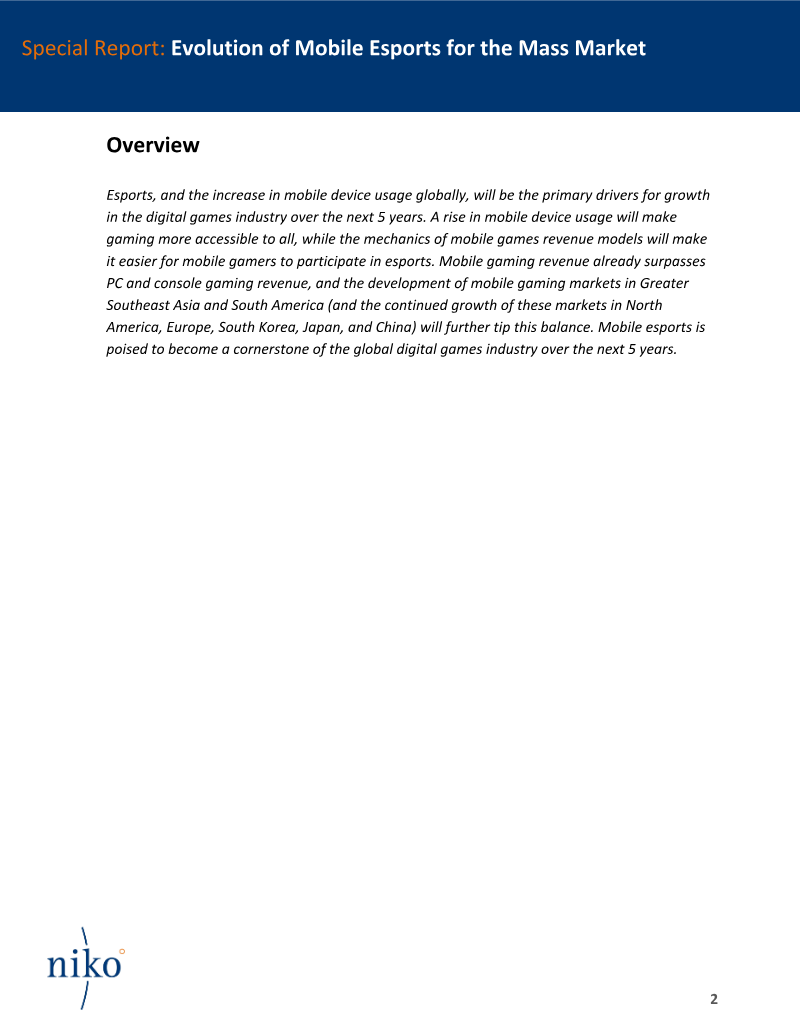
Mobile esports is positioned to become the primary catalyst for growth in the digital games industry over the next five years, leveraging a global player base of 2.53 billion that already surpasses the combined reach of PC and console gaming. In 2018, mobile esports titles generated $15.32 billion in revenue, representing over a quarter of the total mobile market. This expansion is driven by high smartphone penetration and a fundamental shift from high-profile spectator events toward a pervasive ecosystem of regional and online-only competitions. By lowering barriers to entry, the sector has successfully attracted a more diverse and gender-balanced audience than traditional competitive gaming platforms. The industry is currently transitioning from a publisher-funded marketing tool into a scalable mass-market powerhouse. While professional PC esports historically dominated revenue, mobile esports is rapidly closing the gap, fueled by sophisticated monetization strategies including media rights, sponsorships, and microtransaction-based models like season passes. Asia serves as the epicenter of this evolution, with China and Southeast Asia hosting the most concentrated markets for competitive mobile titles. Significant investments from traditional sports franchises and the expansion of media rights into mainstream cable television further signal the professionalization and maturation of the sector. Technological advancements in 5G and cloud gaming are disrupting the historical dominance of PC titles by delivering high-quality competitive experiences on accessible hardware. This technological shift, combined with strong government support in Asian markets, has led to explosive growth, exemplified by a 44.5% revenue increase in top Belt and Road markets during the first half of 2019. As industry leaders establish franchised leagues and record-breaking prize pools, the mobile esports model is proving more sustainable and participatory than its predecessors. Ultimately, the sector’s massive reach and superior monetization capabilities ensure its trajectory to overtake PC esports as the dominant global competitive gaming format.
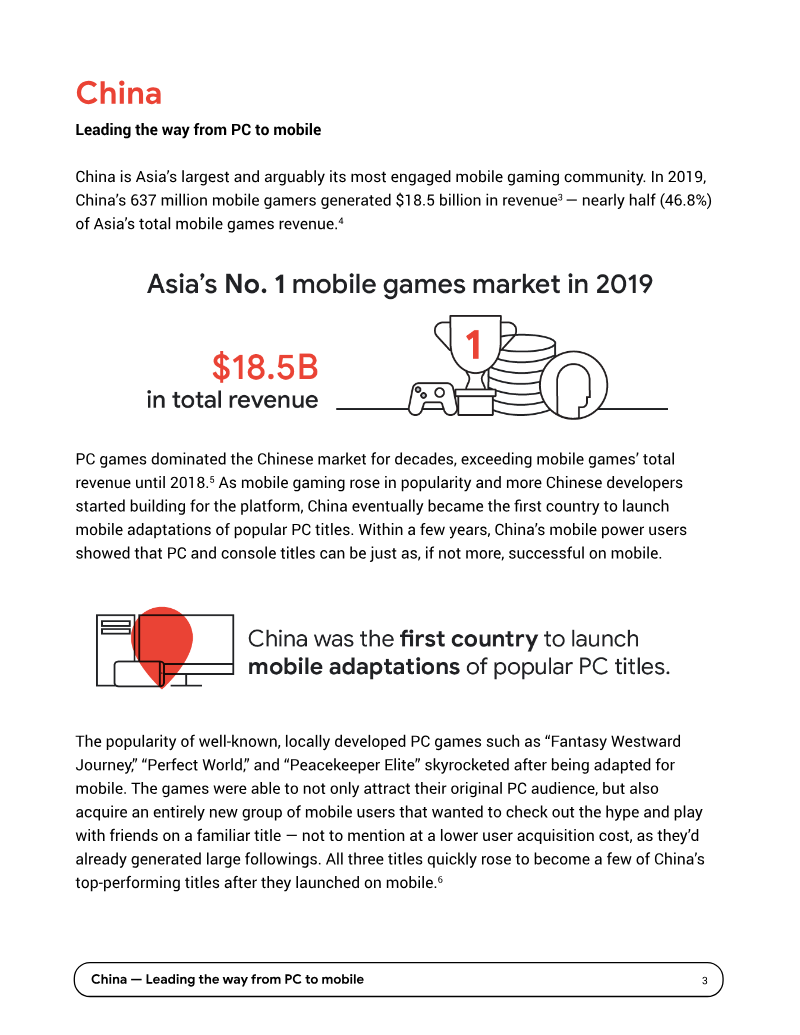
Asia represents the world’s most significant mobile gaming hub, housing over half of the global player base and generating the majority of the industry's mobile revenue. The primary objective of this analysis is to examine the distinct player preferences, cultural influences, and market regulations across five key regions: China, Japan, South Korea, India, and Southeast Asia. By evaluating top-grossing titles and genre shifts through the first half of 2020, the findings illustrate a broader regional transition from casual play toward complex, competitive, and socially-driven experiences. China remains the largest market, characterized by the successful migration of PC intellectual properties to mobile and a regulatory environment that necessitates domestic partnerships. In contrast, Japan’s market is defined by a deep-rooted console history and the pervasive influence of anime and manga aesthetics, with RPGs accounting for nearly half of its mobile revenue. South Korea leverages its robust 5G infrastructure and "PC bang" culture to sustain a market dominated by high-fidelity MMORPGs. Meanwhile, India and Southeast Asia emerge as high-growth regions where young populations and increasing smartphone accessibility are fueling a massive surge in mobile esports and battle royale titles. The data reveals that localization involves more than translation; it requires integrating local folklore, respecting religious customs, and optimizing for hardware constraints. For instance, "lite" versions of games are essential for market penetration in India, while community-centric features are vital for success in Southeast Asia. Across all regions, the rise of mobile esports is a dominant trend, with competitive titles increasingly displacing traditional genres in the top-grossing charts. The methodology utilizes data from Niko Partners, incorporating market models, five-year forecasts, and qualitative surveys from a panel of millions of consumers across Asia. The analysis covers the period from 2016 through June 2020, drawing on data from retailers, app markets, and interviews with industry executives to provide a comprehensive view of the mobile landscape.
Southeast Asia represents a rapidly accelerating segment of the global esports market, characterized by high growth rates in both viewership and revenue. Between 2019 and 2024, the region is projected to see a compound annual growth rate (CAGR) in audience size that significantly outpaces global averages, with year-over-year increases reaching as high as 18.2%. This expansion is driven by a mobile-first gaming culture where 82% of the online population plays mobile games and 39% of players identify mobile as their primary platform. Key markets fueling this trend include Indonesia, Vietnam, the Philippines, Thailand, Malaysia, and Singapore. The regional ecosystem is heavily influenced by mobile-centric titles, specifically Mobile Legends: Bang Bang, Garena Free Fire, and PUBG Mobile. These three games accounted for roughly half of all global esports hours watched for those titles on Twitch and YouTube Live during the first half of 2021. Revenue streams in the region mirror global trends, with sponsorship serving as the primary contributor, supported by media rights, publisher fees, and digital goods. Government intervention also plays a critical role in market maturation, with initiatives like the Youth Esports Program in the Philippines and the integration of esports into the 30th SEA Games as a medal event. Data for these findings was sourced from Newzoo’s 2021 Global Esports and Live Streaming Market Report and Consumer Insights. The methodology utilized a Major City Approach for most Southeast Asian nations to represent active internet users aged 10-50, while Singapore data covered the general online population within that age bracket. The findings conclude that improved internet infrastructure and the accessibility of mobile devices are the primary catalysts for long-term engagement and the continued attraction of non-endemic brand sponsorships to the region.