1 free read left. Create a free account for unlimited reading + AI research.
Create free accountWhitepaper DiGRA
1 free read left. Create a free account for unlimited reading + AI research.
Create free accountWhitepaperDiGRA
Distilling the key insights…
This study presents a multilingual persuasion detection dataset built from dialogue in three Bioware role-playing games, Neverwinter Nights, Knights of the Old Republic, and Knights of the Old Republic II, spanning English, Spanish, German, French, and Italian. The corpus draws its labels from in-game "[Persuade]" tags aligned across languages through string identifiers, yielding roughly 7,900 persuasion sentences and 33,600 non-persuasion sentences, an approximately 80/20 class split. The authors argue that video games are an underused source of semi-annotated NLP data and that this resource is likely the largest multilingual persuasion dataset to date, extending prior work that concentrated almost entirely on English.
The central thesis is that game dialogue is a viable and valuable resource for natural language processing. To test this, the authors fine-tuned eleven BERT-based classifiers. Monolingual models performed strongly, achieving macro F1 scores near 0.8 and weighted F1 scores near 0.9. Multilingual BERT, by contrast, performed poorly on the persuasive class, with macro F1 near 0.5. The authors attribute this gap to a domain mismatch, since Wikipedia-based pretraining poorly suits game dialogue, rather than to multilingualism itself.
Error analysis indicates that the models reliably detect explicit cues such as currency references, commands, and promises, but struggle with ambiguous or context-dependent lines where persuasive intent depends on surrounding narrative. The scope of the work is therefore cross-lingual, covering five European languages, and focused on a single game genre and developer, with its findings positioned as a proof of concept for using interactive fiction as training and evaluation data for persuasion detection.
Each row is a game or company this document names, each column a document, oldest first. A mark means that document names it. Select a row to see those documents.
DiGRA · 2022
DiGRA · 2022
DiGRA · 2022
DiGRA · 2022
DiGRA · 2022
DiGRA · 2022
DiGRA · 2022
DiGRA · 2022
DiGRA · 2022
DiGRA · 2022
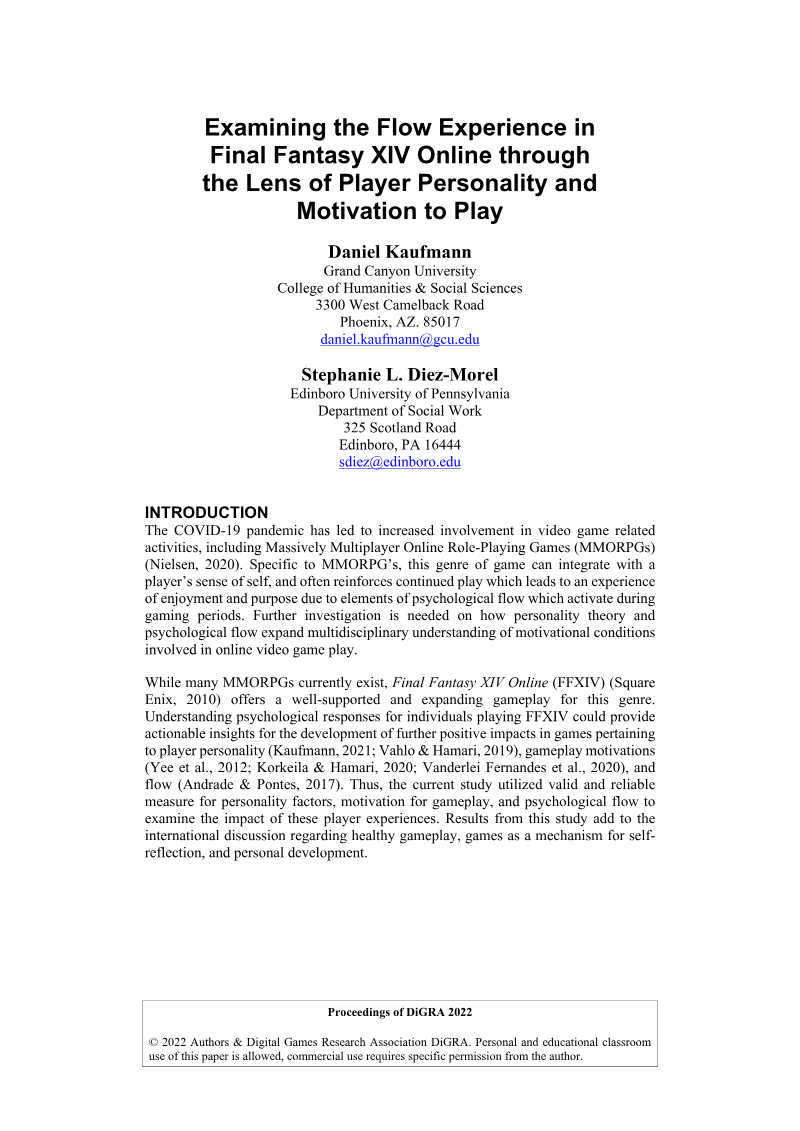
DiGRA · 2022
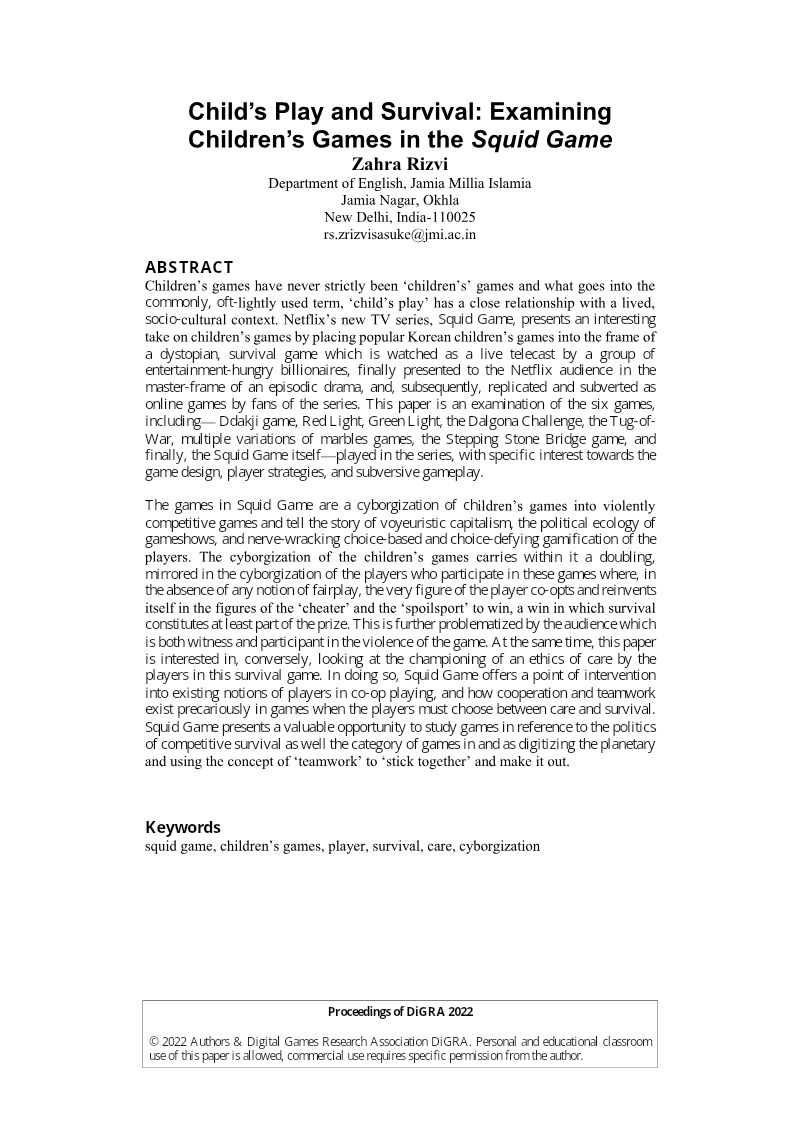
DiGRA · 2022
Game Developers Conference · 2023