1 free read left. Create a free account for unlimited reading + AI research.
Create free account
Marketing games in the social casino industry
Key insights
6 takeaways- 01The social casino industry is a $4.4 billion global mobile gaming market characterized by high saturation and intense competition.
- 02Effective user acquisition relies on aligning game positioning with creative assets and maintaining transparent, strategic relationships with advertising networks.
- 03Sustainable growth requires prioritizing retention metrics and data-driven user behavior modeling before scaling paid acquisition campaigns.
- 04Fraudulent traffic, including sophisticated bots and incentivized traffic, accounts for an estimated 5% to 7% of total industry traffic.
- 05Operators must implement rigorous post-install behavior analysis and clear validation metrics to reduce friction and maximize return on investment.
- 06Mitigating fraud risk requires proactive data monitoring, including the use of sub-publisher data transparency and strategic whitelisting or blacklisting of traffic sources.
Ask AI about this video
Transcript
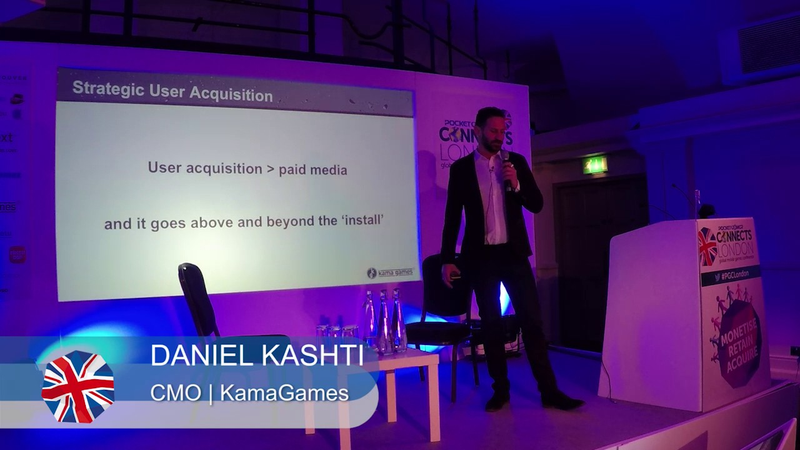
So everyone, my name is Daniel Kosti. I'm here to talk a little to speak about user acquisition. I need to cover all the topics. So I'm just going to touch the top line strategies and important acquisitions I kind of keep in mind uh think about user acquisition in the gaming industry. Um my background is uh started 12 years ago in the mobile industry. Uh I started to diving to and focus more on games probably 8 years ago. Uh The beginning of my career I was part of a TV broadcast company trying to help them uh kind of moving from the linear era to the digital era. And then I joined a leading uh poker brand PokerStars as uh to help them
becoming from a single brand, single platform company to a multi-brand uh company. I joined KamaGames uh end of 2016 as chief marketing uh officer uh with the objective of helping them growing their market And so KamaGames is a social casino operator. That's going to work better. Okay. So um KamaGames is a social casino operator, developer, and a publisher um that uh focus on designing premium games mostly focus on uh card and table games. Our main kind of brand mission is to uh deliver the most exciting um social gaming experience for everyone. And by everyone what we're really trying to say is that we're trying to personalize the experience, the playing experience for the different segments and on a personal level. And so,
it end up working pretty well for us. And as you can see, we've managed to build a various, you know, significant user base across the globe, which helps us to maintain a concurrent liquidity, real-time liquidity of just over 15,000 people, which is essentially what it means that for music player game, that is the key cuz you're able to to provide a very positive gaming experience across the different levels of the game. So, Come again as I said, uh is operating on the social casino niche. The social casino is is is is a subset of the global gaming industry. Um it's a 4.4 billion industry expected to be this year. Um pretty probably uh a little bit more. Um and the reason this niche is actually interesting and relevant to speak about in the context of of the, you know, greater mobile uh gaming industry is the fact that it's extremely uh uh competitive industry, extremely competitive uh genre. And it is still growing. And it may it
is able to monetize its users um in levels that is probably uh setting the the benchmark for the entire industry, entire global uh gaming industry. And so, what I'll try to do is just to kind of go through the main main points. Some of them are going to be cliches, but we're going to dive into it and it's all based on our experience uh and and and the conversations that we're having with with our partners, with our friends. So, probably best to kind of start with scoping what user acquisition really means on a strategic level. And what user acquisition means is is definitely not paid media. Paid media is a very small part of your user acquisition strategy. If you focus only on your paid media, you're going to end up overspending. You're going to end up uh building a business which is not sustainable. You'll not be able to grow it. There are always going to be people that are going to be able spend more on their on their paid media on their installs. And so, focusing on your paid acquisition is is the wrong way to go about it. The second thing The second thing is,
sorry, is that user acquisition goes way beyond the act of install. User acquisition really starts at the retention level. I think there was another guy here a couple of sessions ago speaking about how he was optimizing his retention metrics before starting money on the install, which is the right way to go about it. If you want to be If you want to stay competitive in a very saturated uh industry, in a red ocean industry, you really need to get your um engagement metrics right. And so, the second point is data. And this is a cliché, I admit, but any organization that I've worked with uh during the past probably 12 years has always been focused on the data. And that's I think what separates a successful brands from those that are not doing so well. And the reason this is important is that understanding your data helps you prevent from overspending and helps you uh build a business that is that you are able to actually grow
and make it profitable. So, we As part of Kamcord, we probably spent good eight or 10 months just building the models, just being able to kind of understand the different funnels and understand the users. And we go through a very detailed KYC process, know your customers. Um which really helped us kind of understand better how are we going to position ourselves when we go out and start acquiring users um if it's through organic channels or the paid channels. The third point is your execution and how well you go uh into the different markets. And so, it's about understanding yourself and the competition and the outlook of the market. It's understanding how you are going to position uh your game and how does that translate into your creative uh user interface and and other touch points that you're going to meet your players across. It's about optimizing your retention as I mentioned, which is key key thing. I
cannot emphasize enough how important it is to get your retention retention metrics uh uh correct. And then it's about understanding your user acquisition partners. There are many many other uh many many partners, many many agencies and networks and publishers to work with. Um some of them are in this room. Um and you really need to build those relationship with the ones that earn your trust. Um as they are managing a big chunk of your uh budgets at the end of the day. And then moving on to the main challenges that you'll face. And most of them are around how you spend the money. And how you're actually uh allocating your budgets and how you understand what the true value of the users are. And so it is about the budgets and how you build those and how you control them. It is about your cost of acquisition and optimizing the funnels post install act. And it's about maximizing your ROI, reducing friction and getting the
maximum out of each install you actually paid for. The fourth point is a I think is a point that uh doesn't get uh enough focus and that's the fraud piece. And the reason it is important is that um fraudulent traffic can make or break company. In extreme scenarios of course, but it can definitely make or break your campaigns and it does. Now the size of the issue is is is is huge. Like you can see that across the overall industry marketing and and and and and and then you can see it on the uh mobile app marketing side of things. So it's a hundred million dollars uh of fraud, which is money that you spend on things that will never converge. And what is fraud? Fraud is essentially two things or two main things. One is uh traffic that is coming from non-human uh devices, from bots, and those bots are getting more and more sophisticated over time. So, you will have the classic scenario
when you have a bot downloading your app, but the most sophisticated bot will actually spend money in your app, just enough to make you think that your ROI your you're about to ROI positive to be ROI positive. But at the end of the day, if you're paying if you're paying uh three or four or five dollars CPA, and that bot only spent 99 cents, and you're scaling cuz you think it's going to work in line with your models, you're going to end up losing. And it happens a lot. Uh the second type of fraud is actually um when you expect to be purchasing non-incentivized traffic, but you end up getting mixed traffic. This happens a lot. This goes back to um really building relationship with your user acquisition partners, your agency, with your networks. And so, kind of to try and mitigate the risk of fraud, and by mitigate I mean you will always see fraud. The benchmark is probably 5% uh maybe 7% in some in some markets.
But in order to mitigate that risk, what you really need to do is is kind of I tried to outline this in three kind of points. First, and it's probably the most important one, know your key validation metrics, especially the early metrics. Understand what the behavior of that you would expect from any user, from any install, across the different markets, across the different operating systems, different days of the week. Understand how Okay, a user just downloaded the app. What is the first thing that a typical user would do? Number of hands played, number of uh requests sent, finished the tutorial that finished the the Um did it came back after 2 minutes? Did he leave the app after 20 seconds? There are multiple attributes they can look at. And that's why it's key to understand how your natural funnel look like across the different segments. Second point is to work with networks that obviously earn your trust. And it gives you visibility to the data that you want to have. Uh if it's a sub publisher level, whatever case may be. Uh but it's about relationship building.
Um the third thing is is whitelisting and blacklisting. Now, that's a very kind of that's a blanket approach. And what it ends up resulting or might end up resulting is with uh missing on some legitimate traffic. So, it's kind of limits your growth opportunity. But at the same time, it is a very efficient way to uh instantly block fraudulent traffic. And so, just to recap the main points, data is king for sure. Retention is the best way to study your user and getting your figures right and know where you can spend money and how much you can spend money or how much you can spend in each of the markets. User acquisition, proper user acquisition, definitely today has to focus on organic growth, not necessarily on the paid media side of things. Um it's about how you execute and crystallizing crystallizing your value
and then translating that into your creative and into your uh local partners. And it's about at the end of the day testing and exploring and being more creative or as creative as you can. That's pretty much it, actually. So, if there are any questions, be happy to take. Any questions? Excellent. Thank you very much. Thank you. Hey.
Summary
The social casino industry, a highly competitive segment of the global mobile gaming market, is currently valued at approximately $4.4 billion. Success in this sector requires a sophisticated approach to user acquisition that extends well beyond paid media. Because the industry is saturated, sustainable growth depends on prioritizing retention metrics and data-driven modeling before scaling paid campaigns. Establishing a robust understanding of user behavior through detailed "know your customer" processes allows operators to optimize funnels and ensure long-term profitability.
Effective user acquisition is defined by a holistic strategy that balances organic growth with strategic paid partnerships. Key operational pillars include the precise alignment of game positioning with creative assets, the cultivation of trusted relationships with advertising networks, and the continuous testing of market-specific variables. Because the industry sets high benchmarks for monetization, operators must rigorously analyze post-install behavior to maximize return on investment and reduce friction within the player experience.
A critical challenge in this landscape is the prevalence of fraudulent traffic, which can significantly undermine financial performance. Fraud often manifests through sophisticated bots that mimic human spending patterns to deceive acquisition models, or through the delivery of incentivized traffic when non-incentivized traffic is expected. To mitigate these risks, companies should establish clear validation metrics for early user behavior, maintain transparency with partners regarding sub-publisher data, and utilize strategic whitelisting and blacklisting. While fraud is an inherent risk—often estimated at 5% to 7% of traffic—proactive data monitoring and relationship management are essential to maintaining a sustainable and scalable business model in the social casino space.






















Comments