1 free read left. Create a free account for unlimited reading + AI research.
Create free account
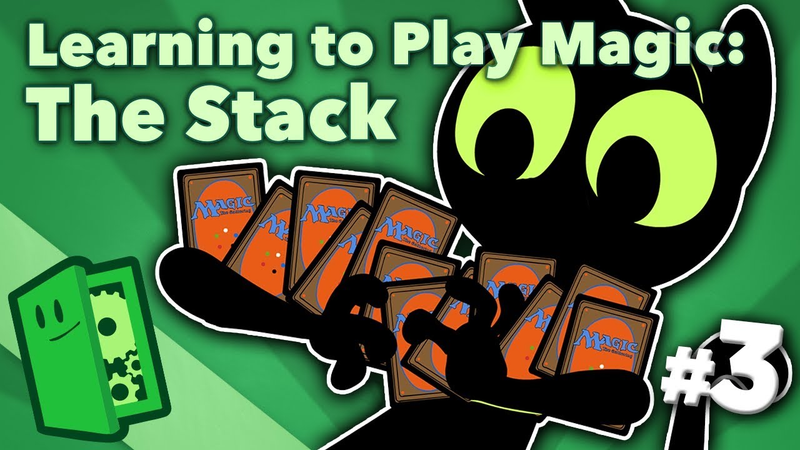
Learning to Play Magic - Part 3 - The Stack - Extra Credits
Key insights
5 takeaways- 01Advanced gameplay involves chaining multiple spells and abilities to create complex, sequential interactions that generate significant board advantages.
- 02Strategic risk exists when abilities rely on specific game states, as opponents can use the stack to alter variables—like creature stats—before an effect resolves, potentially causing unintended negative outcomes.
- 03The stack operates on a last-in, first-out (LIFO) system, meaning the most recently played spell or ability is the first to resolve.
- 04Players can neutralize threats by responding to an opponent's action with a spell that resolves first, such as using a removal spell to invalidate a creature buff before it takes effect.
- 05The stack allows for resource optimization, such as sacrificing a creature to pay for an ability cost in response to an opponent's removal spell, ensuring the value is captured before the creature leaves play.
Ask AI about this video
Transcript
Okay, okay, okay. I think I've got you now, Zoey. I attack with Evra Halcyon's Witness and swap my life total for its power. Wait, you play a Befuddle? And I lose? What? Befuddled is right. I guess I need a refresher on the stack. If only I knew a place to get one of those. How you doing? This is the episode you were waiting for. Why were you waiting for this episode? Oh, maybe you don't know. Maybe you didn't even realize you were, but you totally were. Why? Because the stack may be the coolest concept in Magic, and understanding it is what separates advanced players from those just starting out. And once you've got it down, it'll help you understand a ton of other things. You see, Richard Garfield, the original designer of Magic the Gathering, was a math teacher. And when he built Magic, he built it around one of the most useful concepts in mathematics and computer science. Order
of operations. So, if you can wrap your head around the stack, you'll be miles ahead thinking around these problems in other fields. So, what is the stack? Well, for those of you who've done a bit of computer programming, it's actually identical to the stack in memory management. But for the rest of us, it's the order that the cards resolve in. And even though that might seem like a small thing, it's perhaps the most powerful tool a player has in Magic. How the stack works is a last in, first out, or LIFO system. You can imagine actually building a stack out of the cards you play, and then resolving them from the top down. So, for example, here, I attack Zoey with my Bristling Boar. He's so bristly. But Zoey then blocks with her Omenspeaker. Now, normally, the Omenspeaker would die, but Zoey plays her Giant Growth, and her creature is about to become 4/6 and eat my boar buddy. But not so fast, because I have this lightning strike. In response to
Zoe playing her giant growth, I play my lightning strike on her omen speaker. And what happens? Well, the lightning strike was played last, which means it will resolve first. Boom! There it goes. It deals three damage to the omen speaker before the giant growth resolves, killing the omen speaker and leaving the giant growth with no target, which means it just fizzles and goes to the graveyard. Wait, what's that, Zoe? What if you played Lazotep's Plating in response to my lightning strike? Huh. Well, in that case, things would have played out a little differently. Lazotep's Plating is at the top of the stack and going to resolve first. It'll make Zoe's omen speaker untargetable by my spells, meaning that my lightning strike is now aimed at a target it can no longer legally target, which means it will now fizzle and her omen speaker will eat my poor poor poor you monster. Let's collect myself. Okay, so let's walk through a few more uses of the stack. An interesting example would be
around the card Heartfire, because it's a card that requires you to sacrifice a creature when you cast it. So, if Zoe plays an Ob Nixilis's Cruelty from her tiny adorable black black heart on, for instance, my Part the Water. Well, I could respond by playing my Heartfire and sacrificing my Part the Water to pay the cost. I didn't save my creature, but at least I got value out of it rather than just letting it die to Zoe's spell. On the other hand, if I sacrifice my Part the Water to cast Heartfire at her Serra Angel, and she casts Teferi's Time Twist, which removes a creature from the game for a turn, my Heartfire's now going to fizzle, because its target just hopped out of the world for a minute. But also, my Part the Water is still super dead, because sacrificing it was part of the casting cost of Heartfire. Another advanced and quite honestly hilarious example of stack resolution I saw on a stream recently. Now, this one's going to be pretty complex, so hold on to your hats. And don't worry if you have to go back and rewind to follow this. I've got an Aven Wind Mage in play. Then I cast Neoform on it, which
has me sacrifice a creature and search my deck for a creature that costs one more than the sacrificed creature and put that into play. Okay, pretty straightforward so far. But now I respond to my own casting of Neoform before it resolves by casting Expansion on it, which allows me to copy a sorcery and choose a new target for it. And because I'm copying the spell and not casting it again, I don't have to pay the additional cost of sacrificing a creature to cast it. Now, I'm getting two four-mana creatures for the price of one. The combo's so nice, it creature'd me twice. Oh, oh, oh, but we are not done yet because now I let the top card on the stack, the copied Neoform, resolve, meaning I get to hunt through my deck for a four-mana creature. And in my deck, I've cleverly put Narumeha, which is a four-mana wizard that says when it comes into play, you may copy a spell. Well, if we look back at our stack, our original Neoform hasn't resolved yet, so we can copy it. The
copy then goes to the top of my stack and we resolve it. And oh, look, I happen to have a four-mana creature called Spark Double in my deck. Spark Double basically clones a creature when it comes into play. So, we're going to have it copy Narumeha. The original Neoform that we cast is still on the stack, so we get to copy it again and get another Spark Double and make another Narumeha. And I think you can see where this is going. We ended up sacrificing a two-two creature for a pile of Narumehas. And when we finally run out of Spark Doubles to make them from, we even get to resolve the original Neoform that we cast ages ago and get one more creature to boot. Yeah, that was a lot. So, actually, I'm going to wrap this up with just one more example. Remember back in the beginning of the episode when I lost to Zoe? Well, I think I know why now. Evra Halcyon's Witness has an ability which says, "Exchange your life total with Evra
Halcyon's Witness's power." Okay, great. I'm at 20 health, Zoe didn't block Evra, and I'm about to bop Zoe on the nose for 20 walloping points of damage. But, when I used Evra's power, it went on the stack. And before it could resolve, Zoe cast Befuddle, which reduces a creature's power by four. So, since Befuddle is on the top of the stack, it resolves first. Evra's power is now zero, and yeah, I've already said it to be exchanged with my life total. There are no take-backs on the stack. I swap my life total for a big honking zero and a GG from my adorable cat. The more you know. And the next time on Learning to Play Magic, we're going to be talking about a very different kind of stacking. No, we're going to talk about stacking a bunch of magic cards together and constructing your very own deck. Uh, are those cards even in sleeves?
You got to clean up your mess, pal. What do you think this
Summary
The stack serves as the fundamental mechanic governing the order of operations in Magic: The Gathering. By utilizing a last-in, first-out (LIFO) system, the game dictates that the most recently played spell or ability resolves first. Mastering this concept is essential for transitioning from a novice to an advanced player, as it mirrors logical structures found in mathematics and computer science.
The mechanics of the stack allow players to respond to opponents' actions, potentially neutralizing threats before they take effect. For instance, if a player casts a spell to buff a creature, an opponent can respond by casting a removal spell on that same creature. Because the removal spell is placed on top of the stack, it resolves first, causing the buff spell to fizzle due to the loss of its target. Similarly, players can use the stack to gain value from creatures that are about to be destroyed by sacrificing them to pay for other abilities, ensuring that the cost is met even if the creature is removed from play.
Advanced play involves chaining multiple spells and abilities to create complex interactions. By copying spells or triggering "enter the battlefield" effects, players can generate significant board advantages that resolve sequentially from the top of the stack downward. However, the stack also introduces risks; if a player initiates an ability that relies on a specific state—such as exchanging a life total for a creature's power—an opponent can use the stack to alter that creature's stats before the exchange resolves, leading to unintended and potentially game-ending consequences. Understanding these interactions is critical for strategic decision-making and effective resource management.














Comments