1 free read left. Create a free account for unlimited reading + AI research.
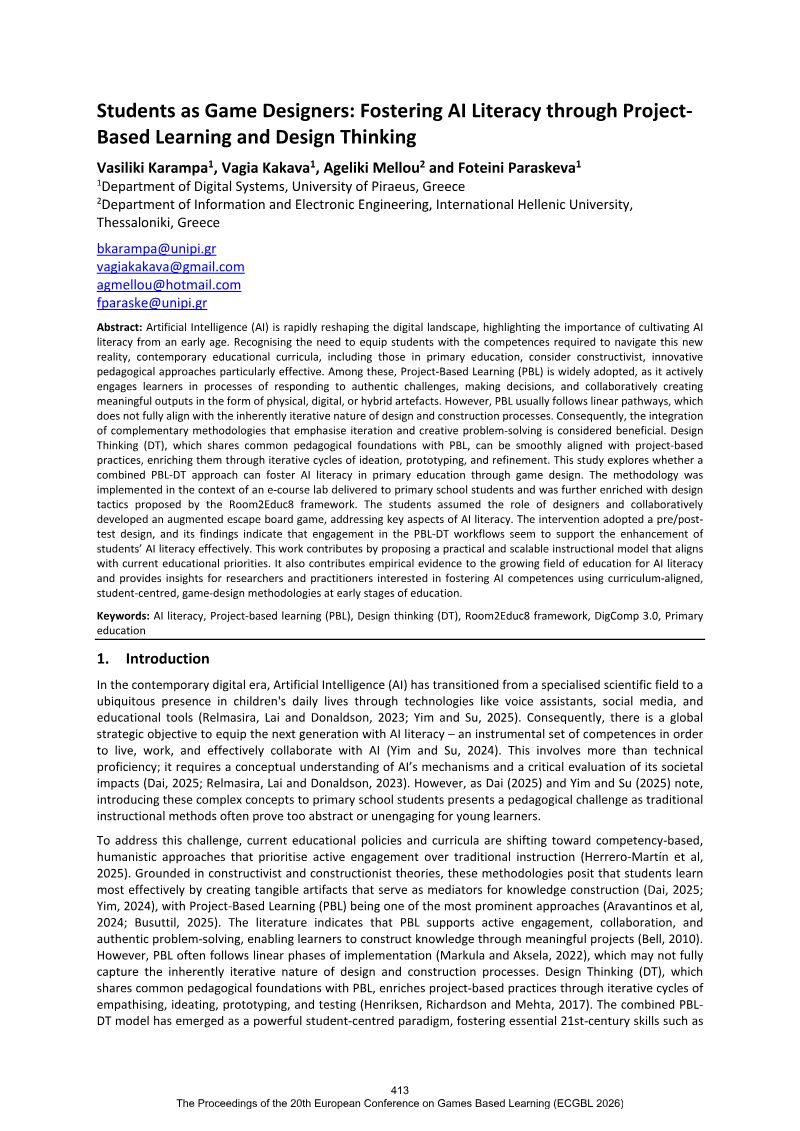
Create free accountWhitepaper European Conference on Games Based Learning (ECGBL)
1 free read left. Create a free account for unlimited reading + AI research.
Create free accountWhitepaperEuropean Conference on Games Based Learning (ECGBL)
Undergraduate honors students researched environmental topics, co-created tabletop games, tested them with peers, and led gameplay for members of the public.
This study examines how undergraduate honors students learned about environmental justice by researching environmental topics, co-creating tabletop games, testing them with peers, and leading gameplay for members of the public. Grounded in critical pedagogy and constructionism, the work positions game-making as a form of active, reflective learning intended to raise students' critical consciousness of social and environmental inequities. The participants were 19 students at a private mid-Atlantic university in the United States, working in teams of four to five. The research uses a qualitative content analysis of students' reflective essays, supplemented by the games themselves, with a convenience sample and explicitly acknowledged small-scale limitations.
Across the reflective essays, four broad themes emerged: learning about environmental issues through game design, learning about game design through peer testing, learning to value others through co-creation, and learning about the power of disseminating games. Students reported growing awareness of hazards such as diamond mining, ocean microplastics, environmental racism, and wildfires, along with a sense that policy protections are inadequate. Peer testing prompted concrete revisions, including reworked question difficulty, expanded question spaces, and pre-play information for younger audiences. Students described collaboration as essential to communicating complex ideas clearly, and many expressed pride and a sense of responsibility to spread awareness.
The authors conclude that the assignment helped shift students' frames of reference and deepened their learning through preparation for teaching others, though the evidence rests on self-reported reflections rather than measured outcomes. They also observe that collaboration and the "messiness" of game development are often undervalued in game development culture, which tends to prioritize technical expertise. The findings suggest game co-creation may serve as a viable model of critical pedagogy for educators interested in environmental justice and experiential learning.



European Conference on Games Based Learning (ECGBL) · 2026



European Conference on Games Based Learning (ECGBL) · 2026



European Conference on Games Based Learning (ECGBL) · 2026



European Conference on Games Based Learning (ECGBL) · 2026



European Conference on Games Based Learning (ECGBL) · 2026



European Conference on Games Based Learning (ECGBL) · 2026



European Conference on Games Based Learning (ECGBL) · 2026



European Conference on Games Based Learning (ECGBL) · 2026



European Conference on Games Based Learning (ECGBL) · 2026



European Conference on Games Based Learning (ECGBL) · 2026



European Conference on Games Based Learning (ECGBL) · 2026



European Conference on Games Based Learning (ECGBL) · 2026
European Conference on Games Based Learning (ECGBL) · 2026
European Conference on Games Based Learning (ECGBL) · 2026



European Conference on Games Based Learning (ECGBL) · 2026