1 free read left. Create a free account for unlimited reading + AI research.
Create free accountWhitepaper DiGRA
1 free read left. Create a free account for unlimited reading + AI research.
Create free accountWhitepaperDiGRA
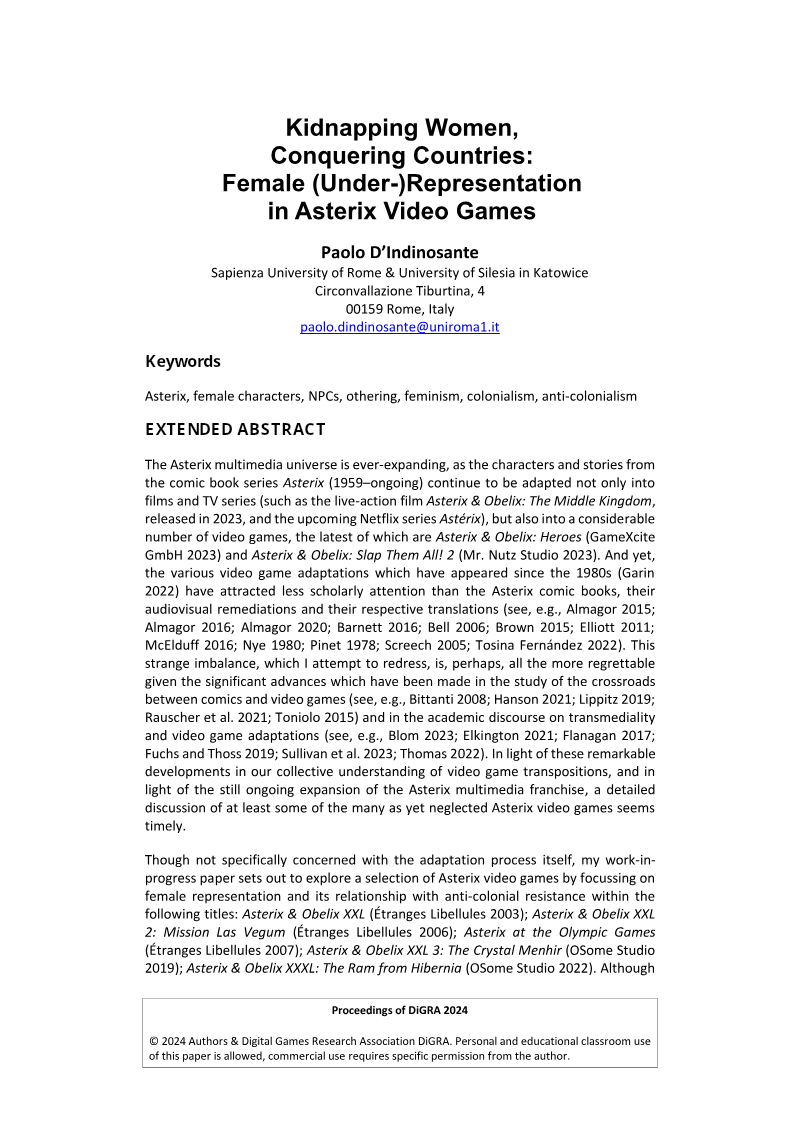
The author argues that the video game adaptations have been studied less than the comics, films, and translations. The paper seeks to redress this imbalance.
This paper examines female representation in a selection of Asterix video games, focusing on how women are portrayed and how their portrayal relates to anti-colonial resistance themes. The author argues that the Asterix video game adaptations have received far less scholarly attention than the comics, films, and translations of the franchise, and seeks to redress this imbalance. The study covers five titles released between 2003 and 2022 on PlayStation platforms, including Asterix & Obelix XXL, its sequel Mission Las Vegum, Asterix at the Olympic Games, The Crystal Menhir, and The Ram from Hibernia. The scope is limited to these games, which are presented as a work-in-progress analysis rather than an exhaustive survey.
The central finding is that women, when present, are consistently relegated to submissive non-player character roles, with the earlier titles relying on tropes such as the "damsel in distress" and "woman as a reward." The more recent games show greater awareness of these prejudices, as in The Crystal Menhir, where characters explicitly remark on the retrograde nature of abducting a woman to conquer a country. However, the paper concludes that this awareness does not translate into meaningful agency for female or other marginalised characters. The protagonist of The Crystal Menhir, Avina, remains largely a damsel in distress and her one rescue act occurs off screen, while the subversive potential of the Hibernian Keratin is similarly contained in The Ram from Hibernia.
The methodology is a multimodal character analysis grounded in feminist and postcolonialist perspectives. It examines the narrative, audiovisual, and procedural layers of each game, assessing characters' appearance, dialogue, actions, and functions. The author suggests these games can be read as digital spaces where gender stereotypes and colonialist logics are represented, reinforced, and occasionally played with or resisted, and calls for further work comparing the games with other Asterix media.
Each row is a game or company this document names, each column a document, oldest first. A mark means that document names it. Select a row to see those documents.

DiGRA · 2026

DiGRA · 2026



DiGRA · 2026



DiGRA · 2026



DiGRA · 2026



DiGRA · 2026



DiGRA · 2026



DiGRA · 2026

DiGRA · 2026



DiGRA · 2026



DiGRA · 2026

DiGRA · 2026
DiGRA · 2026