
Market (Overall)·Updated Mar 17, 2026 by Newzoo
What can I help with?
AI-powered answers with citations from the library.
What can I help with?
AI-powered answers with citations from the library.
Report · January 1, 2020
Published by Newzoo
The 2020 Global Games Market Report provides a comprehensive analysis of the video game industry during a landmark year defined by the COVID-19 pandemic and the transition to next-generation consoles. The central thesis posits that gaming has evolved beyond simple entertainment to become a primary social network and a precursor to the "metaverse," with interactive virtual spaces increasingly replacing traditional social media for younger generations. Key findings indicate that the global games market was projected to generate $159.3 billion in 2020, representing a 9.3% year-on-year increase. Mobile gaming remained the largest segment, accounting for $77.2 billion (48% of the market), driven by low barriers to entry and the rise of hypercasual titles. Console and PC segments followed with $45.2 billion and $36.9 billion respectively. Geographically, the Asia-Pacific region dominated the landscape, generating $78.4 billion—nearly half of all global revenues—while the Middle East and Africa emerged as the fastest-growing region. By the end of 2020, the global player base was expected to reach 2.7 billion, with forecasts suggesting the market would surpass $200 billion and 3 billion players by 2023. The scope of the analysis covers 30 key markets representing over 90% of global revenues, with data segmented by region (Asia-Pacific, North America, Europe, Latin America, and Middle East/Africa) and platform. Methodology relies on a top-down predictive model integrating macroeconomic data, financial reports from over 100 public companies, and primary consumer research involving 62,500 respondents. The report concludes that while lockdown measures provided a short-term surge in engagement and revenue, the industry faces long-term shifts toward platform-agnostic cloud gaming and subscription models. Additionally, it highlights the successful globalization of Chinese gaming firms, which pivoted to international markets following domestic regulatory freezes, now leading the industry in mobile development and cross-border investment.
# Free Version 2020 # Global Games Market Report Key Trends | Market Sizing & Forecasts Special Focus Topics | Rankings
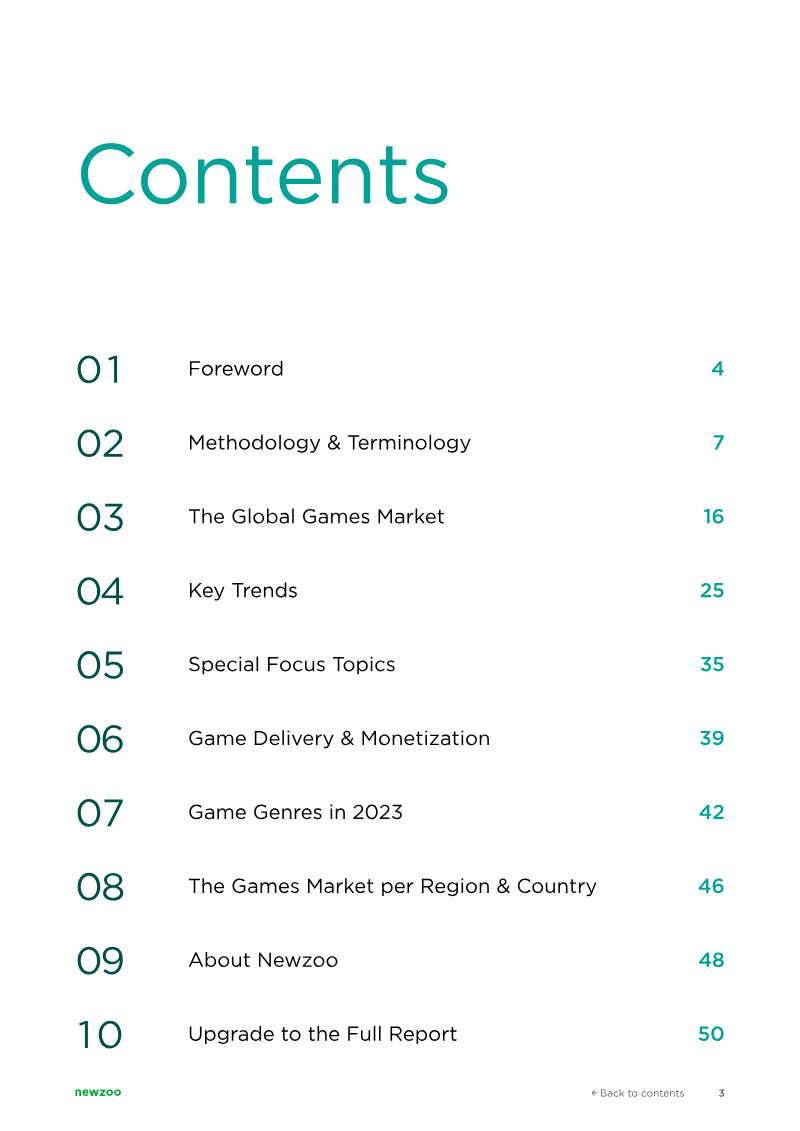
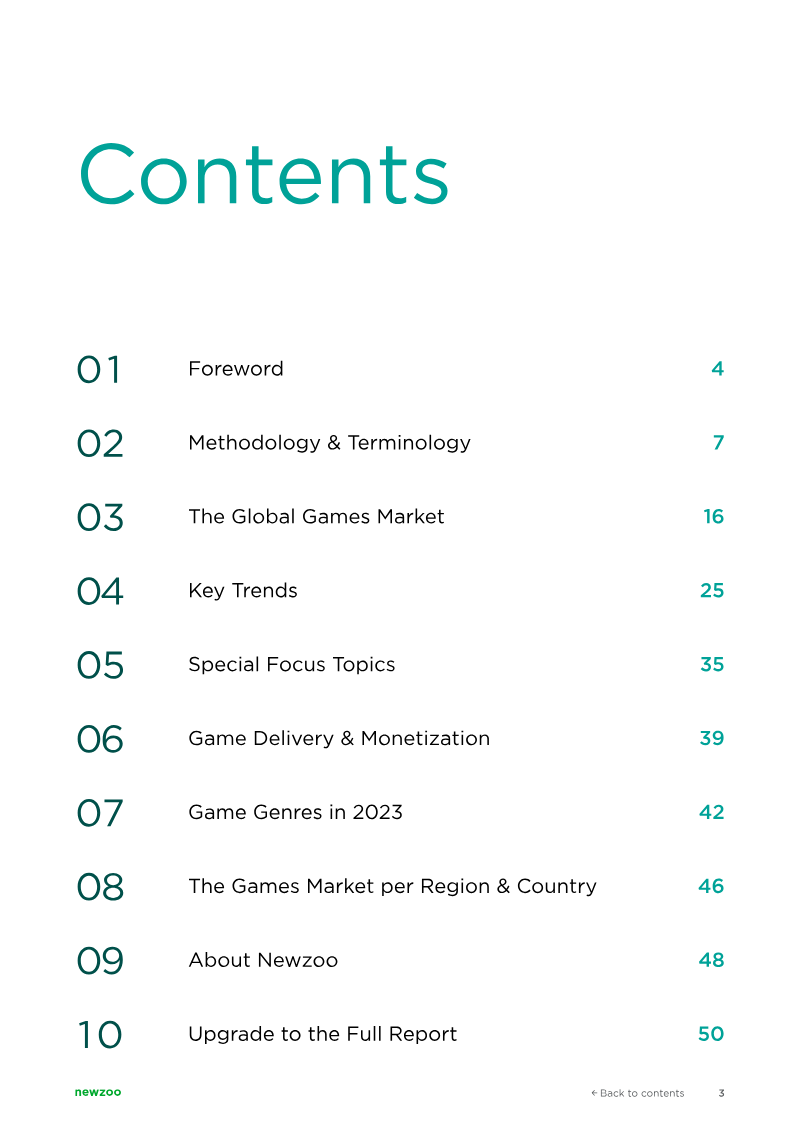
# Table of Contents - 00. Foreword 3 - 01 . Methodology & Terminology 5 - 0 2 . The Global Games Market 12 - 03. Key Global Trends 19 - 0 4 . Rankings 2 5 - 05. Special Focus Topics 2 7 - 06. About Newzoo 30
# Foreword # Newzoo’s 2020 Global Games Market Report With great pride, we present the 2020 Global Games Market Report. This is another landmark year for the industry, which continues to be shaped by global events on a scale never-beforeseen in our lifetime. Games are playing a pivotal function in society as a pillar of entertainment, social connection, and relief, improving the quality of life for millions during the COVID-19 pandemic. Consumers are spending more time gaming than ever, and the games market has seen unprecedented levels of engagement in the first half of 2020. Meanwhile, the second half of the year will see a climactic event nearly a decade in the making: both Sony and Microsoft will launch the next generation of home consoles, ushering in an exciting new era for the games market. The lockdown measures across the world have accelerated—and even catalyzed—change in the games market. Ten years ago, younger generations were leaving behind traditional media for social media. Today, they are leaving behind social media for the more interactive experiences that gaming offers. Playing games has always been an inherently social experience, and this year, the World Health Organization officially promoted video games as a recommended social activity during the pandemic. At its core, gaming is a universal language connecting people through a shared passion, common goals, and unifying experiences. Game worlds are generally more immersive than social apps. Through everimproving connectivity technology, games are becoming fully fledged, fully functional social networks. The largest social networks like Facebook and Bytedance’s TikTok recognize the opportunity (and threat), and continue to increase investment in games to unlock and explore their potential. It doesn’t stop there: game worlds are experimenting with experiences that go beyond the game itself. Fortnite famously hosted one concert last year, and in the first six months of 2020 alone, we have seen global entertainers host concerts in Fortnite in front of millions, a late-night talk show host an episode via Animal Crossing, people celebrating weddings and graduations in game worlds, and more. Thanks to gaming, the once-impossible concept of a metaverse—a virtual space that is persistently online and active, and unlimited in scope with its own economy—is edging closer to reality.
w host an episode via Animal Crossing, people celebrating weddings and graduations in game worlds, and more. Thanks to gaming, the once-impossible concept of a metaverse—a virtual space that is persistently online and active, and unlimited in scope with its own economy—is edging closer to reality. Mobile gaming continues to break barriers, expanding the reach of gaming around the world. By the end of this year alone, more than 92 million new players from emerging markets will have entered the ecosystem, most of them via mobile. One of the key contributing factors is the ongoing growth of hypercasual mobile games. The accessibility of these titles—through simple gameplay, little-to-no waiting time, and ad-based monetization—allows anyone to play and enjoy. Chinese game companies, in particular, are leading the change for mobile, finding new revenues and success in the wake of 2018’s nine-month-long licensing freeze.
At the same time, game companies are investigating new ways to deliver content to consumers. Subscription services offer a new level of value and have the potential to redefine the relationship between developers, publishers, and players. Similarly, cloud gaming services are on track to attract even more players by lowering the upfront cost of hardware, removing one of the highest barriers to entry to PC and console gaming. Going forward, we see leading companies willingly sacrifice short-term revenues for long-term success. By prioritizing user engagement above all, companies are pushing us further toward a platform-agnostic future. It doesn’t matter which device people play on—as long as they are accessing these companies’ ecosystems. To that purpose, we have further improved our game revenue breakdown. We now split revenues per platform between full games (boxed and digital), in-game revenues, and subscription revenues on console. We will continue to expand this breakdown in the coming months to account for the ever-evolving games market. Tom Wijman Sr. Market Analyst [email protected] Full 137-page version $7500 Includes access to the Newzoo Platform
# Methodology # Sizing the Market With A Variety of Data Newzoo aims to provide clients and market stakeholders with the best possible assessment of the size of the overall games market, broken down into segments and regions. By developing many data points, we ensure that our numbers make sense on a segment, regional, and individual country/market level. Below, we describe our approach in more detail to explain what underpins our forecasts, facilitating comparisons with other data sources. At the highest level, Newzoo focuses on three key metrics for every market: players, payers, and revenues. We define a market as a country or geographic region in combination with one or more game segment(s). The data on players and payers is mainly based on our own primary consumer research, which continues to form the basis of our detailed understanding of consumers and games. In our primary consumer research, conducted from February and March 2020, more than 62,500 invite-only respondents across 30 key countries/markets were interviewed. The 30 countries/ markets together represent more than $90 \%$ of global game revenues. The respondents are between the ages of 10 and 65 for all markets except for Turkey, Saudi Arabia, Indonesia, India, Thailand, Singapore, Vietnam, Philippines, Malaysia, Taiwan, and China, for which the focus is 10 to 50. Respondents are selected carefully to represent the online population in developed countries and the urban population of major cities in Turkey, Saudi Arabia, Southeast Asia, and India. In China, we focus on the population of Tier 1 and Tier 2 cities. The player and payer ratios resulting from our consumer research are projected against the online population, using UN population and ITU internet penetration metrics. The logic behind the model is that the online population is an important driver of the number of potential gamers and an indicator of how much more structural growth a country can expect in its potential gamer population. The differences between the player and payer numbers in the Global Games Market Report and our Consumer Insights stem from the use of age boundaries and the use of the core city approach. In the Global Games Market Report, the total population is considered, while our Consumer Insights use the population between the ages of 10 and 50 or 65 to best represent the online urban population in most countries. The revenue data comes from our predictive games market model, which uses a top-down approach to market sizing. We incorporate macroeconomic and census data from the IMF and UN, such as household income and GDP per capita, transactional and app store revenue data from our data partner Priori, our primary consumer research, other partner data, detailed financial information reported by more than 100 public companies, and third-party research. We also receive valuable input from clients, often leading international game companies.
The global games market is entering a period of stabilization and renewed growth, with 2023 revenues projected to reach $184.0 billion. This recovery follows a post-pandemic correction and is supported by a massive player base of 3.31 billion people worldwide. While the industry faces macroeconomic pressures and shifting privacy regulations, long-term forecasts remain positive, with total revenues expected to climb to $205.4 billion by 2026. This trajectory is fueled by the maturation of the current console generation, the expansion of the middle class in emerging markets, and the increasing influence of transmedia strategies that drive engagement across multiple entertainment formats. Market dynamics are shifting significantly across different platforms and regions. Mobile gaming remains the largest revenue segment at $89.7 billion, yet it is currently experiencing a 1.4% decline as privacy policies complicate user acquisition and monetization, particularly within the RPG genre. In contrast, the PC and console segments are the primary growth engines for 2023, benefiting from a steady supply of hardware and a robust slate of high-profile releases. Geographically, the Asia-Pacific region maintains its dominance, accounting for 46% of global revenue, even as regulatory hurdles in China slow its immediate growth. Meanwhile, significant capital infusions, such as Saudi Arabia’s $38 billion investment through Savvy Games Group, are reshaping the competitive landscape. Technological and structural transformations are further defining the industry's future. Generative AI is emerging as a pivotal tool for managing the rising costs of AAA development, though its adoption is tempered by concerns over copyright and workforce impact. Revenue models have transitioned almost entirely to digital formats, with physical sales becoming negligible in the PC market and live-service models dominating console engagement. As the industry evolves, the rise of cloud gaming and handheld "complementary devices" like the Steam Deck are expanding how and where players interact with content, ensuring the market remains resilient despite shifting regulatory and economic conditions.
The analysis projects that worldwide consumer spending on video games will reach $183.9 billion in 2023, serving more than 3.3 billion players. Revenue is now detailed by downloadable content, micro‑transactions and in‑game subscriptions across PC and console platforms, reflecting a more granular view of monetisation. Estimates are derived from a top‑down model that integrates macro‑economic and census data with primary research from over 74,000 respondents in 36 key markets, supplemented by partner‑provided transaction figures and updated each quarter. Geographically, the Asia‑Pacific region remains the dominant market, accounting for 46 % of global gaming revenues, yet its growth turned negative at ‑0.2 % year‑over‑year, driven by declines in China, Japan and South Korea. The region’s publisher landscape is led by Tencent, which tops the list of publicly‑traded companies by revenue. The study covers 35 countries that together represent more than 90 % of worldwide game income, encompassing PC, console and mobile segments. Genre performance highlights shooters as the leading PC category, generating $5.5 billion—14.1 % of PC revenue—and expanding 4.9 % YoY, buoyed by titles such as Valorant, Counter‑Strike, Payday 3 and S.T.A.L.K.E.R. 2. On mobile, role‑playing games hold the largest share at 23.1 % of mobile revenue, but they are experiencing a year‑on‑year decline as Apple and Google privacy reforms have raised user‑acquisition costs. Overall, the market retains its massive scale but shows signs of slowing growth, particularly in its largest region, while shifts in privacy policy are reshaping mobile economics and shooter titles continue to drive PC revenue growth.
The global games market entered a corrective phase in 2022, with annual revenues projected to decline by 4.3% to $184.4 billion. This contraction follows a period of unsustainable pandemic-driven expansion and is further exacerbated by macroeconomic inflation, supply chain disruptions, and a sparse release schedule for major titles. Despite this short-term dip, the industry maintains a massive engagement base of 3.2 billion players and is expected to resume an upward trajectory, reaching an estimated $211.2 billion by 2025. While mature markets like North America and Asia-Pacific are experiencing revenue declines, emerging mobile-first regions such as Latin America and the Middle East & Africa continue to show positive growth. The industry is currently undergoing a structural shift toward platform-agnostic ecosystems and hybrid monetization strategies. As traditional mobile advertising faces challenges from privacy policy changes like Apple’s IDFA, console and PC developers are increasingly adopting programmatic in-game advertising to monetize the hundreds of millions of players who do not make direct purchases. This shift is supported by major platform holders like Sony and Microsoft, who are integrating non-intrusive, blended advertisements to create recurring revenue streams. Furthermore, the rise of user-generated content, cloud gaming, and blockchain-based models is redefining how players interact with and derive value from digital environments. Future market stability is increasingly tied to ecosystem-based analysis rather than hardware-specific metrics, reflecting a broader trend of cross-platform play and industry consolidation. Regulatory shifts in China have also prompted a strategic pivot toward global expansion in other emerging markets. As the industry evolves, success will likely depend on balancing diverse monetization models with authentic player experiences, while leveraging new technologies in virtual reality and cloud infrastructure to maintain long-term engagement across a diversifying global audience.
The global games market is projected to generate $175.8 billion in 2021, representing a marginal 1.1% year-on-year decline. This temporary contraction is primarily driven by pandemic-related supply chain disruptions, hardware shortages, and significant delays in AAA game releases, which have disproportionately impacted the console and PC segments. Despite these challenges, mobile gaming continues to expand, accounting for $90.7$ billion or 51% of total market revenue. The Asia-Pacific region remains the dominant force in the industry, contributing over half of all global revenue and supporting 55% of the world’s three billion players. The long-term outlook for the industry remains robust, with total revenues expected to surpass $218 billion by 2024. This growth is fueled by the permanent acceleration of the metaverse trend, which has transitioned video games from mere entertainment products into essential social hubs. This shift has revitalized the virtual reality sector, particularly following the commercial success of the Oculus Quest 2, and has spurred a wave of consolidation through high-profile mergers and acquisitions. While privacy changes such as the removal of Apple’s IDFA present new hurdles for mobile marketing, the segment’s 4.4% growth indicates continued resilience. Strategic decision-making in this evolving landscape relies on granular performance metrics and consumer insights across dozens of global markets. By tracking key performance indicators such as monthly active users and retention rates for thousands of titles, stakeholders can navigate the complexities of game development and transaction advisory. Ultimately, the integration of social connectivity, immersive hardware, and mobile accessibility ensures that the gaming industry will continue its upward trajectory beyond the immediate disruptions of the early 2020s.