Updated Jun 1, 2026 by PlaySafeID
Whitepaper
Published by PlaySafeID, InvestGame
“I hate cheating in games. So do all of my friends and everyone that I know. We’re all aware of the impact of cheating on a personal scale; It ruins the experience, and in my circle of relatively hardcore gamers, we’ve all quit games or stopped spending due to the effects of cheating. There’s been a lot of speculation that cheating has become a crisis, and we wanted to understand if that’s true. We wanted to find out how a wide range of gamers feel across different countries, gender, and age.
Foreword from the CEO “I hate cheating in games. So do all of my friends and everyone that I know. We’re all aware of the impact of cheating on a personal scale; It ruins the experience, and in my circle of relatively hardcore gamers, we’ve all quit games or stopped spending due to the effects of cheating. There’s been a lot of speculation that cheating has become a crisis, and we wanted to understand if that’s true. We wanted to find out how a wide range of gamers feel across different countries, gender, and age. Eager to understand the reality, this study was commissioned to unpack the cheating crisis. Built on a survey of over 2,000 gamers, this whitepaper explores the real-world impact on gamers, revenue, and communities, and offers a clear path forward to rebuild trust and accountability, and most importantly, bring back what makes games fun. Playing without cheating, where you know everyone is playing by the rules, and nobody has an unfair advantage.” Andrew Wailes, Founder and CEO, PlaySafe ID
Key Findings The survey commissioned for this report 80% uncovered powerful insights about the state of cheating in gaming. Here are the key takeaways you need to know: of gamers have encountered cheating in online games ■ Cheating is now a crisis, with 80% of gamers encountering it in online games. Only 20% of gamers say they 73% never come across cheaters ■ Player retention is at risk. 55% of gamers would A significant 42% of gamers have be happy to verify considered quitting a game entirely of gamers have either reduced themselves in order because of cheaters or stopped spending on in-game to play without ■ The gaming community is highly purchases because of cheating cheaters receptive to identity verification as 42% a solution. 73% would be happy to verify themselves in order to play without cheaters of gamers have considered ■ Cheating has a direct financial quitting a game entirely impact on the games industry, as because of cheaters 55% of gamers have either reduced 83% or stopped spending on in-game purchases because of it ■ Gamers are ready for a solution. of gamers would A massive 83% would be more be more likely likely to play a game that is credibly to play a game promoted as being cheat-free 79% that is credibly promoted as being cheat-free ■ The vast majority of gamers, of gamers agree being cheat-free 79%, agree that penalties for that penalties for cheating should apply across cheating should multiple games, suggesting a desire apply across for industry-wide accountability multiple games apply across
y promoted as being cheat-free ■ The vast majority of gamers, of gamers agree being cheat-free 79%, agree that penalties for that penalties for cheating should apply across cheating should multiple games, suggesting a desire apply across for industry-wide accountability multiple games apply across Audience 2,013 Most likely to play 82% Chart first person shooters, gamers in the sports games and US and UK casual games play games sports games and multiple gamers in the casual games times a US and UK week
Introduction foundation of creating positive gaming experiences In the world of online gaming, fair play is the foundation of creating positive gaming experiences and building a thriving community. But a crisis is eroding that trust, threatening player enjoyment and the business models that developers and publishers rely on to both grow and serve customers. Cheating has become a serious business issue, impacting revenue streams, damaging brand reputation, and driving players away. The aforementioned survey pooled insights from The aforementioned survey pooled insights from over 2,000 gamers across the UK and the USA, and was conducted by independent research agency Atomik Research on behalf of PlaySafe ID. It has revealed the massive scale of the cheating problem, painting a clear but disheartening picture: cheating is no longer a fringe issue, but a major cross genre challenge that the industry can't afford to ignore.
The Scale of the Problem It's surprising to many outside of gaming How often do you encounter just how widespread cheating has become. cheating in online games? Our research found that 80% of gamers have encountered cheating in online games. For the gaming community, cheating is a regular occurrence, with 52% saying they Never encounter it at least a few times a month, if not more often. The problem is so common Rarely that only 20% of players claim to have never (once every few months) seen it. This shows that for many, cheating Occasionally has become an unfortunate part of their (a few times a month) online gaming routine. Frequently Cheating's increasing ease of implementation (weekly) and visibility is also a big part of the issue. The survey found that 54% of gamers come Almost every session across content on how to cheat on YouTube, followed by TikTok with 38%, and specific Every session gaming websites with 34%. With such easy access to tools and methods, developers are constantly battling to stay one step ahead. 0% 30% Where do you typically see content related to cheating in videogames? 60% 0% Twitch Tiktok Youtube Reddit Facebook Instagram Twitter/X Google Gaming Discord Other Websites
The Erosion of Player Trust and Satisfaction Cheating has a direct and significant impact How close have you come to quitting on how players feel about a game. The data playing a game because of cheaters? reveals that 42% of gamers have considered quitting a game because of cheaters. This number is even higher in the UK, where 45% I’ve never considered of gamers have thought about leaving a title quitting a game for the same reason. It is understandable too. because of cheaters Cheats undermine the very point of playing a I’ve considered competitive game. This highlights a serious quitting a game retention problem that's not about any game because of cheaters itself, but about the failure to maintain a fair I’ve quit a game and secure environment. because of cheaters The temptation to cheat is also worryingly I’ve quit multiple games high, with 62% of gamers admitting to having because of cheaters felt tempted to cheat at least occasionally, and 25% feeling the temptation frequently or Has quit 1 or more always. This suggests a difficult cycle where games or has considered a bad experience can lead to a breakdown of quitting due to cheaters integrity, creating a culture of ‘if you can't beat them, join them.’ 0% 40% 80% Have you ever felt tempted How much do you trust game developers to to cheat in a video game? effectively deal with cheating in multiplayer games? 80% 100% 40% 50% 0% 0% Tempted Always Frequently Rarely Never Yes Fully Mostly A Little Not at all
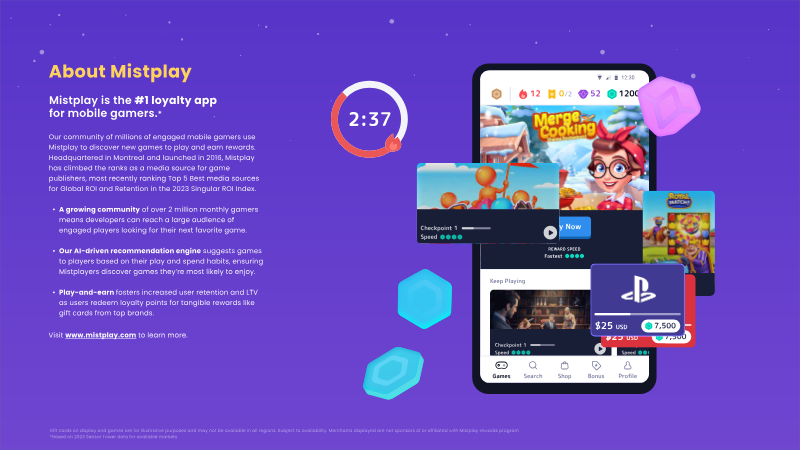
The Mobile Gaming Loyalty Report examines the drivers of player engagement, retention, and spending across the mobile landscape. By combining a longitudinal benchmark of 500 games with a survey of 3,000 mobile gamers in the US and Canada during 2023, the analysis establishes a Loyalty Index based on six key monetization and engagement KPIs. The findings emphasize that while user acquisition remains expensive, maximizing the lifetime value of existing players through loyalty-centric design is essential for sustainable growth. Role-Playing Games (RPGs) emerge as the most loyal genre, scoring 75 out of 100 on the index due to deep gameplay loops and compounding monetization systems that encourage high-value, frequent spending. Strategy games follow closely, excelling in repeat purchases and session frequency. Conversely, Lifestyle games lead in average sessions per user, utilizing bite-sized tasks and emotional storytelling to drive incremental spending. Data indicates a significant gap between average and top-quartile performers in genres like Casino and Sports, suggesting substantial room for optimization in retention and spender conversion. Consumer behavior insights reveal a disconnect between play and spend habits; while over 77% of spenders rotate between two to seven games weekly, 53% concentrate their spending on a single title. Progression is the primary motivator for both continued play and in-app purchases, whereas "pay-to-win" mechanics and poorly received updates are leading causes of churn. Notably, 39% of players will abandon a game if a bad update is not corrected within a week. High-value spenders, defined as those spending over $100, exhibit more demanding standards for app store ratings and customer service. Marketing effectiveness is heavily influenced by authenticity and social proof. Over 71% of gamers demand real gameplay footage in advertisements, and 60% consider app store ratings and reviews crucial for downloads. While digital ads remain the primary discovery tool, word-of-mouth ranks as a top-three acquisition source. Additionally, there is a strong interest in play-and-earn mechanics, with 84% of respondents open to trying games that offer tangible rewards.
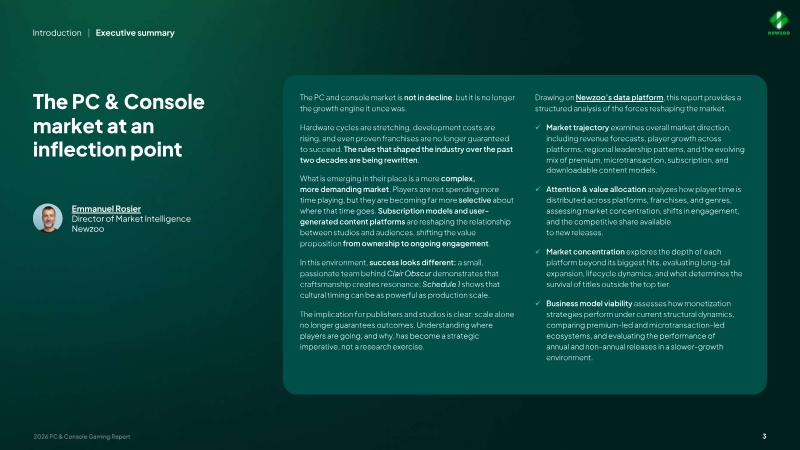
1. Market trajectory What direction is the PC and console market heading in 2026? 8 What direction is the PC and console market heading in 2026? 2. Attention & value allocation Where do players spend time and money on PC and console? 17 3. Market concentration What happens if you are not a top-20 game? 45 4.
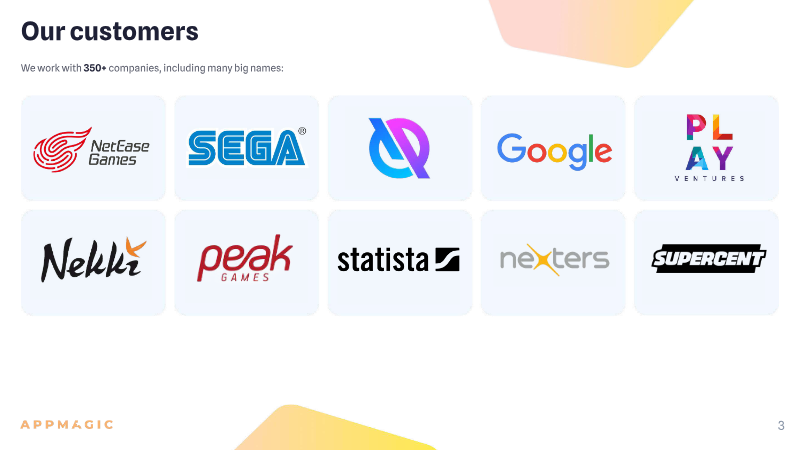
The global mobile gaming market reached $57.1 billion between 2023 and 2025, representing a 3.4% increase driven primarily by the App Store and emerging regions such as LATAM and MENA. While established markets like China and Japan experienced revenue contractions of up to 15%, the Strategy genre surged by over 25%, bolstered by a massive 213% increase in Card Battlers. A pivotal shift in the industry is the rise of direct-to-consumer revenue, which grew by 46% among the top 100 US titles as developers increasingly adopt webshops and alternative payment systems to bypass traditional platform fees. Monetization trends indicate a widening performance gap between platforms, with the App Store consistently outperforming Google Play in both revenue growth and average revenue per paying user. In the United States, the share of high-value players spending over $100 rose from 22% to 32%, while the App Store’s 90-day ARPPU climbed by 71%. This growth is largely attributed to rising transaction values, including the introduction of $159.99 price caps in top-tier titles. Conversely, Google Play’s growth remains dependent on a higher frequency of smaller, low-priced purchases, particularly as the RPG sector faces a 15% decline and a significant drop in Android spending. Genre-specific performance reveals a move toward diversification and sophisticated LiveOps. The Puzzle genre grew by 15%, led by a 911% revenue explosion in Block Puzzles, while the Hybridcasual segment saw in-app purchase revenue surge by 84% through the standardization of Season Passes and failure-triggered offers. Despite a 7.5% decline in the Casino market, the Simulation genre successfully increased average purchase values by 52%. Across all segments, developers are prioritizing customizable bundles and high-value special offers to maintain engagement and offset declining purchase frequencies among long-term players.
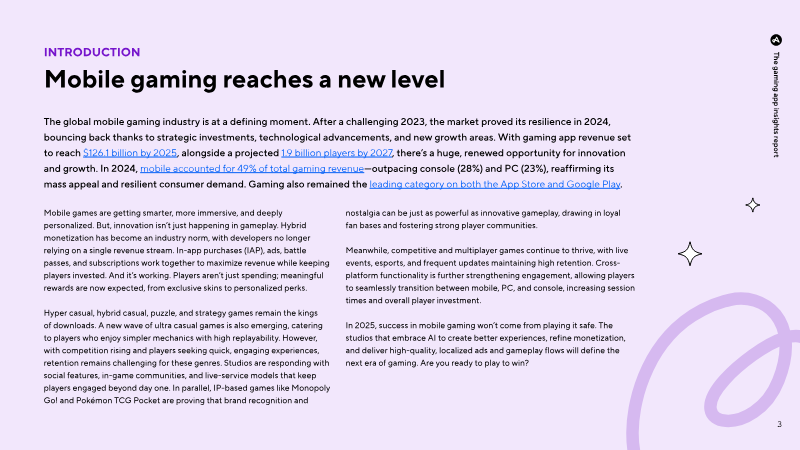
The mobile gaming industry is entering a period of strategic recalibration, projected to reach $126.1 billion in revenue by 2025. This growth is underpinned by a transition toward hybrid monetization models and the integration of AI-powered personalization to combat persistent retention challenges. While global install volume grew by 4% in 2024, the market exhibits a distinct geographic divide; North American and European markets face stagnation, whereas Latin America and the Middle East and North Africa regions demonstrate robust expansion. Success in this evolving landscape requires developers to move beyond traditional acquisition, favoring diversified channels such as Connected TV and localized, player-centric engagement strategies. Data from early 2025 indicates that user tracking remains a pivotal operational hurdle, with global App Tracking Transparency opt-in rates hovering at 37.9%. Although arcade games have seen notable improvements in opt-in performance, the United States remains relatively static at 32%, underscoring the necessity for refined messaging strategies to maintain visibility. Concurrently, the industry is grappling with a complex financial environment characterized by rising costs per install and declining average revenue metrics. These headwinds are forcing a shift in marketing tactics, as developers increasingly rely on a broader array of acquisition partners and data-informed creative experimentation to sustain growth. Ultimately, the path to profitability in 2025 lies in prioritizing long-term player value over short-term acquisition metrics. By leveraging AI-driven optimization and fostering community-building initiatives, developers can mitigate the impact of declining revenue per user. The industry is clearly moving toward a more sophisticated, data-reliant ecosystem where the ability to measure performance across fragmented channels—including mobile and Connected TV—is essential for maintaining a competitive advantage in a maturing global market.