1 free read left. Create a free account for unlimited reading + AI research.
Create free accountArticle Naavik
1 free read left. Create a free account for unlimited reading + AI research.
Create free accountArticleNaavik
Decentralized autonomous organizations represent an underappreciated web3 force in gaming, with the potential to redistribute ownership across entire communities rather than only between players and creators. The five largest DAOs held a combined treasury above $15 billion as of January 2022. Their differentiators from traditional organizations include tokenized ownership, decentralization by design, smart-contract automation, real-time financial transparency, and easier capital formation. The latter matters for equity: only 1.2% of the $147 billion in US venture funding in the first half of 2021 went to Black entrepreneurs, and just 0.34% to Black women. ConstitutionDAO's average contribution of $206.26 illustrates how DAOs can lower barriers that accreditation thresholds otherwise impose.
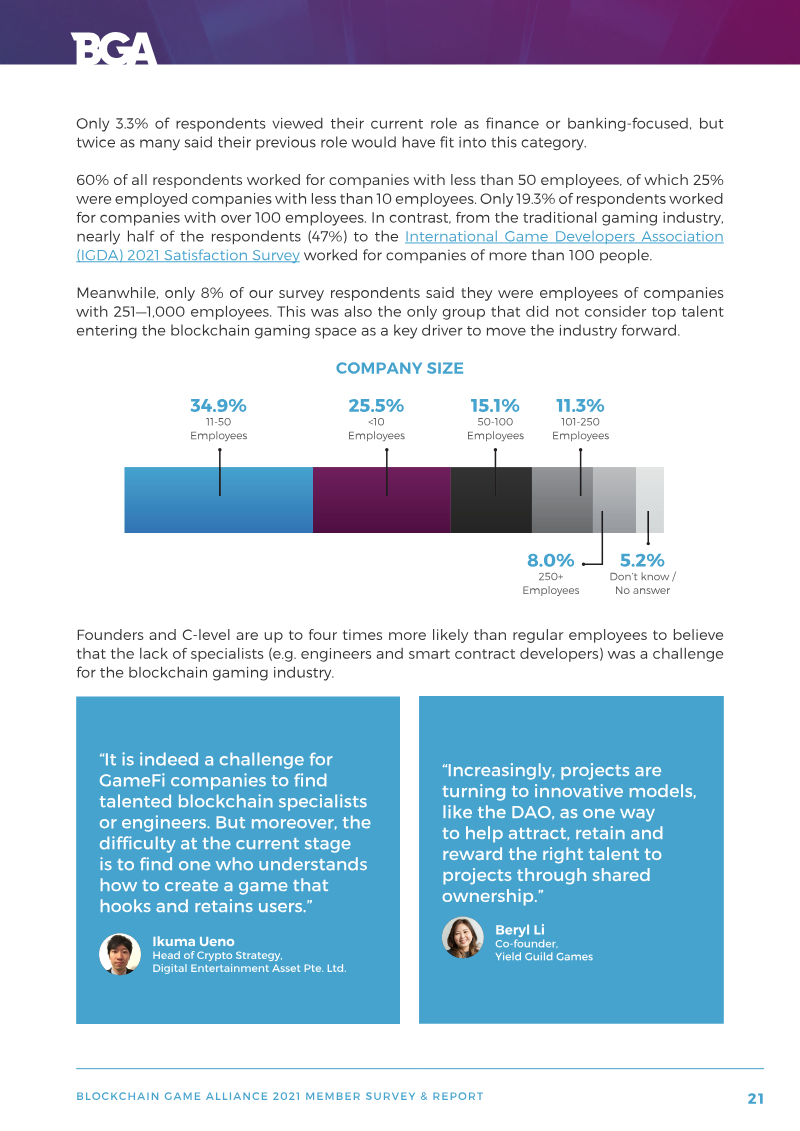
Gaming DAOs fall into three categories: guilds, incubators and accelerators, and developers. Guilds such as Yield Guild Games, which splits scholarship revenue 70/20/10 among scholars, managers, and the guild, have thrived in the bull market but may struggle in a downturn. Incubators like Game7 aim to expand the broader web3 gaming ecosystem. Developer DAOs, including Star Atlas, Aavegotchi, Dope Wars, and Decentraland, are the most ambitious yet least proven, and the industry is likely to remain wary of community-led design and pay-for-power dynamics. Balancing player input with developer expertise could nonetheless help address low consumer trust, as EVE Online's player council demonstrates.
DAO-led development faces serious obstacles: misaligned token-holder incentives, voter apathy (even billion-dollar DAOs struggle to reach 10% turnout), and the coordination demands of building games. Tooling, onboarding, and regulation remain immature, though Wyoming recognizes DAOs as LLCs. Consequently, leading web3 gaming companies such as Sorare, Mythical Games, Gala Games, Dapper Labs, and Sky Mavis are not DAOs.
Traction is still expected through guilds, region-specific funded DAOs like Ancient8 and IndiGG, creator-economy communities, and fan-driven projects. Freedom from shareholder profit pressure could ease the budget-versus-scope tradeoff in development. AAA studios will likely adopt DAOs last, with larger firms more probably investing in them as low-risk experiments. The analysis centers on the early 2020s web3 gaming landscape with a global scope.
Each row is a game or company this document names, each column a document, oldest first. A mark means that document names it. Select a row to see those documents.

Naavik · 2026
Naavik · 2026

Naavik · 2026

Naavik · 2026

Naavik · 2026

Naavik · 2026

Naavik · 2026

Naavik · 2026

Naavik · 2026

Naavik · 2026

Naavik · 2026

Naavik · 2026
Blockchain Game Alliance · 2025